

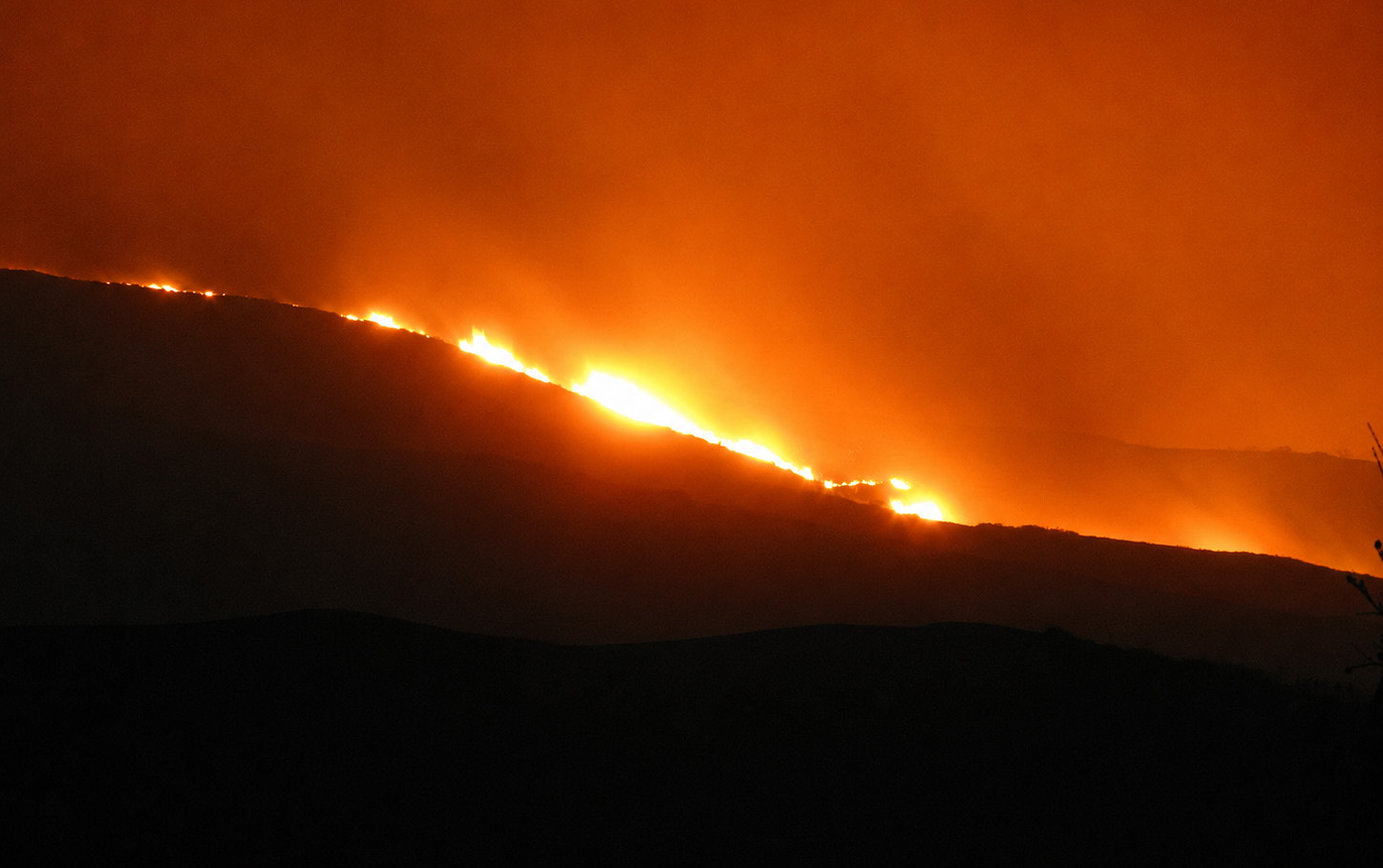
First Minister of Scotland John Swinney has requested military aerial support from the UK Government to help tackle the Cairngorms wildfire, now in its 11th day, as a major incident remains in place and residents are evacuated from Nethy Bridge.
The Scottish Government has asked the UK Government for military assistance to help fight the wildfire in the Cairngorms National Park, First Minister John Swinney stated.
The request was made following a further meeting of the Scottish Government’s Resilience Room on Saturday, chaired by Swinney.
The First Minister said:
“The latest update I received on the situation in the Cairngorms shows an improved picture, however, as we have already seen, events can change very quickly due to the weather conditions. I would like to again thank the fire service, police and local partners for their efforts. This remains a major and serious incident, so it is still extremely important that people follow the advice of emergency services and the Cairngorms National Park – it is essential people avoid the affected areas for safety reasons and to allow responders to focus on tackling the wildfire.
A request has been made today to the UK Government for military assistance in aerial support that can be used to supplement existing resources that are being deployed to tackle the Cairngorms wildfire and we await a response.”
The meeting was also attended by Deputy First Minister Jenny Gilruth, Justice Secretary Neil Gray, Net Zero Secretary Gillian Martin and Transport Secretary Stephen Flynn, alongside representatives from the Scottish Fire and Rescue Service, Police Scotland, Highland Council and the Cairngorms National Park Authority. The fire service reported positive progress in tackling the blaze while continuing to take preventative measures to stop its spread, with air support being prioritised for the areas where it is of most benefit.
Swinney said the latest update showed an improved picture, but cautioned that conditions could change quickly. He said the situation remained a major and serious incident, and that it was essential people avoid the affected areas for safety reasons and to allow responders to focus on tackling the wildfire.
The fire broke out on Wednesday 15 July and the battle to control it is now into its 11th day. A sudden shift in weather bringing stronger winds has caused unpredictable flare-ups, pushing the fire towards properties and woodland in Strathnethy, home to around 600 residents. A major incident was declared and many residents were evacuated from Nethy Bridge overnight because of the danger from flames heading in their direction.
According to local reporting, the first calls for military airborne assistance were made to the Scottish Government by community leaders in Badenoch and Strathspey within 48 hours of the outbreak, with the formal request now coming days later. A response from the UK Government is awaited.
Requests of this kind are made under Military Aid to the Civil Authorities, the standing arrangement through which the armed forces can be called on to support civilian responders during emergencies when the required capability is not otherwise available. Aerial firefighting support typically involves helicopters fitted with underslung buckets to drop water on terrain that ground crews cannot easily reach, a capability that has been provided to wildfire and flooding responses in the UK before.
Image Tim Williams, CC BY 2.0, via Wikimedia Commons



It might be worth getting an A400m firefighting kit.
Compared to the cost of a Bombardier aircraft an A400m firefighting module has got to be a good call especially if helicopters do not have the capacity.
Coll
I was thinking the same as this is happening more and more nationwside year on year
Early deployment would nail it before the problem problem gets out of control
At present the authorities try to suppress with a lot of manual work and hope for rain
Coll,
Hmmm … perhaps the Mobile Airborne Fire Fighting System MAFFS II? Palletized, RO-RO system to temporarily convert military cargo aircraft into Type 1 airtankers w/out permanent structural changes. Water/retardant capacity: ~11.350 liters. Discharge performance: Saturation of an area approximately 450 m × 35 m w/in 10 sec (upper bound on time frame). Discharge @ 1200 PSI through a nozzle typically placed @ the left rear paratroop door on the C-130J. Refill turn w/in 12 min by an experienced ground crew and mod/demod w/in 2-4 hrs. Typically a joint operation between U.S Forest Service (equipment and retardant) and ANG and/or USAFR C-130J Wings. Understand the mission can become a seriously sporting proposition under certain op conditions. 😉 Would presume that MAFFS could/would be compatible w/ A-400 ops. 🤔
The equipment I was referring to is the Airbus kit.
We need additional fire-fighting equipment, and we need to tackle the issue that’s driving increases in wildfires across Europe.
If not, we’ll all be worse off in the coming decades. No doubt in 2040 we’ll be complaining about why we never did anything now.
The planet’s fine. It doesn’t give a fuck, it’s seen far worse. We’re not ‘saving the planet’. We’re saving the lifestyle we have today.
Additional firefighting equipment is a shout but you could start by reversing cuts to the fire service by not closing stations or reducing the number of firefighters on pumps from 6 to 3…
We need to start by creating a Sovereign Wildfire Monitoring and Liaison service. EFFIS satellite wildfire monitoring linked into the currently available helicopter firefighter capability.
Over the past couple of years we have seen increasing wildfires all over the UK with Gov saying ” It is for local services to deal with”. The costs of hiring private helicopter services then fall on the local government to be recovered from public) private insurance cover. Someone up high in UK Gov needs to get a grip and soon.
I am a bit surprised the forces are not best equipped to fight difficult fires, i know this isn’t their job but making use of an A400M or Chinook to drop fire retardant/water or even using drones/helicopters to catch hotspots during major incidents would provide firefighters with more resources, considering they are running on tighter budgets than the military.
Wildfires are happening every year and we will only continue to have more flare ups every summer.
swaying slightly off-topic here but I’m sure Essex County Fire & Rescue would have appreciated military support tackling the most recent warehouse fire, 20 firefighters hospitalised and x3 £500,000 appliances destroyed, they’re lucky no one was killed…
Our mily]tary have a lot of experience in Cyprus where I believe a Chinook has recently taken over the firefighting role to help the Cypriots out
Out of date info by me
2 x Airbus H145 Jupiter HC Mk2 helicopters just deployed to Cyprus
UKDJ article 26/7
Ahhhh, what say the SNP to asking Government in London for help with this Scottish problem???
So can only England get help then, people like you are the reason they are trying to move power more north the quicker the better me thinks.
Might I refer my Honourable Friend to the fires currently burning in Wales, Derbyshire (100 Days) and Surrey.
Wild fires are a problem in many areas of the UK.
And Scotland is a proud and valued part of the UK, thank you.
hello.
Greetings. Testing it’s working again are we?
A400 with firefighting kit can dump 20 tons, refill procedure takes 10 min, and from what i read it costs approx €1m per kit
with an airfield that can refill the fire retardant which is not too far from fire, an A400 should be able to do 2 runs in an hour,
obvioulsy it doesn’t compare to a Canadair that can do up to 120 tons per hour of near a lake or sea, but much better than a helicopter which typically carry 4 tons
Croatia signed a €105 million contract to purchase two next-generation DHC-515 Firefighting recently. Think UK needs to go down the A400m route first on cost alone.
Cue 39 Engr Regt cutting fire breaks all over the mountains👍
Yep, they’re up there at Kinloss already.
‘The IPCC says in Chapter 12 of its Sixth Assessment Report there has been no observable change in the wildfire regime. “There is low confidence in any long-term increases in meteorological drought or fire weather at the global scale,” states the IPCC. The organization goes on say that, based on trends and models forecasts, it does not expect any observable change in wildfire behavior, numbers, intensity, or acreage lost, to arise by 2050 or even by 2100. On this point, the IPCC would seem to be on solid ground since satellite data sets from NASA and the European Space Agency both show a decline in wildfires in recent decades. In short, since wildfires are declining, it is impossible for climate change to be making wildfires more frequent or severe.’
So, once we have excluded the impossible, what we are left with is:
‘…residents “feel completely let down by the Scottish government who had dithered…if you said the fire was contained and you had enough resources last Wednesday and Thursday, why are we still fighting it 10 days later and it’s still running out of control? It is still not controlled in any way shape or form.’
Incompetence…
May be its time to the UK had its own Canadair type aircraft based through-out the country able to come together when there is a big fire like this one as we are seeing more and more “wild fires” each year.
‘Wildfire incident record data suggests that causation is split equally between accident or negligence and deliberate ignition…’
Rethinking cause, consequence and investigation in the UK, Rhodri Jones, Greater Manchester Fire and Rescue Service, July 2026
Monro, could I ask where you got that quotation that you used above? It appears to be a quote of a passage that itself contains a quote from an IPCC report. I have just looked at the 6th assessment report (2022), which is very large (378MB of text) and Chapter 12 is entirely concerned with Central and South America only. Not only that but I have searched the document, a PDF, for the key phrase “meteorological drought or fire weather” and it was not found in Chapter 12 or, more importantly, in the whole document. Just to be sure I have tried to look through the summaries and cannot find anything resembling that quotation.
Basically, that appears to be a hoax or just possibly misinformation; where the the quote come from?
As ever we are dangerously behind the curve on the wildfire threat. Most fire brigades have invested in a few pickup trucks but even if we place orders now for UniMog types the lead time for delivery will be horrendous. God knows what the lead time is for Canadair aircraft and any other specialist aircraft, the Europeans must have piles of kit on order. We have oil spill aircraft sitting idle year after year so why not buy a few fire fighting aircraft even if they get little use? And Mr Burn Ham take note you will undoubtedly be able to count that as a defence spend.