

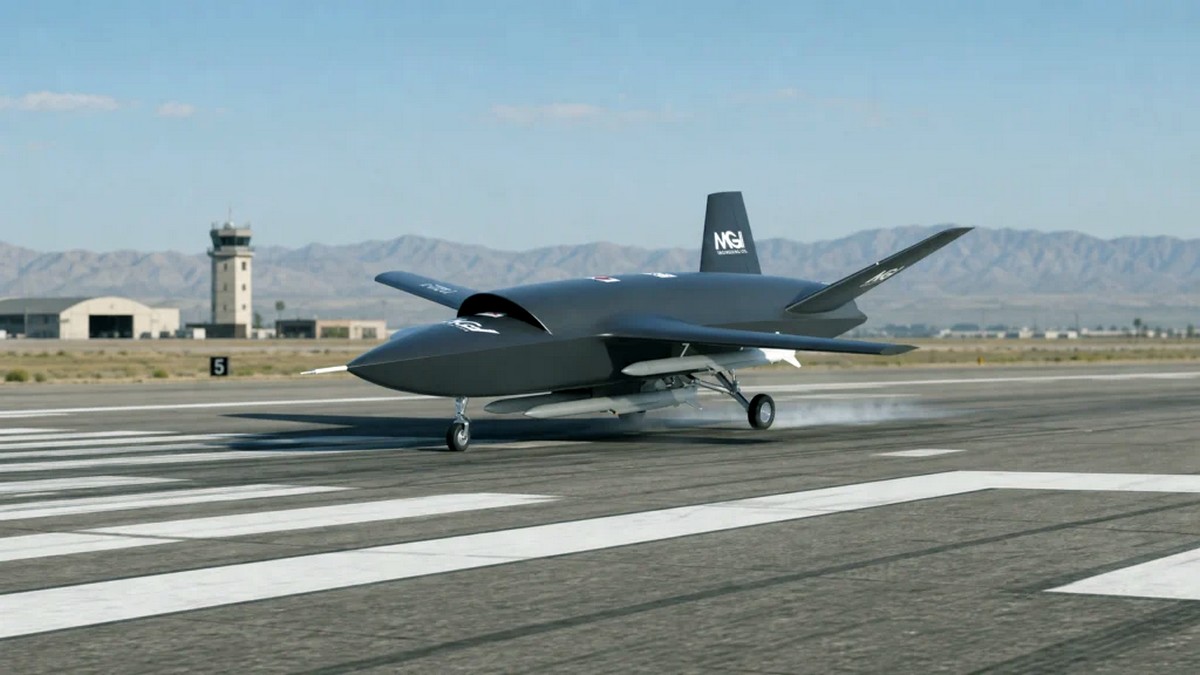
British engineering SME MGI Engineering has unveiled a new autonomous combat aircraft, the T-022 Vortex, which it is aiming at the UK’s StormFighter requirement, the company stated.
The Oxfordshire-based firm describes Vortex as the first UK-built Autonomous Collaborative Platform of its kind, an uncrewed aircraft designed from the outset to operate alongside crewed jets as part of a coordinated team. The launch follows what the company says was successful testing of its deep-strike TigerShark programme under the Ministry of Defence’s Project BRAKESTOP.
According to MGI, the aircraft has a maximum take-off weight of 3,500kg, a range exceeding 4,000km and a top speed approaching Mach 0.85. The company says it can carry up to 1,000kg of payload across four weapon or sensor stations, both internally and externally, at a cost of between £3 million and £6 million per aircraft depending on fit. The company states that Vortex is powered by a Rolls-Royce Orpheus engine, or similar powerplants, delivering 12 to 16 kilonewtons of thrust.
MGI says the aircraft is engineered for manned-unmanned teaming, allowing a single crewed aircraft such as a Typhoon or F-35 to direct multiple Vortex platforms as autonomous wingmen, sharing sensor data and executing coordinated tasks without a ground operator in the loop for every decision. In contested airspace where communications may be jammed, the company says the aircraft is designed to continue operating independently.
The firm positions Vortex within the UK’s Autonomous Collaborative Platforms programme, the MOD-backed effort to develop affordable uncrewed aircraft that extend the reach of the RAF’s crewed force. That programme was announced by the government as StormFighter, backed by £300 million in the Defence Investment Plan.
Mike Gascoyne, CEO of MGI Engineering, was quoted in the press release as saying: “Vortex is the logical next step in the journey we’ve been on since SkyShark and TigerShark. This isn’t an experiment, it is a fully capable collaborative combat aircraft, engineered at a price point that makes it possible to field at genuine scale. That changes the economics of air power, and it changes the risk calculus. You can put Vortex into the most dangerous environments without putting a pilot there with it.”
According to MGI, the aircraft measures 11 metres in length with a 7.6-metre wingspan, comparable to a light combat aircraft, and has an operating altitude range of 20 metres to 12,000 metres. The company says it is credible across mission profiles from intelligence gathering and electronic warfare to strike and the suppression of enemy air defences.
Vortex joins a growing family of autonomous platforms marketed by the company, including the SkyShark short-range one-way effector, the TigerShark long-range deep-strike cruise missile, and a lower-cost development platform, LeopardShark, derived from a reusable version of the TigerShark.
The unveiling illustrates the breadth of industry interest in the StormFighter competition, which has drawn interest from established primes and smaller firms alike. BAE Systems unveiled its own sovereign collaborative combat aircraft prototype, Brontanax, at the Farnborough International Airshow earlier this month. Mike Gascoyne, MGI’s founder, is well known in engineering circles from a long career in Formula One aerodynamics before moving into aerospace, and the company has positioned itself around low-cost, rapidly developed autonomous systems rather than large crewed-scale programmes.



Good. Check it does what it says on the tin. Check it is capable of handling everything from missiles to guns.
If still no problems order 100 with various adaptations.
In an ideal world it should be carrier capable.
See if Ukraine will help us test a further 50.
Need it capable of the type of mass production Henry Form could only dream of.
Probably worth testing in the Arctic & Falklands plus somewhere much warmer.
By taking up funds urgently needed for the carrier projected unmanned aircraft is this yet another sabotage effort in the ongoing RAF FAA contest?The RAF might be better joining Australian/ USA projects.
The RAF vs. FAA sabotage theory ignores how modular these next-gen platforms actually are, Jonno. BAE has already indicated that the Brontanax architecture is being developed with modularity in mind, meaning a carrier-suitable variant for the Fleet Air Arm isn’t being killed off—the core tech is being matured here first.
As for just joining U.S. or Australian projects: that completely defeats the purpose of the UK’s Strategic Space and Air defence goals. If we just buy into the Pentagon’s CCA programs, we fall right back into the exact same ITAR restrictions and proprietary software traps that hamstring our fleet autonomy. Building domestic options like Brontanax and the Vortex keeps high-end aerospace engineering skills in the UK and ensures the MoD holds the digital keys to its own front-line assets, rather than renting them from Washington.
What utter bollox
Maybe wait until its actually exists and has flown perhaps?
Better yet, instead of the RAF having to try and support dozens of different types of CCAs, they launch a programme where manufacturers can submit their designs for comparison. The RAF then orders the best solution. Would need a fancy name for this programme, how about “Storm Fighter”? That’s catchy…
Yes I have always championed Form over Function. 🤡
James Function never got the hang of mass production.
🤣
If it is good enough, will the RAF/MoD be able to resist ordering an asset much cheaper than the reported £20 million each Brontanax? ( cough cough )
Or go for the pricier option. Interesting to see what Streeting decides
I suspect they will be tempted by BAE’s offfering. I suspect they want an export winning high visible product and Brontanax might well be that. If no one else produces a 6th Gen aircraft and the UK has its one CCA tailor made to operate with Tempest it could be a resounding export success that could easily double UK defence exports and produce tens of thousands of jobs alongside GCAP.
A cheap as chips basic offering from a UK SME probably can’t garner the same interest.
The fact that BAE manufactures near Manchester is likely to be a major factor in their consideration as well.
I think we need to get use to a UK armed forces procurement that’s a lot more like France where exports and jobs take precedence over short term military expediency and interoperability with the USA. That’s how they will justify the massive extra cost and borrowing they are looking to do. CCA and Tempest along side a renewed naval offering (Command Ship and T91,92,93,94) will be the major spearhead of this effort. Also expect JLR to win the light mobility vehicle program.
Agree, I too think they’ll choose the more expensive option in BAES.
But if we are talking about mass, it’d be good to at least get a couple of these built to flying condition to test them.
Dear Jim Putinbot,
The Bae offering is more attractive because it exists and will fly in a few months time. This Vortex does not exist. Just a bunch of CGI and a press release.
PS JLR has no chance of winning LMV. The UK will not accept expensive vehicles built in Slovakia by an Indian company that are unsuited for the job.
Didn’t even know JLR had put in a bid. They would need to put a lot of effort into de-boulevarding the Defender, but must say as an Indian owned company with one presumes a massive potential sale in India and the greater area I am a little surprised the holding Company didn’t consider a militarised derivative early on, considering the existing entrenched position in Uk armed forces. Hey worked for Royal Enfield back in the day.
I don’t know they have either. Be a waste of their time.
Stick a Cummins engine in and they might be in with a shout. JLR own engines are ridiculously complex and finicky.
To be honest if you have 2 options, one a more expensive high end and the other a cheaper bit more attritional.. why not go for both. We seem to be falling into the one silver bullet does everything false paradigm that the UK always falls into.. give a squadron a couple of sets of high end expensive drones for the more challenging ops and a few sets of cheaper drones for lower end stuff or if it needs a no return mission undertaken.
I think that’s one thing people are not building in to the equation… cheaper drones that can easily be replaced allow for low cost and risk no return missions and that’s hard to mitigate against.
I suppose if you want something attritional then you don’t want it costing £3-6 million and needing its own runway and maintenance team. You will probably be looking at something more like MALD, SPEAR EW or AR3 Storm shroud in the hundreds of thousands and air or catapult launched.
3-6 million is totally attritional range.. South Koreas Hyunmoo-2C and the bunker-penetrating Hyunmoo-5 have estimated production costs between $5 million and $15 million each and these are one shot attrition resources.
So yep if you are using five 3 million pound drones and you can kill a core strategic asset but will loss the lot then that’s a good attritional unit.
If you think modified for inflation a Sherman tank cost about 1.5 million and had five trained crew they were most definitely Attritional assets.. they were so attritional it was British army policy in the 44/45 European campaign to have a 100% in theatre attritional reserve.
If you get any asset in the UK inventory that cost £6 million wasted then you can bet your going to spend a long time doing paperwork 😀
I guess it’s that balance between ‘losable’ at lower cost than one costing 4 times as much and what capability loss there might be between the two as a non attributable platform. I must admit that there is still room for a high/lower joint acquisition is on paper a great idea, gives the option of taking greater risks with the cheaper option when if you are only high end you might not risk it and lose a big win strike. All depends on what the joint acquisition costs would be based on the total numbers acquired and break down plus a similar equation based on ongoing maintenance costs too over simply going for the more expensive option. What price flexibility and options? So desirable absolutely, practical financially, well that needs to be concluded I guess.
Look at how many Storm Shadow the Ukrainians were firing to hit a single target. That’s an acceptable cost-exchange ratio for a relatively short range strike, so a pair of Vortex carrying 6 Spear each for 3000km make a bargain.
Slinging a pair of Meteor on a platform costing less than £3M is a really bad idea. What gets sacrificed to reduce the price that low? Vortex has little stealth shaping and no RAM, so in future it will really struggle to get within Meteor range anyway and if it gets shot down before firing that isn’t £3M down the drain, it’s £7M. Doubling the cost of the CCA to both improve performance on low-risk missions and improve survivability also reduces the chance of a very expensive payload being wasted.
Vortex IMO is slightly on the cheap side of that balance, while if my hopes for Brontanax are correct it represents an upper limit optimised for strike payload and range. MGI have instead decided that extreme range is enough of a draw- £3M isn’t much more than we would pay for a 4,000km range cruise missile anyway, so multi-target strikes at that range and cost are an excellent deal.
I totally agree.
You said Streeting would cut the waste and be more efficient, judging by his actions at the DoH.
Lets see if they resist BAES and go for these as well or one hat fits all solution.
Yep, I would say 25 million a pop is probably far too much for a high numbers drone.
I suppose the question will be on radars. If your going to put a very expensive radar in a platform then your probably going to want it to be survivable. If it doesn’t have a radar then how useful is it. Britain will run out of Meteors pretty fast if Tempest starts firing them fast enough to need a drone carrying 6 more.
Also if you think about a low cost CCA like this carrying 6 meteors then your £6 million drone is now carrying £12 million in missiles. Suddenly using a more survivable £25 million drone looks more prudent.
Sorry should be 4 meteors not 6 after looking at the picture.
While MGI’s figures do suggest 4 Meteor could be carried, it would have to be 2 internally and 2 external based on the 400kg internal, 600 external numbers.
And not attritable either. I understand that
Tier 3 in the UK system is survivable, Tier 2 attritable, Tier 1 expendable.
I’m just not convinced by the middle category. I can see level 3 and 1 doing all the roles of level 2 without introducing another layer of complexity, training and logistics. I suspect BAE and Lockheed see the same thing which is why both are offering high end level 3 platforms and low end level 1 platforms like blizzard .
One platform costing tens of millions and the other hundreds of thousands.
Yes I can see the argument, in the end only ongoing conflict experience is going to determine where the various lines reasonably fall I suspect. And perhaps where adaptability comes into plays to a degree be it top down or bottom up to cover some of that level 2 offering should it be deemed necessary in such a conflict if we decide its not worth pursuing beforehand.
I like the USAF’s incremental approach. They’re not treating CCA as a single aircraft programme, but as a family of aircraft that can evolve over time, with different increments optimised for different missions and benefiting from advances in autonomy, sensors and manufacturing.
Increment 1 will field the FQ-42A and FQ-44A, with the USAF planning to procure over 150 aircraft by the end of the decade. The aim is to get an operational capability into service quickly, rather than waiting for a perfect solution.
The interesting part is that Increment 2 isn’t simply a Block 2 upgrade of Increment 1. The Air Force wants industry to come back with different concepts, with previous losers able to compete again, potentially alongside new entrants. Different mission requirements are also expected, allowing the force to evolve as technology and threats change.
It feels like a much more agile approach than trying to design one ‘gold-plated’ CCA from the outset.
For the UK, something similar makes sense to me. Rather than trying to gold-plate a single design or commit to multiple types from the outset, I’d get a capable CCA into service as quickly as possible so the RAF/FAA can gain real operational experience. Then, five years later, run a fresh competition for Increment 2. By then, autonomy, sensors and the threat picture will have evolved, so it makes more sense to compete a new set of requirements than simply develop an upgraded version of the aircraft already in service.
There’s an even cheaper option…
On MGI’s website there is also a beefed-up TigerShark called LeopardShark, which is pretty much the same but slightly bigger engines and fuselage room for landing gear and a very small internal bay. External payload is given as 300kg (2x ASRAAM or 2x APKWS pods), and mission radius as 1000km.
I thought Leopard Shark was their test rig.
It says “Used as both a Test and Evaluation demonstrator and developed into an ultra-low-cost ACP” so they seem to have decided it had usefulness beyond trials.
Interesting contrast here with BAE’s offering. This is £3-6 million while BAE appears to be looking at £25 million. This seems to be falling in,Jen with what happened in the US where Lockheed was looking at a CCA in the tens of million of dollars by the Airforce went with Anduril and GD in the millions of dollar range.
Ideally we would take on both however it’s a major question if a small SME can manufacture such a high end defence solution for such a low price. Kratos went down this route and ultimately failed to deliver for the minimal price($ 2 million) it promised.
Next big question is can BAE deliver anything on its own for a quarter of the price of a manned fighter and is a quarter of of the price of a manned fighter worth paying if the platform can’t operate on its own.
Ideally a high low mix might be the best solution but then that’s two separate logistics and training pipelines to sustain.
MGI should be delivering Tiger Shark for Brakestop later this year, a deliberately cost conscious project, so I guess we’ll find out soon enough whether they are up to doing cost and volume.
It’s good to have options, at the very least to make BAE price competitive.
If they deliver under Brakestop that will presumably buy them credibility with the MoD et al, and increase the chance they might get a bit of the £300m CCA pie.
My one concern with Brontmax is how they are talking about cutting down the life span of them to avoid cost escalation (100s of hours instead of 1000s) and what that might mean for training or routine peace-time missions. This can be the low in a high-low mix. Plus with the founder’s background in F1, they can iterate fast to evolve the design where it has shortcomings.
I will note the press release says “Rolls Royce Orphus engines, or similar” but the product page says “P&W CW 530 turbofan (or equivalent), 12–16 kN thrust”. I assume it’s been designed on the available latter but the former is better PR (and isn’t yet an off-the-shelf product).
Dear Jim Putinbot,
This Vortex can be any price you can imagine. It doesn’t exist and depends on an engine that also doesn’t exist.
Bae’s offering, on the other hand, does. And comes from a company with a long and successful history of developing autonomous unmanned aircraft.
Geez you truly are the Grinch aren’t you. Did he pinch your sandwiches at school or something.
Shame really your last sentence is worth the read.
I try.
I agree it’s difficult to come to solid conclusions at the moment and I fear only under the stress of an actual conflict will solid answers likely be found. Ukraine could be pretty important here, they are the only ones I reckon who can truly help determine those answers.
GCAP is supposed to fly high and fast. 60,000 ft and supercruise. CCAs are limited to 40,000 ft and high subsonic. Will the CCAs be sent out first with GCAP taking over control when it arrives?
Yes, the CCA probably won’t operate directly with Tempest (following it) they will likely be sent form bases or even ground launched from near the front line. They will fly in an AO autonomously and then the manned aircraft will have the option to access them to either engage their weapons and sensors or send them towards a particular target with electronic counter measures and jamming.
However such formations are likely to only be used in conjunction with Tempest at the start of a major shooting war. On operations such as QRA and air policing I think it’s far more likely that either platform will operate alone.
If Russian bombers are detected then it’s likely that a tempest will take off alone as it’s going to be much faster. It may also be the case that CCA are used in their own and controlled by either a ground station or via AWACS.
Der Jim Putinbot,
you are spouting absolute rubbish about something you clearly know extremely little about.
Ahhhh.
Is that some other GCAP that Britain isn’t involved in?
Super cruise is still not anywhere near as effective as a subsonic cruise speed. It’s not as insanely wasteful as afterburners but even as super cruise aircraft like the f22 needs to overcoming the massive aerodynamic drag at supersonic speeds and still requires significantly more fuel per nautical mile than flying at its most economical subsonic.
In reality super cruise is still a used for a tactical response.. so making a fast intercept, or running at high speed after a strike… plodding to a strike or a long patrol will still be undertaken at subsonic cruise speed.
So an F22 using super cruise has a range of about 600 miles, on subsonic cruise it’s about 1000miles.
Biggest negative about any kind of supersonic flight is its impact on stealth. Supersonic objects are very hot.
How hot do you think a super sonic object is likely to get 😀
… and certainly with present formulations can be very destructive to the stealth coatings. I would hope that will be improved mind, I remember seeing both YF-23 and especially the Valkyrie’s more traditional coatings suffering at supersonic speeds. Tough environment.
I’m scratching my head if he thinks the heat affects the stealth coating or if he thinks super sonic heating produces a detectable thermal signature 🤔
Seems like he is not replying.
Supersonic flight certainly produces a measurable heat signature, Concorde’s leading edges would reach about 100C at M2. Not as much as afterburner but IRST are only going to get better.
That’s what I was thinking as well. Super sonic air heating is a marginal heat source compared to even a sub sonic exhaust ploom. Perhaps Mr Grinch is not as smart as he thinks 😀
GCAP’s engine is going to have a lot of work done to reduce the exhaust temperature so I wouldn’t be so sure that the plume would be more visible than the physical heating of the airframe.
What I meant is that supercruise is very much stealthier than going supersonic on afterburner but the heating effects make it a lot worse than just flying slightly slower.
So is StormFighter the MoD program and Brontanax is BAE bid for StormFighter? I was a bit confused the other day with all the multiple articles that were released.
Yes, the naming had me confused too, for a time.
Storm Fighter seems to be the program, Brontonax the product on offer to meet it.
But then you also have Storm Shroud and Storm Fire which I think are the proper names of the assets.
Thanks for clearing that up, I think the problem is there are so many drone programs running concurrently it’s easy to mix them all up. Especially when they all have names that sound similar.
Yup. There are four Storm drone projects forming a framework. Storm Shroud is already operational, and along with Storm Chrome delivers EW. Storm Fighter delivers high capability kinetic. Storm Fire is 1000 mile range one way effector. Expect lots more confusing names to keep hitting the news.
Those names are just confusing for confusing sake. It’s like the bloody SPEAR series of missiles always get them confused.
Amazing innit you wait ages for a major drone announcement and then you get a good few more than two coming along almost at once.
Weren’t we all NA. We lead the World in military branding that’s for sure. Though the awkward Brontonax is hardly a gold medalist sadly.
Both would be an option at these prices.
Brontonax to fly with tempest/ lightning/ typhoon in a more dangerous theatre and these to escort E7/ rivet joint/ c17/ a400 etc al
Perhaps the best solution is for BAES to adopt this solution as it is c.20% the cost of a Brontanax,
the question is – is this good enough to team with a GCAP / Tempest or does it sit somewhere else in the mix
I thought the stated plan was for these loyal wings to be c. £1m a pop – this seems the closest at this point, definitely needs to be sub £10m imo
Assume Brontanax is similar to Ghostbat which is c.£10m and real, either way lets order some and send to Ukraine to see how they perform – no need for massive testing here when we can do it in a real war zone.
Vortex has only a very small weapons bay (400kg, 2 Meteor) and would carry most of its weapons externally as seen above. Brontanax articles sometimes included the quote that it had the capacity for every missile currently in RAF service. Assuming that includes Storm Shadow that allows up to 1300kg payload and a 5m long weapon bay, which I can believe given the huge lower fuselage and engine placement.
So this is very much a low cost alternative, I think it could be worth it as a more expendable missile platform but would be in no way survivable.
Missile *strike* platform, it would be less useful in air combat.
Yep it’s a different fish.. essentially have both. Use this as a lower cost attritional unit. Brontanax at 25 million is not attritional at all.
Personally, I would not include Storm Shadow in that list. Or assume absolute precision in the wording of the claim.
Just found a longer article. Yep says everything except Storm Shadow. That’s a pity and not a very high bar as all it means is the length for Meteor and diameter for AMRAAM. I don’t even know how a 2x Meteor bay would accommodate Spear?
Spot on regarding the Brontanax, Torpedoj. Because it’s the size of a Hawk trainer, BAE built it with the fuselage depth required to internalize heavy strike assets like Storm Shadow, preserving its low-observable geometry. Just a quick flag on the Vortex specs though: the 400kg limit is strictly for its internal bay. MGI’s official data sheet notes its total maximum payload is actually 1,000 kg when utilizing its four stations. That said, your conclusion is 100% correct. At £3M–£6M, the Vortex is the definition of ‘attritable mass’. It sacrifices high-end stealth and structural survivability to act as an affordable, semi-expendable missile platform. Brontanax is an ‘exquisite’ high-survivability CCA, while Vortex is the low-cost volume play. The RAF’s Storm Fighter requirement will likely need a mix of both philosophies to balance the budget.
You’ve hit on a really interesting layout problem, Torpedoj. Regarding how a 2x Meteor bay can accommodate SPEAR 3, it all comes down to folding surfaces versus fixed geometry.
The Meteor is 3.65 meters long with fixed, non-yielding ramjet intakes and fins. SPEAR 3, on the other hand, is a miniaturized cruise missile at just 1.8 meters long, featuring fold-out main wings and fins that sit completely flush against the chassis until launch. Because of this tight stowed diameter, designers can utilize multiple ejector racks. In the space required to clear the fixed width and length of a single Meteor, you can comfortably cluster multiple folding-wing SPEAR 3s.
Also, just to flag on your earlier comment regarding the Vortex’s limits—the 400kg figure is strictly the weight limit for that internal bay. MGI’s official data sheet notes its total maximum payload capacity is actually 1,000 kg when utilizing its four weapon stations (internal and external combined). It’s certainly a low-cost, attritable play compared to BAE’s larger Brontanax, but it packs a significantly heavier punch than the internal bay numbers suggest on their own
If you aren’t a bot, you’re doing an excellent impression of one.
Not a bot, just a regular reader! It’s just basic geometry—a missile with fold-out wings like SPEAR 3 takes up less horizontal space than a Meteor with fixed ramjets. Glad the payload layout made sense anyway
Thanks TJ for the update.
Is it cheap because it has got next to no sensors on board and they all come as expensive “extras” that go on the pylons?
It’s cheap because its a pile of presentation slides.
Goody … more Concepts
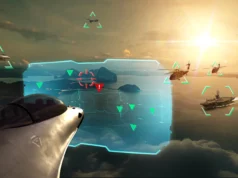
Interesting for a British product that the CGI looks like Nellis AFB in Nevada, with those mountains and style of ATC tower.
Good eye!!
Doesn’t look like the smoothest of landings though. More like Sumburgh in a cross wind…
1. Possibly the low part of a hi-lo mix with BAE’s Brontanax? Guess it depends which Tier of drones it would sit within….
2. Wonder if these could launch (and maybe recover) from the though-deck of the amphibious transport ships? Great for support commando/littoral operations, or simple fleet defence when QE and PoW are in port/refit/working up.
As always, the ideas and ingredients are there for us to rebuild some significant military power through our own industry, and we are ever frustrated by the lack of will and drive to seize the opportunity.
Out of interest I wonder if the Brontonax will be compatible with the Gripen, as that would give Bae a far greater test environment for it (indeed as and when these other options too) in Ukraine when that asset becomes operational.
Fascinating spot, Spyinthesky. The UK’s recent €300M funding package for Ukraine’s Gripen squadron makes a BAE Brontanax / Gripen pairing highly logical from a strategic standpoint. The Gripen E’s open software architecture is practically built for rapid third-party integration, completely bypassing the rigid software restrictions we see on American platforms. Deploying the Brontanax alongside the Gripen in Ukraine would give BAE Systems an invaluable, real-world testing environment against cutting-edge peer electronic warfare—something no simulator can replicate. The only real technical bottleneck would be the tactical data links; mapping the autonomous command loops between a Swedish fighter and a brand-new British CCA protocol under heavy jamming would be a massive engineering hurdle. But if they pull it off, it completely rewrites the playbook for affordable mass in contested airspace.
There’s talk of Brontanax being tested alongside a Typhoon through the use of an external control pod. Gripen E looks like better match.
The T-022 Vortex proves exactly why 6th-gen manned command nodes like Tempest are mandatory. At £3M-£6M a pop, MGI is pitching an incredible ‘affordable mass’ missile and sensor truck. But with a cruise speed of Mach 0.71 to 0.85, it is completely subsonic and non-stealthy. It cannot survive or think through heavy electronic warfare on its own. The Storm Fighter bid shows that the future isn’t ‘drones replacing manned jets’—it’s manned jets acting as the battlefield quarterback, shielding and directing low-cost swarms like the Vortex right into the teeth of enemy air defences.
I’m not sure the expensive crewed jet will be shielding the cheap uncrewed drones. May need a doctrinal tweak there!
Fair point Jon, definitely worded that badly! Definitely wouldn’t want a £100m asset taking a bullet for a cheap drone. I meant more electronic shielding. The Vortex doesn’t have the space or budget for high-end jamming kit or defensive suites, so it needs the Tempest standing back to suppress enemy radar and open up a corridor for it. More like a modern SEAD/EW umbrella than a physical shield. Otherwise those subsonic drones are just target practice
BAE claim that Brontenax will have 75/80% of the capability of a manned fighter at 25% of the price. What can’t it do? Does it rely heavily on the sensors of the manned fighter, and is that a large part of the cost difference?
Ghost Bat can be fitted with a radar but has operated without one in missile testing against target drones. Kizizelma is fitted with an AESA radar and IRST and relied solely on onboard sensors in tests against a target drone.
The Turks are forging ahead with their program while we have not. When Cameron managed to end Taranis and failed to create a European program was the time the UK should have been forging ahead.
Reality and experience in Ukraine shows that Hi – Lo solutions will be required. The thing the UK requires is mass.
Every day the Ukrainians deploy more drones and o e way effectors than the UK forces possess. There is a lesson there