

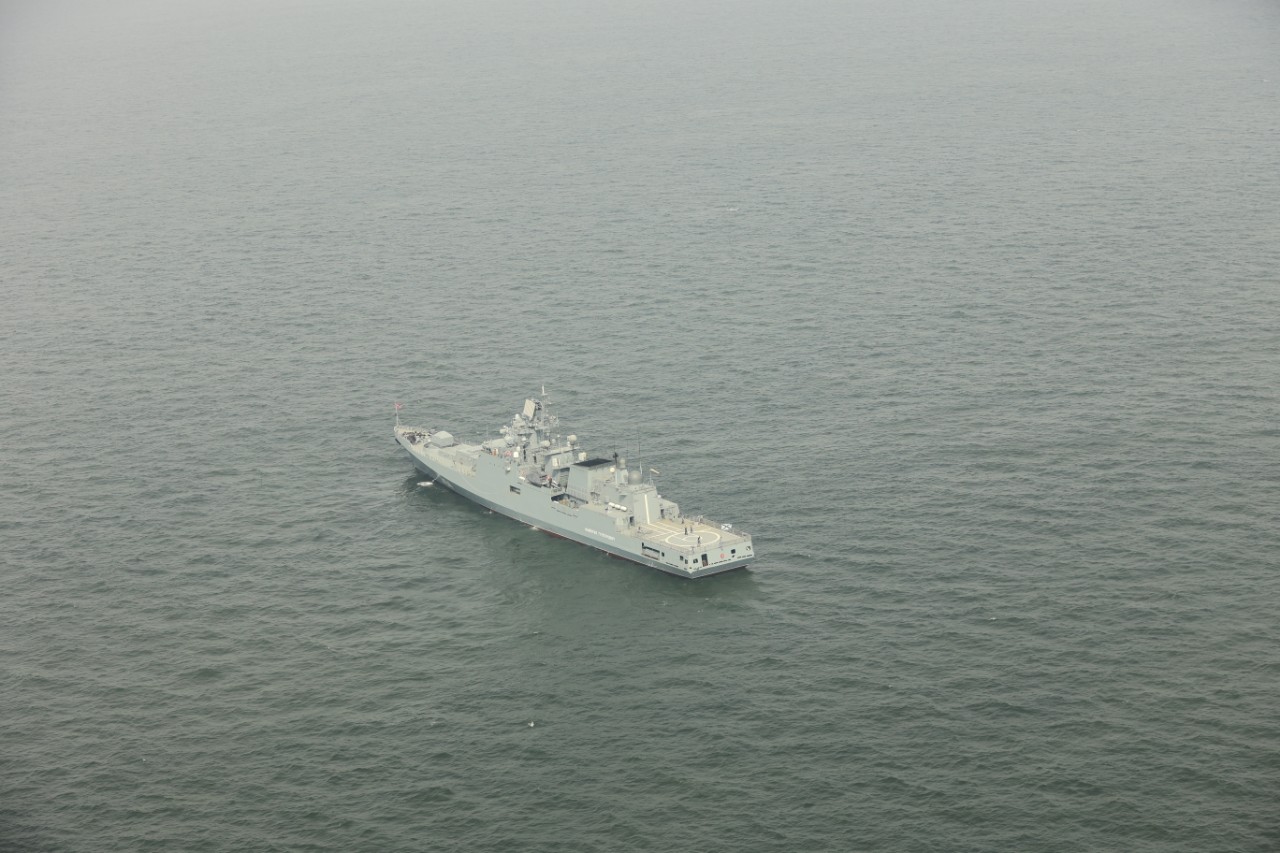
The retired British couple whose yacht had warning shots fired near it by a Russian warship in the English Channel have disputed Moscow’s account of the incident, describing the experience as “surreal” and rejecting the Russian claim that they made a dangerous approach, in an interview with BBC Newsnight.
Jane and Alan Kelvey were sailing around 23 miles off the Isle of Wight on Tuesday morning, on passage from Lymington to Cherbourg, when they came into close contact with the Russian frigate Admiral Grigorovich. Speaking to Victoria Derbyshire in a broadcast interview for Newsnight, the couple gave a detailed account that runs directly counter to the version since put out by the Russian Ministry of Defence.
By Jane Kelvey’s account, the couple spotted a vessel in the distance that was not showing on their AIS, the automatic identification system, and as they closed they saw it was a warship, around four to five hundred metres off their starboard side, motionless and, she said, holding station rather than adrift. The ship gave five blasts on its horn, she said, prompting the couple to turn two degrees to port to show they had made a deliberate change of course and seen it, before a second set of five blasts was followed by four or five rounds of small arms fire that she believed went up into the air and was not aimed at them.
The couple were adamant that they posed no danger to the frigate and that the Russian vessel made no attempt to contact them before opening fire. “They didn’t send up any flares, they didn’t try to radio us,” Jane Kelvey said, adding that the ship did not look adrift and that the yacht was “definitely not on a collision course”. Her husband added simply, “we were gonna miss them.” As far as they were concerned, she said, “it wasn’t an incident until the gunfire started.”
Pressed on the Russian Ministry of Defence statement, which said the frigate had detected the British-flagged yacht “proceeding under engine power on a dangerous course close to the ship”, Jane Kelvey rejected it flatly, saying “absolutely not” and that the couple were “not on a dangerous course”. Asked what they made of the Russian version, Alan Kelvey called it “normal lies”, while his wife said “it’s just not true, they’re blaming us and as far as we’re concerned, we were blameless.” Both described the firing as completely unnecessary.
Despite the encounter, the couple recounted it with striking calm, with Alan Kelvey describing it as “just another day”. Jane Kelvey said her immediate instinct had been to get on the VHF radio and call the Solent coastguard to report what the Russian warship was doing, but that she had held off because the frigate would have been able to hear the transmission, waiting instead until she could get a signal to dial 999 for the coastguard. She reported the incident, she said, only because sailors are expected to report anything that causes a hazard to navigation.
The couple described a lengthy back-and-forth with the authorities that followed, involving the Solent coastguard and its French counterpart at Jobourg, before the Royal Navy offshore patrol vessel HMS Tyne came by in the afternoon to check they were safe. Jane Kelvey said she had been surprised at how much the episode had “blown up” and disappointed at the accusations made against them, which she maintained were untrue, while Alan Kelvey said the Russians “shouldn’t really be firing when people are around”.
Their account adds a sharply different perspective to the picture set out by the British Ministry of Defence, which has said the Grigorovich fired warning shots to prevent a possible collision and was understood to have been drifting rather than under power at the time, while assessing the episode as an isolated incident unconnected to the Royal Navy’s boarding last week of the sanctioned Russian shadow fleet tanker SMYRTOS. The couple’s version, in which the warship was holding station, made no radio contact and fired despite the yacht altering course to pass clear, leaves open questions about how the two sides came to such different readings of the same encounter in one of the world’s busiest waterways.
The Kelveys, for their part, told Newsnight they intended to press on, with Alan Kelvey saying they planned to keep sailing for the next two months. Asked how they had marked the end of the day, Jane Kelvey said they had needed a drink when they got in, a rosé for her and a beer for her husband, after more than twelve hours at sea and an hour and a half with the French gendarmerie.


Wow, approaching a Russian warship and they turned 2 degrees after I’ve warning blasts 😂
I’ve gained $17,240 only within four weeks by comfortably working part-time from home. Immediately when I had lost my last business, I was very troubled and thankfully I’ve located this project now in this way I’m in a position to receive thousand USD directly from home. Each individual certainly can do this easy work & make more greenbacks online by visiting
following website—.,.,…..,.,.,.,.—>> LIVEJOB1.COM
As soon as they said they altered course by 2 degrees and thought that was suitable action you knew they were halfwitted WAFIs with no idea what they were doing. I wonder if they were also monitoring Ch 16, I suspect not.
yes, i have come across the same type myself many times, I can guarantee he was on that deck screaming RYA regulations from 1964 claiming right of way because he is under sail.
A warship if it was not under power and in international water was probably with in its rights to fire warning shots. I can image when they stared firing he turned allot more than 2 degrees.
The big question is why was no NATO military vessel shadowing a Russian warship with its AIS switched off, was this a result of French or British inaction or was HMS Tyne monitoring.
The other articles say Mersey was monitoring the Orc ship so surely they know exactly what happened!
Good Answer Jim,
Any Warship, regardless of Nation, give a WIDE BERTH!!!
JUST BEING NOSEY, ME THINKS,
NOW THEY ARE FAMOUS,!!!
“…., I can guarantee he was on that deck screaming RYA regulations from 1964 claiming right of way because he is under sail.”
No Jim, he very likely wasn’t. Firstly, the RYA don’t write the maritime rules of the road or ‘Colregs’ as they are known. Secondly, a sailing vessel, under sail is somewhat constrained in how it can manoeuvre , they don’t want to risk a potentially dangerous gybe or lose way so a 2 degree course alteration is prudent and seamanlike.. Thirdly, visibility wasn’t ideal, the Russian vessel wasn’t showing on AIS and the yacht may not have had radar. Fourthly, a retired civilian couple probably aren’t familiar with the profile of every nations warships, they easily could have assumed it was RN, Belgian, French, German etc. Fifth, they were sailing and making innocent passage in international waters, they were perfectly entitled to be there. The RN, and other western navies repeatedly exercise freedom of navigation worldwide, but this couple on their holidays can’t in virtually home waters?
I’m not aware of any other navy ( western anyway) that issues warning shots to adjacent sailing craft that by no stretch pose a collision risk. I’ve had a US submarine sail within half a mile of my own yacht on the approaches to Holy Loch., I’ve passed several warships within a similar range. No shots were ever fired.
“I’m not aware of any other navy ( western anyway) that issues warning shots to adjacent sailing craft that by no stretch pose a collision risk.”
A bit of context helps to understand the behaviour of the Russian crew:
– Ursa Major sank in the Mediterranean near Spain in late 2024, most likely as a result of clandestine operations;
– Vilamoura was damaged in June 2025 in the Mediterranean off Libya, with its engine room flooded;
– Several “shadow fleet” vessels have been neutralised in various locations.
On top of that, you have the US submarine torpedoing the Iranian frigate Dena in 2026, most sailors dead.
Also, while a 2° course alteration may make perfect sense from the sailing vessel’s perspective, it is unlikely to reassure the crew of the Russian ship.
This is not about denying the aggressiveness of the Russian frigate — it’s simply about acknowledging the context in which they are operating.
Certainly, there is context to it and no doubt the incidents you listed possibly played a part in the Russian crew’s actions. However, the retired couple sailing their yacht on innocent passage to France wouldn’t really have had that to the forefront of their minds, it’s questionable as to whether they even knew it was Russian when they first sighted it. What I don’t get is the ‘victim blaming ‘ or finger pointing at an elderly couple setting off on their holidays, as they attempted to set off WW3.I don’t recall these same people blaming the Skrpals for going out for lunch in Salisbury in 2018.
Agreed, most unsurprising that a week after the UK seize a Russian shadow tanker they park one of their frigates in the Channel and decide to focus their frustrations on a yacht that couldn’t retaliate but would create headlines. They chose to be stationary in the area. What we need to ask ourselves is why?
They know our navy is stretched and what better way to exploit that than by feeding the narrative of ‘unsupervised’ Ruskies roaming the English Channel and taking pot shots at civilian vessels.
Everything the Russians do is carefully choreographed, to think otherwise is foolish on our part. I don’t know what more evidence we need, in order for us to understand what is going on here. If we don’t man-mark every Russian warship that enters the channel this kind of ‘ungentlemanly’ behaviour will continue.
Good post Andy. Time to get some stronger presence in the channel rather than just a few B1 Rivers. No UK subs available so hopefully trying out some uusvs without broadcasting it out loud. And “drifting”. Really, where’s their tug?
Having done an RYA course, they said ultimately might is right, and to keep well clear of large ships even if you do have right of way
I dont agree with your ‘2 degree’ chastisement of a yachting couple but absolutely do with your questioning why no NATO asset was shadowing this warship. I mean, we all know the reasons why there was nobody there but your question holds solid…
It really depends, they say they were not within 500 yards, the Russian did not attempt radio contact and the 2 points meant there was no collision risk..
If they were already close to the wind then maybe 2 points sailing was all they had.. without a full tack.. as the couple said they ended up having to go to engines to go about. Which says to me they were close hauled to the wind.. and warships are mean to follow the rules as well and not just threaten violence on the high seas.
The 2 degree thing I just don’t get. Unless they were on autopilot trying to hold a straight course to within 2 degrees is nearly impossible and even under autopilot any sort of swell will cause the heading to shift by that much. It also depends a lot on whether the frigate was heading East or West as if they were already passing astern a small change in course might have been a reasonably course of action but if they were trying to cross the bow even with a stationary vessel that’s just plain stupid.
Even so the Russians shouldn’t have been drifting so close to a shipping lane (20nmi S of the IOW is I think just N of the main westbound flow) and firing any weapon at a civilian while under very little threat is silly. There were several steps on the ladder that should have come in between, like using a signal gun or as they were stationary launching a boat.
By the South of it they were sailing close to the wind and did not have a lot of sailing left before getting iron bound.. they said after shots were fired they took the craft under engine power and turned about.. not a normal action..
Should say five warning blasts
You idiot, can’t you read? Pissed again last night were we?
“as they closed they saw it was a warship, around four to five hundred metres off their starboard side, motionless “. Yep, idiots with no sense and terrible eyesight, apparently.
There was fog in the channel yesterday so that isn’t as ridiculous as it sounds.
There was sea fog and poor visibility.. the warship had its AIS off.. which in is meant to prevent this sort of thing.. essentially it was laying doggo in low visibility conditions across a know crossing point.. it was clearly looking for a yacht to stumble close so it could make a point…
Well it seems clear that the MoD are taking the party line and downplaying everything, which is probably for the best, if they are even contradicting the two Brits who witnessed the event.
That’s the problem, at the moment if they overplay it 25% of the public will demand we start firing on Russian ships.. 25% will become even more anxious, 25% will believe the government is just trying to deflect from their favourite issue ( the boats, not doing enough for them re benefits etc etc) and 25% will think it’s the deep state trying to take control via a Zionist or Islamist plot ( depending on the power group they feel is controlling the state ) and we need to rebel and joint Russia or the US or some other political body politic.
I over cook it all a bit.. but you get my meaning.. it’s essentially the governments job not to overreact.. but also not to under react.. in the end if this is Russia making its displeasure known about the tanker it’s pretty petty and weak.
Yes, better than just sinking them as a couple of posters want! Cool heads please.
Well, I just question why the MOD didn’t notice a ship was Drifting south of their naval base, even a curious Battenberg clad ship coming out to ask if they had everything in order.
On the grand scheme of things, no matter how daft the yachting couple’s statement may be, if the MOD and HMG put out a statement it’s got to be default setting that’s it’s taken to be lies/spin or politicking until proven otherwise. Starmer at this moment in time will ensure any load of shit is pushed out to the public domain, in a desperate attempt at seeming in control!
After reading all I can of this my conclusion is..
The Russian ship was holding position across a known crossing point to France, without its AIS on in fog bound low visibility conditions.. it was waiting for a sailing vessel to stumble into it so it could make a something like this..
It’s geopolitical theatre.
Tend to agree with this. No reason for the frigates actions other than to cause issues or make a point, unless they were drifting after all, which the couple’s account contradicts.
Well the Russians showed themselves to be very twitchy. They obviously know that Ukraine has assets and personnel based in Portsmouth.
Bit behind the news down here in Aus. Could they possibly be checking the seabed below for cables to distrupt? Are they still drifting? Have called for a tug or some help? Are they trying to create a trigger event so they can unload? Pity no UK subs to check it out but could be good practice for one of the new uusvs. Or, maybe something is seriously wrong on onboard? As one of my 🇬🇧 mugs says, “Keep calm and carry on”. Not hard to get a bit worked up though.
At a more basic level lets hope replacements are got for the three B1s before they depart and some additional standoff ashm ability is acquired.
Surprised the Russians didn’t say they were there to stop the illegal crossing of small boats by smugglers …. Their excuses are always a lot of fun ( I loved the one against the fishing fleet for their white fleet action in 1905)
I’ve gained $17,240 only within four weeks by comfortably working part-time from home. Immediately when I had lost my last business, I was very troubled and thankfully I’ve located this project now in this way I’m in a position to receive thousand USD directly from home. Each individual certainly can do this easy work & make more greenbacks online by visiting
following website—.,.,.,.,.—>>> JobatHome1.Com
Mr & Mrs Kelvey certainly had quite a day in the channel.
I saw the interview with them by Victoria Derbyshire on News Night. Mrs Kelvey did all the talking and certainly came across to me as someone who thinks she knows everything and actually knows nothing.
I question if a turn of 2 degrees would even be noticeable from the bridge of a warship. This is a good indication of seafaring incompetence. Such incompetence would also explain why they did not hear a radio broadcast by the Russian vessel if they were not even monitoring channel 16.
Some vessels will deactivate their AIS for legitimate operational reasons. This is often done by Border Force vessels as they like to pay surprise visits to people! This however does not explain why the Russian vessel did not have hers switched on. I suspect a bit of Russian naughtiness.