

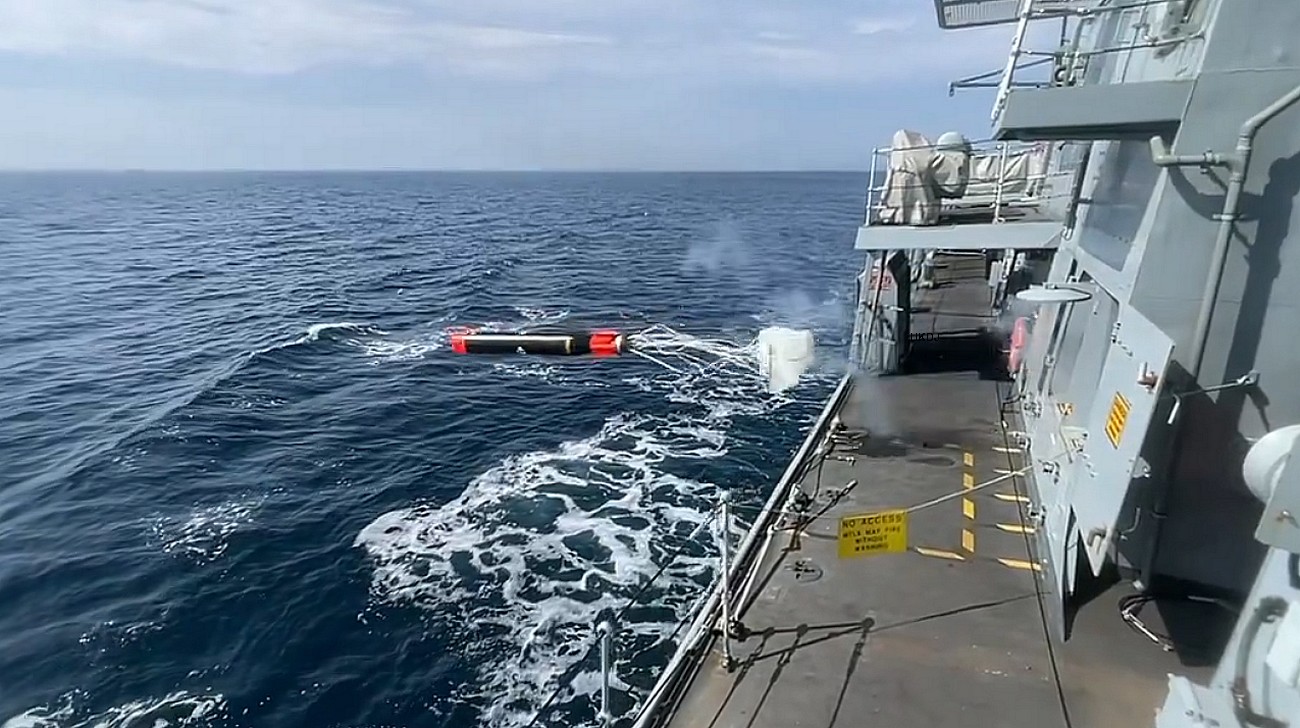
The Torpedo Repair and Maintenance contract, announced by the Ministry of Defence on 4 August, runs from July 2026 to June 2029. It covers both weapons in Royal Navy service, carried by submarines, surface warships and maritime patrol aircraft.
Torpedoes are one of the Royal Navy’s most important tools for keeping the UK safe at sea, and the department says that without them “Britain’s ability to defend its waters, protect trade routes and maintain its nuclear deterrent would be at risk”. The contract, it says, “will ensure sailors and submariners always have reliable, battle-ready equipment when they need it”.
Of the 315 jobs, 150 are highly skilled engineering and technician roles at BAE Systems: 100 in Portsmouth and 50 more across Edinburgh, Chelmsford and near Glasgow. A further 165 are supported through the company’s UK supply chain. The department describes the funding as part of the £298 billion over four years announced under the Defence Investment Plan, and as furthering a commitment to use defence spending to “drive economic growth in every postcode, creating well-paid, long-term jobs in advanced manufacturing and engineering across the UK”.
Minister for Defence Readiness and Industry Luke Pollard said:
“This is defence spending doing exactly what it should, keeping our country safe while securing 315 skilled jobs and creating new opportunities across our country. We are proud to be backing British jobs, British skills and British industry.”
The contract is a bridge rather than an endpoint. It leads to WHITEHEAD2, a longer term programme intended to deliver a modernised torpedo support solution from 2029 onwards, which the MoD says will keep the Royal Navy ahead of future threats.
Rear Admiral Matt Stratton, Royal Navy Director Naval Acquisition, said:
“This contract extension ensures the Royal Navy retains a safe, reliable and continuous torpedo support capability. It is a critical enabler of our operational readiness and directly supports the UK’s Continuous At Sea Deterrent.”
Richard Murray, Director Lethality and Protect at the National Armaments Director Group Materiel, said:
“This contract extension secures continued, reliable support to the UK’s torpedo capability. Bringing together the Navy, National Armaments Director Group and industry as a single team has delivered real, tangible results for UK defence.”
Scott Jamieson, Managing Director of BAE Systems’ Maritime and Land Defence Solutions, said:
“Since 2019 we have delivered consistently high levels of torpedo availability for the UK Armed Forces, supporting both the successful entry into service of Spearfish and the ongoing operational readiness of Sting Ray. As a trusted partner to UK Defence, we are proud to underpin the nation’s Continuous at Sea Deterrent and anti-submarine warfare capability through exceptional reliability, availability and performance.”



This is an average (including the ones suggested as not highly skilled) annual cost of £140k per job, not including the supply chain. Is that reasonable for what they will be doing?
Our stocks of torpedoes can’t be huge, do they get one each to take home and look after?
These are very complex weapons. And if we want them to work as advertised if they are ever fired in anger, then they need maintenance and support.
Of course.
That is not what TJ asked though.
Another scenario, would you pay more than is reasonable for said support, even if you knew that it was more than necessary and you were being milked?
As you say, these are high tech complex things, they need support.
The “Support” area of DE&S spend is I recall higher than the equipment spend.
I’m suspicious every time I read these recurring themes of seemingly ultra high costs, the MIC bleeds the MoD dry because it can, now so much in house ability has been lost.
The alternative is to not pay and our Torpedoes are left unmaintained and unusable, not an option either.
And how do you know they are being bled dry when you don’t really know what’s involved. It probably cost considerably more in manning and maintenance when the Navy did it itself. And as weapons have got ever more complex, it makes sense for BAE to do it. Not everything is a rip off Daniele. These contracts have many clauses and penalties built in, so they to have to deliver. When I was at Cottesmore, BAE did an outstanding job of providing Harrier upgrades and improving availability to the frontline on a far smaller budget than the RAF would have needed to have done it all themselves. 1 RAF Technician costs the MOD far more than paying for 1 BAE contractor tech. They don’t have to provide accommodation, a pension, Deployment benefits, education, family support. The list is long. Same with Typhoon availability. The contract has to provide X number of airframes available on any given day, plus surge capacity if needed. And they do it. Typhoon availability is outstanding. Many of these contracts save money in the longer run, meaning the RN, RAF and Army have more money for other priorities. All this support work is not going to come back in house. Those days are long gone. So would you rather BAE do it, or a foreign company do it. It’s as simple as that. Vast majority of NATO Armed Forces do it this way. Its not just us.
Meanwhile, in the Falklands, HMS Conqueror used WW2 era torpedoes.
Is there a New Next Gen Torpedo in the pipeline..?
Believe the only announced near-term programme is the evolutionary mid-life upgrade of Sting Ray Mod 1 stockpile into Mod 2 configuration (upgraded software, improved acoustic seeker) by early 2030s. Vaguely recall a (BAES/MoD?) concept study to replace ASROC, perhaps w/ a Sting Ray front end, unsure re status. Blue sky/ocean idle speculation: future joulnt AUKUS Pillar 2 programme for next gen heavyweight torpedo (perhaps after Pillar 1 is deemed successful)? 🤔
… joint …🙄