

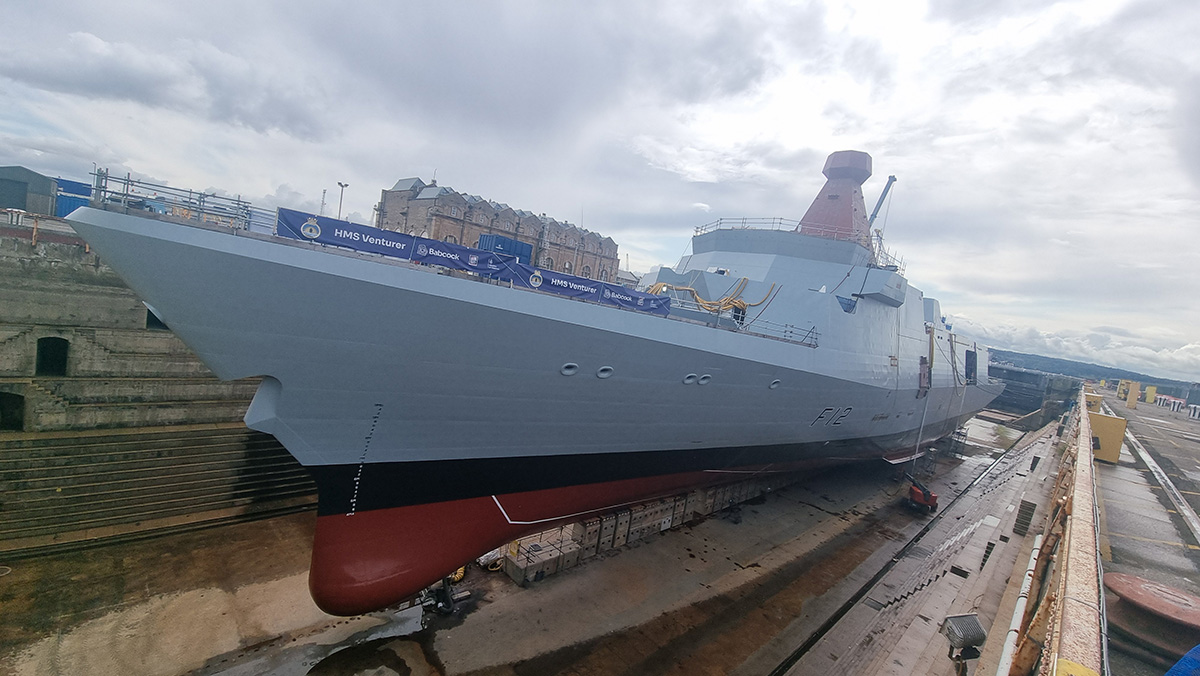
A new 878 Institute paper wants the Common Combat Vessel based on the proven Type 31 design, cutting production risk and keeping Rosyth working as the current frigate run ends.
Six Common Combat Vessels are to replace the cancelled Type 83, acting as command ships for four new classes of as yet undesigned autonomous platforms, the Type 9X. All of it has to be designed, built, tested, delivered and doctrinally proven by 2035, when the Type 45 leaves service. The paper calls these tight timeframes “especially for a procurement system known to move at glacial speed”.
Robert Clark’s fifth recommendation is to reduce that risk by not starting from scratch. The existing Type 31 frigate design should be the template for the CCVs, he writes, because “a proven platform would minimise production risk, utilise existing supply chains” and maintain shipbuilding at Rosyth once the Type 31 programme finishes in the early 2030s, just as CCV production is expected to begin. Elsewhere he argues the yards at Rosyth “should be utilised for the incoming CCVs”.
The Hybrid Navy concept was introduced alongside the Atlantic Bastion strategy by the First Sea Lord in December 2025, and at least £1.3bn has been allocated to it over four years. Clark’s broader reservation is that in practice this means “cutting proven (and crucial) crewed platforms for untested and uncrewed ones”.
He does credit the concept on its own terms, accepting that around 30 Large Uncrewed Surface Vessels working with a smaller escort fleet “could provide deterrence by denial” through distributed sensors and effectors, extending radar coverage over a wider area.
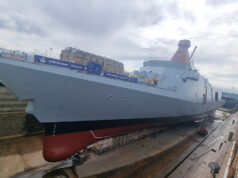
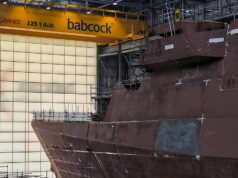
Type 31 is currently in build at Rosyth. The paper’s related recommendations cover the Type 26 as an export platform and extending the Type 45 to cover the air defence gap left by the Type 83’s cancellation. The Ministry of Defence has not yet responded to the report.
Britain’s Military Deterrence Gaps by Robert Clark is available in full from the 878 Institute.




Why is this nonsense report getting so much coverage.
Yes and as others have also suggested, just call it T32, keep it separate and still build some T83s as T45s successor. Have a bit of both. Get some more “real” ships built before drowning in drones and motherships. A few more T31s and B3 opvs and helos. Drones won’t do port visits, fly the flag, or do humanitarian relief very well and are likely to be treated just as shooting targets by our adversaries. It could all be very wasteful in resources and monies spent if not controlled and does the RN really need 981 of them? Needs some balance of naval presence.
six? What happened to the rest?
You then run into the issue of funding the design and construction of two new classes instead of one. Better to focus a mid-sized destroyer and get a decent number of them; I’d take 8 modern Daring-equivalents (48 VLS, 57mm + 40mm guns, lasers, and a good radar) over 4 super destroyers and 6+ T31 derivatives.
I agree though, regarding “real” ships. At least in regards to the navy, drone ships should be viewed as force multipliers, not the force itself.
48VLS is a pathetic number these days. Mk.41 costs under £1m per cell, the systems are the expensive bits on a ship, you might as well give it a depth of fire worthy of its radar, combat suite, etc.
48 is too small for existing destroyers, the Daring class being the least armed modern destroyer time in the world, and outside of the Type 45/Horizon nobody else fields any less than 64 cells.
With only a decent radar you’re vulnerable to high end hypersonic or ballistic missiles which then put your expensive carriers at risk.
Without a good destroyer the destroyers don’t stand much chance against modern weaponary and the carriers stand no chance.
That said, if we look at things like the Sejong the Great or Maya class’, a good, high end destroyers isn’t actually that expensive so long as you commit and don’t constantly redesign mid production.
48 VLS would simply be what the CCV / T46 would carry itself; magazine depth would be provided by the proposed missile barges. Likewise, while a “good” core radar is important, having multiple radar pickets scattered over a wide area and transmitting data to a central system should (and I emphasise SHOULD) provide an overall better picture.
Remember, Type 83 is currently flagged as unaffordable, and the implications of the CCV name are that a big, modern destroyer isn’t on the cards.
The Sejong the Great is just a bigger Burke built by the world’s largest shipbuilding nation; it’s cheap because it’s using previous generation tech built using massive economies of scale. The Maya is roughly the same.
I truly hope CCV ends up being a well-armed destroyer with all of the capability it needs, but I won’t be holding my breath for a Burnham-class battleship
As yet undesignated,? FFS!! no plans? No tech ready and tested yet six of them. NO BLOODY IDEA HAVE THEY?
They probably have a x1000 more if ab idea than you do
T45 batch 2. It has the strength for a tall mast and it has the space to be a flexible platform, especially if it reduces VLS capacity and the re-design won’t take long or cost much. I’m not convinced small, cheap drone ships could provide the required radar coverage; even if forward deployed. Extra T31’s for Rosyth. Sorted!
If i read the DIP correctly, there is £1.3B to design, build and equip the CCV and affiliated drones. These vessels are not going to be well equiped or large i’m afraid. Capability will lie in the drones and given their unproven status, i think this is a huge gamble.
I hope that’s £1.3bn per ship rather than all 6! It is a gamble…one I don’t believe is necessary. Fingers crossed there is more money coming to defence with a friendly face at the Treasury, but I wouldn’t hold my breath. The cynic in me reckons Healey quit because Burnham offered him a juicer post rather than some matter of principle.
The 1.3 billion is for the first Four to five year development and production of the T9x autonomous platforms. Not the cost of the CCVs as they will be built later and funded in the next parliaments funding cycle… essentially the government quietly abandoned the whole concept of the 10 year funding plan that was meant to be the DIP and just planned up until 2030.
In the end if as is promised defence spending hits 3% of next parliament and 3.5% by the end of it then there will be buckets of money for capital expenditure.. as by that point most of the RNs big ticket capital items will have been built or already funded.
Indeed difficult to cost out a ship class that hasn’t even been fully conceptualised in size or capability yet, let alone designed and costed.
You put your finger on it. It needs to have a short timebox to come out of Concept. Ideally no more than 6 months. Only then it be judged if the Arrowhead is the right solution.
When you said six months I realised that you had no idea of what you’re talking about
Aye. Part of me wonders if the RN are just hedging their bets, and purposefully slowing the CCV down, so that T45 can continue through to the 2040s, and construction on a true T45 successor can begin in the mid-2030s.
However, the government needs Babcock to survive, and so will want to give them frigate work of some kind, which is why the CCV is essentially T32.
I think maybe the RN are playing the long game.. they know the T45 has just had its systems and power updated so it’s not going to have an obsolescence issue and its hull can do 35 years.. so all the cost to keep them ticking into to the 2040s has essentially already been paid.
This gives the navy 20 years.
I think they see the CCV as a way to get more hulls now, as they did with the T31.. if they can get 6 more hulls and protect the T45s into the late 2040s they have got their 25 strong navy… all they need to do then is protect it, and they know the UK has bound itself in treaty to be spending 3.5+1.5 % on defence for 2035.. with the navy have essentially completed or funded its major surface fleet capitalisation, and a fleet at or heading to 25 escorts at that point and lots of money about for 2035, it’s the perfect time to come out and say… everyone else has a large AAW destroyer class.. we have tried but smaller autonomous vessels and CCV cannot protect the carriers from ballistic missiles and hypersonics.. we must a a large AAW vessel to function as a first rate navy.. can we have one for 2045-2050 to replace the T45s… ohh yes and BAE will be launching their last T26 in 2038ish so they need to build something as well….
Ten year equipment plans sound great but funding will never exceed four years so anything beyond year five will always be a statement of wishes. One parliament can never bind another. For all we know the defence picture might drastically improve post 2030, Putin can’t live forever and if that’s the case then no point is boosting spending to 3.5%. 3% of GDP is a perfectly adequate amount of long term spending.
That 1.3bn is actually funds for development for over 20 different classes the dip was a joke of word play and sophistry. The budget they have been told for ccv current leaves it not even being able to be a t31 variant and will have no growth potential and there are serious issues with the t9x series apparently aswell regarding not just cost but feasibility. Give it 1-2yrs of studies showing this doesnt work and isnt cheap the ccv rebarnaded back to t32 and either a t46 or t83 will be back on the menu especially if we do get a defence budget increase
Agree.
These drone ships will be incapable of deploying beyond the European littoral. Who maintains them and sends shore parties to repair after disasters? Robots in time maybe. I am not convinced anything over 1000t will work. Flower class corvettes were the smallest viable escorts in WW2 and they struggled hugely in heavy weather and even in the best conditions crept along at 18kn.
Well I think T45 won’t leave service with such an abrupt timeline, but when it is able to.
Also, considering how long it’s taken to get a single T26 built, let alone trials, I think this timeline is pie in the sky, even if it’s built to the T31 hull which is a simpler type.
Exactly: T31 isn’t exactly flying out of Rosyth.
I accept that one T31#3 has been built then there will be an experience efficiency gain that is very real but that is not yet reality and it looks like T26#1 will beat T31#1 into trials…..not the best look.
True but the simple fact is BAE have got a minimum of 13 T26s to build..and that’s filling their books to 2040… Babcock will need a hull to put on the blocks for 2030.
Simple fact is that Babcock need to deliver a warship fit for trials before they can be given any further orders.
No point in ordering ships that either are not fit or are not delivered even vaguely on time.
Yes agreed, but hopefully we should see trials in 2027 for HMS Venturer and at that point they can put in an order for the firsts CCV to be laid down in 2030…
There is a point. In fact there are several. A five ship run takes so little time between the first one being operational and the last one is in build, that there’s a good chance Babcock would be laying people off if we want to eat the pudding first. They’d be stopping apprenticeships and training even sooner. Babcock are a big company and it won’t bankrupt them to have to do some rework. They will get it right in the end and they will become increasingly efficient. The bigger the order book, the more they will invest and the faster the efficiencies will come. It also shows trust, which helps the chances of exports.
I forgot to mention that the design work for the variance between the T31 B1 and whatever is wanted for the CCVs will also take time. You leave it all too long and you end up delaying the build – again.
It sort of depends on where they go and how clever they are..
If they are clever beans, they will us the fact the T45 are just had power and capability upgrades that don’t finish until 2032 and that the hulls have hull plating thickness that will not likely be an issue until they are 35 years old.. using this it’s not going to be anything like as problematic keeping them running well into their 30s as the T23s.. the major works and costs on power and system obsolescence have already been paid and done…so cashing out these vessels before their hulls are nackered and need major works is foolish.
So keep the T45s running from 2045-2050 if they have to..and from 2032 onwards derisk the introduction of Aster 30 NT by putting it on the T45s..
Make the CCV a AAW focused Arrowhead 140 keeping as close to T31 as you can for commonality.. just add a volume search radar ( which it’s got the ability to take with no major changes) and give it 32 MK41s straight away.. fill the mission space with all your autonomous ship control gubbins via PODs ( this will allow you to bring the old T31s up to the same command and control standards with ease as well as the T26s). Have the first one on the blocks for 2030 launches in 2033 and commissioned in 2035-36 to them pop out one a year until the end of the decade.
In the early 2030s make the assessment on the need for a true high end AAW destroyer to manage the air defence ( and ABM defence) of the carrier battle group) .. at which point I think they will decide they will need something like the US, Japan, China, Korea and Italy are building and so they can order a number of big AAW destroyers for the mid to late 2040s as the T45s get decommissioned.
Your final RN in the 2040s then becomes:
1) 8 ASW frigates ( t26)
2) 11 Arrowhead 140 ( T31 and CCV as your basic GP/ second level AAW and drone control warship)
3) 4-6 AAW Destroyers ( T45 and true replacement)
This gives you 24-25 escorts as will as the autonomous ships.. which is probably about right.
I think this will probably happen simple if Russia and China are still strategic competitors, the US isolates more and we do go to 3.5% of gdp…
The fear is that the OSD for T45 is being dictated by the lack of budget lines for LIFEX.
So RN ends up in the T23 mess again.
I do think that some very large high end AAW ships will be needed even with all the dronesque ships around.
Having a large synthetic array on land is one thing but doing that on the water is quite another.
Indeed, and I never take the Navy for idiots.. they may sometimes play the political game badly and get caught out.
In this instance I think they are playing the tide.. it’s low tide with lots of needs so they are playing along.. get their CCV hulls in the water and autonomous ships and play the game by trying to get it all to do high end AAW.. when they know very well it’s probably going to work well with conventional air breather and new drone threats, but it will never cut with ABM and hypersonic threats.. so when the tide is hight in 2035 they will go all out to get an AAW destroyer.
Plus 3-4 more B3 opvs…. to help free up the T31s! Lol.
To utilise the rule of three could we add one more T26 and T31 here?
That all depends on the condition of the ships, the cost to extend their service life, and to a lesser extent, the crew to man them.
The RN has decommissioned ships long before their time was due. For example, HMS Iron Duke, and Albion and Bulwark.
Yes I agree they are hardly run in yet. They have a lot to recommend now PIP is almost complete. Maybe with AI you could cut crew numbers considerably.
Arrowhead 140 hull, specifically the ‘large radar’ variant visible on Babcock’s website. 16 VLS forward, 57mm, single 40mm rear. Plenty of mission bay space replacing the previous central 32-cell VLS. Works with 2-4 T91 for a group total of 80-144 strike-length cells, and with 2 T94 to provide radar pickets, or, in a different configuration, volume search radars.
You trade individual missile depth on the CCV, but retain a relatively cheap price point, ease of production and rapid deliverability. Depth is compensated for by close escorting T91, which enhances survivability of the package on the whole. The main issue is the weakness of the CCV radar (probably Sampson+ performance rather than the massive system floated for T83), but this can be partially compensated for by the T94.
It’ll probably not be initially as capable as a dedicated T83, but it will be more survivable against enemy action. It will probably be less easily deployable, but that depends on how many T9X are constructed.
A couple of problems for the T31. The first is overall size. Even taking out the amidships VLS, there’s only space for up to 3 11m USVs, due to the hatch size and the davit system. A 11m USV is next to useless in any seas with a large amount of swell. A USV that is only 11m long will not be able to power a suitable radar to increase the ship’s field of view in any significance. Then there’s the issue of launching and recovering the USV in heavy seas.
The next area on the problem list is available electrical power. The ship is powered by 4 gensets that push out 8.2 MW each for a total of 32.8MW, along with 8 additional gensets for powering pumps and other loads, with a total of 9MW. Giving a combined total of 41.8MW. Compare this with the T45 post PIP. With 2 WR21 gas turbines, giving a combined output of 43MW and 3 gensets producing a combined 12, for a combined total of 55MW. meaning there is a discrepancy of 13.2MW.
Why is this important, the T45 already powers the ship’s CMS, Sampson and S1850M radars and everything else, but still has headroom to power two Dragonfire lasers. Does the T31 have headroom for an additional long range search radar like the S8150M, as well as powering a pair of laser CIWS systems like Dragonfire? I feel the ship will need a power increase to match the requirements needed for an AAW ship. But the base design has never been powered with a gas turbine. So how easy is it to swap a gen set for a MT30? Or swap the gensets for even more powerful versions?
There may be a solution to some of these questions in the form of Babcock’s proposed Arrowhead 160. Which as the name implies is some 20m longer. Where Babcock are using the increased size to increase the VLS count specifically for an AAW ship. But it would present an opportunity to investigate upping the power. Where it could power a long range radar, as well powering Dragonfire.
To be brutally honest, the idea of using a 11m USV as a radar picket that is deployed from the mothership, is a dead end! The boat won’t be able to power a radar that could push out the ship’s radar horizon sufficiently. Plus due to the size the radar will need to be mounted fairly low, so its radar horizon will be really short. My thoughts are the “loyal wingman” needs to be a ship and at a minimum the size of a River Batch 2. This is so it has the necessary volume for fuel storage, meaning it doesn’t have to come alongside the CCV or other vessels every 5 minutes for a refuel. Secondly the larger size and beam will allow the radar to be mounted much higher up, giving a better radar horizon. Additionally, a ship the size of the B2, can cope with the realities of operating in various seas and sea states. The ship’s overall depth should allow the fitment of 2 x 8 cell strike length Mk41 VLS, possibly more. But also allow the ship to mount a couple of CIWS autocannons, that could deal with leakers and drones. Which is pretty much what BAES were proposing for their T92, but using a trimaran hull. But for me perhaps the most important reason, is the ship can be operated either lean manned or remotely. Giving the Navy another independent ship option for tasking, besides acting as the wingman for the CCV.
Apologies, I didn’t mean that the T9X (e.g, the radar and missile drones) would be serviced from the mission bay. Those are going to be far too large (3000t apparently). I more meant that the space could be used for containerised modules of more mundane nature. Additional generators, perhaps, which could then feed into the issue with power generation that you mention subsequently?
As for volume search, that could be offloaded to a picket unmanned vessel, right? A 3000t system without crewing requirements should be able to handle that.
Trying to turn an 11-metre hull into a viable radar picket or force multiplier in rough North Atlantic sea states is a complete engineering dead end. The power deficit alone proves that you cannot simply dress up a Type 31/Arrowhead hull as a top-tier Anti-Air Warfare (AAW) destroyer replacement without a radical, highly expensive redesign of the prime movers.
The alternative proposal—utilising an uncrewed or lean-manned vessel the size of a River Batch 2 or the proposed BAE Type 92—is far more realistic. If we are forced to field an entirely unproven ‘mothership and drone’ architecture by 2035 because the Type 45 fleet is leaving service, we cannot afford to waste the next five years discovering that our drone pickets cannot generate enough megawatts to switch their own radars on or launch in a heavy swell. The MoD needs to look at the engineering reality laid out here before this turns into another catastrophic procurement black hole.
There is a longer variant of the 140s. A 150? Maybe could have a more powerful power plant.
Type 31 too small to replace Type45 – I would personally like to see a production line of Type 45 hulls being built as an ongoing progression and upgraded as time goes on. Keeps production going, proven design, evolution and lower risk. We do need far more T26 and T31 but not at the expense of T45 – mass is very important these days – we need something that can fight off large numbers of enemy drones, that means a bigger hull to carry them. It is foreseeable to imagine a task force being attacked by 500-1,000 drones of different types in a mass swamping attack – don’t see a T31 type being able to cope.
HMS PowerPoint
HMS Fitted For, But Not Equipped.
LeetOrt fYes I think the navy could be playing a blinders here!
I just can’t see the type 45s going from 2035 after a £billion pound of upgrades only finishing in 2032 they will be extended for a decade if there is any sense left in the mod.
Then funding should be available for their true replacement from 2035 onwards actually getting to the navies 24 minimum stated esort fleet.
The nuclear attack submarines in any future conflict with China would be our best assets to send to help the Americans with the surface fleet concentrated in the high North countering Russia
Well, considering HMS Glasgow is taking something like 11 years from first steel cut to operational, that takes us out to 2037 or 2038 for the first CCV already – assuming a design freeze….
And what will be providing air defence FF or the carrier groups and other surface ships?
The Americans or the French?
In this scenario, the CCV and T9X are.
The T45 will just be extended until they are commissioned.
“could provide deterrence by denial”
Instead of deterrence by denial, how about something a little stronger like, deterrence by destruction instead?
It makes sense to use an existing hull for CCV. In an ideal world it would be T26 as that design is intended specifically for high-end CSG type ops, whilst the T31 isn’t. About the only thing CCV will have in common with T31 is the basic hull, even the engineering setup will need to change given the huge data centre like power and HVAC requirements. But Rosyth badly need needs the work and Babcock are quietly warning the MOD that without new orders they will have to start running down operations there from early next year, starting with the painfully assembled and now well blooded design team. A six ship CCV contract will guarantee the yards future to the end of the 2030’s. So everyone happy – even the RN (at least in public!)
This whole CCV idea makes me very nervous. Maybe it shouldn’t but does it really make sense to design and build what boils down to four or five classes of ship to replace six 45’s? All in eight years? If we are looking at economics we would be better off ultilising the T26 hull with a succesor radar and armed with Aster and camm. If the French can do it so can we, and Bae have already said it can be achieved.We are now getting an argument about crewing but a T26 has 160 personnel. That cannot be a problem surely. If the theory is about keeping Babcocks working I have the answer. Order another five T31’s.
Who is this Robert Clark fool?