

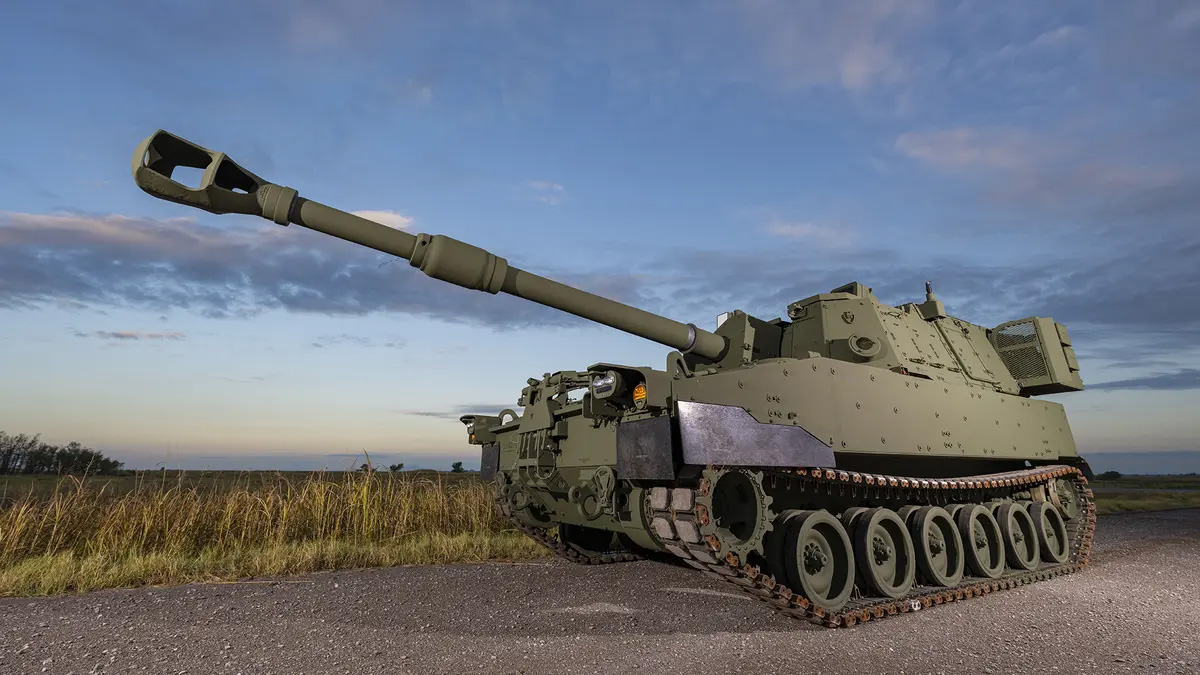
BAE Systems has been awarded a contract worth USD 535 million to produce additional M109A7 Paladin self-propelled howitzers and M992A3 ammunition carriers for the US Army, the company stated.
The M109A7 is the latest variant in the long-running Paladin family of 155mm tracked self-propelled artillery systems and serves as the standard indirect fire platform for the US Army’s Armored Brigade Combat Teams.
According to BAE Systems, the platform offers what it describes as a “scoot-and-shoot” capability, delivering precise fires in under 30 seconds when emplaced or within a minute while on the move. The company said this combination of responsiveness and mobility is designed to improve survivability against counter-battery threats, an increasingly relevant consideration given lessons emerging from recent conflicts where static artillery has proven highly vulnerable to drones and counter-battery radar.
Dan Furber, vice president of artillery programs at BAE Systems Combat Mission Systems, pointed to the system’s track record. “The M109A7 Paladin is a battle-proven platform that delivers what Soldiers need to succeed on today’s battlefield,” he said, as quoted in the company’s release. “With its reliable performance and robust industrial base, the Paladin ensures our troops have the firepower and support they can count on when it matters most.”
The M109A7 represents a substantial overhaul of the older M109A6 design rather than a wholly new vehicle. It retains the main armament and cab of its predecessor but pairs them with a new chassis sharing common drivetrain and suspension components with the Bradley Fighting Vehicle, alongside upgraded electrical and power generation systems intended to accommodate future technology insertion. The M992A3 ammunition carrier accompanies the howitzer in service, providing resupply and crew protection within the same formation.
BAE Systems described the M109A7 as one of the lightest tracked self-propelled howitzer systems currently fielded, according to the company, with an adaptable chassis designed to perform across varied terrain.








I can only ask, why? I’m not saying the age of artillery is over and it’s all drones now, but, why a tracked unit and at a time when we’re seeing Artillery being outranged and by cheaper, high mass swarms that will do the job and with “better” targeting.
Ah well, I can see these might be useful vs FPV drones, but their armour is only rated for small arms and shrapnel, right, not a direct hit from a shaped charge.
TJ, you are right, and these units are not what I’d describe as ‘Shoot & Scoot’, which is seen as an essential requirement today.
I shared an interesting article which was in British Army Review the other day regards the issues facing our own Royal Artillery and how all the noise about improving matters is being undone by supply issues and the usual red tape, money, and fiefdom issues. From a serving Lt Col no less.
It also noted.
A 155mm shell is almost impossible to intercept. Drones can be and are.
A 155mm shell cannot be jammed or spoofed. Drones can be and are.
A 155mm shell can be fired in all weather conditions. Drones, I assume, might not be able to.
Another poster noted that a shell responds quicker, unless by luck a loitering Drone is already nearby.
I’d also question if the days of tracked SP artillery are over then why is Poland buying so many? And why South Korea sells K9.
Mass, raw firepower from the Royal Artillery remains as relevant now as before, maybe more with modern ISTAR systems.
So a mix of both Drones and guns still very much needed.
Yep one very simple factor says it all
A 20mile range FPV drone travels at 100mph a 155mm shell travels at 2000mph
If we say your 155mm artillery is hiding 30 miles away and can react within 30 seconds that means you will have fire landing on target within 1.5 minutes.
To get that same response time you would need a drone swarm within 2.5 miles
If your battery of 4 paladins can fire 8 rounds in 30 seconds.. before bugging off that means to have the same effect as battery of paladins you need 8 drones in the air within 2.5 miles of your formation..( the new British system is far better than the paladins with double the rate of fire in 30 seconds ( 4 rounds instead of 2).
But what is Better all depends on how many drones you have.. and I’m not sure people can get there minds wrapped around that.. Russia has peaked supply of FPV drones to the front at 15,000 a day during offensives. In the face of being able to deploy 15,000 drones a few batteries of 155mm essentially become irrelevant.. if you give your battle group even 500 or so FPV drones for use in a day it can easily have 20-50 in the air around it at all times.. you cannot surged your 155mm artillery, a battery is providing you with 8-16 rounds before scooting.. that’s it it’s a flat capability. But with drones if your undertaking an offensive you can throw as many FPV drones in the air as you have available.. if you want to defend an area you can just keep on throwing insane numbers of drones into that area.
In reality the side that can keep throwing more and more FPV drones at the enemy will win.. Ukrainian now launches more FPV drones at the front than Russia does.. and a country with a fifth of the population and a tenth of wealth is now winning.. in any normal pre drone conflict Ukraine would have lost by now, the number of men and amount of material Russia has thrown at it is simply overwhelming.
At the beginning of the Ukraine war 70% of casualties were from artillery and rocket fire and Ukrainian was slowly but surely losing an attritional war, but now it’s about 10-20% with, 70% of all front line casualties are now drone related… and yet Ukraine and Russia still have insane amounts of artillery and by all accounts Ukraine is slowly but surely winning the attrition war because it has a greater drone industry..
When Al Carns left he was very specific in that he said the DIP was trying to fight the last war and not the new war we are seeing in Ukraine.. and in reality what he meant by last war was heavy armour and heavy fires and the new war in Ukraine drones..
Massed AA would take down drones travelling no faster than a WW2 bomber.
Unfortunately artillery guided by GPS can obliterate said AA, meaning armies must disperse and drop their 50.cals….
…making them vulnerable to drones. (and meaning you don’t need to waste shells on small groups of infantry, drones can take care of that)
People don’t realise how good artillery has got. We are way past the box barrages of WW2, they are very precise. This is a joint artillery and drone revolution, each complementing and strengthening the other.
It will be interesting to see how that stacks up, when Ukraine gets a sufficient number of Gripens armed with Meteor. Which can team up with their Erieye.
As I’d say they would win local air superiority for air to air. Which would mean on the local scale, their other fixed wing assets could with coordination, then be used for air to ground missions. If they can neutralize a sizeable chunk of Russia’s surface to air systems. It will leave Russia’s ground forces open to significant attack.
Would that then mean the effective use of FPV drones etc by Russia would then significantly diminish? Could the concentrated use of air power enable maneuver warfare?
At the moment neither side has air superiority. Russia surprisingly stating off with a massive Air Force, has squandered their opportunity. By not having and then employing modern guided anti-radiation missiles. Allowing Ukraine to build a sizeable Western based ground based anti defence layer. However, Ukraine simply does not have the numbers or the right aircraft with modern beyond visual range missiles to engage Russian aircraft without significant risk, to battle equally with Russia in the air domain. Gripen and Meteor might make all the difference. Will this be the combination that breaks the attritional deadlock and mitigates some of the drone advantages over the front lines?
In the US context , a division or Corps possesses vast firepower, backed by the most powerful air support on the planet. The US is powering ahead with anti drone tech, space based surveillance and targeting as well as the ability to locate and track units down to the single soldier with a mobile phone device and would do the same to drone units. The US ( or NATO) won’t fight like Ukr or Russia . The US seems happy with 39 cal, less barrell wear. HIMARS and M270 will deal with threats out to 155mm and it has an array of it’s own drones and loitering munitions.
A mobile phone is a transmitter.. a modern FPV drone controller is not as its fibre optics. In the end there is a very good reason Ukraine is shipping 9000 drones a day to the front and 70% of all casualties are now drone related., when at the beginning of the war 70% of all casualties were from artillery.. and the reality is the next war will probably remove the operator from the drone as well… ethically we will shift.
They are making a difference in Ukraine though or have made a difference
Because drones cant fire super quick fused shells that will detonate at 60ft above the ground over infantry in the open and fire ground burst shells to dig infantry out of foxholes inside 30 minutes. The amount and weight of artillery fire is still decisive in ground operations in Ukraine. Both sides are using drones because neither can use air power.
Ron sorry but if that was the case we would not be Seeing 70% of all casualties coming from drones. At the beginning of the war 70% of casualties came from artillery.. now it’s swapped to drones and only 10-20% of casualties are from artillery, artillery has become an adjunct used in specific situations. when your shipping 9000 drones a day to the front it’s telling in a way artillery cannot be. An 155 battery does not hunt the enemy down 24/7 as they hide in their fox holes..
Oh dear god. Suppression of infarty postions with artillery fire means they can shoot at you while you cross open ground. See WW1 for what happens when move across open ground in front of emplaced machine guns. You aren’t going to traget each foxhole simultaneously for 10-20 minutes with drones to stop them shooting. An artillery shell travels at 2000 mph, if you have traget in the open the shells would arrive long before drones moving 100 mph. Its not about killing its about breaking up attacks and suppression defences. Please stick to your armchair.
Ron your in your chair as well mate.. a drone saturated environment means the drones don’t move very far.. they are ever present. Your shell will take about 2 minutes to arrive if your are prepared.. a drone within 3 miles will take 2 minutes to arrive. An artillery battery can drop a couple of shells per gun before the need to reposition.. drones can be thrown continuously..
I’m sorry mate but the casualty rates and changes in how they are operating in Ukraine tell you all you need to know.. you have 10,000 drones a day going to the front line.. your enemy cannot fart without dying. There are no infantry concentrations to break up.. because they cannot concentrate.
It is notable how far US artillery has fallen behind European and other self propelled artillery designs with longer reach.
Yes it’s very much inferior, especially in the most important area of rate of fire.. 4 rounds per minute burst is vey slow in an environment your getting less than a minimum in before you have to move.
As Al Carns would say, they are buying things to fight the last war.
RCH-155 rate of fire is double, at 8 rounds per minute.
Ranges are no longer comparable, even more so with introduction of new guns covering the 60 to 100km range. The 25km of the Paladin is something from the past. The lack of mobility of that plateforme make it dangerous for the crew.
Maybe they are thinking what they might need on Pacific islands rather than the vast plains of Eastern Europe.
Or, simply, that have plenty of weapons with longer reach and Paladin is proven and,relatively, low cost.
Just how do intend these island M109s to be supplied. There’s a reason why there are 105mm air mobile howitwzers. Its not much good if your opponent can counter battery you from outside your range. The Paladin’s gun is 30 years old and the newer generations of artillery outrange it and have higher burst fire.
Not an artillery man, so perhaps this is a dumb question: How difficult would it be to design a 155 mm “Cannister” shell that could be detonated by radio link once determined to be at the front of an incoming drone swarm? Although exploding outwards, they would still be travelling forward at the cannister’s speed, thus providing a “death cone” for the drones to pass through…
I am very surprised at those who think that drones have replaced or could replace artillery. Attack drones are designed to attack and destroy a point target accurately. That is usually a high-value target such as an AFV but if drones are plentiful and some of them in the Inventory at least are very cheap, they can engage low-value targets down to an individual enemy soldier or soft-skinned vehicles.
Artillery classically is an area weapon (albeit one in which accuracy has increased over the years). It is intended to be used to suppress direct fire weapons down to and especially those borne by Infantry, to reduce the morale of troops in the open and if necessary to ‘rubble-ise’ buildings where defenders may be located. Artillery provides reliable, all-weather, day/night fire support to ground forces by destruction, neutralisation and suppression. Drones really do not effectively do neutralisation and suppression.
Daniele’s quote from a serving Lt Col is very useful reading too.
In a different, but similar vein, drones do not replace tanks, but they can do some of the job that tanks do.
So far, of the german PZH2000 only very few had been destroyed in several years. Tells you something. So modern artillery is seemingöy quite flexible despite being high Value targets. They had their share of mechanical issues but have made quite some “impact”.
So I guess they will do their share.