

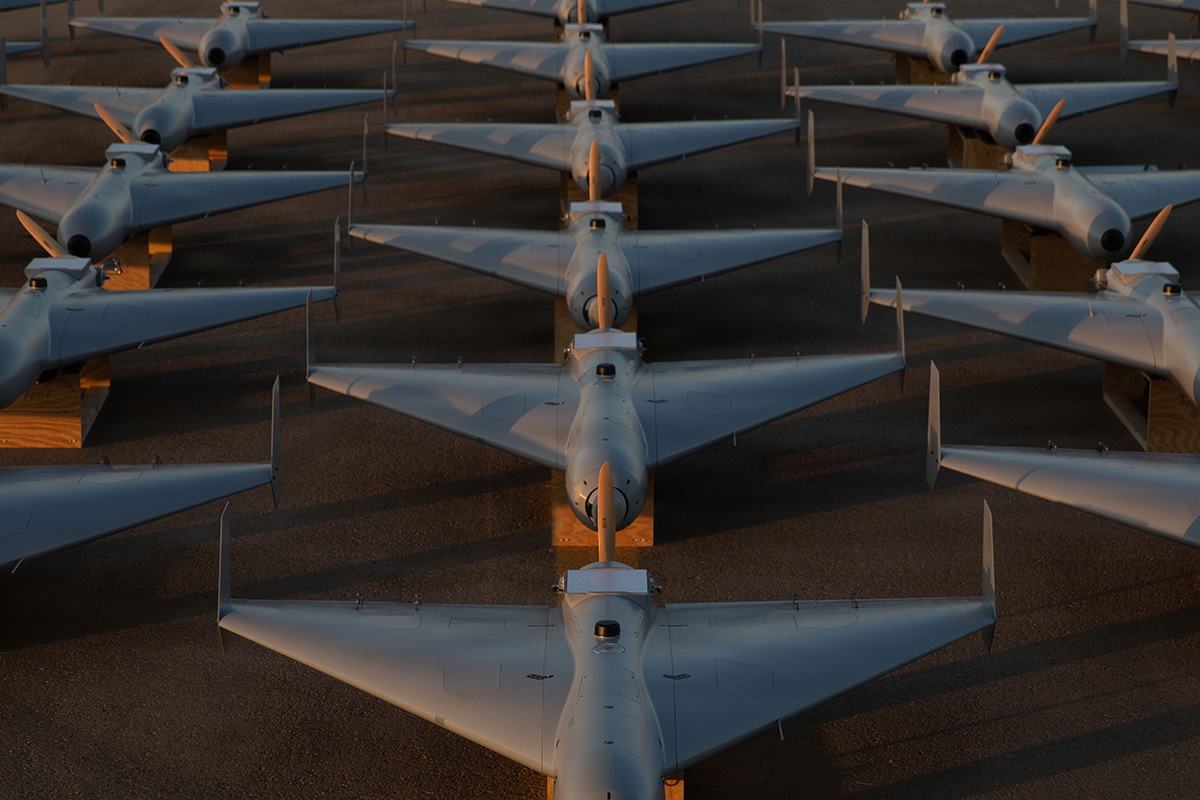
Russia, China, Iran and North Korea are systematically learning from the war in Ukraine and could erode NATO’s advantages over time unless the alliance adapts faster than they do, a senior NATO military official has warned.
On the sidelines of the NATO Defence Ministers’ meeting, the UK Defence Journal was told that the war was “no longer just the regional war” but had become “a global learning environment”, with the four states not simply watching the conflict but learning from it, supporting one another and exchanging technology in a way the official said was “increasingly systematic”.
The official set out how that cooperation worked in practice, saying Iran provided drones, ammunition, explosives and technology, North Korea supplied artillery systems, missiles and personnel, and China provided microelectronics, machinery and assistance that enabled Russia’s defence industry, with Russia in turn sharing technology and battlefield lessons with its partners.
This led to what the official described as a question that was “not a rhetorical question”, namely whether the alliance was learning more than its adversaries, warning that “if our adversaries can observe, adapt, and scale faster than we can”, then the advantage of NATO’s current capabilities would erode over time.
The lessons of Ukraine were not Ukraine’s alone, the official argued, but “modern warfare lessons” that applied in Europe, in the Indo-Pacific and wherever future conflict might occur, in a battlefield where decision cycles were compressing, unmanned systems were proliferating and electronic warfare had become foundational, with adaptation itself now a capability in its own right.
Every Ukrainian lesson had been learned under combat conditions and every innovation developed under pressure while the country fought for national survival, the official said, concluding that the alliance’s responsibility was “to learn from those lessons before we are forced to learn them ourselves”.





We can’t obtain all the facts about this week’s Ukrainian drone attacks on Moscow, yet I’m sure they have caused considerable disquiet within the population? If we need to understand the effectiveness of modern military drones, we should look no further than the images of burning oil refineries in Russia to imagine a similar fate hitting a British installation and filling the skies with black acid smoke. I fear such a spectre is not too far in the future if we take a dilatory approach to countermeasures and our military budgets.
Sadly our prime minister isn’t interest.
I’ve gained $17,240 only within four weeks by comfortably working part-time from home. Immediately when I had lost my last business, I was very troubled and thankfully I’ve located this project now in this way I’m in a position to receive thousand USD directly from home. Each individual certainly can do this easy work & make more greenbacks online by visiting
following website—.,.,.,.,.—>>> JobatHome1.Com
I’ve gained $17,240 only within four weeks by comfortably working part-time from home. Immediately when I had lost my last business, I was very troubled and thankfully (s01s) I’ve located this project now in this way I’m in a position to receive thousand USD directly from home. Each individual certainly can do this easy work & make more greenbacks online by visiting
following website—.,.,.,.,.—>>> Homeprofit1.site
Indeed…Keeping up is far from his Priorities..
As a consequence of the ruinously high electricity prices generated by this and previous government’s dotty pursuit of the chimerical and unevidenced net zero agenda, we now have remarkably few refineries.
Following closures at the Grangemouth and Lindsey refineries in 2025, there are only four operational refineries remaining in the UK, down from 18 refineries during the 1970s.
Not a great consolation however as we are now dependent on oil and gas from Norway and electricity from France, both with vulnerable infrastructure.
That is precisely what happens when a country is run by a bunch of complete lunatics for thirty six years and counting…
Wonder how much Producd fuel we’re Now importing into the Uk and from Where..!??
And whos standing to gain..?
Unfortunately, Keir is our best hope for Defence; the lefties are wringing their hands at the prospect of social spending which will drive us beyond the brink.
Of course, they will be out at the next election and there is no other party who will be better than Keir and his cohort.
Al Carns as PM, if you like 100:1 odds, go for it, I would but he would still have to draw on the newbie, infantile, lefties for support, which wouldn’t be given.
Almost prophetic, Cameron initiated the process of removal from the EU because of dogma, Keir and Reeves have screwed the country because they couldn’t turn down their own dogma.
The country is stuffed.
Don’t think Keir or Reeves are the issue. Its the increase in welfare spending and inability to dial it back – and that’s down to the mass of Labour bsckbenchers. Not looking forward to Andy being PM.
And not just welfare spending.
‘At the outset of the net zero plan, there
was at least some attempt to calculate realistic numbers. The Treasury estimated
over £1 trillion in 2019, and NESO came up with £3 trillion net present value cost in
2020, which equates to around £5 trillion to £6 trillion in gross cash costs. Their 2025
estimate is £7.6 trillion of gross costs and, as we have seen, may well be a
considerable under-estimate.’
IEA 2026
There is a deafening official silence about the ruinous cost of the pursuit of the unevidenced goal of ‘net zero’.
And that is before consideration of the National security risks of relying on France for 15% of our electricity and Norway for the bulk of our oil and gas, both with vulnerable infrastructure already reconnoitred by Russian vessels.
Britain has been well and truly stuffed by our politicians of the last 36 years.
STARMER Being ignored by fellow Leaders may become the Norm for Future British Leaders…!!
sure Everyone will be Cordial to any British leader at first but With
No perceived Soft or Hard Power it really does leave us in No man’s land…!
Britain: a major international player in search of a statesman/stateswoman since 1990.
Nice Thught however it’s a country which Wields far less Power than we had in the 80/90s..!
The World itself Appears full of squabbling leaders With their own Domestic troubles and Agendas not to sure if theres a true statesman/ stateswoman Around .??
There is one…but her party are, quite rightly, still very unpopular indeed after their performance in and out of power since 1990.
Wonder if STARMER fancies a Job paying $17,240….!!
haha, good one!