

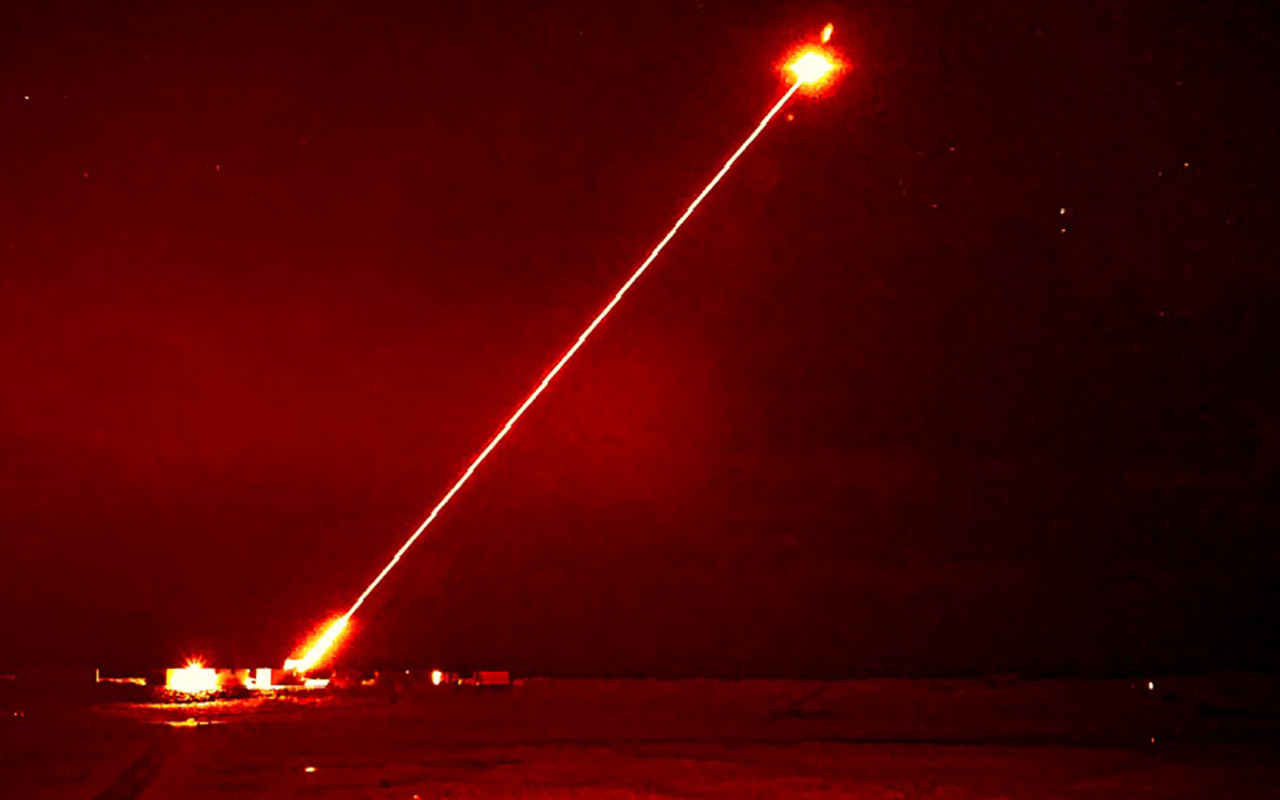
The government has said it is committed to accelerating the development and deployment of directed energy weapons to counter low-cost drones.
The commitment was set out by the Minister of State at the Ministry of Defence, Lord Coaker, in response to a written question from the Labour peer Lord Spellar, who had asked when directed energy weapons designed to combat low-cost drones would be available to the UK armed forces.
Coaker said the government was “committed to accelerating the development and deployment of directed energy weapons” to counter low-cost drones, describing the United Kingdom as “a world leader” in research on high-energy lasers and radio frequency weapons, working with key allies who share its aims in the field.
Directed energy weapons have become one of the most sought-after answers to the drone problem, offering a way to engage targets at the speed of light at a cost per shot measured in pounds rather than the hundreds of thousands of pounds that conventional interceptor missiles can cost, an economics that has become central to the search for affordable defences against the mass drone attacks now seen in Ukraine and increasingly threatening warships, bases and land forces well beyond it.
As a concrete marker of that effort, Coaker pointed to DragonFire, the British-developed high-energy laser, the first example of which is due to be installed on a Type 45 destroyer in 2027, “five years ahead of the original plan”, a deployment he said would make the United Kingdom “the first European NATO nation to operationally deploy advanced laser directed energy technology”. While that first system will go to sea, directed energy is being pursued across the armed forces, the technology equally relevant to protecting land forces and fixed sites from the same cheap drones.
The stated commitment to accelerate directed energy also sits alongside a separate effort, widely reported by this website and others, to speed up the protection of Royal Navy warships against drones, two distinct strands that together point to a push to close the gap between the threat now posed by cheap unmanned systems and the defences currently fielded to meet it.











Will believe it when it is fitted and working. I really hope so however.
I’ve gained $17,240 only within four weeks by comfortably working part-time from home. Immediately when I had lost my last business, I was very troubled and thankfully I’ve located this project now in this way I’m in a position to receive thousand USD directly from home. Each individual certainly can do this easy work & make more greenbacks online by visiting…
following website—.,.,.,.,.,.,.,.,.—>>> PAYAtHOME1.COM
Nice if something goes right.
Ah but they’ve committed to it, which means wait five years then fit every ship in the last week.
LAST MINUTE DOT COM !!
The army are most at risk from these drones. Some kind of vehical mounted High Energy Laser System needs producing.
The problem is power consumption, which is much easier to solve on a ship. Better range and/or faster defeat needs more power, more power needs either more storage or production, more power storage or production needs a bigger vehicle.
On a T45 you have two gas turbines (essentially Trent jet engines) producing 21MW each and 3 diesel generators producing 3MW each – in other words, plenty of power. To do that on a land based platform you’d probably need something the size of a MAN SV 6×6 fitted with a generator, some kind of power storage (flywheel or battery), and the laser, not to mention any control systems or comms, as it’s presumably linked into the air surveillance system and not standalone.
You use capacitors to store energy and then rapidly discharge. You dont need peak power out all the time. 50kW laser weapons have been mounted on wolfhound, styker and JTLS chassis.
I suspect many of these issues will be resolved pretty soon.
People who know about energy weapons should worry about erergy weapons. Power solutions is someone else’s problem.
committed to accelerating the development and deployment of directed energy weapons to counter low-cost drones., thats means some time this centry, what a true government stsatemeant conforming nothing,
Could just use a big Magnifying glass.
That’s two brilliant Ideas I’ve had today. 😊
I’ve got a torch..
🥱
One of the advantages of directed energy weapons, especially in regards to home defence of say a dockyard in the middle of a city is that it does not follow the what goes up must come down rule.. obviously the drone will come down.. but the munitions you are firing at it will not.
Issue in the urban scenario is drones following rivers or valleys to stay low with urban landscape very much in the background, especially if using DEW from higher advantage points.
Fitted for but not with photons
I’ve gained $17,240 only within four weeks by comfortably working part-time from home. Immediately when I had lost my last business, I was very troubled and thankfully I’ve located this project now in this way I’m in a position to receive thousand USD directly from home. Each individual certainly can do this easy work & make more greenbacks online by visiting
following website—.,.,.,.,.—>>> JobatHome1.Com
Ah…something else we are a world leader in….having lots of programs but not buying anything.
Dragonfire should already fitted and dozens more ordeted for all ships.
AA
🤡
‘Ah…something else we are a world leader in…’ whinging about stuff we have absolutely no fscking idea about! but fsck it! we’ll bitch and moan about it anyway!
You’re the ‘expert’ and you think Dragonfire is all sorted and ready to go, but somehow, is sitting on a shelf somewhere collecting dust … because the gov./MoD are feckless. To me that’s a considerable failing in logical thinking.
To put it simply, you cannot fit a weapon that was still a science project until just recently. DragonFire isn’t a finished product waiting on a shelf; it’s a “Capability Demonstrator”. It only just completed its final, major live-fire testing campaigns in Scotland, where it successfully shot down high-speed drones. Turning a weapon that works perfectly in a controlled testing range into something that doesn’t short circuit in the middle of a North Atlantic gale takes time and patience.
The maritime environment is harsh, very harsh. The optical lenses, tracking mirrors, and delicate fiber-laser lines have to be completely ruggedised. If freezing saltwater, heavy ship vibrations, or diesel exhaust film compromises the glass components, the laser loses its incredible precision. You can’t just bolt a 50 kW laser to the deck and plug it into a standard wall socket. It requires heavy engineering below deck to install Flywheel Energy Storage Systems (FESS) so the weapon doesn’t trip out the ship’s main radar and computer grids when it fires. The ship’s combat management system has to be completely recoded so the main radar can automatically hand off target tracking data to Leonardo’s optical tracking turret instantly … It’s difficult, it takes time and patience.
Ordering “dozens” instantly would be an engineering trap, likely result in an incredibly expensive disaster. Under the MoD’s new ‘Integrated Procurement Model’, they are explicitly buying a “minimum deployable capability” for the first few T45’s. This allows the Navy to test the 50 kW version in real world combat environments first, and ONCE they learn how the hardware handles real operations in real conditions, they will upgrade and modify the design … this is “spiral development” … before spending billions mass producing it. If they ordered 50 units today, they would be stuck with 50 un-upgraded, early-generation models.
The first ships fitted will be T45s which will serve as initial ‘torchbearers’ in ’27, the MoD formalised this timeline with a £316 million production contract and the rollout is tightly focused as they transition from a test environment into operational naval service. The T45s already have the electrical architecture required, due to their new PIP’s, combined with high tech flywheel energy storage buffers, meaning they can easily cope with supplying the 50 kW laser weapon without tripping out the ship’s main grid.
If the Type 45 deployment is successful, the MoD plans to look at adapting the tech for Type 26 and Type 31 frigates further down the line.
Thankfully the MoD has bypassed standard bureaucratic red tape by rewriting procurement rules. They officially signed a £316 million manufacturing contract with MBDA to fast track the weapon to the fleet by ’27, cutting five whole years off the original timeline.
The Royal Navy operates 6 Type 45 Destroyers, 8 upcoming Type 26 Frigates, and 5 Type 31 Frigates. That is 19 frontline warships, and to avoid the single-unit “blind spot” vulnerability, each ship logically needs at least two turrets for 360 degree arcs of coverage that’s 38 units total. Even if mass production drops the integrated cost from £158 million down to a conservative … £40 million per unit, equipping just the frigate and destroyer fleets crosses £1.5 billion for untested baseline units.
The fleet actually is being expanded, but the “dozens” ain’t happening immediately, even though the MoD has quietly expanded the rollout so that instead of the single test ship originally planned, the government has adjusted its planning documents to target equipping up to four T45s by ’27. Backed by an additional £1 billion injection into directed-energy weapons in the latest SDR / Integrated Review so … the intent to scale up is clearly there.
Impressively the MoD is actually moving at a speed rarely seen in peacetime procurement. Instead of the standard peacetime routine, where the MoD spends a decade writing option papers and testing a system until it is 100% perfect, they have deployed a new ‘Integrated Procurement Model’, this is the legal framework that allows them to buy a ‘minimum deployable capability’ … where they are now putting a “70%” perfect weapon on a ship to get it into combat and then plan to fix and upgrade it later via “spiral development”.
They aren’t holding back out of laziness; they are pacing the orders to match how fast the shipyards can physically install the complex flywheel energy storage systems needed to power the weapon.
Issue in the urban scenario is drones following rivers or valleys to stay low with urban landscape very much in the bsckground, especially if using DEW from higher advantage points.
The ocean however is pretty notoriously flat and valley free
My comment was meant to be in response to jonathan and his ‘what goes up must come down’ discussion.
Nice but it looks like whenever the MOD is being hammered because of defence spending they publish something about accelerating directed energy weapons