

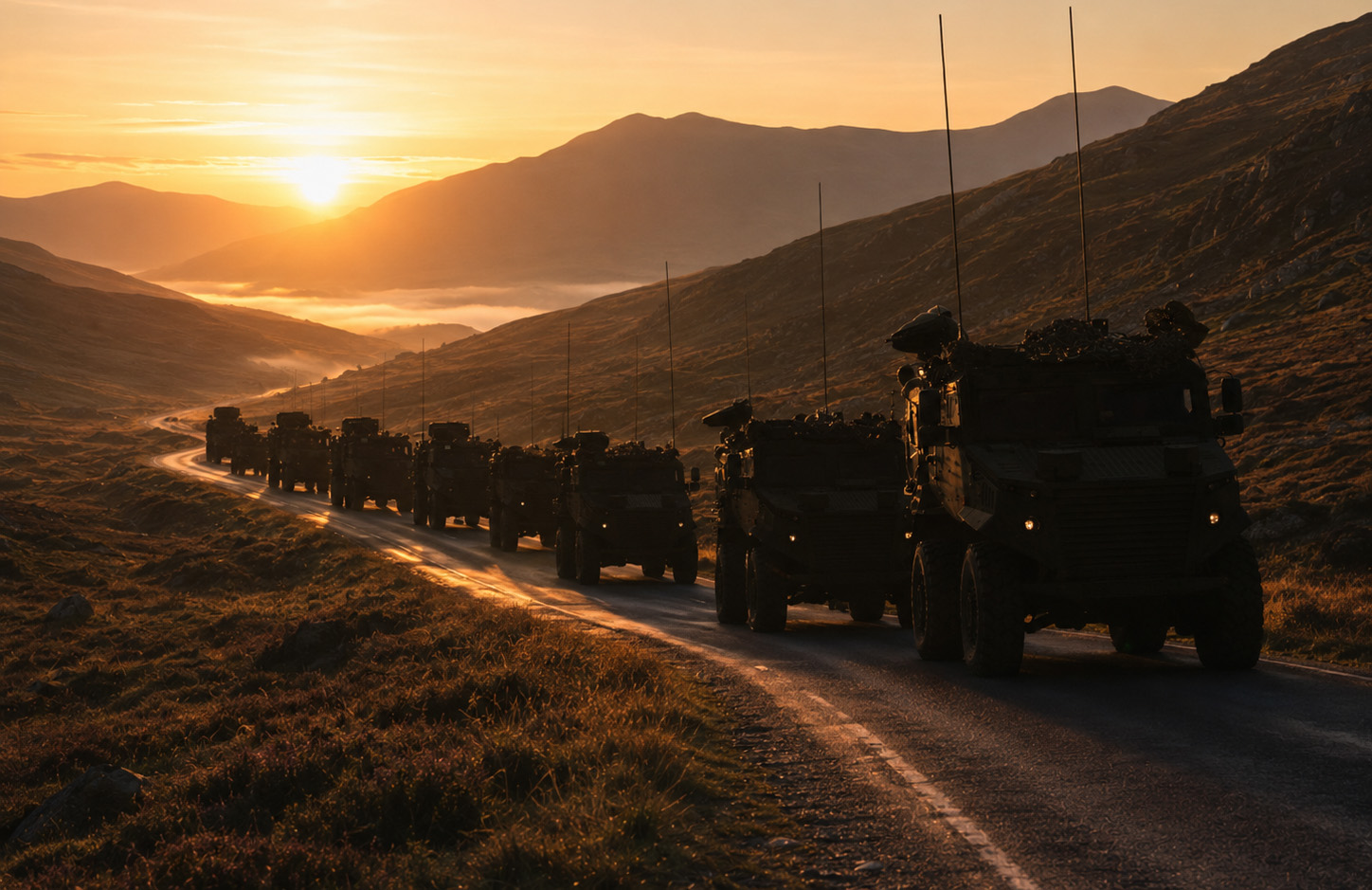
The Ministry of Defence has formally launched a competition worth an estimated £2 billion to deliver a new Light Mobility Vehicle for the Armed Forces, replacing capabilities currently provided by legacy fleets, including Land Rover and Pinzgauer, according to a tender notice.
The notice, published on 31 July, sets out the department’s intention to competitively assess, select and award a contract covering the vehicles and associated support services. It states that the programme “is expected to deliver a range of vehicles, including the provision of a wheeled utility platform designed to modernise capabilities currently fulfilled by legacy fleets such as Land Rover and Pinzgauer.”
The estimated total value is £2 billion excluding VAT, or £2.5 billion including it. The contract is expected to run from 31 May 2027 to 30 May 2036, with up to eleven option years that could extend it to 2047, giving a potential duration of 20 years.
Central to the approach is a single Common Base Platform from which nine variants would be built: a General Purpose Vehicle, Battlefield Ambulance, Tactical Mobility Vehicle, Utility Vehicle, Enhanced Protection Vehicle, Command and Control Vehicle, Equipment Support Vehicle, Troop Carrying Vehicle and Mission Systems Vehicle. The notice says the common platform “will support a variety of warfighting roles across the Joint Force, enhancing interoperability, flexibility, and operational effectiveness.”
The initial purchase carries options to expand the fleet substantially. The contract includes options “to support future operational requirements, fleet growth and replacement needs vehicles with the ability to increase the vehicle fleet to in excess of 9,500,” the notice states.
The UK has opted against dividing the competition into lots, explaining that a lotted approach carried a “high potential of a mixed fleet of solutions based on multiple platforms from multiple suppliers.” A single common platform, it says, promotes standardisation, reduces fleet complexity and enables economies of scale.
Chinese suppliers are barred from the competition. The notice states that “in accordance with the Procurement Act 2023, the Authority is exercising its rights under Section 19 (3)b to exclude Chinese Suppliers from this procurement.”
The competition will run under the competitive flexible procedure in four stages. Requests to participate close on 1 September 2026, with a maximum of seven suppliers to be invited to tender following assessment of a Procurement Specific Questionnaire. Down-selected bidders then enter a limited dialogue phase while simultaneously taking part in UK-based vehicle trials, with the notice proposing that “Tenderers that fail the trials will be notified immediately and eliminated at this stage.” A paper-based assessment and award stage follow, with an estimated award decision date of 31 May 2027.
The notice specifies that assessment criteria for the trials will be fixed and will not form part of the dialogue stage, and that the Cardinal Points Specifications to be trialled will be final when issued in the draft invitation to tender.
Award criteria place cost first and quality second, with the authority intending to use a Weighted Value for Money Index considering whole life costs across both vehicle delivery and support. Social Value and the Land Industrial Strategy are to account for between 10% and 20% of the overall tender.
Beyond the vehicles themselves, the contract covers a support solution that may include maintenance, repair and logistics to sustain availability across the fleet’s life, along with a training element. The primary delivery location is the United Kingdom, though the notice specifies the support solution must be capable of providing services worldwide. Post Design Services are included to allow continued development of the variants as technology matures.
The notice also lists known risks that could prompt later modification of the contract, among them the integration of emerging technologies not yet defined at award, obsolescence or export control restrictions affecting components, and “evolving geopolitical conditions, shifting Defence priorities, or changes in the nature of conflict” that could increase demand beyond the quantities and options included.
The notice marks the formal start of a competition that has been years in preparation. LMV is the first of three Category A sub-programmes within the wider Land Mobility Programme, alongside Light Protected Mobility and Medium Protected Mobility, and was previously known as the General Support Utility Platform. Defence Equipment and Support briefed industry on the requirement at the Defence Vehicle Dynamics event in September 2024 and issued a Request for Information in January 2025.
Several contenders have already shown vehicles publicly. Babcock has developed its Toyota-based General Logistics Vehicle in Long and Medium variants, Supacat has displayed a Light Mobility Vehicle built on a HiLoad chassis, and Team LionStrike, formed between GM Defence, BAE Systems and NP Aerospace, has proposed a range including the General Motors Infantry Squad Vehicle. Speaking about the requirement earlier this year, Defence Readiness and Industry Minister Luke Pollard said: “I want this to be, as much as possible, an off-the-shelf purchase.”
The Land Rover Wolf and Pinzgauer fleets have provided light utility mobility across all three services for decades, with both types originally envisaged as having a 15-year service life before their out-of-service dates were extended to 2030. The British Army began the phased withdrawal of the Land Rover at a ceremony at Bovington Camp in March 2026, after more than 70 years of service. With the contract estimated to begin at the end of May 2027, the timetable leaves a narrow margin against the 2030 out-of-service date for the fleets being replaced.











Don’t like that cost first quality second comment – putting cost first usually means an inferior product that won’t do the job properly … also, for what is in commercial terms a small order I agree we need to use off the shelf option rather than try to make our own (expensive) tailor made versions. So one of the things above I agree with, one I don’t.
Fits in with the government’s approach to defence at the moment, cost first capability second.
Land Rover = Highest cost and lowest quality so let’s not do that again!!
£2Bn sounds a lot until, as you say, bespoking starts and then costs rise dramatically….
£200k sounds a lot for a 4×4 vehicle but they readily come to this price point for event builds.
£2b sounds like no where near enough to me. Miltary contracts are always massively overpriced and if you compare this to say the US program £2b wouldn’t but a whole load of vehicles. I suspect we are cheating out and end up with a vehicle that isn’t properly protected for any realistic threat scenario like the landrover wasnt.
£200k per vehicle which replaces a Land Rover and its not required to be a fighting vehicle. If it’s heavy with armour it will be less useful for the other roles. Can we trust mod to make a good decision?
Trust the MOD to make the right decsion, based on what track record are you judging that trust. Everything land wise has been either a mess or forced on them due to said mess. Even the chally3 hasn’t been fully budgeted for and so will come without active protection.
Any vehicle these days needs to be able to take a hit. Just look at how Russia and Ukraine have been targeting and destroying supply vehicles far behind the front line. The idea of a non armoured vehicle behind suitable for any role in the army is outdated.
Given the British army’s historical preference for putting cost last and ending up buying something s**t from a US defence contractor that comes in too few numbers to do the job I’m all up for going cheap.
It’s a 4X4 utility vehicle, no need to reinvent the wheel.
Fully agree.
Land Rover was that though. Originally Austin Champ was the Vehicle for the job, gold plated bespoke design that was a better off road Vehicle. But Land Rover while less capable was a much cheaper vehicle. So it is probably the right way round, this is after all the general purpose, be everywhere cheap as chips vehicle that should be cheap enough to buy in quantity and not be worried about if a bunch get broken.
All depends really. If it is a case of why buy a Porsche when a Honda will do then I am all for it, even it doesn’t have all the knobs and whistles. After all, we’ve all seen what happens when the MOD starts it’s requirements absurdity.
Rob, traditionally and in most cases a competitive evaluation or competition is conducted by DE&S and the practical side is farmed out to the appropriate Service. The Army Trials Unit will principally put the bidders equipments through many Battlefield Missions and report whether the equipment fully meets the Requirements, would meet them with some modification or won’t meet them.
The short list of succesful candidates is then passed to finance staff who assess the financial aspects and usually the cheapest compliant Bid wins. Thus the quality line has been passed. The kit will do the job.
However the responsible Minister gets the final say and will apply political factors. Thus a company that had never before designed, developed or made any vehicle and lacked suitable premises and had a weak financial position got to build Ajax. But at least the Minister was happy that a marginal constituency in Wales got 200 new jobs.
“Mind the Gap” incoming, if OOS is 2030.
Though when has MoD and HMG ever worried about capability gaps. I might make a list…..
I’m especially keen on LPM and MPM to get going, after decades of false starts, as I’d like to see 4 Bde get a PM vehicle, and also a sizeable CAVS order now that Boxer batch 2 has quietly died, bar a few variants.
Landcruiser LC70’s
‘…considering whole life costs across both vehicle delivery and support’ and then ignoring the result in search of votes, as usual…
O come on chaps… all those moans on here about the UK only buying gold plated at exorbitant prices… you can’t have it it both ways! It reinforces my view that too many commentators on here are only interested in disparaging the current government, and MOD, whoever they are and whatever they do… and no real interest in UK defence.
It’s just people making comments because they can.
Or not, when some of us seem to be held for moderation.
It is simply the triumph of experience over hope.
E.G. Pinzgauer, a few years ago now, won the British Army wheeled ambulance competition based on through life costs. But it was the Land Rover bid that was accepted. Ajax? Jobs in Wales. Challenger? Jobs in Leeds…and so on and so forth…
The strict four-stage trial process is the most interesting part of this framework. Forcing bidders to pass punishing, physical UK-based field trials before they can even look at the final contract is exactly how the MoD avoids another off-the-shelf procurement disaster. If a vehicle can’t handle the physical abuse during the trial phase, it’s instantly eliminated on paper. It makes the upcoming field tests the absolute make-or-break moment for companies like Babcock and BAE
Have there been changes to selection process since Ajax was chosen? Maybe they include hearing and vibration testing, weighing of the vehicle. How will this work, a new factory with unskilled workers will build in the uk? Then parts supply etc for next 20 +years?
The physical UK field trials are designed precisely to catch those engineering flaws before a contract signature. On-site verification will undoubtedly prioritize ergonomics, vibration, and weight thresholds this time. Long-term support and domestic workforce training will likely be heavily weighted in the social value criteria during the final stages.
Has to be a UK company, fully manufactured, not just assembled in the UK. Get exports going too. This is about securing our skills, supply chains or we won’t be safe. Plus tax payers don’t go to work to pay taxes to prop up foreign industry. These are the basics we should be doing ourselves. If we can’t build and design a car ourselves then just scrap the MOD and use the money to hand out even more benefits.
It would indeed be great to have the LMVs manufactured in the UK by a British company. Alas, since JLR switched its focus to building Chelsea tractors for the civil market, we don’t manufacture utility 4x4s.
The proposed Babcock Toyota is manufactured overseas, Babcock would just do conversion and final assembly.
Team Lionside’s GM vehicle would be an import from the USA, with conversion by BAE.
The Toyota Hilux Invincible, 270 of which are on order for 11 Bde in the recce/strike role, is manufactured in South Africa and Thailand.
And so on. I think only Supacat and Babcock build a LMV.in the UK, the Jackal and Extenda. But these are specialist light vehicles, the LMV programme would I think need a larger, more powerful vehicle
Sadly can’t see us exporting vehicles, who is buying high end when they can convert Toyota trucks? Feel it has to a vehicle already in wide production which has a secure future of production in decades to come.
Two more billion to go abroad. Let’s face it had the mod ordered 2 billion quids worth of land rovers stipulating they were to be made in the UK we would be making them today. As to the unit cost… FFKS are we buying rolls Royce a?
9500 units is not enough to keep a large-scale production line open. JLR apparently ditched production of the Defender because it was expensive to manufacture (was never designed for modern assembly lines) and non-compliant with a raft of civil standards. The car business is tough – look how many of the big conglomerates are currently struggling…
You also can’t divide the contract cost by the projected number of vehicles. For starters, an Ambulance or “Protected Mobility” variant is going to be far more expensive than a “General Service” one, by nature of what it is. Secondly, the contract will include a whole raft of other stuff different or not applicable to a civil model; maintenance manuals (in MOD “Support Publication” format, and technical writers aren’t cheap), maintainer training, maintainer tooling, spares, packaging, tie-down schemes for everything from low-loaders to aircraft, weapons firing trials, durability trials, wading trials, rollover trials, acceptance trials, Log Demos…
Oh, and a monster Safety Case to underpin it all. Which the Contractor will be held legally liable for if they manage to miss what is later judged to be any possibly foreseeable hazard.
Its not enough even for our miniature version of an army. But it is a start, it is enough to make a starting point and from there to export and grow a business… the original landrover worked really well for a huge number of applications.
As for why the standards ended tyhe landrover it has to be seen as a sad reflection on the managements ability, its not as if it would have been difficult to replace the engine or the electronics around it. It might have been harder to add crash protection but then it would have surely been quite possible to have argued that it didnt need it, after all the big German Mercedes version is no different in basic design and they still make it.
The variants are not that expensive if you look at how it is done for the old landrovers and for other similar vehicles – a basic chassis with control cab and then a rangfe of bolt on body options. Its not like we dont know how to do this – its how the motor industry started.
And as for the bullshit about safety cases, yes, all vehicles have that, no manufacturer finds it that difficult these days and there are ways out of accountability – starting with the way you word the contract
Chin off the bean counters and let the people who use / maintain it have the biggest say. For far too long have those who think they know whats best have messed around with a perfectly good platform only to incur huge delays and operating issues.
I’ve worked and maintained pretty much every piece of vehicle equipment the British Army uses to date and some are horrific.
What ever happened to being able to repair by repair not repair by replace?
Currently working on the Foxhound platform and that is the most labour intensive vehicle I’ve ever come across, yes better protection than the snatch it replaced but still terrible. Again a quick decision that has come around and bit us in the behind. Aweful vehicle, underpowered, unreliable and the spares contract is shocking. I mean you can’t even get the main vehicle batteries for them through the system at the moment, which is by the way the same AGM batteries off a BMW 5 series!!
That’s disappointing about the Foxhound, Gaz, I thought we had a good one there but, from what you say, it sounds like a bit of a pup. IIRC, didn’t they cost £900k+ per vehicle, which is a lot for a little light protected mobility truck? Is it another not very successful US base vehicle design?