

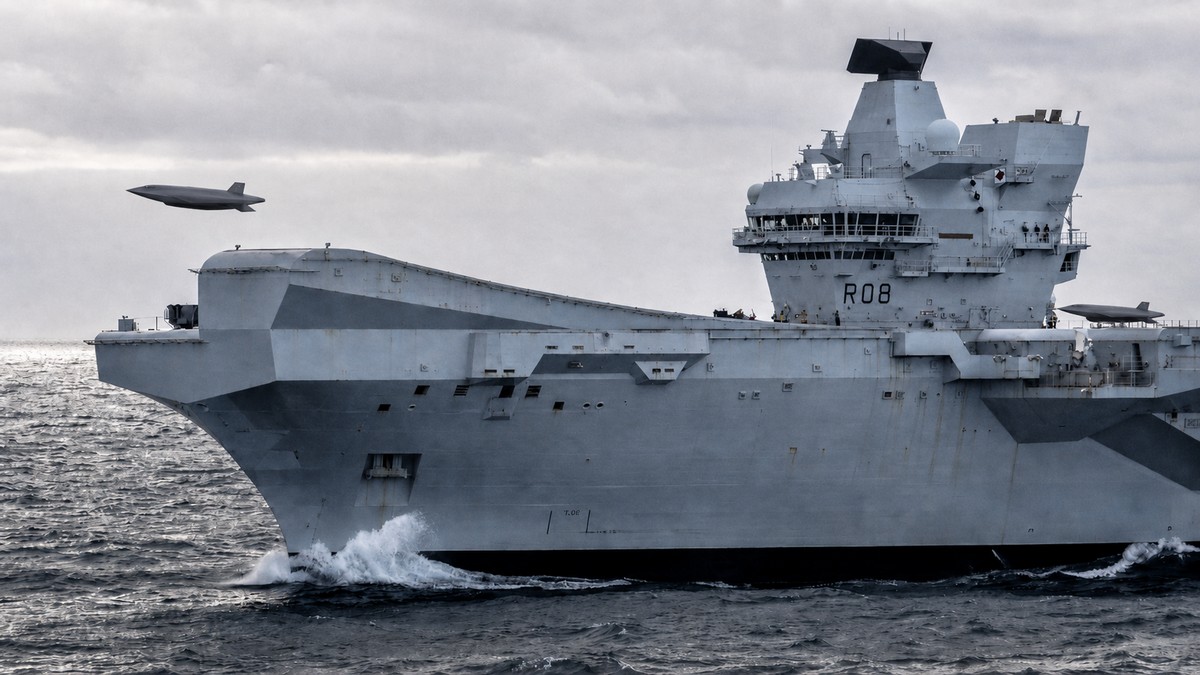
The Defence Investment Plan commits almost £250m to Project PANTHEON to build a Hybrid Carrier Air Wing, with jet-powered drones trialled under Project VANQUISH to fly alongside the F-35B and an autonomous early warning system for the carriers.
The Royal Navy will spend almost £250 million developing autonomous aircraft to fly from its two aircraft carriers alongside the F-35B, building what it calls a Hybrid Carrier Air Wing under a programme named Project PANTHEON, the Defence Investment Plan said.
The plan set the money aside for Project PANTHEON, which it described as the development of autonomous systems to begin building the hybrid air wing, and for trials of jet-powered drones to work with the F-35B force under a linked effort called Project VANQUISH, saying that the Queen Elizabeth-class carriers would be “exploiting uncrewed systems, such as CCAs, to augment the F-35B force.” CCA stands for collaborative combat aircraft, the term for the autonomous machines, often called loyal wingmen, that are meant to fly with crewed jets and take on a share of their work.
The two projects sit in the Royal Navy’s wider Maritime Aviation Transformation effort, which aims to move the Fleet Air Arm towards a largely uncrewed force by around 2040, and they take the place of earlier carrier-drone studies known as Project VIXEN and Project ARK ROYAL, both of which leaned on fitting catapults and arrestor wires to the carriers and have since been shelved.
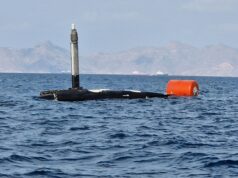
PANTHEON is intended as an umbrella for a family of autonomous platforms spanning surveillance, strike and resupply, while VANQUISH is the more specific demonstrator, a jet-powered, high-subsonic aircraft that has to launch and recover from a carrier without catapults or arrestor gear and that is designed to be attritable enough to be risked in places a crewed jet would not be sent.




Are the carriers still getting the deck launched strike missiles as outlined in the SDR?
Hopefully not 😂
Daftest bit of the SDR
…… so no more F-35Bs then I assume.
Not for 250m.
I think the 12 F-35As are it for the next four years or so. The immediate emphasis is going to be unmanned fighters for both the RN and RAF. I fear Tempest will be the next new manned fighter/bomber, though it’s rumoured that unmanned operations may be designed into the plane?
Yep tempest from very start was ment to be able to be crewless
F35 is covered elsewhere in the DIP. Still talks of the next batch which includes F35A. To me that says more b’s are expected though how many is anyone’s guess.
F35a acquisition under auspices of contributing to wider EU nuclear (literally USA nuclear bombs held in Europe that can only be accessed with USA realtime consent) is a joke. These bombs are an outdated joke of a deterrent that could only ever realistically be possibly delivered on target inside of NATO borders…..
….other than being an island and geographically a bit more difficult for non NATO nations to attack with conventional weapons the UK has no authority to waste tax payers money on providing this already provided deterrent…
….it is very poor justification for the uneccesatry acquisition of f35a on top of tempest and continuing typhoon expense….
I get that it is highly unlikely that UK will quit the tempest program but in my opinion it should quit it it is not good value for money and (just like nuclear powered attack submarines ) is a disproportionate use of funds to achieve bragging rights at vast and uneccesary cost without benefiting regular folk…..
Good news but £250 million won’t touch the sides in this.
The Royal Navy will spend almost £250 million developing an autonomous erection more like.
If you like me are struggling to keep all these pieces in your head, I had Claude read the DIP and produce this summary for me:
Headline figures
£298bn total defence investment over four years; £15bn additional/new funding (£11.6bn genuinely new cash, rest from estate rationalisation, reprioritised spending, Treasury absorbing other costs)
Budget to reach 2.7% of GDP by 2029, on a path to NATO’s 3.5% target by 2035
£50bn Defence Export Facility (UK Export Finance) to support UK defence exporters
Surface fleet — Type 45 / Type 83 / Common Combat Vessels
Type 83 destroyer programme abandoned entirely; no successor design exists beyond early concept work
Replaced by at least six Common Combat Vessels (CCVs) — smaller, cheaper crewed “hub” ships coordinating uncrewed systems, delivery from early 2030s
Reporting is contradictory on Type 45: some sources say formal retirement from 2035 with money redirected to CCVs; others (and the logic of ongoing PIP/Sea Ceptor/Sea Viper Evolution upgrades, all completing ~2032) point toward informal extension into the early-mid 2040s — unresolved, needs primary DIP text
£1.3bn additional into the hybrid fleet to replace Type 45 capability
Type 32 frigate programme also dropped/folded into the CCV concept
New uncrewed naval platforms — Type 91/92/93/94
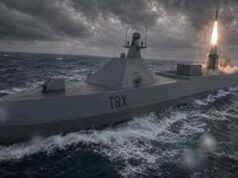
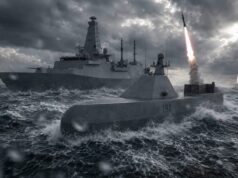
Type 91: uncrewed missile platform (“arsenal ship”), dispersed missile capacity
Type 92: uncrewed underwater sensing platform, ASW-focused
Type 93: Extra-Large Uncrewed Underwater Vehicle (XLUUV), developed from the Excalibur programme
Type 94: uncrewed sensor platform — likely needs to be the largest of the four to carry a radar with useful height/range; whether distributed sensing can replace a single tall mast (à la SAMPSON) is an open, untested question
DIP funding is for design work only (National Armaments Director Group) — no hulls yet, all concept-stage
Amphibious capability — MRSS
Original MRSS concept (up to six ships, 25-40,000t, possible Mk41 VLS) abandoned as too complex/unaffordable
UK now pursuing a joint amphibious fleet with the Netherlands, built around the Dutch-led Amphibious Transport Ship (ATS) programme
Genuinely unclear whether this means a shared fleet or just a common design with separately-owned hulls — 2023 MoU proposed joint design, 2024 reporting said that was dropped in favour of “interoperability and commonality” only, most recent (last few days) reporting uses “joint effort”/”combined fleet” language again — treat as unresolved
ATS candidate designs include genuine through-deck/flat-top configurations (not just split well-deck/flight-deck like Albion/Bay) — would be a real flexibility gain if adopted; smaller than original MRSS ambition (Bay-class-ish size, not Albion-class)
Submarines — SSN-AUKUS and Dreadnought
£63bn over four years for the nuclear deterrent overall (Dreadnought-class, SSN-AUKUS, new warhead)
UK reconfirms “up to 12” SSN-AUKUS boats; steel to be cut on first boat at Barrow next year
Part of a 20-boat combined programme (UK 12 + Australia 8, separately owned, shared design, UK-sourced reactors under the Geelong Treaty) — would be the largest non-US submarine commitment in the world if delivered in full
Risk factors: no published total programme cost; reliance on an unproven 18-month build drumbeat at Barrow/Raynesway; current RN SSN fleet already strained (no boats at sea, several in low readiness as of late 2025); shared dependency with Dreadnought for yard capacity; Australian/US AUKUS politics
If delivered, would put the UK third in the world for SSN numbers, ahead of France, closing on China — described as a genuine “battleship-equivalent” capability uplift in modern naval terms
Infrastructure
£26bn over 10 years for Project Royal Oak — naval base upgrades at Faslane, Portsmouth, Devonport (biggest in 45+ years)
Programme EUSTON: three floating docks committed (one more than previously planned) — directly targets the dry-dock/lift bottleneck behind the submarine availability crisis
Aircraft
£8bn over four years for GCAP (next-gen stealth fighter with Japan/Italy)
12 F-35A aircraft to be purchased, joining NATO’s nuclear mission (separate from existing F-35B fleet)
Missiles / Air Defence / Mk41
~£11bn for stockpiles of long-range weapons, cruise missiles, one-way effectors; at least 6 new energetics factories by 2030
£790m over four years for homeland/overseas base air and missile defence — new defence ops centre, counter-drone systems, directed energy weapons, upgraded Type 45 missiles (Sea Viper-related)
Mk41 VLS integration onto Type 31 continues, alongside Naval Strike Missile and new gun ammunition for drone/surface defeat — pre-existing FADS spiral programme, reconfirmed rather than new
Sea Viper Evolution (Type 45 missile/radar upgrade) continuing, on track for ~2032 completion
Drones / digital / other
£5bn+ over four years for drone transformation tri-service; £650m specifically for cheap expendable autonomous systems (Army, Commando Force, Special Forces)
£500m+ for Commando Force modernisation (high-speed Joint Commando Craft, strike drones, High North/Arctic focus)
~£2bn for a new “Digital Targeting Web” (AI/software sensor-to-shooter integration)
£400m Multilateral Defence Mechanism (joint procurement with allies)
£500m Transformation Fund (workforce/AI productivity, reduced consultancy dependence)
£115m via DSIT for AI-related defence risk
Overall assessment
Genuine cash uplift at the budget level, but a real-terms reduction in committed crewed surface escort capability (T83, T32 gone; MRSS shrunk)
High-variance outcome: floor is a thinner surface fleet than today if execution falters (autonomy unproven, SSN-AUKUS build rate historically optimistic); ceiling is a navy with serious undersea offensive teeth, fixed infrastructure bottlenecks, and a genuinely novel hybrid surface concept — if everything lands without a hitch, the RN ends up in a materially better position than today, but that’s a bet on execution the UK doesn’t have a strong recent track record of winning
Nice one Levi/Claude.
I like simple lists, It’s easier to absorb In my Noggin !
You and me both! George and the team have written some fantastic articles today, but I was struggling to keep it all in my head
According to charts 2.7% starts from next year 2027 and flat for rest of the 2020s
There are some mistakes in that summary, though, so watch out.
For example, a 12 ship fleet would not put the UK in third position, it’d be fourth – the AI appears to have forgotten Russia.
True enough. If I had to guess, it skipped over Russia because their fleet size is impossible to verify, what’s a rusted out hulk and what limps on
I love correcting AI. It’s all pretty hit and mis I’m finding lately.
Had to correct a whole bunch of basic facts on a Triumph Daytona 1200 subject recently, Including how many Cylinders It has ….. (4 not 3) it’s a pretty basic error and rather worrying that people are taking AI search results as gospel.
I had a play with it the other day for the first time. Great fun.
I looked up a location used by a certain agency. The first day the AI diligently listed what tiny traces exist regards this place.
The next day, as I delved further, it was adamant that it didnt exist, contradicting itself from the fay before.
So I don’t see it as a reliable source, just another quick search engine.
A couple of weeks ago I was part of a crew building the set for a production I was in. I had worked out a materials list onsite but was overridden by a young man who said he had the correct list thanks to AI and that I needed to accept my way of doing things was outdated. Needless to say we got halfway through and found we were short of materials. I didn’t say anything, just walked over to my van and unloaded what he (and his AI) had missed. Very satisfying moment.
I have also used AI and ChatGPT recently on a rather costly Legal situation and come up against a Human Solicitor Brick Wall of Denial and dismissal.
It’s a rather bizarre situation given the two camps of current thinking/reliance.
I now understand the true meaning when people refer to the Law being an Ass.
Never have I experienced so much greed and dishonesty in my life.
Oh man, I hope it gets promptly resolved in your favour, its the ongoing irritation of that kind of situation that can take it’s toll.
No news about arctic and antarctic ice ships. Its thin gruel and typical Starmer. So glad the man is going. Question how do the drone ships fit in with our few remaining allies. Down to 13 escorts with people. Pathetic.
With all the likely money being spent on the T91/93/93/94s and stuffing their vls with missiles, it’d be interesting to know how much and the equivalent fully armed T26/T31 amd some new OPVs that all might buy.
Just curious that iif the T91 amd T94 have a bridge that they’d still have a lean crew?
Where did project Parthenon suddenly come from? Drone’s / loyal wingmen will accompany F35b’s. For £250 M project cost. Is this at all credible??
its an impossibly tiny investment so I doubt much will come of it at least until they bite the bullet and fit traps. No one would regularly land on even say 5 tons without traps. It just wont work. Think turning hard into the wind, rain, snow, frost, heavy weather, even enemy action. if you lose control and it goes into the park it could be catastrophic. I hope I’m wrong.
Just a name for a few more trials of Banshee drones I suspect.
These CCAs might actually prove to be the fastest way to ‘add’ weapons we’re still waiting integration-of, such as the Meteor, to the F35. 😏
The Army gets kinda shafted as per usual outside of AD. Sky sabre doubling was already in the works but hopefully the 750m short range drone defense can have a chunk of “dual” use. Drone and short range AD. The one “new” item that I think sneaks in is a possible Patria buy. Under the Land Mobility Program there is a mention of a cost-effective versatile 6×6 armoured vehicle which all but says Patria to me.
The Patria looks very impressive.
Looks like the navy got shafted, with two classes of ships cancelled and a third scaled down.
For Sky Sabre, a £118m doubling of deployable units was announced last August. This £350m doubling I’m taking to be a further doubling, given the relative amount spent. So we’d have 24 deployable units, with a further one for training
Yes…Sky Sabre. Are we sure? I wondered if that was a re announcement of ongoing or new.
It’s all so vague, by design.
Truth be told, I’m not sure – and I agree, Sky Sabre info as always been vague – I remember a previous exchange on here between someone think we had 6 batteries when actually we had 6 (deployable) units (although it seems a UK system has 1 launcher, whereas many countries have 2 or 3 paired with a radar and command vehicle).
All I’m really going on is that the numbers of deployable were already increased from 6 to 9 (under the Tories – then changes to 12 under this govt) and the contract value versus the new figure quoted. Given the propensity to re-announce, you never know, but having 12 deployable units remains very poor. 24 would start to resemble a basic defence network, esp if we procure CAMM-ER for a mixed payload.
Yep, I was involved in many of those discussions.
Regards a Launcher or a System, as MoD uses the terms interchangeably in it’s communique.
I believe our System is 2 or 3 Launchers, 1 command vehicle, 1 radar. That makes a Fire Group.
There are meant to be 2 FG per Battery, and there are 4 Batteries in 16 RA.
Long story short, the Regiment is only part equipped, it’s establishment should be 24 Launchers, 6 per Battery.
8 Systems needed.
Then you need reserves, training, and so on.
In Poland, photos showed the FG there having at least 2 Launchers.
When a Regiment is never seen by politicians as ever going to deploy as a complete formation, with individual Batteries held at high readiness with others training, on leave, such shortcuts in kit are commonplace.
CAMM-ER may be too long for the current land based launchers.
I know it isn’t for Poland’s I launcher, as they deploy a mix (makes sense, given CAMM is cheaper per missile) and I think they’re going to be doing the same at sea on their T31 derivatives.
A while back Brazil purchased the ER version on what looks like a very similar chassis set up but with a different radar so it might be doable and as someone mentioned then you can potentially have mixed loads of CAMM-ER/CAMM which might be useful.
And maybe they could adapt the ship based CAMM farms to take the ER as well.
“CAMM-ER may be too long for the current land based launchers.”
So what is the Grifo system of Italian AF and Italian Army?
Good to see “Continued investment in Typhoon as the core of the combat air capability into the 2040s”.
Also noting “Additional investment in new aircraft, crewed and uncrewed, to sustain and enhance
the UK’s combat air force”.
I think the 100 we have now will dwindle pretty quickly given a few more hard years, even with the upgrades.
Too right. There was something around underpinning industrial capacity to ensure Typhoon is able operate into the 2040s. This implies new orders where required.
What AEW craft?
No sign of MQ9 mentioned at all.
The “Mojave” is the stol version that has been successfully proved operational from UK aircraft carriers….
.
Navy is actively seeking a jet powered stol cca…….seems like a very specialised ask to me……
I can’t see am affordable jet powered cca stol for f35b.carrier launched wingman as being pheasible…….I highly doubt doubt it can be done:- which means no cca or drone refuelling for carrier launched F35b.
Mojave stol drone can contribute as an airborne sensor and possibly put short range missiles on target ….so maybe that’s half the battle….
Jet powered cca for carrier launch seems unlikely
I’m interested to see if there is any possibility of a navalised GCAP. They were going to fit the F111 onto the Forrestal CVA’s. You could fit the outer wing with folding and the radar could likewise swing back. The Japanese have had an interest in Naval Aviation.
The Cost is the thing. I doubt we’d ever have more than 3 or 4 squadrons but it could be a magnificent a/c. A true Mosquito/ Canberra effort. Imagine if we’d gone all out with Mosquitos as our main attack a/c in 1941/42; pin point bombing and how many lives could have been saved. I think we’d have won the war in ’44. Certainly an interesting what if.
Interesting thought, pushing the introduction of the Mosquito instead of continuing to use Blenhiems, Stirlings, Manchesters and Wellingtons. My Dad was RAF WW2 and he called the Mossie “All Things For All Men” as it was so versatile.
Project VANQUISH: “a jet-powered, high-subsonic aircraft that has to launch and recover from a carrier without catapults or arrestor gear”
The technology to realise these design goals has existed for 60 years and was first employed operationally in the Harrier aircraft.
Perhaps it time to look at what Boeing was doing with its failed X-32 bid and for Rolls Royce to dust off its F136 engine schematics and see how far miniaturisation has come in the last 20 years.
Think “Banshee”.
I think it will prove to be too expensive to provision a jet powered cca that can take off from and then land upon out aircraft carriers…..
It was always going to be a problem and spear3 (?) is in development to act both stand off small payload air to ground missile and also to include an electric warfare version……sadly though it seems that F35A governance simply can’t be bothered to update the software to enable spear 3 use ( ew variant is probs next best thing to having a cca)……
……cca would also have an air to air refueling variant but again it’s likely too expensive to make one for our aircraft carriers…..so it’s either gonna be buddy air to air refueling or require the big refuellers ( does require extra planning but in the grand scheme of things it might be less expensive to have a standard refueller using suitable airports within range of the mission