

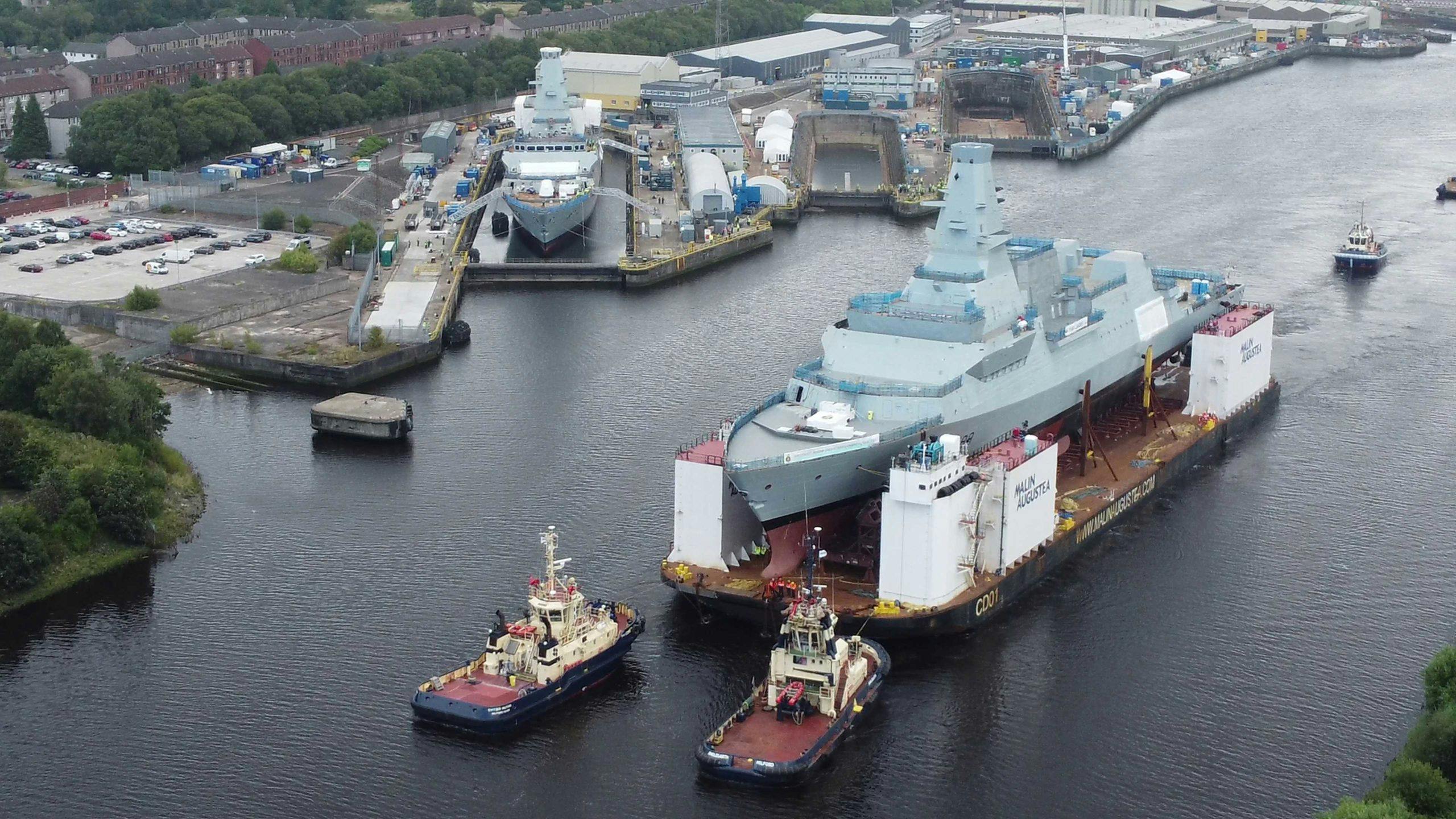
A Glasgow MSP with a shipbuilding background has warned that BAE Systems will need a major new warship design contract within around eighteen months to avoid the risk of job losses on the Clyde, in his response to the Defence Investment Plan.
Paul Sweeney, the Scottish Labour MSP for Glasgow who worked at the Govan and Scotstoun yards before entering politics, gave the plan a cautious welcome, describing it as “a step in the right direction, but still below what was necessary.” He said the concerns about capital investment that preceded it had not gone away, arguing that “John Healey’s concerns are still valid” a fortnight after the defence secretary resigned, and that the country needed a significant uplift in capital spending, with defence investment taken “out of the fiscal rules” to make room for it.
His main worry was the gap between the ships now being built and the design work that should follow them. Sweeney said industry contacts had told him that BAE Systems needed a significant design contract for the new vessel within the next eighteen months “to avoid potentially hundreds of layoffs in design engineering and naval architecture.” He described the Clyde’s design workforce as a world-leading centre that allied navies including Australia, Canada and Norway also drew on, and wanted ministers to award BAE the detailed design of the new Common Combat Vessel and to begin that work while the Type 26 frigates were still in build, calling for “continued ship design with known intervals” to hold the workforce together between programmes.
Much of what he said came back to the industry’s long history of boom and bust, and he wanted a firm government commitment to continuous shipbuilding across the three big naval yards. “We need a commitment from the government on continuous shipbuilding at Barrow, Glasgow and Rosyth,” he said, warning that the previous government had been “strategically foolish” to fragment the work across too many sites and that there was a serious risk of job losses in the next few years if capacity was not sustained.
On the design of the Common Combat Vessel itself, Sweeney disagreed with those who see it growing out of the smaller Type 31 built at Rosyth. He argued the ship would have to be far bigger to work as a command vessel, observing that “steel is actually cheap” and that it would need many more vertical-launch missile cells to match rivals such as China’s Type 055 destroyer, which carries well over a hundred. “The Type 31, in my view, is too small,” he said, predicting the new ship would instead share the Type 26 hull form, which he called “the obvious baseline hull design to carry forward.” He allowed that Babcock might pitch a Type 31 evolution, and the plan itself has yet to settle on a design or a build location.
He was dismissive of the Type 83 destroyer the new vessel effectively replaces, calling it “nothing more than a CGI drawing” that had never been a real ship, and he supported the move towards pairing crewed command ships with cheaper uncrewed vessels. A navy could not easily absorb the loss of a single billion-pound warship, he said, recalling that “the loss of the Sheffield was politically disastrous for the government of the day” during the Falklands conflict, and he argued that spreading missiles and sensors across smaller, more expendable platforms put on picket and policing duties would make the fleet harder to cripple with a single blow.
Sweeney said every part of the plan should be spent at home, agreeing with Andy Burnham that “every penny of the defence investment plan is invested in the UK supply chain,” which he said should apply equally to the large floating docks planned for Faslane under Project EUSTON and to the uncrewed vessels the hybrid fleet will rely on, all of which he said should be built in British yards. He noted that Rosyth faced a more immediate test in needing to land a Danish export order for the Type 31, which he said mattered to keeping that yard busy in the near term.
More widely, he said defence work alone could not keep the industry alive. “We can’t be entirely dependent on government contracts to sustain the entire industry,” he said, which he described as largely the case at present, and he called for Britain to rebuild the commercial shipbuilding it abandoned in the late 1990s, when it slid from being the world’s leading builder to what he called “a statistically insignificant player” as China and South Korea came to dominate global output. He mentioned European states such as Spain, whose state-owned Navantia now owns Harland and Wolff, and to financing tools such as state-backed loans and tax-leasing arrangements that he said gave foreign yards an edge, and he cited the troubled Ferguson Marine yard and its long-delayed ferries Glen Sannox and Glen Rosa as a sign of what happens without sustained investment.
Turning the present naval order book into a lasting industrial base, he argued, would depend on a coherent national plan that outlasted the current run of orders.







Odd reference to the loss of the Sheffield.
‘Spreading capability across smaller, more expendable platforms’ is precisely the doctrine that lead to T42 and its cheaper radar which indirectly caused the sinking of an RN destroyer. The RN is now moving closer to the force structure of the 1970s and ’80s, with a commensurate increase in the likelihood of at least some escorts- unmanned in this case- being sunk.
Sheffield was being used as a radar picket, because the fleet was designed for North Atlantic ASW duties with a limited threat from the air. The fleet was much more survivable in the context it was designed for. I think his point was that this was a high-value asset and also involved considerable loss of life, none of which should be the case for unmanned, distributed platforms.
The bit none of this explains is how you get a powerful radar up high enough on a small platform.
Big radar = heavy – matacentric weight; power hungry – large plant to power it and cool it. None of which relates to small….
Based on the fact that it’s Babacock’s idea (and that BAE are seemingly not impressed) I think it’s most likely CCV will be a T31 derivative, almost exactly the same size as T45. But it’s also IMO likely to be fitted with BAE’s SAMSON/Artisan derived hybrid radar, because otherwise the UK will struggle to maintain a radar program, which would be politically untenable.
The SAMSON development uses evolved Artisan combined with relatively small fixed panels, so it it’s not particularly big and should go on a T31 hull no problem, perhaps with a composite mast. The RAN taught BAE a hard lesson about heavy radars!
the 1980’s? If only we had that mass. 43 Frigates, 12 destroyers 16 Subs, 3 Aircraft Carriers, two assault ships and an RFA that wasn’t run into the ground. What do we have now? 5? Frigates, 5.5 Destroyers ( can’t count Daring as a full one yet.) 5.5 Subs (the other half hopefully in sea trials soon), 2 Aircraft Carriers, no assault ships and an RFA that has been beaten down to almost nothing.
I could perform a similar autopsy on each of the other armed forces and it leads to a simple conclusion the people we elect don’t give a flying fig about keeping us alive in a war, they just want us to re-elect them so rather than taking the hard decision to make defence a national imperative and having it fixed at a decent level, coming out of the pot before the rest gets divided up, we frittered away the blood of previous generations that died to keep us safe so that small people could sit on comfy leather benches and be smug about it.
That list just makes me want to cry, AND vigorously shake the necks of the MP’s from down the decades.
And a range of other ships with poor survivability…..
The radar problem was based on recycling WW2 core concept tech dressed up with marginally better electronics.
Once Exeter arrived things changed as her radar was far superior as was the computer (more memory so more digital filtering needed less aggressive analogue clutter filtering) and an enhanced program running on it.
He should be worried, it is the glacial production from the Scottish yards with the contractors that they already have, which should be enough to guarantee work for years to come
Plus there will , for political reasons, contracts to produce a hybrid navy navy.
To be fair the slow pace of build is more down to government stalling than BAE capability. The Glasgow yards have plenty work for now, but their CEO said something like ‘at least we know where we are’ which I take to mean that BAE won’t be making further production investments now that T83 isn’t happening.
You are always at risk of having ships sunk. It’s what happens in a combat zone. I am also good with going with smaller and cheaper in principle – unless it’s going smaller and cheaper for the sake of going smaller and cheaper. As long as their is a coherent plan and thought behind it I am ready to listen. My concern is this DIP seems to be all about getting rid of expensive stuff and getting cheaper stuff solely because it’s cheaper.
Am I the only one getting the impression that the plan is leaning towards giving the Common Combat Vessel to Rosyth, just to keep them busy? That seems to be what Sweeny is intimating. Glasgow will be building T26 until at least 2035, but that doesn’t keep the design side of BAE in work.
OTOH a T31 based AAW & drone mother ship seems quite sensible as a concept. Aster in the Mk41, plenty of CAMM for magazine depth and a great gun setup to deal with drones. It already has a ‘mission bay’ space at the back, which could be supplemented with a rear launch ramp for USV and flight deck lift for UAV. The big question is what do for radar & sensors.
Can BAE do the Design work and Babcock the build?
You’d have to think BAE would be up for a partnership if it means they get some work share.
Why not an extra 1-3 T31s for the RN take advantage of live costs? Does it all have to be about techy drones and command ships everwhere? Help spread the RNs presence, port visits and flying the flag and doing simpler non-drone stuff.
Hopefully Babcock are still pursuing Denmark and NZ and any others vigorously.
That’s literally what it is. CCV is a concept Babcock invented based on the T31 platform.
But of course the Government can’t say that CCV = T31 because the requirement must be tendered.
I thinknthr uk naval plan has just turned back to fiasco and a downward spiral again . As for autonomous naval vessels i think it is currently ridiculous to think we can have autonomus medium size vessels floating around the atlantic for weeks on end then returning to port by themselves . With the current maintenance issues of manned fleets who have no problems looking after crews but always have engine issues and stuff , i can see these mid size autonomus naval vessels in constant need of maintenance at sea by human beings. To me its just a cost cutting measure and no visibility forward once the t31 and t36 have bern built . I agree with the fundamental principle of drones for land sea and air and am pleased by the fundamental shift forward wirh budgets for this plan. However the lack of manned frigates is noticably huge elephant in the room effecting the RN ability to function at bare minimum. At leaat another 6 frigates required and then a commitment for continuous new ships or lose everything that has been buult up in recent years at the shipyards . And for Kier to use cutting back inrastructure spending in uk to pay for increase in defence is typical pathetic mindset of govt when again the hige rlephant in room is the massive increase in welfare spending by current govt which i believe is about 30billion extra a year that gives zero returns to uk economy 🙂
An interesting critique by Paul Sweeney, with many valid points. But the bottom line is that DIP hasn’t funded the T83 destroyer and the CCV is very unlikely to need a hull as large and expensive as the T26. So very bad news for the BAE Systems’ Maritime – Naval Ships design team.
Or very good news if they get off their arses and start designing drones. Lots and lots of drones.
The market for large export frigates is nearly zero, anyone that can afford them wants to build their own. The market for platforms like Type 91 might be massive if they get it right.
We now have three surface yards including two in Scotland and the pledge to build 13 frigates by Cameron has been delivered, BAE on the Clyde should not be seen as a special case. They can either adapt or die. We can’t keep designing Gucci class cruisers to keep people in jobs. It’s also not like it’s difficult to get a job in central Scotland right now doing ship building tasks. Rosyth is flying people in from the Philippines. Half the East Coast of Scotland is covered in Wind Turbine pieces awaiting welders, mechanics and engineers to install them.
I spoke to a kid last week that just got hired straight out of high school on £40k a year with zero skills to do power pylon prefabrication. BAE needs to be more like Babcock and get looking for work rather than just expecting the MoD to provide. The ship building previous owners like Jarrow and Vosper Thornycroft were always scrapping a round for foreign work. HMG had to sell T26 to Norway. Beyond that BAE has never one a single export order for a UK built ship and as far as I know they have not entered a single competition for years.
BAE don’t need to win any exports, we just give our ships to Brazil, Chilli, Australia and Romania after paying them millions to upgrade them.
Norway is a very unique export case due to their high national wealth, lack of large shipbuilding, and proximity to Russian submarine threat. But regardless that others wish to build their own ships, the T26 design itself has secured many exports which supports wider UK supply chain for high value content.
So Sweeney does IMO have a point in that BAE’s design capability supports wider UK industry, and since we will need high end ASW into the future, if the design capabilities are permitted to atrophy, we risk loosing extremely valuable sovereign industrial capability (e.g. low noise motors and gearboxes) and another T23/Astute situation that’s very difficult to recover.
But the bottom line is that BAE (and indeed the wider supply chain) need to be more efficient and competitive to stay in the game, there is plenty opportunity going forward.
Who is going to design and build T91,92,93,94.? Given the intended functions, they won’t be interchangeable and may need different platform designs.
Will each CCV have a full set of drone ships meaning 6×4 to be built?
I can see that this combination might be cheaper than the 12/14000 ton T83 ideas being discussed. But it is hard to see how it will be cheaper than building replacement T45s, especially as we now know what power plants actually work.
I fear the whole idea is nonsense, won’t work properly and will waste vast amounts of money.
The whole DIP seems less like a plan and more like a political stunt to claim we are meeting NATO targets whilst hiding the reality of more cuts behind the autonomy fantasy.
All these LUSVs might need a tender type ships which don’t seem to have manifested yet. Drone ships might be limited on some long patrols if they can’t be refuelled, repaired or rearmed by some other support vessel that might need davits, cranes and a well dock.
It’s essential that we keep ordering new ship designs to keep ship designers in work 🤔
One wonders how America has gotten by having used the same ship design since the 80’s
Why do we have to design an entirely new hull every ten years?
Keep up the good work Paul, let’s help keep BAE in those sweet sweet tax payer dollars.
Offcourse what about Rosyth Paul? Do they also need a new ship design in 18 months to save jobs?
I can’t figure out if you are being sarcastic asking how has America got along without redesigns. Zumwalt, Freedom, Independence, Constellation classes. Luckily they had been designing new coast guard vessels, which came to their rescue. We’ll have to see about the DDG(X).
That all worked so well and lead to the Cancellation Class….
The basic issue IMO is that the necessary gestation period for replacement platforms exceeds political cycles. So we have here in the DIP a bunch of unfunded previous pronouncements hitting fiscal reality. But the compromise solutions we will likely end up with (for AAW and Amphib) aren’t terrible.
I cannot help but agree, the DIP is an abortion of a document regarding defence capability rebuilding, especially for the manned surface warships, the canned T83s being the most obvious example.
.
.
How can anyone with any cerebral activity not see a few basic concept buckets – note no service platforms exist, let alone have been proven – think that The UK, hmg, the mod [lowercase lack of respect intentional) have any idea of what is needed and when.
.
.
5ish T26s and 5x T31 frigates in build for The UK – The DIP plans to order additional T26s, but intentions are not orders – reflects the critical mass of the RN into the future. That is not a plan to fight and win, that is a plan (sic) for UK RN men and women to buckle themselves in their pits and say hello to Davy Jones when things get hot.
.
.
It seems the proponents of the DIP have watched too much of the [first 20min – probably indicative of their attention span] Guardians of the Galaxy Vol. 2 🤔 😅