

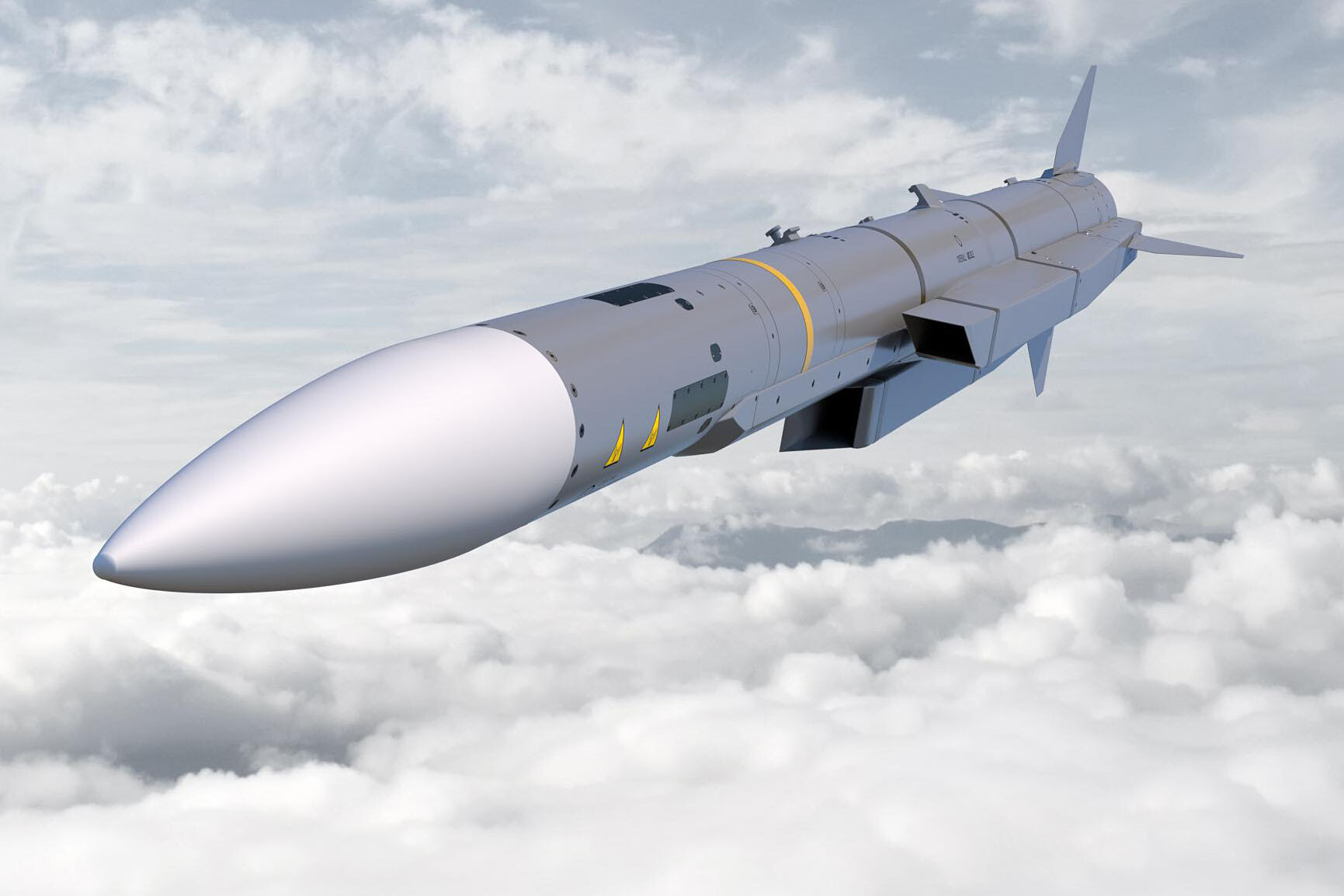
The Ministry of Defence will not proceed with a planned mid-life upgrade of the Meteor air-to-air missile, with investment instead directed towards the Future Air Superiority Effectors programme, the UK Defence Journal understands.
Minister for Defence Readiness and Industry Luke Pollard confirmed the decision, listing it among a series of choices to move on from older systems in favour of their successors. “We’re not continuing with the midlife upgrade of the Meteor,” the minister said, with the department “investing in the new capability,” FASE, instead. “We want to invest in next generation of capabilities faster than the previous generation of capabilities.”
Meteor, developed by MBDA, is a ramjet-powered beyond-visual-range air-to-air missile in service on Royal Air Force Typhoons since 2018, with integration onto the F-35B planned under the eventual Block 4 upgrade. Its throttleable ducted rocket motor sustains thrust into the terminal phase of an engagement, giving the weapon what MBDA describes as the largest no-escape zone of any missile in its class.
FASE is intended to deliver next-generation air-to-air effectors able to engage a broad range of targets from multiple platforms, including future crewed and uncrewed aircraft. Pollard told Parliament in September last year that the programme was in its pre-concept phase, with work under way to establish a concept phase. The decision also follows the memorandum of understanding signed by the UK and France on 1 April to conduct a 12-month joint study into a Meteor successor, a deliverable of the Lancaster House 2.0 treaty that will assess the future threat environment, identify candidate technologies and set a development roadmap, overseen by a new joint Complex Weapons Portfolio Office.
The minister drew a direct parallel with Storm Shadow, where the plan similarly declines to restart production of the existing weapon in favour of its replacement. “Storm Shadow’s an incredible missile that has delivered exceptional service,” Pollard said, but the department needed to step up to bigger capabilities delivered by the next generation. The Defence Investment Plan allocates £1.4 billion over the next four years to MBDA’s Stratus family of cruise and anti-ship missiles, being developed with France and Italy as the Storm Shadow successor.
The Meteor decision sits alongside other retirements set out in the same answer, including the withdrawal of the Shadow R1 surveillance aircraft, a decision not to proceed with the Skynet 6 narrowband satellite, and the retirement of 34 Wildcat battlefield reconnaissance helicopters from 2027, with uncrewed systems taking on the forward reconnaissance role. An MOD official told the briefing that too much of the munitions budget had been going on “high end complex munitions, very capable but low numbers,” and that the plan rebalances spending towards weapons that can be produced quickly and at scale, restarting UK production lines for CAMM, ASRAAM and the Stingray torpedo alongside sovereign manufacture of energetics and explosives.










Sensible move and we have an excellent track record with MBDA and France in developing missiles so I’m sure this will be great.
There is a major discussion to be had about ramjet powered munitions. They are highly capable yet expensive. However if this missile is to have double the range of Meteor then it suggests to me a ram jet powered missile but using something similar to the latest generation of soldiers propellants being used on AIM 260.
It’s also worth noting that the UK developed Meteor specifically because the Eurofighter was not stealthy and the rationale was this could be over come with a massive radar and very long range missile.
Tempest GCAP won’t have the same limitations so perhaps its primary missile doesn’t need to be as capable as meteor was and can be larger for longer range given the larger bays on Tempest. The same logic might not work for France though as they still have no plan for a fifth gen fighter much less a 6th gen fighter.
Can you explain how a non linear ramjet uses solid fuel?
I’m not sure this is great news TBH – both should have been funded.
I agree, Meteor is in service right now, FASE is in pre-concept phase and may never actually come to be. Our people need the very best kit to be able to fight in the here and now, not years away. Why are our dozy politicians blind to thar?
The only way we will see FASE operational before 2038 is if we work jointly with the Japanese.
That’s like saying why are we developing Meteor when we have AMRAAM in service now. Meteor is very capable, and will be for many years to come. But replacements are always around the corner
I’m not saying we shouldn’t look to the future, that’s fine providing we upgrade Meteor to fulfil its potential until such time as FASE actually materialises!
But the money probably isn’t available to do both.
Because as you say they are ignorant and plain dozy and have never been in business or realise how ambitious are the yanks. I also have a weird feeling there are a lot of bungs being thrown about at present.
See below, it uses a solid propellant gas generator. What an amazing weapon.
Meteor utilizes a solid-fuel, variable-flow ducted rocket (a type of ramjet). This design uses a solid-propellant gas generator to supply and control the throttle of the ramjet. This provides continuous, adjustable thrust all the way to target intercept.
If it is built with Tempest in mind it can probably be bigger, most reports say Tempest will be pretty massive by fighter standards. A bigger plane means a bigger weapons bay, Meteor was limited by size to fit the F-35 weapons bay, along with easy integration onto other aircraft; it’s not a coincidence that its dimensions are almost identical to the AMRAAM.
It raises a number of interesting questions, if we go for a larger missile, it suggests to me that our F35B and incoming A fleets will likely switch to US AA weapons permanently.
I can see them simply cancelling Meteor integration as another cut.
Given Lockeed Martin just signed a $74 million contract just 4 days ago to complete integration of Meteor into the F35 for the UK and Italy, I doubt they’d now cancel.
Meteor wasn’t designed around F35, just that it needed to be able to fit in the same spaces as AMRAAM on Typhoon, which required similar dimensions for the recessed hardpoints on the belly.
I agree that FASE could be a significantly bigger missile similar to PL-15.
Given the supposed urgency to re-equip for a possible Russian attack on NATO by 2030 this seems a short-sighted move. Reopening production lines and upgrades should be the priority.
Given how Russian TU-22s, TU-160s and Beriev A-50s operate from Russian airspace instead of entering Ukrainian airspace, long-range missiles like Meteor are the obvious solution.
Stop with the Russian phantom already, they can’t handle Ukraine and they’re going to attack NATO. Here they say Russia only has junk and on the other hand you say it’s going to attack all of NATO, don’t you realize how pathetic it is?
Do you honestly believe all wars start because one side or the other wants an all-out war. Do you think Putin wanted what he got in Ukraine? If the war stops in Ukraine, Putin will have to restore his country’s economy to a peacetime footing. Have you any idea how hard that will be, reintegrating hundreds of thousands of veterans with no civilian jobs available? Will he personally survive the attempt?
There’s every chance he’ll use the opportunity of having half a million troops under arms to prod at the Baltics, just as he did Georgia, Moldova and Ukraine, this time in an attempt to split NATO and unify Russia all in the same action. He won’t want war. He’ll want Trump to split from NATO and the rest of NATO to break up over deciding whether to respond to a mostly greyzone attack on Latvia or wherever.
He may well be right. The JEF countries will pile in expecting the rest of NATO to follow, only to look around and ask where is everyone else? Can Russia handle the JEF alone? He may well think so. On the other hand he might get an all out war and will rely on the threat of nukes to protect the Motherland.
There’s always one vatnik lurking about.
Putin doesn’t plan to “attack all of NATO”. He plans to destroy NATO by making Article V a false-promise. The easiest way to do that is to attack a small, nearby, member such as Estonia. Do you really think Trump is going to lead the USA into an all-out direct conflict with Russia just to save Estonia…?
If so, I have a bridge to sell you.
“There’s always one Vulcan lurking about” anorl 🤦♂️
Soz mate, I couldn’t help myself 😁😁😁
He’ll still get all of European NATO responding in kind, which he’ll quickly find it his worst nightmare as we’re closer, faster, meaner and much more dangerous. And fresh off rocking his sh1t in Ukraine. Somebody surely has to notice it’s European weapons that defeated him whereas American weapons were short range, old and in small quantities. And easily countered by Iran.
America’s day is over.
“Stop with the Russian phantom already”
Is that English?
Russian machine-translated to English perhaps..
Seems rather American to me.
Or a bit of both.
Nah, a septic tank would write “fantom” 😉
Putin is effectively playing a smoke screen in having an Army for Ukraine and another totally fresh reserve army building up elsewhere, BeloRus or elsewhere for instance.
If you was Russian. Why wait 5 years to attack and give NATO 5 years to build up capability. If they are serious, why not do it now.
Err… because they’re a bit busy with Ukraine.
2030 is the date being bandied about by NATO etc.
If Putin wants to break-up NATO he has to end the Ukraine War and then move on, say Estonia, while Trump is still in power.
Russia’s best time is now, while they have a self-interested POTUS.
Russia’s best time is under Trump (actually under a Vance presidency, but that’s not guaranteed), after having ended things in Ukraine.
Remember the original plan was for Ukraine to be defeated in days. Their resilience in stopping Russia may have saved NATO from such a test thus far.
Well said that man 😁🇺🇦👍
Investing in a mid-life upgrade would have been a medium-term move at best. If the concern is about the Russian threat as it exists over the next ~5 years, then this is likely a sensible move, as any upgrades would likely take that long to develop and field at scale.
Rather than trading off the short term for the long term, it seems the DIP is focusing on immediate results *or* long-term benefit, and ditched anything that doesn’t fall into one of those categories. Meteor as it exists today is competitive, and a mid-life upgrade would take time and cost money to develop, so better to put those resources into buying more of the current spec and building towards a true next-gen successor
Meteor as it exists now is competitive.
But competitive edges disappear over time.
Will it still be competitive in 5 years?
Wouldn’t it be cheaper to upgrade existing Meteor stockpiles rather than buy completely new missiles? Or is money not an issue anymore?
It would and wouldn’t be cheaper.
On the one hand, a mid-life upgrade of an existing missile would be fairly cheap in relative terms, but on the other hand that only buys you a few years before you have to buy a new missile anyway, and you can either do that by making a new one (meaning spending money on development) or buying off-the-shelf (meaning few jobs and no export sales).
Missiles are something we’re very good at so HMG would rather invest money in keeping MBDA at the cutting edge, thus gaining money from tax receipts and export sales as well as keeping good jobs in the UK. A new missile is a cheaper way of doing that than a new missile and an MLU.
Those few years the mid-life upgrade gives might very well straddle a hot-war, in which case the upgrade is more than worth it.
You can’t fire conceptual designs at the enemy.
It might be cheaper, it might not be. I think the driving concern is when that capability will be delivered.
A mid-life upgrade program won’t deliver anything for, say, 5 years, then a gradual bump in capability as the MKii is rolled out, followed by another tail-off as that then ages until being replaced in, say, 2040.
Buying more MkIs now and ploughing the rest into the next gen gives a more immediate boost to capability, but then becomes relatively less and less competitive after 5 years until overtaking again when the new missile debuts in, say, 2038 with the additional funding.
So if you think the greatest relative threat from Russia is going to come in the next 5 years or after 2038, ditching the mid-life upgrade makes sense. If you think the threat is going to peak between 2030 and 2038 instead, then pursuing it makes the most sense.
Obviously those dates are entirely illustrative, but you get the idea. The same amount of resources are being spent, it’s when and how each approach takes risk that’s the key issue.
The right move would have been to do BOTH.
Invest in Meteor upgrade and the sucsessor.
Not doing so inevitably will lead to a gap in which capabilities will be lacking, but worse still the new program might be hugely delayed or even fail completely. Historically not a rare occurrence.
As such you need to provide continuity and redundancy.
Sadly though, the UK under Labour is only barely doing better than the Torry years of total neglect of the military .
I know the UK economy is struggling , after Brexit, but defence should not be ignored.
Big lessons were learned after the Pakistan India fight, one of them was that Chinese missiles have Low Probability of Intercept radars which mean Raffales dint even know they have been locked on to.
We can’t just keep cranking out Meteor in its current format. It’s also ridiculously expensive.
It’s cheap compared to the cost of irreplaceable items like the A-50s, TU-22s, etc.
Another stupid decision. One thing we learned from the Pak v Ind and the US/Israel vs Iran, was the sheer volume of missiles each side got through. If we have Meteor, we should upgrade it as the new proposal is too big to fit in the F35 and would take up too much space on the Typhoon. The other reason, the Meteor is in production, tested, certified and known to work. Why not use the Meteor as a medium-to-long-range missile and the FASE as a Ultra long/long range missile? Obviously, the Stratus family of cruise and anti-ship missiles are replacements for the Storm Shadow. Any news on when that will be entering trials? Can it carry a larger payload or a variable payload for tougher and hardened targets? That’s the only real area that SS needs improving on as far as I know.
France and Italy are working with the UK on the Storm Shadow replacement. Obviously, the Stratus family of cruise and anti-ship missiles will take the lessons learned from Storm Shadow’s active service. Any news on when that will be entering trials? Can it carry a larger payload or a variable payload for tougher and hardened targets? That’s the only real area that SS needs improving on as far as I know. I am surprised they didn’t bring in Germany, Spain, Poland, Denmark, and Sweden to lighten the R&D cost.
I expect that’s too difficult for the Ministry Of Deferment?
Ministry of Deferment – good one mate 😁👍🤣
Meteor’s pretty good value really, it’s supposed to cost around £2M while AIM-260 is speculated to be between £2.5M and £4.5M.
A missile that only cost £0.5M but put the launching aircraft at risk due to worse kinematics would be terrible value. The ramjet motor works and is effective as you described above and a mid-life upgrade would be able to use the better motor energetics anyway.
The French seem to have had a fire lit under them since the PAK/IN fight and aim to deliver a longer ranged missile called Comet to work alongside Meteor by 2030; that’s possible but only really by using the ‘moar motor’ SRM strategy from PL-15 and -17. There is also Stratus-RS which has an AA mode against larger targets but will be available later.
Tend to agree with this unless the 2030 threat is scare mongering. As others have said its too early to rely on a next generation weapon thats still in capability acquisition phase. We should use meteor as the test bed for new propellants and software.
Plus, as we’ve seen in Ukraine, western technology is at least a generation ahead of what Russia has. We might consider Meteor old and outdated, but it’d probably still swat the VKS from the sky with ease.
Ukraine is desperate to get Meteor operable once it gets its Gripens into service, this will be a step change for them in being able to threaten Russian glide bomb launchers way more effectively than at present with F-16s.
As for its replacement I suspect it will be larger and with even longer range. I think the idea that Tempest being bigger, stealthier and longer range itself does not mean extra range for its air to air missiles is no longer required, the whole point of designing an aircraft like Tempest is because it can outrange the opposition in all respects itself and its sensors, power generation, range, efficiency and weaponry, as the environment becomes more hostile generally to your aerial assets. The F-35 and certainly Gen 4 aircraft were simply designed for a different threat environment than that increasingly going to exist in the 30s onwards where stealth is vital but only part of the overall requirement to survive and be effective. If a manned aircraft in most respects is to be useful at that point it simply has to be large have internal capacity for large long range weaponry and be very capable in all its systems so that it can defend, control external assets and threaten at ever greater range.
Stratus has already moved out of concept whereas FASE is still in pre-concept. We probably won’t see Stratus LO in operation for 5 more years and Stratus RS longer still. FASE is many years behind this timescale. It is a glint in a Minister’s eye at best. Cutting Storm Shadow is premature, cutting Meteor, still NATO’s best in class, is at best foolish. If the military truly believe there a chance of war by 2030, replacing currently attainable capability for far-future promises, doesn’t match up.
This is just another cut, dressed with a pretty FASE sticker.
Especially foolish given the government just signed a further multimillion pound contract for integration work of Meteor onto the F35 🤦🏻♂️
Unlike Storm Shadow, Meteor is not being phased out as a capability, it’s just the MLU that’s been binned. Presumably Meteor will remain is service as-is.
Yes, thank God. As we’ve lost our marbles if otherwise.
Yes and no.
A meteor midlife upgrade would likely not be fielded at any significant scale before 2030, and the missile has it currently exists remains competitive. If the minister truly believes that the threat from Russia is going to be most acute over the next 5 years, then that would be an arguement for just buying more of the current spec missile, and focusing more development resources to the next gen successor.
It’s very similar to the logic that drove the decision to up the budget for GCAP over ordering more late-run typhoons. That wasn’t a cut in capability, but a rebalancing of when new capability would arrive.
Agreed hey it’s like the left hand doesn’t know what the right hand is doing. As an alternative take if you ask me all the talk of conflict by 2030 is more about the immediate pr required to getting the public accepting of the spending that’s already in place and proposed and excuses for not thus delivering elsewhere, otherwise why would you be curtailing production of or cancelling upgrades to the very weapons required to fight it with headline infused supposed replacement by weapons that won’t be available to fight it, certainly not in the required numbers. Mind you Govts have been known to be that stupid for perceived self serving short term exigency so who knows.
Does anyone know who owns Meteor’s IP. Specifically does the UK own it? I’m trying to sofk out IP wise if working with Frsnce is a good thing here. They didnt purchase many Meteor.
From memory meteor is ~40% UK, including the special sauce air breathing bit.
The benefit for working with France for the UK is less on the IP side (though they are valuable in that area too), and more their stable political and financial backing. France will never back out of developing a domestic system, and the UK will be less likely to back out of one if it means having to abandon an international consortium. Working with France allows us to borrow some of their backbone for our own political fights 🙂
Does Bayern-Chemie Gesellschaft für flugchemische Antriebe mbH sound British to you?
Who owns the IP for the propulsion system of the Airbus A350, Rolls-Royce or BP?
The manufacture of the energetics may not be the clever bit, the throttle, nozzle and intake may well be.
Probably would have in the 8th Century.
More jam tomorrow
but more than that we seem to be throwing away yesterday’s jam to make room for tomorrow’s
Restarting CAMM production? Had it finished? It’s a new system or are the moving onto CAMM MR?
Yes that caught my eye, seems like we never actually plan to fight an actual war with the stuff we produce just to keep the expertise and ability to do so there… as long as we have a decade to do so.
What deficiency was the planned midlife upgrade intended to address? If production of the existing missile can be continued or restarted, the announcement seems only to mean that development funds will be switched to a successor.
I presume that the other users of Meteor are content with this decision?
– Upgraded Datalinks, giving increase communication range, coverage, and resistance to enemy jamming.
– Advanced Seeker Tech, adding an AESA seeker.
– Upgraded propulsion, with adaptive air intakes to sustain its high-speed (Mach 4+)
– Added GPS integration to give the air-to-air missile a secondary ground-attack capability.
Whatever reason might we have for carrying a 150 mile Mach 4 stand-off ground attack missile, the Treasury would never have authorised its launch.
Seems a lot to me. So I wonder what the mythical replacement will have to out perform all that. Would be interesting to see what the ‘pre concepting’ is considering and whether anything much more than those sort of upgrades ever gets beyond the actual concepting process due to cost and technological hurdles. I guess being in it with the French probably ensures something does exit the process… unless Farage is in charge.
Loving the new spin words on cuts.
“Retirements.”
All the retirements lark reminds me of the trick HMG pulled in 2008.
No more T45s now, we’ll “accelerete” the T26 programme.
Which still hasn’t arrived, and in numbers far less than originally envisaged.
But years down the line most won’t notice or remember.
On the MLU on Meteor, at least the current capability remains.
Latest reports say the Grippens for Ukraine will be supplied with meteor by Sweden next year.
TBF to HMG (bleugh, I know), the funding was set aside in 2009 for the T26 order, and had that plan been followed through they would have come on stream earlier as promised.
The fact they didn’t is more because one plan was replaced by another by the new incoming government, not because the original plan was disingenuous or unfunded.
Absolutely. When I use the term HMG I don’t just mean current, the Frigate T26 delay debacle is at the Tories door.
That I think 9 others ( 6 T22B2, Boxer Beaver, Brave, London, Sheffield, Coventry) plus 3 still young T23 were cut with zero replacement, also contributing to lack of assets now ) is another story.
The uni party are responsible, 1995 to now.
Yeah right can’t see that happening again. In the end the result is what’s important and what any present Govt’s words spouted (disingenuous or otherwise) rather less reliable, be it then or now and the further down the line the ‘planned’ results are supposed to be the less reliable any such words having meaning. An upgrade of Meteor would be rather more difficult to reverse than plans for a whole new mythical missile and let’s be honest the end result might not actually end up being much more than that proposed for Meteor but conveniently the costs pushed well down the line to be someone else’s problem. Maybe I’m just being cynical mind, though difficult not to be as the only consistency over time is the ever present Defence Reviews and re-Reviews.
OK … But if it turns out that we finish up with another capability gap where one system is gone while it’s successor is either still on the drawing board or delayed…
Indeed, let’s hope we can plan the dates of the next war or delay it to a more appropriate and convenient time. Perhaps as we are so entwined in cooperative agreements with allies we can extend it to enemies too.
Makes me wonder if Germany is now using the opportunity to germanize the missile completely for the MLU. Ramjet and warhead are already German – and the Germans weren’t happy with the seeker anyway. So if they replace the seeker with something better than basically most of the relevant parts are German.
Air superiority what with?
Stealth doesn’t work and russian beyond visual range is better than NATOs.
I suppose the excuse will be we may as well give all these to Ukraine as well seeing as they are going mouldy in the stores and don’t work anyway
Sorry David but Russias air defence has been shown to be a complete pile of 💩. Like much else Russian its some & mirrors.
Sorry David but Russias air defence has been shown to be a complete pile of 💩. Like much else Russian its some & mirrors.
They have very long range air to air missiles on paper but which seem to not have been effective in reality. Potential range is one thing hitting something when it gets there entirely different which is where Meteor has the biggest advantage. The Chinese do concern me rather more mind, let’s hope we don’t have to test any capability gap against them.
Is there any evidence at all to suggest Russian BVR is superior to ours in any way ? Far from it evidence from Ukraine would seem to suggest. If so the Ukraine airforce would have been shot out of the air back in 2022 and looking at the situation as of now that seems very far from the case.
Is there any evidence at all to suggest Russian BVR is superior to ours in any way ? Far from it evidence from Ukraine would seem to suggest. If so the Ukraine airforce would have been shot out of the air back in 2022 and looking at the situation as of now that seems very far from the case.
It’s another mythical advantage they boasted of but as long as precautions are followed are far more bark than bite. On paper F-16s of all allied aircraft should be very vulnerable to them but simply haven’t been. That said Gripens with Meteor will be a step change compared to what F-16s with AMRAAM can offer as they have to operate generally well behind the front line.
The US is currently developing a long range air to air missile. Meteor is one of our militaries successes . The Russians had in some ways have better aircraft, but no doubt scared of a Typhoon armed with Meteor. Ask yourselves one question your piloting a GCAP do your want that latest MIG on you or would you prefer to shoot it down 90 miles + . I know what I would prefer. So no Type 45s replacements so no carrier protection so when T45s go so do the carriers. Gcap without meteor,or similar. is like a male porn actor with a one inch penis. Drones you need big mass and our politicians have shown since the 1960s they have no stomach for that. DIP is underfunded by 4.7 billion. The new Labour leader will probably use that as an excuse for another defence review . IE more defence cuts.
“decision not to proceed with the Skynet 6 narrowband satellite” ..why not?