

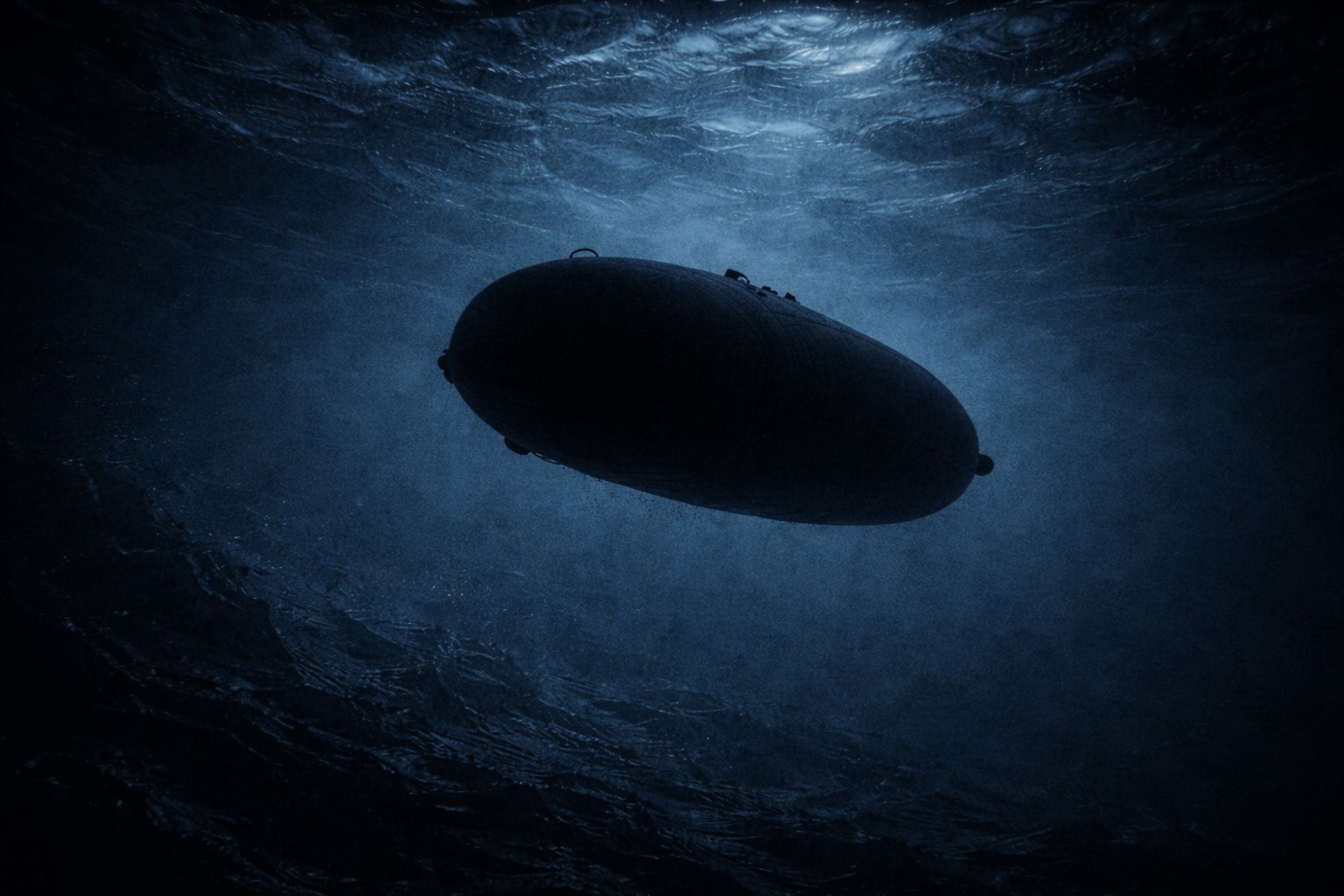
The world’s oceans have long been viewed as a domain of strategic advantage, vast, opaque, and difficult to control, and today the need to gain an advantage is more acute than ever.
The subsea environment is rapidly becoming more contested, congested and complex, with adversaries increasingly able to operate, interfere and exploit vulnerabilities at depth, and as a result the underwater battlespace is re-emerging as one of the most critical frontiers for national security.
Recent events underline the urgency, with damage to fibre-optic and power cables in the Baltic Sea in late 2024 highlighting just how exposed our critical undersea infrastructure (CUI) has become. More recently, the subsea domain has repeatedly been used by nation states for grey zone warfare activities such as surveillance and reconnaissance, with then Defence Secretary John Healey calling out Russia for conducting a “covert” operation over cables and pipelines in waters north of the UK.
These incidents are not isolated anomalies; they are part of a growing pattern of activity designed to disrupt, probe and undermine resilience without crossing the threshold of open conflict. For nations heavily dependent on undersea cables for communications, energy and economic continuity, the seabed is no longer a hidden layer of infrastructure, it is a strategic vulnerability.
Of course, the threat isn’t just related to subsea infrastructure, as technological advancements and the growing role of uncrewed underwater vehicles (UUVs), combined with geopolitical instability, have heightened the threat to vessels and platforms, thereby raising the importance of anti-submarine warfare (ASW) operations.
This shift has been recognised at the highest levels, with the UK’s 2025 Strategic Defence Review describing maritime security as a “strategic imperative,” while NATO has responded with increased surveillance and operational focus in key regions such as the Baltic, and the message is clear: the subsea domain is now central to geopolitical competition.
A changing threat landscape
The nature of the threat is evolving as quickly as the technology enabling it, and we are seeing a broader range of capable adversaries adopting more sophisticated tactics, often operating below the threshold of attribution. These developments are placing increasing pressure on three critical capability areas: intelligence, surveillance and reconnaissance (ISR); anti-submarine warfare (ASW); and critical undersea infrastructure protection.
Traditional approaches are no longer sufficient, because crewed submarines, for example, remain highly capable but are not always suitable for persistent, high-risk ISR missions, and at the same time the scale of the ASW challenge, spanning multiple regions and requiring continuous monitoring, far exceeds the capacity of many current force structures.
Overlaying these challenges is the growing vulnerability of undersea infrastructure itself. For decades, cables and pipelines were effectively out of reach and therefore out of mind, but today advances in underwater technology have changed the game, and CUI is now an attractive and accessible target, forming the backbone of global connectivity and economic activity, and therefore a prime objective for disruption.
A critical capability gap
Addressing this threat requires more than incremental improvement; it demands a fundamental shift in how we operate underwater, and at the heart of the challenge lies a critical capability gap: subsea communications.
Current systems, largely reliant on traditional radio frequency technologies, are constrained by low data rates and environmental limitations, with variations in temperature, salinity and pressure degrading performance, particularly at depth. In an era where speed of information and decision-making defines operational success, such constraints are no longer acceptable.
A step-change in connectivity is much needed, with resilient, secure and high-capacity underwater networking required to support real-time data exchange across a distributed system of platforms, and without this our ability to detect, deter and respond to subsea threats will remain fragmented and reactive.
Towards a networked underwater force
Next-generation underwater networking represents a vital piece of this puzzle, since by enabling seamless communication across acoustic, optical, radio frequency and cabled channels, such systems can create an integrated, multi-domain operating picture. This is not simply about improving communications; it is about transforming how naval forces operate.
A networked approach allows for the deployment of a mix of crewed and uncrewed platforms working collaboratively as a system-of-systems, in which autonomous vehicles can be positioned persistently in high-risk areas, gathering intelligence and feeding it back in near real-time, while sensors distributed across the seabed and water column provide continuous monitoring, and surface and airborne assets act as data relays and control nodes.
Crucially, this architecture enables faster decision-making, because by fusing data from multiple sources into a common operating picture, commanders gain the indicators and warnings needed to act before threats materialise, and in a domain where visibility is inherently limited, such foresight is a decisive advantage.
From data collection to decision advantage
One of the most significant benefits of advanced underwater networking is the ability to move from post-mission analysis to in-mission intelligence, as traditionally the data gathered by underwater platforms is analysed only after recovery, introducing delays that limit its operational value.
By contrast, network-enabled systems allow data to be processed, shared and acted upon in near real-time, with autonomous vehicles equipped with edge processing capabilities able to identify critical data points and transmit them immediately, and multiple platforms operating simultaneously, covering wider areas and combining their observations to build a richer intelligence picture. This shift transforms ISR from a passive activity into an active, responsive capability, providing operators with timely insights that support evidence-based decision-making.
While progress is already being made, we must maintain the pace of innovation, because the underwater battlespace is evolving rapidly and the window for maintaining a competitive edge is narrowing. Collaboration between government and industry will be essential, as will continued investment in experimentation and operational testing.
Engineering advantage in the underwater domain
The stakes could not be higher, since the subsea domain underpins global prosperity and security, from communications and energy to defence and deterrence, and its protection requires more than vigilance; it demands a proactive, technology-driven approach that anticipates and counters emerging threats.
Next-generation underwater networking is not a silver bullet, but it is a critical enabler, and by connecting sensors, platforms and decision-makers in real time, it provides the foundation for a more resilient and responsive maritime force.
In the race to secure the underwater battlespace, standing still is not an option, and by embracing innovation and accelerating capability development, the UK and its allies can reclaim the initiative, protecting vital infrastructure, strengthening deterrence, and ensuring that this hidden domain works to our advantage, not our vulnerability.
Tim O’Neill is Subsea Campaign Lead at BAE Systems Digital Intelligence.
This article is the opinion of the author and not necessarily that of the UK Defence Journal. If you would like to submit your own article on this topic or any other, please see our submission guidelines.








I’m struggling to see how this will work in reality. Water is notoriously bad for transmitting radio waves through, except at very low frequencies, which also inhibits fast data throughput or a wide bandwidth. Similarly lasers also suffer hugely when transmitting in water, due to dispersion and absorption. The only medium that is effective is acoustics, but its not very directional, plus everyone else can hear you.
So by networking are they suggesting a massive buoy farm, that acts as the network infrastructure, that the USV/UUV either gets near to or surfaces, to then link to a satellite data-link?
Multi-path, mesh networking perhaps? It reads like it’s not homogeneous, so there will be several path technologies. It also reads as though there will be smart relay prioritisation at the nodes.
Great article Tim, and thx for UKDJ for identifying the broad need to pursue strategic advantage.
There is already a remedy that far exceeds BaE overview here, providing complete oversight and offensive capability to protect any underwater domain and cables. Problem is the ‘Big Boys’ own the space, thus excluding new independent remedies.
Luckily with the recent ‘shake up’ in Ukraine promoting innovation over legacy, maybe some will rub off for UK !