

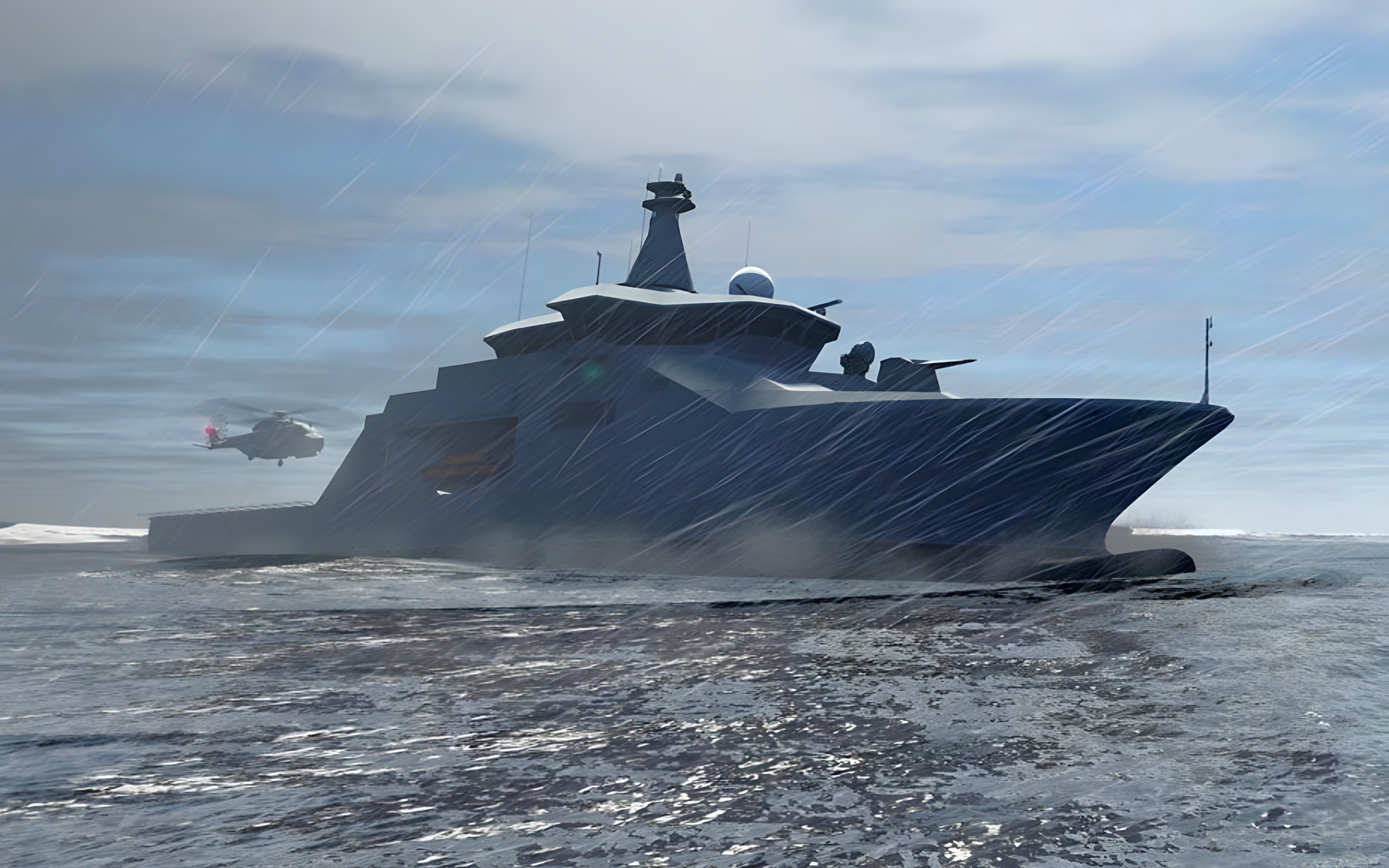
The United Kingdom will procure three offshore support vessels in conjunction with Norway under the next phase of the Mine Hunting Capability programme, the Ministry of Defence has confirmed, putting a number for the first time on the mothership fleet that will support the Royal Navy’s autonomous mine countermeasures systems.
The figure came in a written answer from Defence Minister Luke Pollard to Conservative MP Ben Obese-Jecty, who asked how many of the vessels referenced in the Defence Investment Plan the department intends to buy. “The Defence Investment Plan sets out the Government’s intention to pursue closer cooperation with Norway across a number of maritime capability areas. As part of the next phase of the Mine Hunting Capability programme, the Department will procure three Offshore Support Vessels, alongside enhanced autonomous mine countermeasures capability,” Pollard said, as quoted in the answer.
The answer is the latest confirmation of a plan that has taken shape in stages, with the Defence Investment Plan committing £1.1 billion to the Mine Hunting Capability programme and a separate written answer this week putting the offshore support vessel element at £90 million within the seabed warfare investments, described then as being procured in conjunction with Norway under the autonomous minehunting programme. What the latest answer adds is the number, three vessels, giving the programme a defined shape as it moves into its next phase.
The vessels answer a practical question created by the Royal Navy’s wholesale shift away from crewed minehunters, whose retirement was underlined this week when HMS Chiddingfold formally left service.
The uncrewed systems taking over the role, including the remotely operated boats delivered under the Anglo-French Maritime Mine Counter Measures programme with their towed sonars and mine neutralisation vehicles, need platforms to carry them to distant operating areas, launch and recover them, and sustain the operators who direct missions, a function the Navy has trialled using the converted commercial vessel RFA Stirling Castle. Dedicated offshore support vessels would put that mothership arrangement on an enduring footing, and commercial offshore designs of the type both the UK and Norway have already adapted for naval work offer a comparatively quick and affordable route to hulls.
The Norwegian dimension continues the run of maritime cooperation under the Lunna House Agreement, which spans Norway’s purchase of at least five Type 26 frigates built on the Clyde, joint operations against Russian submarine activity in the North Atlantic, and now the shared procurement of mine warfare support shipping, with both nations facing the same challenge of protecting ports, approaches and offshore infrastructure across northern waters.
The answer does not say where the vessels will be built, how the buy will be divided between the two nations, or when they will enter service.


3 was always the number suggested.
I’ve read that these will be built in Norway, as part of the offset agreement. Also that it was confirmed that the RM CIC will also be built in Norway.
Minor detail, Stirling Castle is HMS now.
Is three really enough though? Seems very lean. Always better than nothing. Wondering then if the B1 River replacements might be variants of these or just nothing ordered? And all the P2000s? The B2 Rivers still very useful for global presence and might be wasted if kept locally.
Always the way Quintin!
With B1, “under review.” Possibly another way of saying we’re skint.
They need to keep B1s in service for another 6 year period so retiring them around 2034. In that time get 3 of these mine hunting in service and have a further batch of 5 for B1 replacements.
If we are thinking long term. 10 to replace B1 and B2. And then 5-10 for Drone motherships. That could be provided between 2030-2040
All easily done, where there’s a will!
We might be surprised yet, these are relatively cheap and they have small crews. It would make a lot of sense to have a much larger common fleet that can swap roles as required between MCM and presence/fisheries taskings. I suspect that’s the intention, but commitment to a larger fleet won’t be made until we’ve tested the concept with the initial three ships.
Considering Belgium, Netherlands France are building 6 each of the same vessel. Our navy known for its speciality in MCM is just a hollowed, we have less autonomous mcm that the retired Hunt & Sandowns-Class ships
With the announcement of us building 8 amphibious ships plus the 6 command ships then it makes sense for these to be built in Norway. Even if they are designated HMS and classed as a warship. We need these to be derived cheaply and quickly.
Agreed.
Even if it means an end to all complex warships for the RN being built in the UK? The words slope and slippery come to mind.
I’ve never supported that anyway.
I support kit in the militaries hands first and foremost. If our yards cannot and if we reciprocate to Norway by buying JSM, CIC, these, and whatever else for the 5 T26 they get from us then push on.
Sterling Castle wasn’t built in the UK. So if you are looking for a slippery slope, you could pick that or HMS Protector. Because of the delays to shipbuilding and quite a few warships in the pipeline to build, yours would be a purist doctrine leading to a worse outcome. Are they even warships?
Sterling Castle is hardly a complex warship, she was purchased as a trials vessel and will almost certainly never operate in any sort of contested environment. Patrick Blackett the same. Now if you have a ship with a cannon on the front, even if it is only a 30MM or 40MM as well as other defensive weaponry then I would consider that to be a complex warship. HMS Protector isn’t that either.
My worry is that once the stable door is opened the government of the day will be able to cite precedent and next the CCSs will be built outside of the UK and then the drone fleet and then in twenty years and we need replacements we look back and our naval shipbuilding will have gone, the same way as our heavy and light armoured vehicle production has gone and the way our aircraft industry has gone.
Thee ships are going to be far similar to Stirling Castle and Proteous than any warship being built in Britain currently.
Thats never been suggested at all Iain.
Bugger, you got In first !
HMS SC…. It made me smile the other day when you could see people singing “God Save Our Queen” on the footy !
I still catch myself doing that, it’s hard not to when that’s all one ever knew.
It shouldn’t be our national anthem for sports and other events anyway, but that’s just my opinion.
Jerusalem!
Agreed! Though that’d send the lefties and PC shaggers doolally I’m sure.
Wales and Scotland have theirs, so why not England?
The national anthem should be for state occasions or events with the presence of the Monarch.
You might love your country yet disagree with having a King, bit difficult to sing the national anthem then?
I quite liked “The Sex Pistols” version though….
Im Welsh and i think Jerusalem would be great for England!
So the coat that is JEF is woven just a little bit tighter, well, good things will come from this, especially in the subsea environment If the USA leaves, & NATO gets too confused whether it is, or is the Federalised block that is the EU, reliable partners is exactly what we will need. I shall look forward to reading further correspondence from yourself. Kind regards Pete
🙂
“Dedicated offshore support vessels would put that mothership arrangement on an enduring footing, and commercial offshore designs of the type both the UK and Norway have already adapted for naval work offer a comparatively quick and affordable route to hulls.”
Does this mean that the basic design would be for an HMS Stirling Castle style with a military upgrade for resilience etc??
90 million doesn’t buy much.
I recall Stirling alone was bought for 40 odd million, need to confirm that.
Norway are saying it will be a proven COTS design, with minimal military upgrades. These kind of OSVs are anyway proper blue water ships, with excellent seakeeping and habitability.
It’s actually HMS Stirling Castle now (not RFA as the article says)
Sorry to be that person !
No, I was that person! 😆
Excellent news. I am all in favour of joint bulds whwere practical, particularly with out JEF allies. Very sound.
Actually, the Defence Equipment Plan 2022-2032 specifically described the intention to procure up to six MCM Maritime Autonomous Mission Systems (MAS), up to four MCM Logistics Support Vessels (LSV), and a commercially sourced offshore support vessel (OSV). It was assumed at the time that this meant an LSV would be based at each of Devonport, Portsmouth, Clyde and Bahrain. Presumably its the last that has been cut. Hard to know how many MAS (i.e. complete sets of USVs and UUVs) are going to eventually be purchased, maybe not even decided yet. Given the unique requirements of Faslane, I was wondering if one I was wondering if one MAS could be essentially land based there, or at least have a support ship cheaper and less sophisticated than a LSV, e.g. SD Northern River.
The OSV, HMS Stirling Castle, we now know is good only for trials, testing and training – I bet there is no budget to keep her after 2029/30.
“I was wondering if one I was wondering if one MAS could be essentially land based there, or at least have a support ship cheaper and less sophisticated than a LSV, e.g. SD Northern River.”
I think this is current Project Wilton Element, Zulu Sqn of the MTXG is at Faslane with the USVs RNMBs Harrier, Hazard, and Hebe. I think that constitutes a ARCIMS “system.”
SD Northern River seems to be a busy vessel supporting NSRS and SF training as well so not guaranteed for MCM there.