

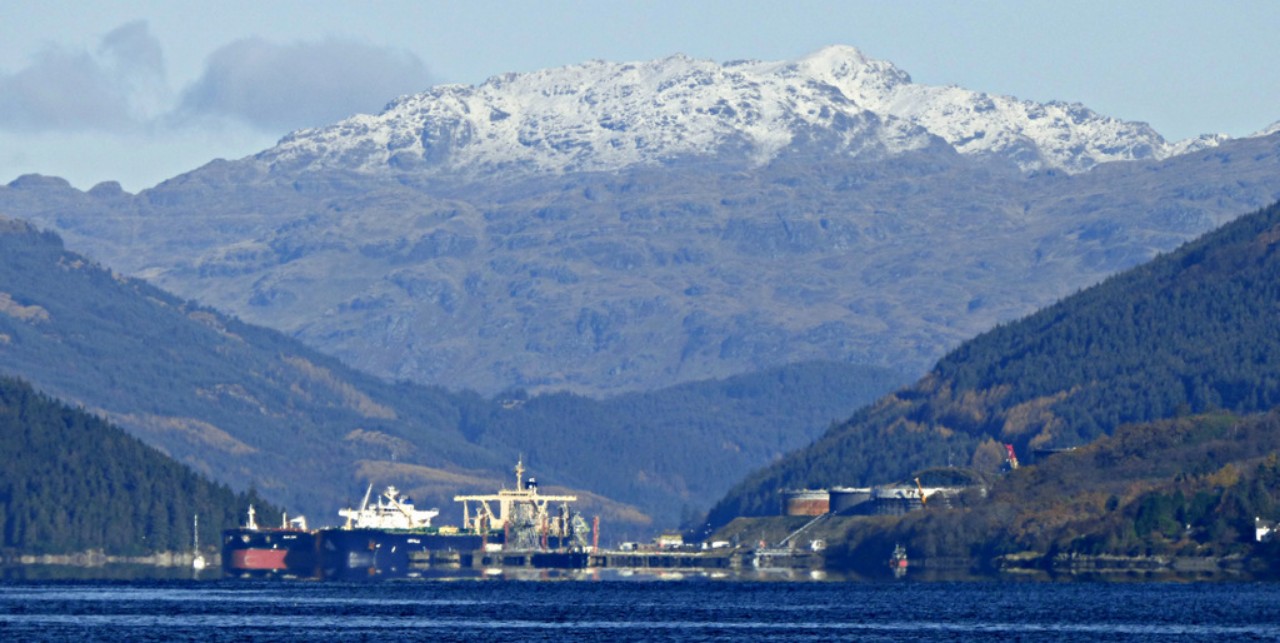
The Finnart Oil Terminal will become a new mine hunting base for the Royal Navy, First Sea Lord General Sir Gwyn Jenkins has revealed, giving the newly purchased Loch Long site an operational role beyond the fuel storage role announced when the acquisition was confirmed earlier this week.
Speaking in a video filmed among the terminal’s storage tanks, the head of the Royal Navy set out a dual purpose for the site. “The purchase of the Finnart Oil Terminal ensures the Royal Navy and NATO will have access to reliable fuel supplies for our warships. It will also become a new mine hunting base for the Hybrid Navy. More resilient, more ready for warfighting,” he said, as quoted in a post on X.
The mine hunting role was not mentioned in the Ministry of Defence’s announcement of the purchase, which described the multi-million-pound acquisition in terms of expanding the Royal Navy’s sovereign fuel-holding capacity, delivering value for taxpayers by using existing infrastructure, and providing additional space to progress the Clyde Transformation Programme.
The First Sea Lord’s confirmation means the site will host an operational element of the fleet, making Finnart, in effect, a new if modest naval facility in Scotland, the first addition of its kind in many years.
The choice of location makes operational sense on several fronts. Finnart sits on the eastern shore of Loch Long, a deep-water sea loch off the Firth of Clyde, and lies close to both Faslane and the Royal Navy’s armament depot at Coulport on the opposite shore, placing it within the cluster of naval infrastructure the £15.1 billion Clyde investment is set to transform, and its acquisition can reasonably be read as part of that wider development of the base complex. The Clyde approaches through which the deterrent submarines and the wider fleet must pass are precisely the kind of waters a mine hunting force exists to keep clear and train in, and the Navy’s mine countermeasures capability is now built around autonomous systems, remotely operated boats, towed sonars and uncrewed underwater vehicles operated from shore facilities and support vessels rather than the traditional minehunters whose is almost over with HMS Chiddingfold’s retirement this week.
The new base also arrives as the supporting force structure takes shape, with the MoD confirming this week that three offshore support vessels will be procured in conjunction with Norway under the next phase of the £1.1 billion Mine Hunting Capability programme, providing motherships for the autonomous systems, and a shore base on deep water within reach of Faslane would offer an obvious home from which such a force could operate across the Clyde and the wider Scottish coast.
A pier capable of handling very large tankers, extensive hardstanding and existing infrastructure give the former commercial terminal attributes that would be expensive to build from scratch. The MoD has not yet set out details of the mine hunting facilities planned for the site, the systems to be based there or the timeline for the role to stand up, and the First Sea Lord’s brief statement leaves those questions for the department to answer as the Clyde programme develops.









I saw 1SLs message the other day. I’m still curious as to why they don’t just use the area of Faslane that was once occupied by 12 Sandown MCMV.
And will the entire MCM force be at Finnart, or just the existing Faslane Project Wilton element? As the rest of the MTXG is at Portsmouth.
I wouldn’t be in the least bit surprised if th return to operating vessels from scrap flow is looked at again. Maybe with a view to the Atlantic bastion project or a base hub for the hybrid ships nearer to the operational area that the bastion will be tasked to operate in.
A Intresting development…wonder if we’ll have a look at returning to Mine laying Capabilites…?
Find it intresting the timing just before a new PM enters office and a potentially new Defence Team in place..
Multi-million pound acquisition ?
I though the site was already owned by MOD and had been leased to BP then Ineos.
Correct, MoD owned the land.