


The Royal Navy of the 2030s will look profoundly different, because under the Defence Investment Plan published this month the Type 83 destroyer is gone, replaced by six Common Combat Vessels acting as command hubs for a family of uncrewed platforms: the Type 91 missile platform, Type 92 underwater sensing platform, Type 93 extra-large uncrewed underwater vehicle and Type 94 sensor platform, all feeding the Atlantic Bastion, Atlantic Shield and Atlantic Strike programmes aimed at countering Russian activity in the North Atlantic and High North.
The question rarely asked amid the procurement announcements is how do you train a navy to fight that way? Part of the answer is taking shape at Rollestone Camp on Salisbury Plain, where UK Defence Journal was given exclusive access to Exercise Virtual Warrior, the first large-scale exercise run on the Maritime Command and Staff Trainer (MCAST), the synthetic training system delivered by QinetiQ under a £25 million contract signed less than a year ago, and where some 240 personnel spent two weeks fighting a simulated High North campaign against real-world adversaries entirely inside a deployable virtual battlespace.
A question the Navy is still answering
Commodore Andy Ingham, Commander Fleet Operational Standards and Training and the officer responsible for assuring that the Navy’s ships, submarines and task groups are ready to fight, is pretty open that the hybrid navy poses questions his organisation is still working through.
“It’s one of those things that we’re assessing now as we start to understand what is the hybrid navy,” he said. “What is it going to look like? What will those vessels be? What will be the makeup of that group of ships? Because all those questions will subtly change the training delivery that will be required to assure and train that warfighting capability.”
One conclusion he is already prepared to state firmly. “One thing it will do almost certainly is make the synthetic training environment much more important. Much more of the training delivery will be on the synthetic side for a hybrid navy, and this is the first step on that journey. So it’s another reason why MCAST and Virtual Warrior is so important.”
The logic follows from arithmetic, since you cannot easily put a formation of uncrewed vessels alongside a frigate for a conventional work-up, but you can model them, in whatever numbers the scenario demands, inside a synthetic environment.
Drones are already shooting at the Royal Navy
The live side is changing too, and Ingham points to Sharpshooter, the live-fire assessment a ship faces at the end of operational training, as the biggest change FOST has made in a decade. “It’s live firing on an instrumented range, and again I can dial up and dial down the complexity, but we use uncrewed target platforms to fly against the vessel, and they can operate under wartime safety conditions.” Drones, in short, are already shooting at the Royal Navy in training, and the next step is the Royal Navy training to fight alongside them.
That work has already started, according to Captain Stuart Yates, the Captain Joint Training and Exercise Planning Staff and the exercise director for Virtual Warrior, whose team is engaged with the fleet’s autonomous experimentation now. “Right now I have some of my team deployed, looking at the autonomous training. At the moment it’s what we call tier one, the lower-level individual training. But the aim is to absolutely interweave autonomous systems, which is the way that the Navy is going, that blended crewed and uncrewed, both into the synthetic environment and the live, and we’ve started that journey already.”
Toward one blended battlespace
The First Sea Lord’s stated approach, as officials at the exercise put it, is “autonomous wherever possible, manned only when necessary”, and the training system is being rebuilt around the same assumption. Under the Navy’s SPARTAN synthetic training programme, of which MCAST is the first tranche, Yates said the goal is a live virtual constructive capability, with funding hoped for from the Defence Investment Plan, in which live and synthetic training happen simultaneously: a real ship at sea fighting alongside simulated uncrewed platforms and virtual allies in a single blended battlespace.
None of this is finished, given that MCAST reached only Initial Operating Capability at Virtual Warrior, exercise staff suggest Full Operating Capability is roughly two years away, and Ingham is clear that the hardest problem, the blend between single-unit training and task group training, is still being worked out.
The direction is set all the same, and it mirrors the fleet itself: a navy that will fight as a network of crewed and uncrewed systems is building the training system to match, and it is betting that most of that training will happen in a synthetic world.
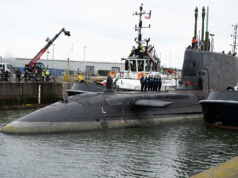

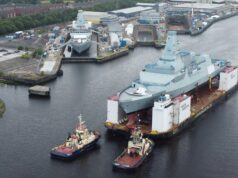
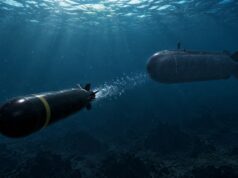
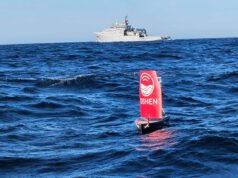
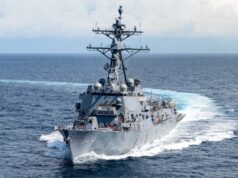


Virtual training of a virtual Navy
a drone operated and manned by drones. theres some irony in that.
Clapham Common Model Yacht Club will soon be swarming with sailors getting their practice in
Just looked at their website. Some rather technical stuff on there (eg meteorology records and sailing plan diagrams).
I look forward to the tabloid headlines in 2038..’drone warships break down again, need towing back to port, leaves carriers defenceless!’
There is serious point here though, things break, especially in the worst possible weather conditions in the North Atlantic. How, with no 24-7 engineering crew on-board, are they going to guarantee avoiding embarrassing failures like the one above?
I suspect that drone ships will be a work in progress for years to come: lots of deadlines missed, lots of cost overruns, lots of cuts made to (numbers and capability of) platforms in order to generate savings.
lets go and kick some argy asses again. maybe one of these ships will be okay for falklands guardship duties.
OK so the CCV is to become a part of Atlantic Bastion, Atlantic Shield and Atlantic Strike, all well and good so far. However what is to become the dedicated AAW platform for the carrier strike group. The original concept for CSGs was two T45s/T83s and 3 T26s plus an Astute for CSG. Now the T26s are meant to operate together with the RNoN in the High North the T83s are no more with the replacement CCVs to operate in Atlantic xyz as command hubs for drones. Somehow the carrier, RFA supply ships and future Amphibious Transport Ships seem to have been forgotten as they don’t seem to have escorts. No matter how world leading a ship is it can only do one job at a time.