

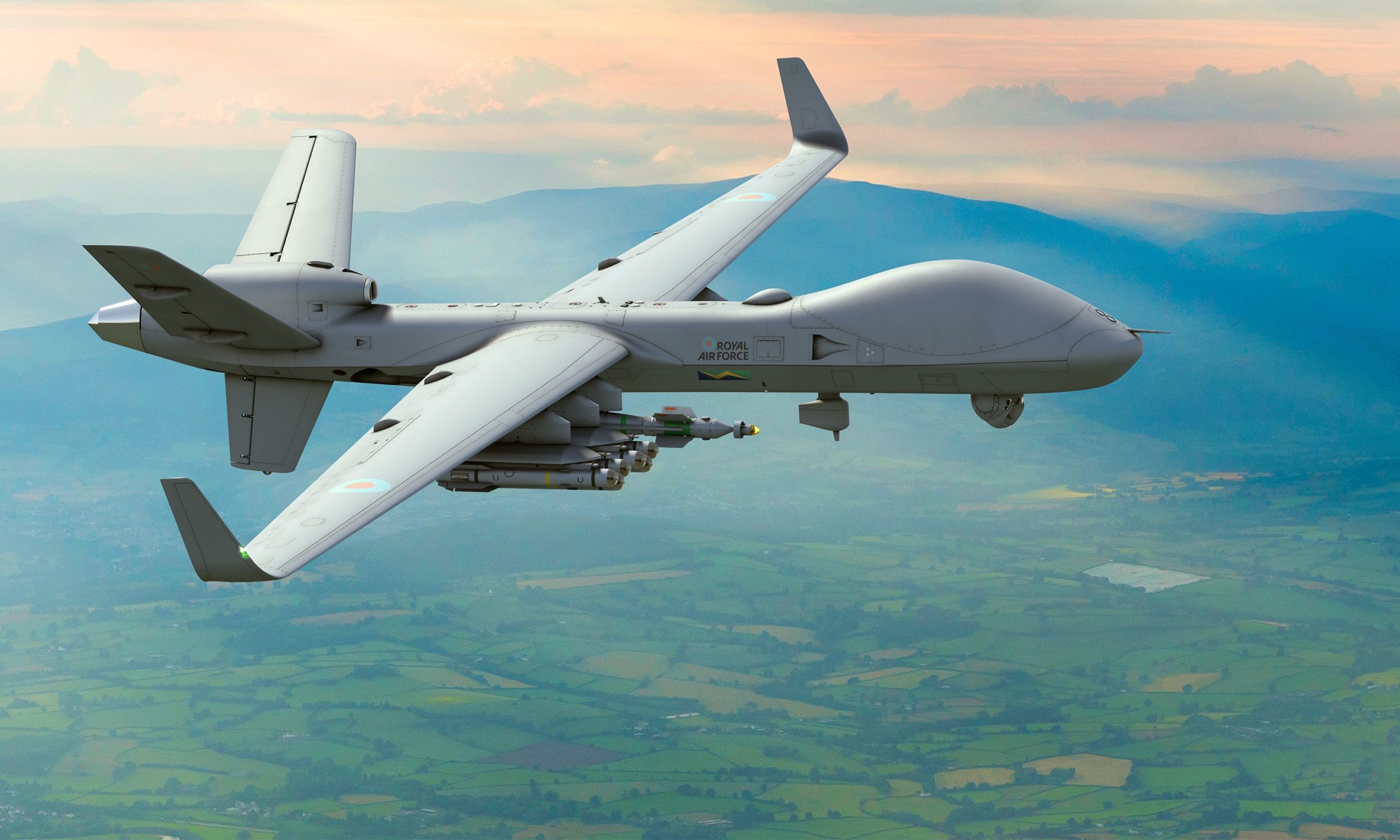
The Royal Air Force’s Protector RG Mk1 has completed weapons qualification testing, with both the Paveway IV laser-guided bomb and the Brimstone 3 air-to-surface missile cleared for launch from the remotely piloted aircraft, General Atomics Aeronautical Systems has announced at the Farnborough International Airshow.
Testing concluded on 18 June at the company’s facilities in Southern California, bringing to an end a six-year collaboration between the US and UK governments and industry, and marked the first time General Atomics has taken the lead role in completing weapons qualification for a customer, with the work conducted under UK Ministry of Defence approval and meeting all requirements for certification of the safe carriage and release of weapons, according to the company.
“The completion of U.S.-based safe-separation weapons testing is a landmark achievement for the Protector RG Mk1. It demonstrates not only the maturity of the platform, but also the ability of the programme to integrate advanced weapons with a cutting-edge, certified remotely piloted air system, delivering benefits to both the UK and our partners,” said Group Captain Rob Evans, the RAF’s Programme Director, as quoted in the press release.
“Protector will provide operational commanders with persistent intelligence, surveillance and reconnaissance, combined with highly precise strike capability, ensuring that the United Kingdom remains equipped to meet evolving security challenges in an increasingly complex security environment.”
David R. Alexander, President of General Atomics Aeronautical Systems, said the RAF is the MQ-9B launch customer and the company is there to support the service in any way it can, adding: “Leading the qualification test was a unique experience and we’re excited to complete the process so successfully for the RAF,” as quoted in the release.
The qualification arms an aircraft that already holds a distinction no large uncrewed system had achieved before, with Protector earning a Military Type Certificate from the UK’s Military Aviation Authority in 2025, the clearance that allows it to operate without geographic restrictions, including over populated areas, and separates it from the Reaper fleet it replaces, which was confined to segregated airspace. The pairing of that certification with the newly qualified weapons gives the RAF a remotely piloted aircraft able to fly from and over the UK while carrying the same British precision weapons integrated across the fast jet force, with Paveway IV the standard guided bomb of the Typhoon and F-35 fleets and Brimstone 3 the low-collateral missile proven against armour and moving targets.
Deliveries of the aircraft continue to the fleet’s home at RAF Waddington, where 31 Squadron operates the type as the RAF builds towards its planned force of sixteen aircraft, replacing the MQ-9A Reaper after more than a decade of operations over Iraq, Syria and Afghanistan. The Protector is based on General Atomics’ MQ-9B SkyGuardian, a family that has gathered momentum internationally, with the type operated by Belgian Defence and the Japan Coast Guard and on order for Canada, Denmark, Poland, Germany, India, Qatar, Taiwan and the US Air Force in support of Special Operations Command, according to the company, meaning the weapons integration completed for the RAF as launch customer establishes a path other operators may follow.





These things can’t operate in contested airspace.
US lost lots recently.
That’s like saying the England Football team can’t play In the World cup because they lose. 😁
There are numerous scenarios where a piece of military equipment might be vulnerable yet has a useful role in other areas.
Might as well scrap the entire RAF AT and AAR force, they cannot either.
Use it elsewhere then.
Agreed, I think the proof in the pudding is that the USAF are trying to get more Reapers- because they found them so useful despite them being shot down.
Drones came to the fore over Azerbaijan and Afghanistan – but as the Ukrainians found, a real air defence system makes life hard, and the Iranian one made life very hard.
We’ve missed the boat – this thing is old school with an RCS the size of a barn – it isn’t survivable on a modern battlefield.
LO UCAS are where it’s at.
And I’ll repeat, only a part of a militaries kit and overall usefulness is on a fully fledged battlefield.
I agree mate, these aircraft have plenty of use in numerous scenarios. They have never been designed or able to operate in contested air space.
They are probably most useful for us in the maritime domain as a supplement to the P8.
Agreed mate. And carrying out ISTAR in the Middle East.
Absolutely, both the above examples, plus the carrier version, ( Stol wing kit) to operate off the QE class in AEW/ ISTAR , anti Surface/ submarine roles.
If they want Crowsnest gone by 2030, then there arnt any other options, as its one of the few large drones that can safely ‘ish’ operate off an unmodified QE Class.
Do we know take off distance?
5-10 for this role should be okay
I think take off landing distance isn’t an issue, I think it can land in 150 meters, so factor the carrier going 25 knots into any available wind and it will probably roll to a stop in 60/80 yards.
The issue is, can it operate in a cross wind, how would handle a pitching deck?
Going down the center line is still far from ideal too, lots of potential for problems.
Unless you are going tiltrotor VSTOL drones, then there’s no getting away from the fact you need an angled deck to operate safely.
It would have the added benefit of of allowing F35B to perform RVL’s at higher speeds too.
Saving wear on all the lift components of this maintenance nightmare of a jet.
Would you rather put a manned recon aircraft over potentially hostile airspace.
See the article about JSM on Reaper. Spear 3 would allow for stand off strikes.
The US has lost ’24 MQ-9 Reaper drones’ in the Iran conflict, which is ‘nearly $1 billion worth of drones’ … ‘20% of America’s prewar Reaper inventory’.
But thats 24 aircraft that didn’t get shot down with their pilots going missing. Every aircraft on earth is vulnerable in any case.
Yes, thank the Lord. But at $30 million a pop that’s hardly ‘attritable’. Low cost is also a form of innovation.
Yes, thank the Lord. But at $30 million a pop that’s hardly ‘attritable’.
(There’s something strange going on with the comments system, saying you’ve already made a comment. Hence the duplicate comment.)
“But thats 24 aircraft that didn’t get shot down with their pilots going missing. Every aircraft on earth is vulnerable in any case.”
Not necessarily, a Reaper cruises at 300kph that is slower than WW2 1939 war start bomber, typically around 360 kph
All the more reason, as a related article on this site has just shown, to use stand-off weapons like NSM from an MQ-9B then?
Yes, fair enough, a drone missile truck basically. But then why do we need a $30 million missile truck? The Ukrainians are able to do this for thousands while our solutions seem to cost millions. It’s not just capability, it’s price and ease of mass production.
I think the reality is, we need a broad spectrum of UAVs, lots and lots of low-end, one-way effectors, mid-end effectors and then the more ‘exquisite’ UAVs like Protector that can loiter for hours, soaking up data and monitoring the situation on the ground and then having the ‘kinetics’ to hit hard, in a timely fashion, when the right situation arises. A UAV like this, getting NSM for example, means it can probably sit sufficiently far enough away from harm and still gather what’s needed. Maybe the use of NSM means it’ll need enhancements to its optics and IR sensors to see further, viewing all targets at the full range of NSM?
The Ukrainians can’t hit targets of opportunity from 7000km with a 400km standoff range. Protector-JSM is something else entirely from Ukraine’s weapons when it comes to long range strike and will be very useful as an anti-ship platform.
It’s more of a cheaper, unmanned alternative to using a P8 than simply a strike drone.
@TorpedoJ and @DP – yes, point taken. With the low numbers of operational surface ships and attack subs this makes sense in this context.
All the more reason, as a related article on this site has just shown, to use stand-off weapons like NSM from an MQ-9B then?
Whilst true, the military needs to be able to operate both in high and low intensity warfare. Especially as counter insurgency warfare is far more likely to occur than near peer. Plus Ukraine has demonstrated that it is possible to use drones in highly defended territory of Moscow, just requires some careful planning to find the gaps.
Could be a useful platform for ELINT and AEW.
These weapons would make it excellent for long-range patrols against small surface vessels.
A bit harsh using these In the English Channel 🤔😁
But effective
Messy.
Congrats to all involved – a great capability
The US ones lost recently were in contested war zone in Iran and associated areas. The UK ones are more useful for long range maritime patrol. Pretty decent bit of kit as our ships cannot be in more than a few places at once.
“The pairing of that certification with the newly qualified weapons gives the RAF a remotely piloted aircraft able to fly from and over the UK” to enforce extreme traffic violations on Britain’s roads.
Fixed.
Undertakers who use inside lane to speed past a block of traffic in the middle and outer lane.
Tailgaters.
The insecure racing boys who absolutely must be the first away from red traffic lights, treating the road like Silverstone, then being so impressed with themselves they get the tissues out.
Yep, them, Paveway IV would do plenty a favour eradicating the idiots.
Haha, with the state of the potholes at the moment, I doubt anyone would notice the cratering- although the scorch marks may be a giveaway…
I see a Count Binface policy review here if he wins.
The important thing will be not to get sucked into using these in contested space.. they are not cheap and best used for long range ISTAR sneaking around the edges..
Tier 1 Expendable.
Tier 2 Attritable, but more expensive.
Tier 3 Survivable.
These will very much be Tier 3.
does anyone remember when David Cameron announced these ten years ago. After ten years we finally got it to the level of having a basic weapons fit that the previous generation had already.
Yes, for 24 I recall? While announcing Strike Brigades that could operate independently hunting terrorists!
Assume he was influenced by CGS CDS talking of French wheeled ops in Africa.
It does seem to me that the understandable focus on getting equipment that can be used in a major european land war has led to a loss of focus on all the other capabilities our armed forces need. I think its fair to say that the next war is rarely the one you think it will be (how many actually saw the falklands coming, or the sudden rush into afghanistan to support the final withdrawal, or medics being aridropped onto remote islands to support an infectious disease case). Plenty of better examples I’m sure.
Anyway, the british armed forces it seems to me have always been able to handle a wide range of deployments. Perhaps these drones won’t last long in eastern europe, but perhaps in practice that’s not where and what the next deployment for them might actually be.
Exactly.
There’s very little to stop us utilising these in a land war in Europe while other units conduct SEAD, but as you say, they offer capability beyond just that. With a public maximum range of 6,000nm or 11,000km (which would obviously be reduced depending on weapon load), Protector can reach anywhere from Morocco to Afghanistan, including Russia. Or it can make the transit to the Falklands from Ascension.
It’s a big, long-endurance platform, which brings a lot of options. Are we utilising them to the fullest? No. Do we have enough to be sustainable in a conflict or cover everywhere we’d want them? Also no. However, it’s better to at least have the foundational capability than not have anything at all, and our current options for long-range strike are pretty limited.
I am surprised that the old Reapers were sent down to the Falkland’s, just for a maritime surveillance role. Pretty certain they could be refurbished to extend their lives.
Any opportunity to save money. Kit that could still walk into many a nations armed forces discarded.
Blame Gordon Brown. He created a rule that any kit the MoD was not actively using had to be sold or he would fine them. This is why so much old but still useful kit has been sold off for pennies. Contrast with Ukraine & Russia who are able to fight for 4 years+, by raiding old soviet stockpiles.