


General Atomics and Kongsberg have completed the first design reviews for integrating the Joint Strike Missile onto the MQ-9B, the uncrewed aircraft family that includes the RAF’s Protector, in a jointly funded effort to give the drone a long-range stealth strike capability, the companies have announced at the Farnborough International Airshow.
The System Requirements Review and Preliminary Design Review were successfully completed at Kongsberg in Norway on 30 June, according to the companies, with the design and integration project funded jointly by both firms rather than by a government customer, aimed at providing long-range strike for the MQ-9B and the growing list of nations that operate or have ordered it.
“We recognise the value JSM brings to our MQ-9B platform,” said Niki Johnson, General Atomics Aeronautical Systems’ Vice President for International Capture and Government Affairs, as quoted in the press release. “This integration effort shows how industry can effectively collaborate to integrate new capabilities and make them available quickly to our warfighters.”
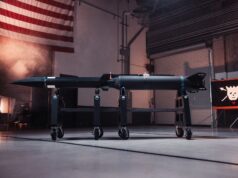
The pairing puts a weapon designed for fifth-generation fighters onto a long-endurance drone, with the Joint Strike Missile a stealthy air-to-surface weapon developed from Kongsberg’s Naval Strike Missile for internal carriage in the F-35, engineered to evade advanced defence systems and strike high-priority targets on land and at sea at ranges of hundreds of kilometres. The missile has been selected by Norway, Japan, Australia, the United States and Germany, according to Kongsberg, and its arrival on the MQ-9B would let the drone threaten targets from well outside the reach of many air defences, addressing the survivability question that hangs over large, slow uncrewed aircraft in contested airspace.
“Having JSM integrated onto an uncrewed air platform – the MQ-9B – enables a highly capable strike mission set that can be employed in conjunction with or independently of piloted aircraft. This is an operational capability that we’re seeing greater interest in across the defence sector,” said Jens Gjestvang, Kongsberg’s Senior Vice President for Missiles and Aerostructures, as quoted in the release.








The JSM on protector would be really potent with a possible range of 345 miles on protector that has a 5000miles..In the end firing a missile from 345 miles away from danger is a very good use of protector.
Makes the case for P-8A/ Protector (SeaGuardian) pairing for patrolling the GIUK gap that much stronger!
Indeed. With no planned increase to the frigate fleet, it would also add some real teeth to the Atlantic Bastion concept; detachments of Protectors could deliver weapons on targets detected by persistent drones
Absolutely, and it’s the kind of relatively permissive environment that makes the cost/risk evaluation stand up.
SeaGuardian, whilst obviously not a P-3 or P-8, is still pretty good, 40-80 sonar buoys depending on A or G model, can swap out sonarbuoy pods for lightweight torpedo’s. Much better loiter time than the P-8. Has a fairly good systems including it’s radar, and lastly sits around $60m a piece instead of $250m.
It would really help us cover more area in the North Sea, and work brilliantly in tandem with the Poseidon. Additionally if we get a STOL version, we could actually fly it from the QEC’s to give the carriers some fixed wing ASW capability.
Yes, the case makes itself really. Plus, it ties into the hybrid navy concept well too, without any downsides that I can see (unlike the surface fleet).
Even if we weren’t to get the STOL kits (although I think we should) I think there’s plenty of justification for expanding the protector fleet to take on the maritime role out of Lossiemouth alongside the P-8As.
JSM on MQ9 rather than F-35B on QE?
Careful, you’ll give the RAF ideas about long-range bombers replacing carriers again…
Can you fly MQ9 off a 160m flat top MRSS?
No, but off the QEs it should be able to do it easily if questions around deck handling are answered.
Would allow some quite interesting access to northern and eastern Russia from the Atlantic and be handy in the Pacific too.
Are you sure it can use the ramp?
No I’m not, that’s one of the questions on deck handling!
The ‘angled deck’ run is the same length as the ramp, but that would interfere a lot with the F35 deck parks.
The deck handling thing has always puzzled me as an argument. Wingspan is roughly the same as an E2-D, length isn’t far off, although the Hawkeye obviously has more mass. But the french operate E-2 off of the CdG, which has a smaller deck than the QE class without issue. Or, at least, the capability provided is worth the hassle.
I put the SeaGuardian in the same bracket. I just don’t see it as an effective argument for why not. Of course, I’m a civilian, so I may be missing something and happy to be corrected…!
No, the STOL version can be flown off the America class according to General Atomics, 257m long, and with a ramp you should be able to drop down to 220m flight deck allowing for the Juan Carlos and Trieste to operate them as well.
160m with a ramp might manage the smaller Mojave but that lacks in everything compared to the MQ-9B.
But still no ASM for our P-8’s 🤔
Although if a P8 has a pair of these armed with JSMs it does not need them itself…
While the name is Ok, Scavenger was so much better IMO for what these do in the ME.
So presumably this means that apiring the NSM with Protector would also be possible?? A naval strike concept based on remote launch platform might be interesting idea.. using airborne rather than sea based platform .. easier RTB for reload, greater area coverage etc .. just a thought
Pairing..not Pairing.. bl**dy autocorrect issue
BUT…. will we buy it? Very good idea though. I hope we do.