

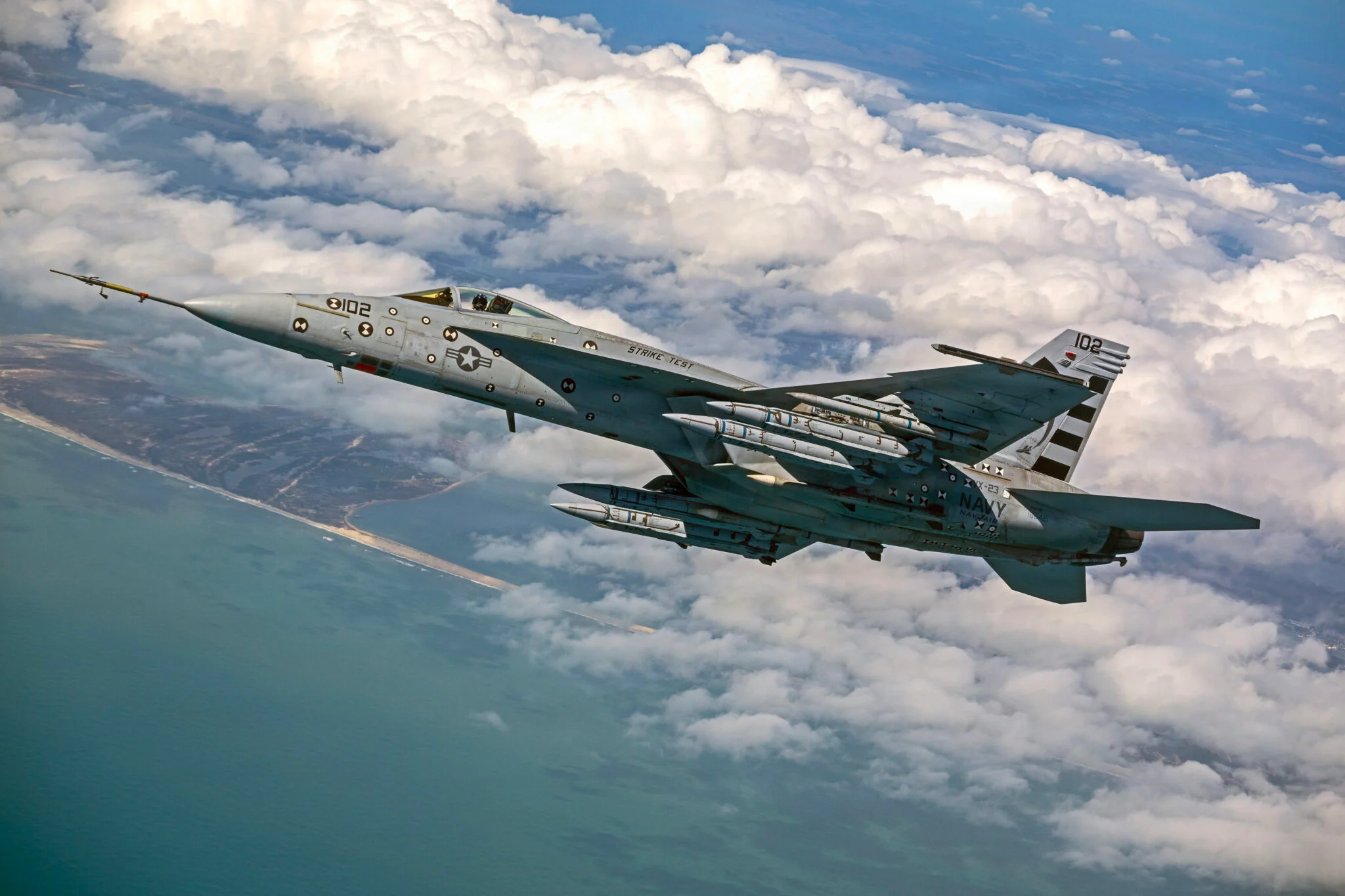
The US Navy has publicly disclosed the AIM-424 Malice, a new very-long-range air-to-air missile from Raytheon with an officially stated reach of more than 250 nautical miles.
The US Navy has revealed details of a previously undisclosed very-long-range air-to-air missile, the AIM-424 Long Range Air-to-Air Missile, known as Malice, with an officially stated range exceeding 250 nautical miles, the UK Defence Journal understands.
The weapon is being developed by Raytheon for US naval and Marine aviation and is intended for fourth, fifth and future sixth-generation combat aircraft. According to the Navy’s newly published fact file, AIM-424 has a range of more than 250 nautical miles, approximately 463 kilometres or 288 statute miles, placing it well beyond the publicly stated reach of most existing Western air-to-air missiles.
The Navy describes Malice as a next-generation weapon intended to strengthen fleet air defence against advanced airborne threats. The service says the missile is designed to increase the reach, lethality and survivability available to naval aviators, allowing fighters to engage targets from substantially greater distances than current-generation weapons.
The missile is listed as measuring 13.5 feet, or 4.11 metres, in length, with a diameter of 13.5 inches and a wingspan of 26.2 inches. Its stated weight is 1,500lb, approximately 680kg. Propulsion is provided by a solid-propellant rocket motor, while the warhead is described as blast fragmentation.
The Navy said in its fact file: “The Department of Navy is developing the Air Intercept Missile (AIM)-424 Long Range Air to Air Missile (LRAAM), a next-generation missile intended to strengthen fleet defense and maintain a decisive air domain overmatch against advanced threats.”
It added that the weapon, “directly supports the Department’s contribution to integrated deterrence by increasing range, lethality, and combat effectiveness for Marine and Naval aviation forces that are defending our fleets, our interests, and our homeland.”
Official imagery associated with the disclosure shows the missile integrated with US Navy fighter aircraft, including the F/A-18E/F Super Hornet and F-35C Lightning II. The Navy’s published specifications state that the weapon is being developed for fourth-, fifth- and sixth-generation platforms, although the fact file does not set out the precise integration configuration for each aircraft or confirm the number of missiles that could be carried internally or externally.
That distinction is particularly relevant for the F-35C, where internal carriage is important to preserving the aircraft’s low-observable characteristics. The information released by the Navy confirms the broader fifth-generation integration requirement but does not provide detailed information on weapon-bay arrangements.
The AIM-424’s range is one of the most notable elements of the disclosure. At more than 250 nautical miles, it is intended to give carrier air wings the ability to threaten hostile aircraft, including potentially high-value support assets, from considerably greater stand-off distances. Actual engagement range in combat would depend on factors including launch altitude and speed, target manoeuvres, sensor support and the missile’s flight profile.
The Navy describes the capability in terms of maintaining a “first look, first shot, first kill” advantage, saying Malice is intended to provide greater tactical flexibility while reducing the need for launching aircraft to approach heavily defended threat aircraft as closely.









It looks kind of like an ESSM with a sharper nose, the AIM-424 is a bit larger according to the sated specs though. There are photos with an AIM-424 in the weapons bay of an F-35C, along with an AMRAAM.
“The Navy describes the capability in terms of maintaining a “first look, first shot, first kill” advantage, . . .”
That only works if the target can be identified at that range.
Perhaps the longest-range, or second-longest-range, air-to-air missile in service, depending on which range stats you believe for the Chinese PL-17.
Meanwhile, the RAF operates Meteor, a piece of kit that has gone from best-in-class to rather dated in under a decade. I have a distinct sense that the RAF will get what they want from their replacement programme, much as they got what they wanted from the DIP.
Hard to be annoyed at it, though. They’ve been the UK’s most critical combat arm in recent years.
I don’t think it’s dated to be honest because there is a difference in long range with a high speed boost and glide like AIM 260 vs continuous power from a RAM jet like Meteor.
AIM 260 has a dual pulse motor to overcome some of the limitations that AMRAAM has but it’s unlikely to have as large a no escape zone as meteor.
I think the lack of an AESA radar seeker in Meteor to allow a low probability of intercept track is a bigger issue.
However western fighters potentially being able to operate both AIM 260 and Meteor at the same time will massively complicate an adversary threat assessment because it’s likely that evasion patterns for the two missiles will be different.
Add in this new AIM 424 and it’s going to be even more with all three missiles likely available on F35 simultaneously.
Thank you for giving the rational take Jim, seriously calling Meteor dated is ridiculous, just as calling every other missile the past decade with shorter range than Meteor ‘dated’ is crass too. So much more to consider, tired of these black and white takes when nuance is the dominating factor. Our potential enemies have had longer range air to air missiles than the West for years but doesn’t mean all ours are thus dated or lacking in capability. Range and kill zones are interactive factors of effectiveness for a start.
From what the French have been saying STRATUS RS might be filling in a similar role for the UK as a hyper long range AWACS/tanker killer. Sattelite radar constellations in low earth orbit are going to be the next major battleground we have to conquer.
Hyper long range missiles with satellite targeting may make our entire airforce obsolete including Tempest, Unfortunately the US can no longer be trusted as a sole development partner for such a system. We really need a NATO or CANZUK collaboration on such a system.
The Europeans are taking action here, time and ultimate capability are the questions mind. Where this leaves Britain is the other one, I suspect Canada will be welcomed into it.
AIM 424 is another major reason for the UK to buy F35A.
Even a small number of F35A equipped with such a weapon could screw up any air component the Russians could field against us. Russian long range bombers in particular could be very vulnerable to this.
Yay, let’s back up the hugely expensive US-dependent fighter with a hugely expensive US-dependent missile. What could possibly go wrong?
MBDA is already developing the Comet missile, which will be longer-ranged than Meteor and is supposed to enter service by 2030. Why rush towards a product made by a less friendly country with no UK industrial content?
Precisely. Simply evolving Meteor with an updated seeker and a little more propellant would allow us to more than match this capability while maintaining sovereignty.
Fundamentally, a rocket engine will never be as fuel-efficient as a (well-designed) ramjet. Rocket propellants are essentially a known science – there haven’t been any massive developments since at least the 1970s.
To achieve the ranges indicated here with a rocket requires some significant compromises – just looking at the stats, the Malice is 12% longer, almost 2 times the diameter, and a whopping 3.6 times heavier than the Meteor! Have fun fitting that into the F35’s already cramped weapon bays.
Comet is apparently going to be rocket propelled and longer ranged than Meteor, so it isn’t that simple. The problem with Meteor is that the ramjet body itself takes up so much space and causes so much drag that you might as well have simply made a larger and fatter rocket motor carrying the oxidiser along. Add in the great improvements in energetics density and dual-pulse motors over the last decades- BAE have some interesting developments in explosive and solid fuel mixing- and solid rockets have made leaps since Meteor was introduced that ramjets have not kept up with.
That isn’t to say that with more development ramjets couldn’t regain the edge, but at the moment Meteor doesn’t fit the trend of ever longer-ranged and more compact rocket AAMs.
Can we have some please for Typhoons. With the new ECRS Mk2 and the AIM-424 combined with a updated Meteor the Typhoon fleet would be able to deal with any incoming bombers from Russia 500 km north of the Greenland-Iceland-Faroe-Shetland-Norway line.
With an advance radar picket line Greenland-Svalbard-Bear Island-Norway with a second line Greenland-Jan Mayen-Norway. It looks like the Thales GF300 or Thales GM406 (GM400a is better)could do the trick. The cost of a GM406 system is $30 million per system so the complete picket line would cost about $500 million. WE could stop all incoming Russian bombers coming into the North Atlantic-Scotland-Iceland and North Sea.
The question then is do they need defending of are they expendable? I my self would give the outer picket a full defence of Aster30 NG/CAAM/Skyranger30. The second line CAAM/CAAM ER/ Skyranger 30. The third line would be CAAM/Skyranger and Typhoons. With a company of troops for ground defence.The cost of 4 SAMP/T batteries is about £2 billion, for 10 CAAM Batteries £3billion the cost of the SkyRanger battery I could not find but if we said the total air defence cost from Greenland-Svalbard-Bear Island-Norway South would cost £6 billion is it worth it? Think in a different way we could stop the Tu160 with their Kh55 outside their range of engagement. Lossiemouth is safe, the Clyde is sake and the North Atlantic is safe (well at least from air attack).
All we then need to do is build a new SOSUS line or lines based on the anti-air picket lines.
I will admit I do not know the difference between a fixed sonar array and a towed array. Hopefully they are not to different and we could use CAPTAS 4 or type 2065 in a fixed array position.
The cost is not to much but possible it could be paid for by all of Europe rather than the UK alone.
The N.Atlantic convoys from N.America to Europe then becomes a submarine issue and the RN is good at that. I really would like to see a Type 23 go up against a latest Arleigh Burke in ASW warfare. The AB going against an Astute and the T23 against a Virginia.
A towed-array is a long, thick wire trailed behind the ship. It contains lots of sonar sensors that listen passively for noise or actively emit low-frequency noise and listens for the return. It has a hydrodynamic body at one end that controls the array’s depth in the water and keeps it stable. By trailing it behind the ship, the array is less sensitive to noise from the ship itself, making it better at detecting submarines.
A fixed sonar, more commonly known as a hull-mounted sonar when installed on a vessel, is attached permanently to a ship’s hull, It provides an ‘always on’ passive listening capability, and can be used to sanitise an area with medium-frequency active sonar pulses.
Does he mean what you’ve stated, or does he mean a Fixed bed array as in a new SOSUS array which are fixed arrays?
Leverages the ESSM airframe and propulsion
Not necessarily, the most detailed amateur analysis I’ve seen suggested that it uses an evolution of the mk104 rocket motor from SM-2 and SM-6 packaged into as small an airframe as possible. The ESSM motor isn’t designed for such long range, it’s a short range inner layer behind the Standard missiles and won’t have the right burn rates. Also Malice weighs more than twice as much as ESSM, the similarity is only visual.
There’s rumours its a two stage design.
The analysis I’ve seen of the images suggested that it consisted of a large booster and a tiny little glide effector separating just near the front of the strakes; in the close up image there is a gap and a ring of bolts there which suggested a stage break.
That might make up for the tiny strakes that would otherwise limit manoeuvrability.
The real headline here isn’t just the staggering 250+ nautical mile range—it’s the dimensions and the internal carriage.
Up until now, the US Navy’s answer to long-range threats was the AIM-174B, which effectively forced a choice between stealth or reach. You could have massive range, but it had to hang off the wing of a Super Hornet like a telegraph pole, ruining the aircraft’s radar profile. The fact that Raytheon has managed to pack a 13.5-inch diameter motor into something that actually fits inside the internal bay of an F-35 completely changes the geometry of the air fight.
The big question from a UK perspective is physical compatibility with our own fleet. We know it fits the F-35C, but does the airframe length allow it to sit inside the shallower internal weapons bay of the F-35B? If the B-model is locked out due to space constraints, the Royal Navy will remain entirely dependent on Meteor for carrier air defence—which is a phenomenal missile, but lacks that extreme sub-strategic reach.
Either way, this completely validates why the UK and Italy are keeping GCAP’s internal weapons bays highly adaptable. Getting trapped by hardware-defined limits is a massive mistake when missile tech is evolving this quickly.
Yes the logic of GCAP is becoming pretty clear. The Swedes have a big decision to make with their next interceptor as that valued ability to operate from remote locations and roads is very much under threat logically to other capabilities and of course now that they are an integral part of NATO so with Ollie give and wider responsibilities. Interested to see what they come up with to solve this conundrum.
The Swedish dilemma perfectly illustrates the tension between mass and specialised doctrine. Their historic reliance on dispersed highway operations and short turnarounds requires a light, agile airframe like Gripen. But as an integral NATO member with wider regional defence obligations, they now face threats that require the extreme, sub-strategic reach of weapons like Malice.
If they opt for a heavier, long-range interceptor to meet those alliance requirements, they risk compromising the very road-basing agility that kept them survivable. It perfectly validates why a modular internal architecture—like the one being designed into GCAP—is vital. You cannot afford to lock an airframe into a single doctrine when the threat profile and missile dimensions are shifting this rapidly.
Struggled to read your comment due to the obvious use of AI.
And why would you think its AI?? is it the use of double spacing, punctuation and correct grammar and spelling that you don’t like or are you just an arse hole??
Sadly the F35A/C weapons bay is 14 ft (4.27m) long, whilst the F35B’s is 12 ft 8 in (3.86m) long. Meteor for example is 3.65m (12ft) long. The F35B weapons bay is therefore too short to fit the AIM-424, which is 13.5ft (4.11m) long. The rumour for the Stratus-RS, is that it will be around 5m long. So again too big for the F35B’s weapons bay. Though there’s nothing stopping MBDA from building either a scaled up (chunkier) Meteor or a smaller Stratus-RS, specifically for the F35B’s weapons bays.
Thanks for pulling up those exact measurements—they layout the physics problem perfectly. It really highlights the long-term dilemma the Royal Navy faces by relying entirely on a STOVL carrier fleet. While our partners flying the F-35A or C can exploit these longer, next-generation weapons internally, our F-35B fleet is permanently restricted by the space stolen by that lift-fan.
Relying on MBDA to develop a shrunk-down variant or a chunkier Meteor specifically for our bays is an option, but the specialized engineering and integration costs would be a massive headache for the Ministry of Defence to justify right now. It just reinforces why keeping GCAP’s internal bays as large and adaptable as possible is so critical. Getting boxed into fixed hardware limits when missile technology is moving this quickly is a massive trap.
The size of the GCAP’s bay/s will be crucial for future air dominance and persistence. As the bay sizing will dictate what weapons and in what number they can be carried internally. However, the size of the bays, must be juggled with structural soundness, the engine’s air intake needs and where to put fuel. I have a feeling the bays will be much larger than those found on other 5th/6th gen jets. As the RAF are requiring not only a bigger internal payload carriage, but the idea that the aircraft needs persistence in the battle space to win and dominant an area. Therefore, the jet will be reliant on what it brings to the fight. Though this may be supported by loyal wingmen aircraft, if they have the range, speed and low observability.
I do know that one of the RAF requirements, is that each of the GCAPs bays must carry at least twice the internal payload weight of the F35A. The bays won’t for example be able to be made bigger once in production. But they could include temporary structures to change the compartmentalisation of the bay, i.e. divide the length into two halves etc. Which may be needed to control the bay’s internal airflow turbulence when the doors are open. I suspect the bay sizing will be maximized to carry at least 8 BVRAAMs internally. As this would give a 2 shot advantage over other 5th/6th gen platforms, that carry either 4 or 6 BVRAAMs internally.
I do know that MBDA are looking at a replacement for Meteor, where the UK and French legs of the company have teamed together. The question is will this be made bigger to accommodate the available space provided by GCAP (possible French FCAS), or will it be kept smaller to fit the bay of the F35B? France aren’t concerned with the constraints of the F35B, so I suspect it will be made bigger. Though there will still be a need for a Meteor sized weapon for both Typhoon and Rafale F5 going forwards. As they need a weapon that can still fit the semi-recessed missile cut-outs in their respective airframes, not forgetting the smaller length of the F35B bay.
I have heard that Lockheed Martin are looking at rearranging the internal layout of the F35B’s bays, as they are limited to carrying 2 BVRAAMs. Unlike the A and C versions that can be equipped with the Sidekick modification, that increases the count from 2 to 3 per bay. The B’s bay is not only shorter, but I believe shallower, due to where the lift fan needs to be accommodated. Also due to the wiring, plumbing and other odds and sods in the bays, have dramatically eaten in to the B’s bay volume. So they are looking if it can be rearranged to give more volume.
It would be fairly easy to design a Meteor variant that was wider (fatter) in diameter and of a similar length. However, there are a number of considerations that need to be addressed. The first is the increased drag. Meteor already is very draggy, due to the two air intakes and their ducting. By also increasing the frontal area and the overall surface area (not forgetting the reduction of the fineness ratio), the drag penalty will rise quite a bit. Plus if the intakes are kept the same size, the overall speed performance will be lower (same thrust vs increased drag). Range however, will be dramatically increased (same thrust vs more fuel time on thrust), where you could be adding at least another 80km to 100km (conservative estimation), i.e. giving a 300km+ ranged weapon. Though there is also the opportunity to increase the size of the intakes to take in more air, which would restore some of the speed performance. Or go the whole hog and design a wider singular intake, which should be better for overall engine performance, but may limit the weapon’s aerobatic capability. If the F35B is going to be limited to only 2 BVRAAMs per bay, pending LM’s study, it may be worth maximising the available space to make a fatter Meteor, thereby giving it a better air to air stand-off capability.
The ideal solution though would be for the two carriers to converted to CATOBAR, and we get the F35C. So we’d be able to fit it with longer weapons carried in the larger weapons bays! Like that’s ever going to happen!
Thanks for pulling up those metrics—it is a fantastic technical breakdown of the physics problem. The point about Lockheed Martin running a study to rearrange the F-35B’s internal plumbing and wiring is fascinating. It shows just how desperate they are to claw back volume, especially since the B-model misses out on the Sidekick modification.
Your aerodynamic analysis of a ‘fatter Meteor’ is a really sharp assessment too. Dealing with the extra drag penalty from the twin ramjet intakes would be a massive headache, but pushing the range out past 300km by maximising the fuel volume might be the only logical way to offset the fact that the F-35B is permanently stuck with a two-missile capacity per bay.
And yes, the CATOBAR conversion dream for the carriers is the ultimate elephant in the room! It’s the perfect reminder of why getting boxed into fixed hardware limits early on is so dangerous. A massive double payload requirement for GCAP over the F-35A is exactly the kind of ambition the RAF needs to be tracking if we want true persistence in the future battlespace.
Will it be integrated onto the F35 before Meteor??
Of course. American weapon. Why buy something non-American that has inexplicably gone from best missile in the world to obsolete in a jiffy.
AA
Well the message is not lost even here is it, with claims we must buy it and buy F35As to exploit it above, so clearly even in this concerning global and US unreliability us ke we find ourselves the message is apparently working.
It’s amazing, isn’t it. Not hard to see how we become incapable of independent action.
That is the crux of the entire issue, Pencilfish and Spyinthesky. Independent action requires sovereign control over both the platform and the weapon.
If the UK rushes to buy an American missile like the AIM-424 that doesn’t even fit inside our F-35B fleet, we completely surrender that operational independence. This is exactly why maintaining the Meteor timeline and ensuring GCAP has highly adaptable internal weapons bays is so critical. True independence means building and deploying our own tech without waiting for a green light from Washington.
On a side note, Pencilfish—there is nothing “AI” about advocating for sovereign British defence capability, nor is there anything artificial about using traditional double-spacing, proper punctuation, and complete sentences. I suggest we stick to debating the hardware rather than analysing typing habits. ok?? 🙂
We seem to be in a bit of a golden period of American missile development with the USAF’s AIM-260 JATM, USN’s AIM-174B Gunslinger, and now AIM-424 Malice. It explains why the US suddenly became very liberal about who they’d sell the AMRAAM D variants too, previously restricted to just a few countries such as the UK.
They are clearly worried about a Pacific theatre war over vast ranges, and keeping their carriers at a safe but operationally effective distance.
The F35B is going to become increasingly important in Pacific theatre war doctrine too, as the USMC’s LHA’s provide a much needed dispersed capability that a small number of large operational CVNs can’t provide. So I’d like to think F35B compatibility is a priority, and the the UK can potentially benefit from this.
We seem to be in a bit of a golden period of American missile development with the USAF’s AIM-260 JATM, USN’s AIM-174B Gunslinger, and now AIM-424 Malice. It explains why the US suddenly became very liberal about who they’d sell the AMRAAM D variants too, previously restricted to just a few countries such as the UK.
They are clearly worried about a Pacific theatre war over vast ranges, and keeping their carriers at a safe but operationally effective distance.
The F35B is going to become increasingly important in Pacific theatre war doctrine too, as the USMC’s LHA’s provide a much needed dispersed capability that a small number of large operational CVNs can’t provide. So I’d like to think F35B compatibility is a priority, and the the UK can potentially benefit from this. A second integrated VLRAAM is an important insurance policy given how we are at the mercy of our disjointed European allies for Meteor production.
The wake up call wasn’t Russia vs Ukraine, but the recent India vs Pakistan spat. Where the World got to see how well the so called export version of the PL15 performed. Especially when it was 3rd party controlled via an AEW aircraft. At a conservative estimate, PL15 has a 50 to 75km range advantage over AMRAAM including the AIM-120D version. Which if operating from a F18 Super Hornet vs a stealthy Chinese J31, means the pilot of the F18 is at a severe disadvantage. Hence the sudden rush to integrate the AIM-174 (top end of the SM6) on to the jet. This should balance the equation, but only if the J31 doesn’t have a PL17 under the wing, which could be a match for the AIM-174. A Chinese AEW platform should see the F18 long before a E2D will see the J31. The AIM-424 swings the advantage back to the US, as the F35 is supposedly stealthier than a J31. So the combination when operating with an E2D, should readdress the range problem with both the PL15 and PL17.
As I mentioned above, the AIM-424 is too long to be fitted in the F35’s weapon bay. It would have to be carried under the wing. The best thing for the USMC. is to purchase Meteor, as that has a similar range to the PL15. Which would maximise the benefits of the F35s stealth if carried internally instead of the lower ranged AMRAAM. Though they’ll more than likely go for the AIM-260 instead, which also has a similar range to Meteor.