

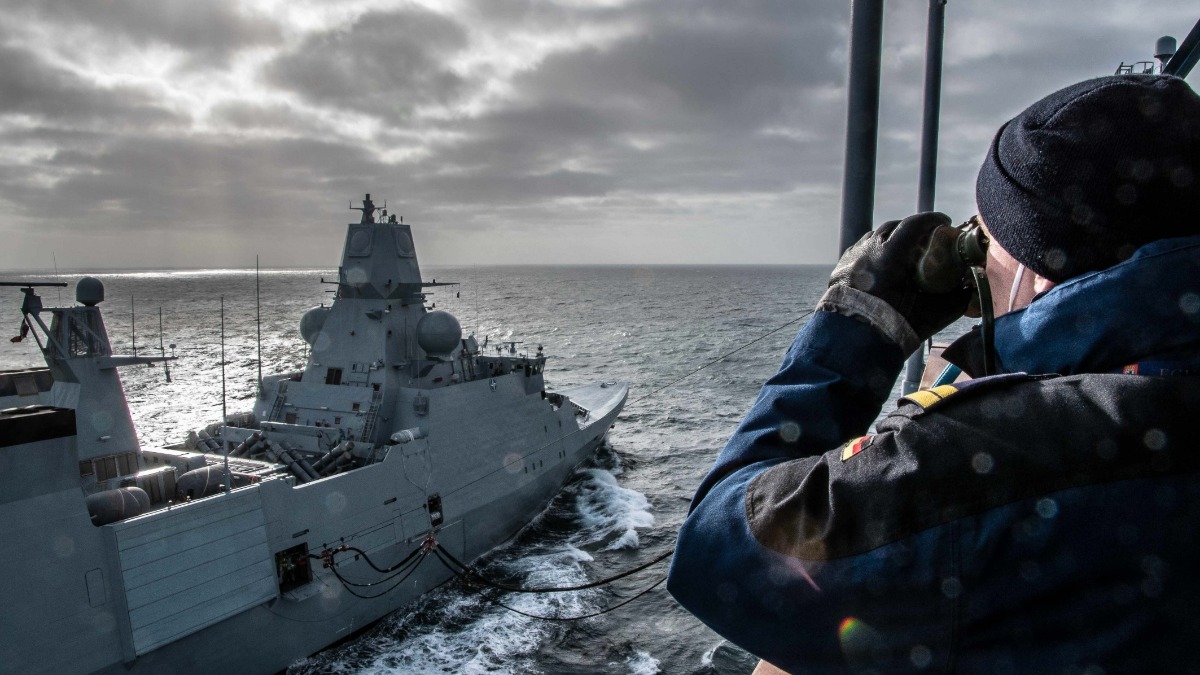
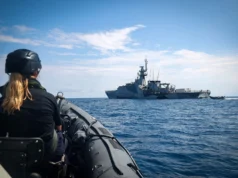
France has assumed command of Standing NATO Maritime Group One from the Royal Navy after a four-month UK-led deployment spanning the Baltic, High North and western Atlantic.
France has taken command of NATO’s Standing Maritime Group One from the United Kingdom, with Rear Admiral Nicolas Molitor succeeding Royal Navy Commodore Maryla Ingham during a ceremony in Reykjavik, Iceland, the UK Defence Journal understands.
The formal handover took place on 19 August after a four-month UK-led deployment covering operations from the Baltic Sea and Arctic to the eastern seaboard of the United States. According to NATO Allied Maritime Command, the British-led battle staff included personnel from Belgium, Germany, Poland, Portugal and Spain, with ships from a wider group of allied navies joining the task force at different points.
During the deployment, the group participated in Baltic Sentry and Arctic Sentry, Exercise Dynamic Mongoose, FLEETEX 250 and the International Naval Review marking the 250th anniversary of the United States Navy. Operational activity also included anti-submarine warfare, gunnery, boarding operations, manoeuvring exercises, casualty evacuation drills and work connected with the protection of critical national infrastructure.
Ingham said, as quoted in a NATO news update: “Leading Standing NATO Maritime Group One has been a great privilege. I am incredibly proud of my Battle Staff and the ships from across the Alliance that have served alongside us, demonstrating NATO’s unwavering commitment to collective defence and deterrence.”
She added: “Throughout my tenure, we have shown that our strength at sea comes not from any one nation, but from the unity, trust and professionalism that bind us together as Allies. In an increasingly complex security environment, that solidarity remains our greatest strategic advantage.”
The deployment also marked a first for the Royal Navy. Ingham’s battle staff initially operated from the German frigate FGS Sachsen before transferring to the Canadian frigate HMCS Ville de Quebec, making it the first Royal Navy-led task group to command operations successively from warships belonging to two allied nations.
While embarked aboard FGS Sachsen, the Royal Navy also deployed a Wildcat HMA2 helicopter from 815 Naval Air Squadron. NATO said the aircraft supported surveillance, reconnaissance and force-protection missions, increasing the group’s ability to maintain situational awareness across its operating area.
The task group drew ships from Belgium, Canada, Denmark, France, Germany, the Netherlands, Norway, Portugal, Spain, Turkey and the United States during the UK command period. NATO said the multinational composition demonstrated the level of integration within its standing naval forces, particularly in areas such as anti-submarine warfare, maritime aviation and cross-deck operations.
Senior NATO and national commanders also visited or worked with the group during the deployment. These included Commander Task Force Baltic Rear Admiral Stephan Haisch of the German Navy, Royal Navy Fleet Commander Vice Admiral Sir Steve Moorhouse and Commander Joint Force Command Norfolk Vice Admiral Douglas Perry of the US Navy.
Standing NATO Maritime Group One is one of the alliance’s four standing naval forces and is maintained at high readiness for maritime security, deterrence and rapid response tasks. Its operating area is principally focused on northern European and Atlantic waters, although deployments can range considerably depending on NATO requirements.
The transfer to French command places Rear Admiral Molitor and his staff in charge of the group as it continues operations under Allied Maritime Command. NATO describes the standing force as part of its permanent maritime posture, intended to provide a readily available multinational naval formation without having to assemble a new task group for each emerging requirement.




Wonder if the French command is based on a French ship?
using warships belonging to two allied nations is not an accomplishment, it’s a failure.
It does read like that. Almost an admission that we dont have enough ships.Next thing you now will be nations chipping in to help our defence budget.
some navy not up to quality type 45 british ships spain to busy crawling coast like just before vikings ittalians have swordfish for a navy navy was never any real quality gealic that region so same balloons from old perspectic land ppl really few slow m o,s
besides that home buisness raw materials silks etc developing them supply europe uk america muslims sell more dresses to saudi arabia
ill take my freeeeee percent top
what about prison brand we can sell that not cops
new in them lighter buisness supply items prison logo sell to inmates allowed id pocket look cool fashion thats aloud get them number printed on lighters mug prisoners make them do ebay option buy mattress duvets keep alot buissness going
thought tobecco was duty freeee like
star next zippo new spicific lighter factory freeeeee mason hand shake chinese steel profitable or shefield steel pure quality
1 diffrence they do there thing on steel think alot of items do like that cheap volume pure chinese use it up good strategy
Craig, the fuck is this title?
“France takes NATO naval command from UK”
It’s not perfidy, it’s normal procedure. Report it as such. Sounds like shite a Russian would characterise it for division clicks.
hardly take stuff unuiqe size bed safe money saving to
Well they can’t do a worse job and most of their stuff works