

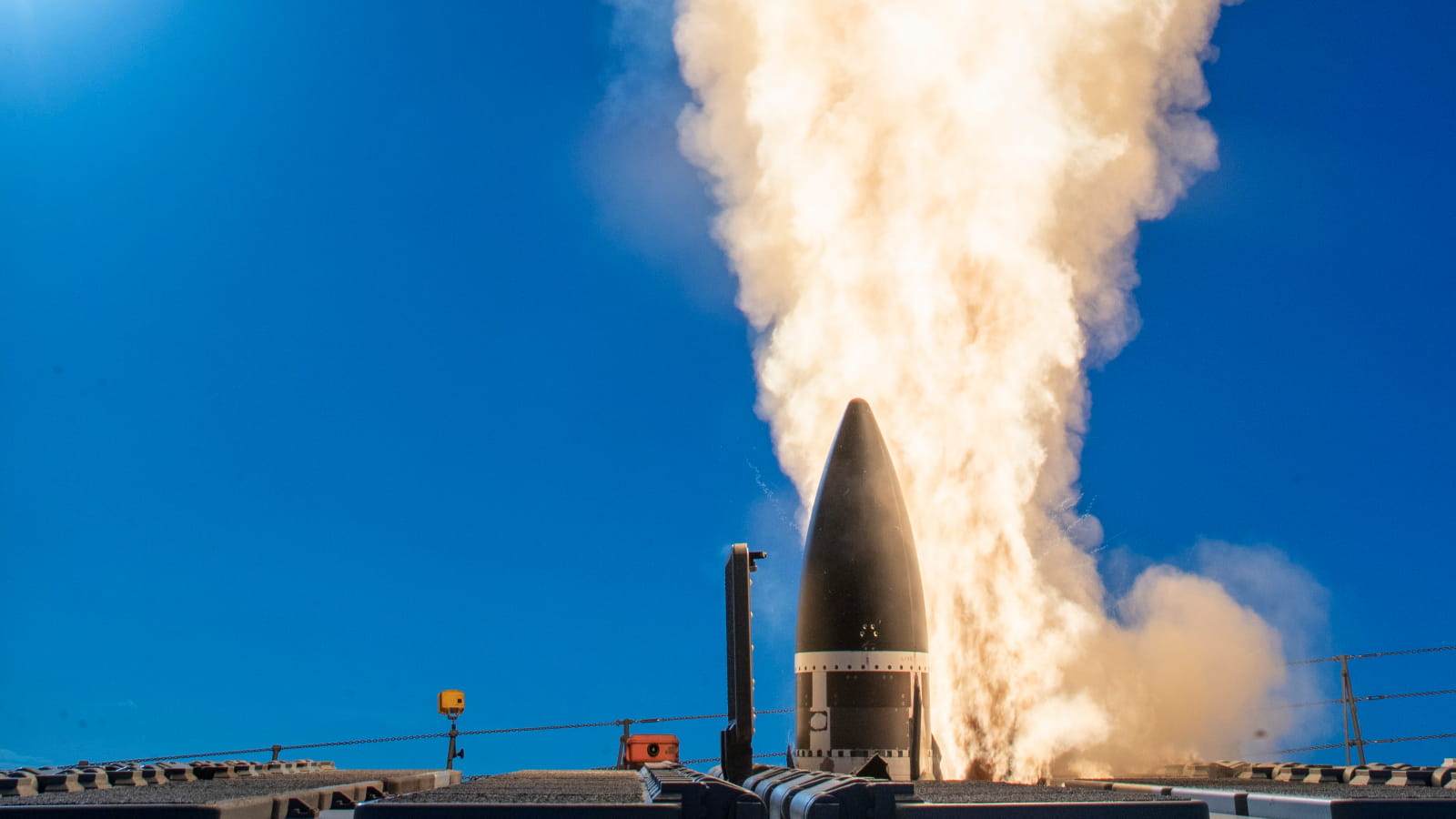
Raytheon has received a $745 million contract to produce and sustain additional SM-3 Block IIA interceptors as the United States expands production capacity for ballistic missile defence weapons.
Raytheon has received a $745 million contract, approximately £553 million, from the US Missile Defense Agency for the production and sustainment of Standard Missile-3 Block IIA ballistic missile interceptors, according to the company.
The contract announced by RTX covers the SM-3 Block IIA, a missile developed cooperatively by Raytheon and Japanese industry. The interceptor is designed to defend against short- to intermediate-range ballistic missile threats and forms part of the wider Standard Missile family used for naval air and missile defence.
Compared with earlier SM-3 variants, the Block IIA incorporates a larger rocket motor and an enhanced kinetic warhead. Rather than relying on an explosive warhead to destroy an incoming ballistic missile, the interceptor’s kinetic element is intended to defeat the target through a high-speed collision. Raytheon says the larger design provides increased reach and allows a wider geographical area to be defended against ballistic missile threats.
Barbara Borgonovi, president of Naval Power at Raytheon, said, as quoted in a news update: “SM-3 Block IIA is a cornerstone of regional defense, giving the U.S. and allied partners greater reach, accuracy and confidence against evolving threats.”
She added: “We’ve made sustained investments in our production lines and processes, which are allowing us to increase capacity and deliver these critical munitions to our customers more quickly.”
The award comes as RTX expands manufacturing capacity across the Standard Missile programme. The company recently invested $115 million in its missile integration facility in Alabama, saying the expansion will increase integration and delivery capacity at the site by more than 50%.
Work under the latest contract will take place at Raytheon facilities in Tucson, Arizona, and Huntsville, Alabama. RTX said it is also recruiting additional staff to support the programme as production capacity increases.






The conflict with Iran was eye opening for me. Whilst the US has an impressive volume of kit, it’s ability to actually fight a war has been shown to be extremely limited by its supply of ammo. Not sure how they managed to get themselves into that issue.
Makes one wonder how any other navy’s missile stocks would fare in similar circumstances these days.
Not just their naval missiles that run dry, seemed to be across the board. But yeah doubt the UK forces would be able to defend themselves for long against masses of cheap drones and missiles.
I think the previously held notion that the West’s technological edge would always allow us to win the war in short thrift is now dead.
Most of us were probably always somewhat skeptical of this, but one of the clear lessons of the Ukraine and Iran conflicts is that mass matters. You could spent your entire budget on a low number of high tech weapons that could be completely undone by (now) low cost drones. The proliferation of such drones is well within reach of even unsophisticated terror cells, who could do untold damage to critical national infrastructure, never mind nation states who can procure them in the millions. And we’re on the back foot given that the west voluntarily allowed its industries to migrate to hostile and adversarial states such as China, who can now easily outproduce us all combined in virtually every major area e.g. ship building, chip manufacture, chemical production, rare earth materials etc. The west’s best hope of defeating China is that their domestic issues, such as rapid demographic decline, force them to reign in their ambitions. Islamist ideology and its spread across Europe and Africa presents a different set of problems.
I think that was always a myth. If you think back to Iraq1 there was mass. The original ‘victory’ of the taliban was as a result of the northern alliance providing the mass and the west providing the bombing. Same for pretty much every war. The west just got into the trap of policitical victories through a bombing campaign.
your depressing always hector only yous in that jap madness giving them tech dark ppl bewilders me. now ppl we head down social housing road min wage workers free an extra 300 a month rent up road tax financially sound fun
buying bk scheme give ppl money council homes bought estates and new builds from annual budget allocated working class bk bone of society generates rents repairs cut cost pay of more less same parts widely available contractors know system easy enough electrics to box clearly marked to switch fuses. more money gov generates annual more money field an army get that fleet. scrapping trident free sailors crew more advanced ships away long stressful deployments on subs javlin enhance land forces abillity dear per shot compared to a tank needs better relations with usa as anally you want them strong using your stuff getting at a base price selling there behalfs wages tax company pays for its self army get product prce of materials had any 1 suggest or work diplomacy save money have a 2 fleet navy patrol boats couple subs guard waters after that marines carriers amphibious landings take places used properly project power africa destitute recruit from anywhere really multiple reason air force weapons war heads jdam retallion not deterent be sense lash out 1 them jdam milltary terms do job. working laser system looking it mounted convoy protection. hence R&D not enough ideas projects or funding dire like