

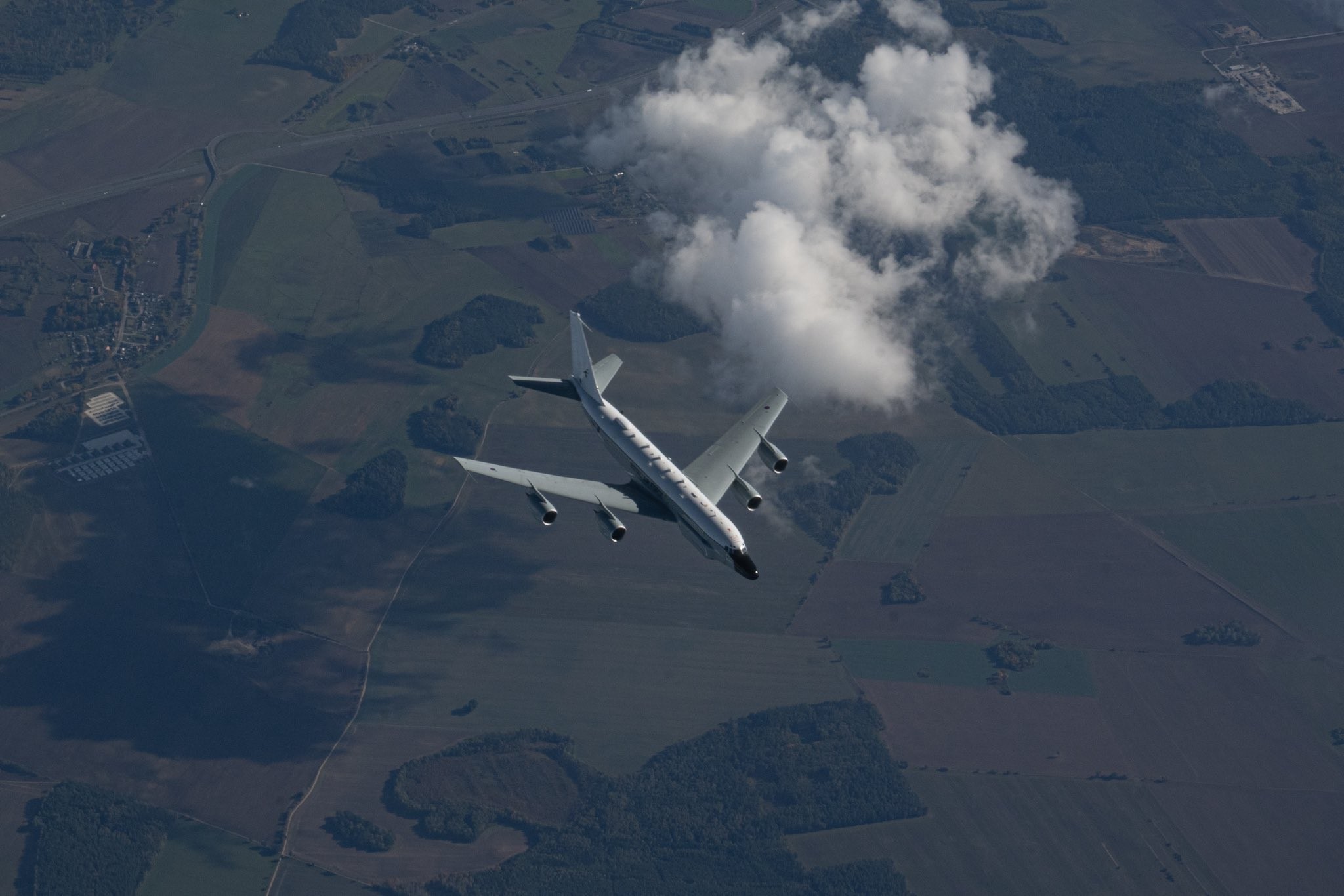
A Royal Air Force RC-135 Rivet Joint has refuelled from a French A330 MRTT during a three-nation exercise intended to open access to more than 30 allied tankers worldwide.
A Royal Air Force RC-135 Rivet Joint has completed air-to-air refuelling with a French A330 MRTT Phénix during a multinational exercise intended to expand the tanker network available to British and American intelligence aircraft, the UK Defence Journal understands.
Exercise Ravitaillement en Vol brought together an RAF RC-135 Rivet Joint, a US Air Force TC-135 training aircraft and a French Air and Space Force A330 Multi Role Tanker Transport over central France. According to a US Air Force news update, it was the first air-to-air refuelling integration involving the United States, United Kingdom and France within the RC-135 enterprise.
The significance of the exercise extends beyond the individual refuelling sorties. The US Air Force said the work established a pathway for American and British RC-135 fleets to make use of more than 30 allied A330 MRTT aircraft around the world, potentially giving the intelligence-gathering aircraft more options for remaining airborne during operations and training.
For the RAF, the development could increase the number of allied tanker aircraft available to support Rivet Joint missions without relying exclusively on a smaller set of previously cleared refuelling platforms. The RC-135 is used for signals intelligence collection, with RAF aircraft operated by 51 Squadron from RAF Waddington. Longer endurance can allow crews to remain in an operating area for extended periods when tanker support is available.
The exercise involved personnel from the US Air Force’s 55th Wing and 55th Operations Group, the Nebraska Air National Guard’s 170th Group, RAF 51 Squadron and 56 Squadron, and the French Air and Space Force’s 31st Air Refuelling and Strategic Transport Wing.
Before the live flights, the multinational team conducted combined planning, simulator work, mission briefings and other preparation. The refuelling mission was then flown in designated areas over central France, requiring diplomatic and operational coordination between all three countries because the activity took place in French national airspace.
The US Air Force said the process demonstrated that tanker interoperability involves considerably more than proving that two aircraft can physically connect. Procedures, communications, command arrangements, emergency actions and airspace clearances also had to be aligned before the capability could become repeatable in routine operations.
The work built on earlier testing conducted at Edwards Air Force Base in October 2023, when a Royal Australian Air Force KC-30A was used with a US RC-135. Because the Australian KC-30A and French A330 MRTT Phénix are closely related aircraft, data and experience from those trials were used to support planning for the exercise in France.
Opening the wider A330 MRTT fleet to the RC-135 community could be particularly relevant during operations where endurance and tanker availability are limiting factors. The US Air Force cited NATO’s eastern flank as one example, saying additional tanker options could allow RC-135 crews to remain on station for longer periods while collecting intelligence. It also pointed to the Indo-Pacific, where the long distances between operating locations make aerial refuelling especially important.
The benefit is also expected to extend to training. Greater access to French and other allied MRTTs could provide RAF crews with more opportunities to practise air-to-air refuelling and maintain qualifications without depending on a single tanker fleet or location.
Although the US Air Force described the exercise in broad terms as increasing operational reach and flexibility, the immediate outcome is more specific: the three nations have demonstrated the procedures needed to support repeatable RC-135 refuelling from the French A330 MRTT and to inform similar integration with other allied aircraft of the same family.
The participating forces will now use the lessons from Ravitaillement en Vol to refine common tactics, techniques and procedures. For the RAF’s Rivet Joint force, that work potentially widens the pool of NATO and partner tankers able to sustain the aircraft during long-duration intelligence missions.








We really need to convert the entire voyager fleet over to the probe system on the centre line, especially with purchases of F35A imminent and the probability that Tempest and drones will use the probe system as well.
The RAF A330s already use the probe and drogue system. That’s the RAF and RN standard. What they need adding is the flying boom system for USAF inspired aircraft like the RC-135, P8A, E7 and future F35As. Many countries now have both probe/drogue and flying boom capability. Back in the 2000s, the UK government arranged to rent its A330s on the cheap.
Daft question… does anyone know if the receiving aircraft/air force has to pay for the fuel transferred? If so, with the amount of interoperability between nations and air forces going on these days, someone will have pedal hard to catch up – lots of ready sharpened pencils!