

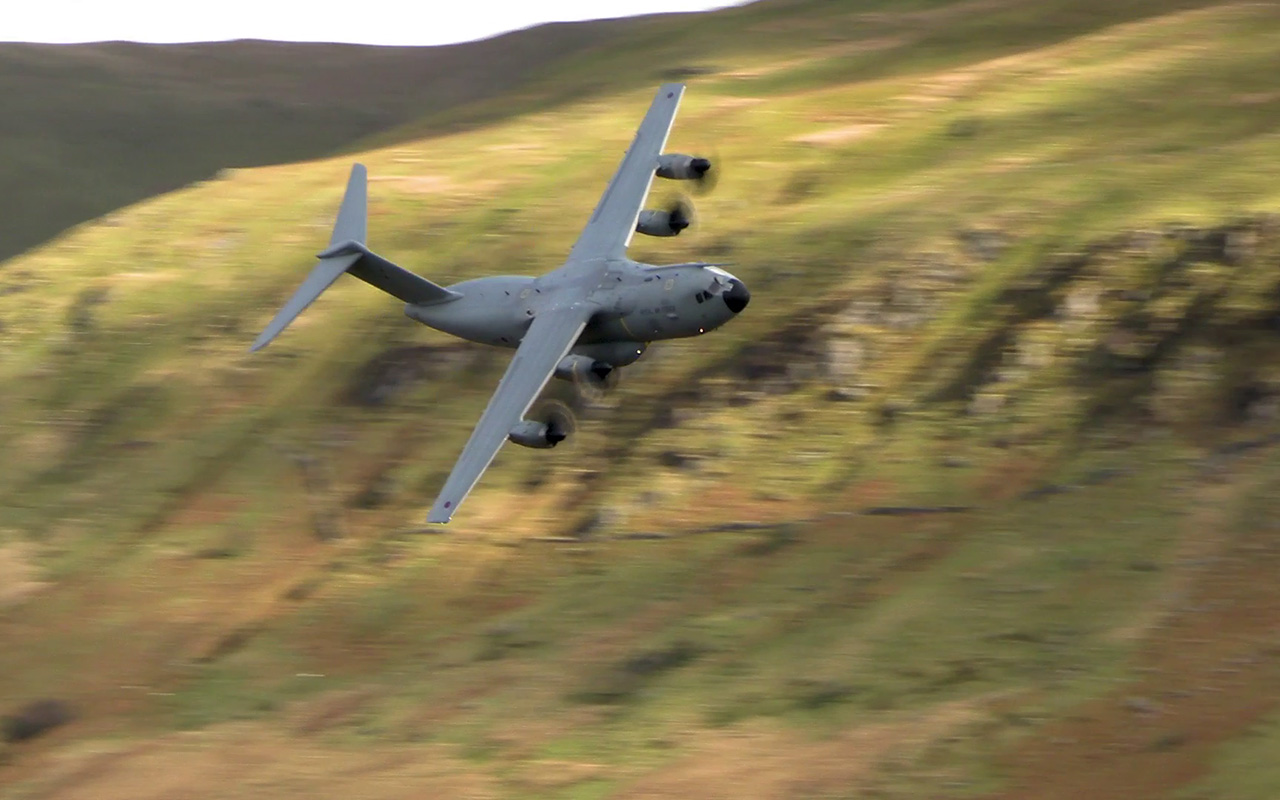
The Ministry of Defence has extended its support contract with Airbus for the Royal Air Force’s A400M Atlas fleet in a deal worth £190 million, which it says will raise the number of mission-capable aircraft available each day from ten to thirteen by the end of 2027.
That amounts to a 30 per cent improvement in availability for the tactical and strategic airlift fleet, according to the department, and the extension sustains more than 350 jobs in the United Kingdom. Airbus will continue maintenance, repair and support work from its UK Support Centre at RAF Brize Norton, where the Atlas force is based.
The notice gives a value just short of £190 million and an award decision date of 8 September. Estimated contract dates run from 1 October this year to 30 April 2029, with a possible twelve-month extension to April 2030 if that is needed to maintain national in-service support. The procedure used was a direct award under the defence and security special regime.
The supplier is listed as Airbus Military Sociedad Limitada, registered at Getafe near Madrid and trading in Britain as Airbus Defence and Space Limited, with Airbus Military UK Limited at Carterton in Oxfordshire, the town adjoining Brize Norton, recorded as an associated organisation, and the contract locations are given as the United Kingdom and Spain.
Availability has been the persistent difficulty with the Atlas rather than the aircraft itself. The Royal Air Force operates a fleet of twenty-two, delivered from 2014 onwards, and they took on the bulk of the transport task after the C-130J Hercules left service in 2023, a withdrawal that drew considerable criticism at the time and left the Atlas and the C-17 Globemaster carrying everything between them.
Moving the daily figure from ten aircraft to thirteen is therefore a larger change than the raw numbers may show, it represents the difference between roughly half the fleet being usable and closer to three fifths.








C-130 was often 100% availability – dumb to ditch them
C-130 availability averaged 71% at time of retirement. This is a contractual obligation to provide a minimum of 61.9% daily availability from the current fleet or 13/21. The previous maintenance contract was signed to produce a minimum availability of 10 when they owned 16 or 62.5% minimum availability.
In essence they are just increasing maintenance resources to match the larger fleet which the previous government hadn’t done.
The A400M could be politely described as stupidly complex and fragile for a transport aircraft
It is what it is. Interestingly before too long drones are going to be nibbling away at the light end of the transport capability and people will probably describe them as not complex enough.
Its also much more capable.
When Airbus was trying to sell A400M to Saudi, they said they could raise max load from 37 tons to 40 tons, with a software upgrade. Has the RAF looked at that?
Yes we should just go back the the C47 🤦♂️
No it was not-ever!
The problem is the Herc has limited range and payload, it doesn’t matter how many you have if they can’t reach where they are needed.
But then again removing them reduced planning considerations, which reduces the options and without certain platforms and people, the least best option may be the only one! A mix was more sensible and in a way the Herc could be considered relatively expendable for certain ops! Cheers.
It’s not really a cut because it was always the plan that A400M would replace C130J as a capability. They only operated concurrently because the Hercs were extended in service due to the poor initial availability of Atlas.
Does RAF air transport work like ‘buying’ a new ( unaffordable) car. Is this a leasing deal? Do we chop them in after 18000 miles?
The answer is no.
Pity…..used cars coming off a 3 year limited mileage lease are a bargain 😂
wow, only 10 a day are currently available? I bet its a much lower number in reality.
If 10 were really available on any given day, then it’s not a has number, as you would assume that number could be surged in time of urgent need. I however suspect the numbers are being messaged.
Putting money on it being lies damn lies and statistics. Ok not this extreme but something like, the plane has no wings or engine, but if you need a trolley to move supplies it’s technically available.
I’m not sure what the point would be in not quoting the real number.
Incredible the A400 has a worse availability rate than the herc… why is it no one in positions of power find this unacceptable?
Just 10, plus however many of the 8 C17 are available, 4 or 5?
For all the tasks that Defence has for them. I’ve read how Defence bids for usage, with SF no doubt getting a large chunk.
Utterly stupid that the Hercs were cut with no let up in what the asset is required to do.
Much more capable, good aircraft, wonderful.
Can it be in Gibraltar picking up a bit of kit when it’s also needed in Norway?
No.
Absolutely, the C130J cut was just another radical fleet cull mate, like Tornado GR4 etc.
Remember the promise of additional A400, never happened.
Sadly, had the A400 been designed with off the shelf turbo fans ( as originally envisioned), then im sure availability would be significantly better, plus they would have also been significantly cheaper and delivered quicker. They would likely have sold significantly more internationally too.
The reality is the engine choice was nothing more than a demand by the pan European MIC for a bigger slice of the cake.
A slice of cake they very nearly choked on!
And neither could the Hercules C130K fleet when availability would have been low back in the day. Tasking lines and crew availability dictate what can be achieved. And available aircraft can fly more than once in a day. We had 66 C130Ks years ago. Nothing close to 66 would have been available on any given day.
Yes mate, but my point as I see it stands. With 14 Hercs, say 7, half available. 7 more assets that now are not.
Agreed mate and what is not thought about by many commentators, by reducing an option (removal of the C130s) you reduce planning considerations and choice, which may mean the only option, may not be the best, but forced on you to consider it by the continued reduction of people and platforms. Cheers.
Ahhh, yes. Why use a River B1 for patrol tasks when a QEC Carrier is available.
Atlas is big, Herc was more suited to the dirt strip SF/S&D Flight role.
Gone.
We use what is left, as now there is no choice.
👏 👏 👏 👏 👏
C-130’s were cheap enough to risk on covert insertion ops.
No one’s going to risk an enormously A400M they may have to blow up in situ behind enemy lines.
Enormously Expensive
Some were destroyed in situ after rough landings.
But maybe the hooligans won’t need to deploy, as they swear too much and may hurt someone’s feelings. 🙄
Reduced to 10 operational airframes and 3-4 C17??
The managed decline continues, what happens when this endless deline finally hits the floor?
Operating two of the most capable transport aircraft in the world isn’t managed decline. Today’s transport fleet. A400, C17 and Voyager can achieve considerably more tactical/strategic/A2A refueling capacity and availability then back in the Hercules C130K , Tristar, VC10 fleet ever could.
Agreed mate however numbers and depth do come into it, and in the current environment if we had a few of the C130s remaining they could easily be considered for the more dangerous, higher risk (and in a way expendable) tasking. Cheers.
It is not certainly more capable when you need an A-400 to transport mere 5t
More wasteful yes.
“Operating two of the most capable transport aircraft in the world isn’t managed decline. Today’s transport fleet. A400, C17 and Voyager can achieve considerably more tactical/strategic/A2A refueling capacity and availability then back in the Hercules C130K , Tristar, VC10 fleet ever could”
We disagree on the premise of your argument im afraid.
Having fewer than half the A400 fleet operational is poor, loosing the extremely useful C130J fleet had absolutely nothing to to do with the centre wing box issues, it was yet another simple radical fleet cut.
Marshall’s has ‘re-lifed’ the airframes ( somthing they could do in their sleep) for onward sale. There was a great deal of legitimate concern and push back within certain areas of the Armed forces regarding tbe loss of C130J.
The proposed additional A400 buy to replace them never happened, as many of us suspected would be the case.
This was a cut, we have lost capability and we are as a result, reliant on allies for certain important SF capabilities, a very ‘real’ loss of sovereign capability, its really that simple.
The cuts simply continue unabated.
It doesn’t say only 10 are actually available.. I read that as a minimum.. those who wish to slam a very good aircraft will do so whatever. No one ever mentions that the Hercs needed new wing spars before sold to Turkey. The fact that they’re still being made doesn’t impress me that much. That says a lot about the state of US manufacturing. ( I was lucky to fly a Herc many years ago, complete with back open and in the cockpit for landing, so I am nostalgic, but hard headed!) Altas has at flown non-stop (with IFR) to Guam, getting in to Franz Josefland and the Tristan de Cunha operation and landing at Pembrey Sands regularly, I think the criticism is unbalanced. I’ve no doubt that availability is an issue… but it looks like a money thing, not a mech thing. There are several on Flightradar24 daily. I need to log the registrations to get a tally.
Well said 👏
Thanks!
Availability issues seems to be across all fleets (RAF, RN, and Army) no matter what the platform.
Maintenance is a common factor and all services must be struggling to match the needs of the front line with the practically of maintaining a platform ( F35, T45 & Ajax come to mind).
Lack of technical support personnel/effective maintenance protocols seems to be a repeating issue.
Indeed. Everything is more complex than the previous generation. Maintenance issues expand exponentially. There’s a lot of nostalgia on here for times that never existed… or as I like to say, nostalgia isn’t what it is used to be! (When I had my Herc flight the crew were telling me that on the first generation Hercs the wiring had been striped from the Argosies they replaced!- though that might have been a wind up.) It’s a human tendency to complicate everything – the promise that better technology will make life simpler is quite difficult to achieve! A club is replaced by a bow and arrow… the strung needs replacing and you’re always looking for feathers and straight sticks. The Bow and arrow is replaced by a gun which needs cleaning and special ammunition. The gun is replaced by a rocket that nobody knows if it’s going actually work until you need it, because it has complex propulsion and guidance systems… and then along comes the laser, which ought to be much simpler, but isn’t because it requires vast amount of electrical energy which requires complex generators to fit in small spaces and be as light as possible. The answer, as many on here advance is – go back to clubs. I like the Jacob’s ones, especially orange.
It certainly WAS a wind up that the wiring from the Argosy fleet was used in the Hercules fleet! The last RAF Hercules was delivered new from Marieta in 1967, the Argosy continued in service as a tactical transport until December 1971 and in other roles until 1976.
It was – although I rather think the airman who told me believed it… as often is the way with the best wind ups. As I was a dog collared clergyman I’m not sure why he’d have mentioned it…!
Agreed the Atlas is an excellent platform but the removal of the C130s was a tactical act of criminality! I spent many hours in them and the crews absolutely loved them, understood them and was fully aware of the “customers” requirements and always pretty up for it. By reducing platforms you are reducing planning considerations and options available within the planning cycle, making a previously none option possibly now the only option!
I don’t disagree, although crews often love aircraft, especially old ones. Turkey had to have new wing spars before receiving them, so they were getting old. Do we need something smaller to complement the Atlas? I don’t know, the next war will not play our like any past ones. I’m all for more aircraft and more types, but what exactly are they for? I don’t quite buy the “Atlas is too big for SF” trope. It can in and out of strips as easily as the Herc, is faster, longer range and so on.
A sensible decision to work on improving availability of the existing fleet and seeing where that puts us, before buying any additional A400s. However, even at 13/22, how does that compare to an availability of 737s at RyanAir or 320s at EasyJet? Is the service life of a short-haul airliner shorter than the expected lifespan of the A400s?
Ah, I see this differently, with 30% increased availability, look forward to a cut in numbers.
Fuck yes! Sad to say although a piss take, it’s probably been looked at, or will be! Cheaper, more availability, more jobs, tip of the spear, this Government blah blah blah….
Unless we start using these aircraft as auxiliary tankers and to launch cruise missiles they have a very limited scope in any operation we are likely to find ourselves committed to in the North Atlantic area. A fleet of 22 A400M and 8 C17’s appears more than sufficient for our needs.
As we have seen from the war with Iran, transport aircraft will not be able to deploy with in 500 miles of an active ballistic missile threat. That being the case in Europe then we are better off driving to the AO.
In modern warfare these aircraft are far more useful in their secondary roles (tanking and stand off weapon delivery) than their primary roles (troop and logistics transport) but they are expensive platforms for those secondary roles.
Yes, but if there is a crisis, this fleet is nowhere near enough. The RAF wanted 12 C-17 & 25 A400M. Perhaps the USAF has the right idea. Core capability manned by full timers. Surge capacity with the part time Air National Guard. Also the RAF could do with one sqn of light twin turboprops for small tasks (C295 or C27J), maybe 5 to 8, to spare inefficient use of larger types. Note the C-17 are getting old. I hope Boeing manages to restart production, in the next 7 years or so.
The US needs massive transport fleets and reserves operating them as they are thousands of miles and an ocean away.
We can drive to any crisis in Europe, if the crisis is outside of Europe and requires more than 30 large transport aircraft then it’s probably better we don’t get involved.
Falklands 1982. Sometimes war comes to you.
You’re right John ref the shortfall in air transport numbers.
Jim overlooks the key task here: we have to retain the capability to airlift, at short notice, up to a brigade group into anywhere HMG deems necessary, whether Estonia, Poland, the next Iraq/Afghan/wherever or a British overseas territory e g. the Falklands. There are currently nowhere near enough air transports to ferry the troops, equipment and munitions to do so. Even allowing for the heavier kit going round by sea, so deployment would be a lengthy process.
It takes a lot of air transport to ferry 4,500 (7 Light Mech Bde) to 6,000 (16 Air Aslt Bde) troops and kit into theatre, far more than our 16 front-line transports can provide. The RAF had been keen to order 6 more A400s, but all has gone quiet on this, with no mention in the SDI. No doubt squeezed out by the mega defence nuclear financial demands.
Ref Jim’s concerns about transport aircraft operating in A2AD environments, they won’t be deployed unless air superiority has been achieved snd a missile screen put in place.
There is definitely a need for a lighter turboprop to ferry smaller parties in to trouble spots, without having to call on the C’17s and A400s.
With a fleet of 22 aircraft, 15 should really be available at short notice.
Two squadrons, each with 6 frontline aircraft, gives 12 fully ready to fly.
A further 3 aircraft (25%) will be in operational reserve/routine maintenance, so quickly available if needed.
Assuming that there are now sufficient aircrew and spare parts – which I’m not sure is the case – the limitation on the number of frontline aircraft comes down to the shortfall in ground crew engineering and maintenance numbers. I suspect there has been a degree of deliberate economy up to now by the RAF here, allowing personnel numbers to shrink to what is affordable, rather than what is needed.
The Airbus contract should just about right the ship. 13 front line is at least a good bit better than 10.
I’m in support of anything which increases availability. It needs to be a philosophy which covers all areas of the military.
For example T45 might be 100% available soon. Even with 2/3 availability that is much better than expected