

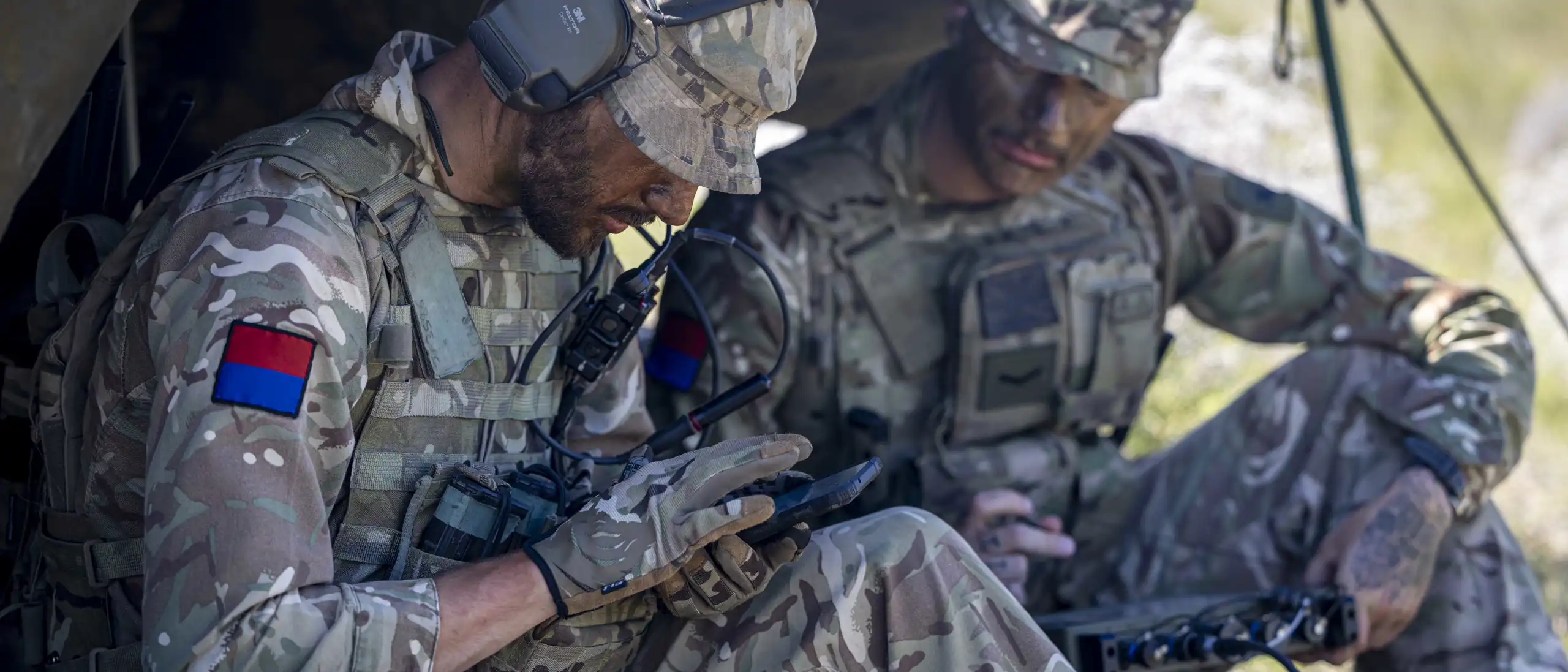
British Army gunners are testing the new Ground Based Surveillance Radar in Canada, using the lightweight system to track troops, vehicles, aircraft and drones and to help correct artillery fire.
British Army gunners are testing a new portable radar in Canada that can track movement across the battlefield and help artillery units correct the fall of shot, the UK Defence Journal understands.
Personnel from 53 Air Assault Battery, 5th Regiment Royal Artillery, are using the Ground Based Surveillance Radar, or GBSR, during Exercise Rhino Bizz at British Army Training Unit Suffield. According to a British Army news update, the first systems were delivered to the Catterick-based unit in late 2025 and are now being assessed as part of a wider network of battlefield sensors.
GBSR is designed to detect and track soldiers and vehicles on the ground as well as aircraft and drones in the air. It can also support artillery and mortar units by tracking where rounds land and providing information that allows crews to adjust their aim. The Army says this can reduce the time required to bring fire accurately onto a target.
The system is intended to complement the battery’s larger Lightweight Multimode Radar rather than replace it. GBSR is sufficiently light to be carried by soldiers moving on foot, allowing small detachments to reposition it quickly to provide local surveillance or fill gaps in coverage from the heavier and more powerful LMR.
Lance Bombardier Devon Neal, second-in-command of a GBSR detachment, said, as quoted in the news update: “One of the great advantages of this kit is how lightweight it is and how quick it is to set up.”
He added: “We can move it quickly to where it’s needed as another sensor to understand the battlefield, and that makes our lethality and survivability a lot better.”
The open terrain around Suffield is also being used to establish a baseline for the radar’s performance. Staff Sergeant Dan Graham said the Canadian prairie offered particularly clean conditions for assessing the system before crews move on to environments where buildings, vegetation and terrain features create more complicated radar returns.
Graham said: “The landscape is quite flat and there are no trees or buildings, so we’re getting a pure return on the radar. It’s giving us a baseline for the system, and then we can develop our understanding by using it in more challenging conditions.”
The radar is being tested as part of Exercise Rhino Bizz, during which 16 Air Assault Brigade is working with Canadian troops on what the Army describes as a recce-strike approach to operations. The concept brings together reconnaissance, surveillance and strike systems in a network intended to shorten the time between detecting a target, understanding what it is and deciding how to engage it.
GBSR is one element of that wider sensor network. Graham described the approach as a “hive mind”, with different sensors contributing information on the same potential target before data is combined to build a clearer picture.
He said: “Once one sensor picks up something, we can direct all the other sensors onto that track and really build up a clear picture of what it is and what it’s doing – and then decide what we want to do about it.”
The Army is also experimenting with artificial intelligence to help merge and interpret information arriving from multiple sensors. Graham said the intention is to reduce the time needed to process battlefield data, claiming that AI-supported fusion can cut the process from minutes to seconds.
The trials reflect the growing emphasis placed on dispersed sensors and rapid targeting as the Army adapts to battlefields increasingly shaped by drones, electronic warfare and persistent surveillance. A lightweight radar that can be carried and repositioned by troops provides another source of information for that network while retaining the ability to support traditional artillery tasks such as observing and correcting fire. For 53 Air Assault Battery, the current work in Canada is therefore focused on establishing how GBSR performs alongside existing radar and other reconnaissance systems before its capabilities are tested in more cluttered and operationally demanding environments.










The new ZB298 (zebedee)?
From Elbit Systems UK, contact signed at 2023, delivery at 2025 and 2026
Hi George, I was comparing the new system to the 70’s and 80’s radar that the RA had when I served with them as attached REME.
Cheers
Ian
Google “Ground Based Surveillance Radar”, turns out this the actual product name, not the description as I thought, good luck!
I was a ZB298 operator with 2RTR back in the late 70s on exercise near the inner German border we sent a Scorpion troop up to the wire so we could gauge the reaction from the watchtower and do a bit more training little did we expect trucks loads of East German soldiers to turn up and an attack helicopter, very good for us in visual and audible terms!