

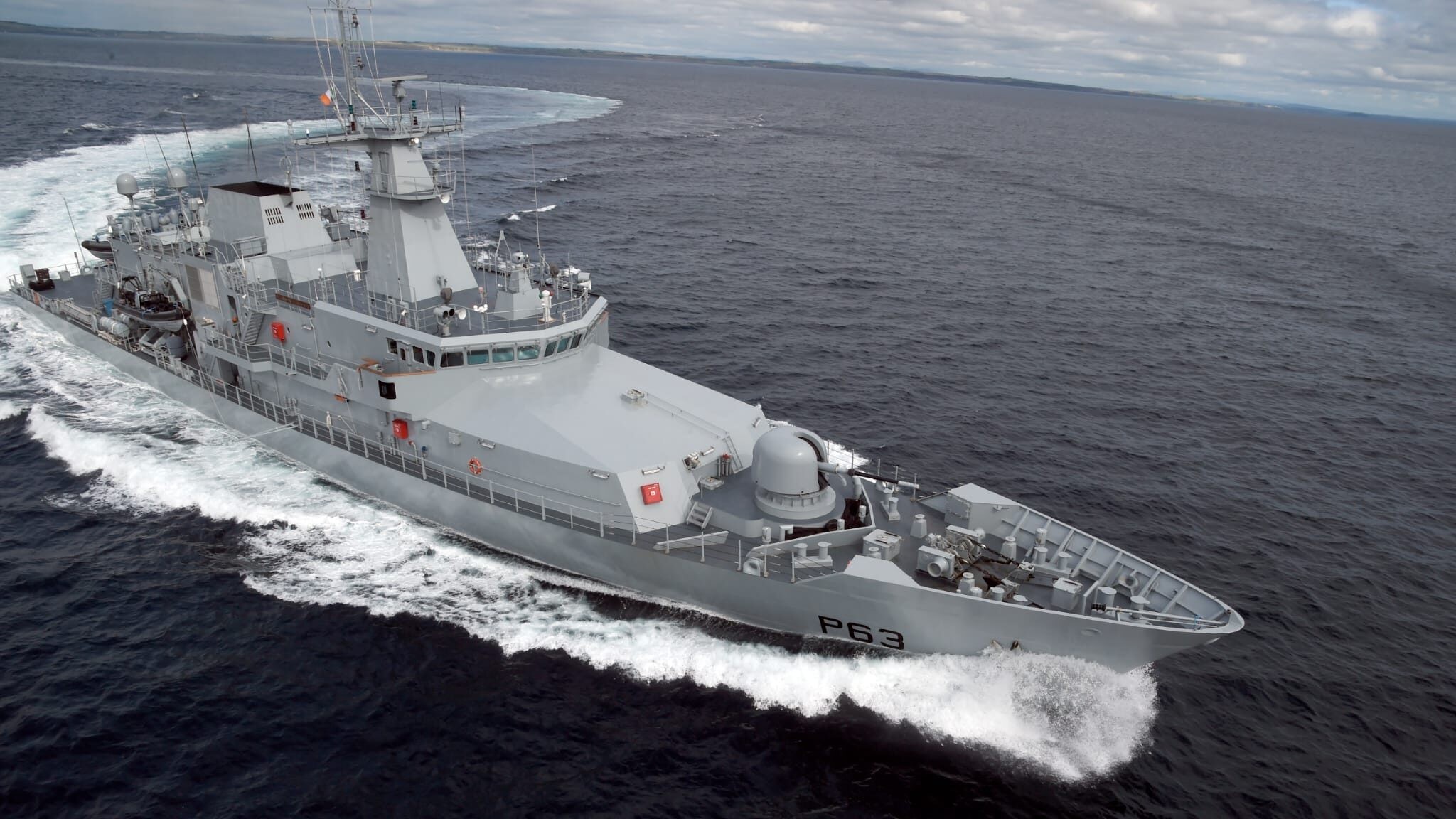
High-level talks between British and Irish defence officials have begun on Ireland joining the Joint Expeditionary Force, the ten-nation grouping led by Britain, according to The Journal.
Niall O’Connor reports that the Irish government has directed the Department of Defence to progress the plan, and that Ireland will initially work as an observer.
Dublin would not join the core elements of the force but a wider grouping known as JEF+, according to the report, which says Ireland has ruled out participation in what it describes as the more offensive core elements.
Sources told the outlet the arrangement is seen as an opportunity for practical cooperation with like-minded partners on shared security challenges, complementing Ireland’s engagement at European Union level. The key, The Journal reports, is that Ireland would draw on the force’s maritime security apparatus to respond to hybrid threats such as drone incursions.
Military sources quoted in the report were candid about what Ireland brings. Given the limits of Irish naval capability, the report says, membership would essentially amount to a watching brief, though it would also offer capability building along with information and intelligence sharing. The meetings are examining what practical benefit Ireland can draw from the other nations.
Who is JEF?
The Joint Expeditionary Force brings together Britain, Denmark, Estonia, Finland, Iceland, Latvia, Lithuania, the Netherlands, Norway and Sweden. It was established in 2014 and operates outside the NATO command structure while being designed to complement it.
The First Sea Lord set out the argument for its existence in an interview published last week. General Sir Gwyn Jenkins said the force brings unique freedoms and permissions because it does not require consensus among all ten nations to act, giving political flexibility to respond in a crisis earlier than NATO might be able to mobilise, given the higher bar of consensus the alliance requires. He said NATO commanders welcome it for exactly that reason, because it gives them choice and options in the early stage of a crisis.
That structure is what makes an Irish association possible at all. Ireland is not a NATO member and its policy of military neutrality would make accession difficult, but the JEF is not a treaty alliance with a mutual defence clause, which leaves room for arrangements of the kind now under discussion.
The force is currently running Lion Protector 26, which began on 3 August and continues to 12 October across Northern Europe, the North Atlantic and the Baltic Sea region. Its opening activity involved escorting vessels carrying allied military equipment into Latvian ports and moving it inland.
Why Ireland is moving
Ireland’s National Maritime Security Strategy, published in February, stated that securing Irish waters will require broader international relationships, with Minister for Defence Helen McEntee saying at the time that the State should not be afraid to work with Britain on security matters.
The undersea infrastructure question sits behind much of this. A substantial share of transatlantic data cables pass through or near Irish waters, and Russian vessels have been observed loitering over cable routes on multiple occasions. Ireland’s defence spending is the lowest in the European Union at around 0.2 per cent of gross domestic product, and the Naval Service has struggled with crewing shortages that have left ships alongside.
The First Sea Lord described the Russian undersea programme in blunt terms in the same interview, saying of the organisation Moscow presents as a deep sea research directorate: “Let’s not kid ourselves. It’s not a research agency. It is an independently funded arm of the Russian state, whose sole purpose is to pursue the destruction of critical underwater infrastructure.”
He also said that allies are struggling to contain very capable Russian submarines.
Cooperation already under way
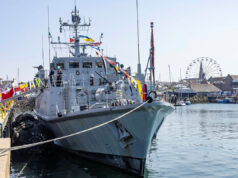
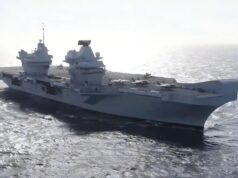
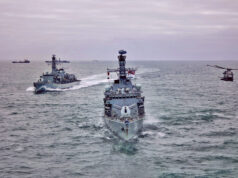
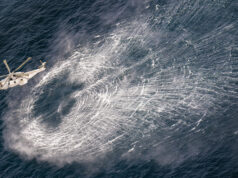
Practical cooperation is running ahead of any formal arrangement. A Royal Navy warship and a Merlin helicopter are operating in the Irish Sea this week providing air defence for the meetings of EU defence and foreign ministers in County Wicklow, at Irish request, with the ship required to remain outside Irish territorial waters on constitutional grounds.
The French air defence frigate Aquitaine performed a similar role off Dublin and County Cork in July.
British involvement in Irish security has drawn political comment at Westminster, with the Conservative MP John Cooper writing to the Defence Secretary last week to complain about the offshore restriction and accusing Ireland of freeloading on defence.



Just meaningless drivel from Ireland – they need to step up and grow a pair either individually or with an alliance.
With the healthy state of the Irish economy, they should be urged to invest in hardware that would justify the business
About time the Irish State recognised that neutrality isn’t going to keep them safe from the very real threat of Russian attack. Whether they like it or not they have the same problem we do – geography. Airways, Sea Lanes and data cables all pass through our territory and areas of responsibility and anyone wanting to challenge NATO in Europe will see those assets as a key target for attack. The island of Ireland could also be subject to direct attack given their lack of defence capabilities and alliances. So this is an important step on the way for the Irish State with regards to recognising their geopolitical reality. I note that they seem to be finally getting over their allergic response to the British State..! Only taken 100 years and we really aren’t that bad these days. 🙂
They really do need to spend more than 0.2% on defence though.
Cheers CR
The DF can’t really spend it at the moment, the procurement section is basically overwhelmed with the purchases ongoing.
Hello Mark,
What are they doing about recruitment? Even if they are buying loads of stuff, I am aware that the NS have had vessel tied up due to a lack of people to crew them although I suspect that the recruitment teams are drawn from the same pool of civil servants?
Reportedly our lot have plenty of volunteers but reject most of them of medical grounds, which begs the question are the medical standards fit for purpose…
Cheers CR
Recruitment and Retention figures are trending upwards currently, think we’ve had 2 years of positive numbers at this stage, one of the restricting factors now is just how the training pipeline manages the numbers, for the NS there’s a particular issue with drop outs mid-course after their first sea duties, but I’ve seen that happen in the commercial sector as well so its not a unique issue.
Whether the numbers stay positive is of course to soon to tell, but there’s work being put into base upgrades as well to pay issues to try and continue the trend.
As for the vessels tied up, the focus is on sustaining the P60’s, rumours around the harbour over whether the Kiwi’s might have done us one with the two Lakes.
As an Irishman this smacks of having your cake and eating for Ireland. They need to cough up more for defence and their responsibilities to the Irish people
It’s more the Government does not want to get into an argument with the opposition and the public’s fantasy about neutrality, along with the realistic current and likely future capabilities of the DF. Spending is happening and upgrades are coming, however slowly they sadly are.
None of the parties want to have the public discussion needed. When it comes to defence they’re pretty much aligned with using neutrality as an excuse to not spend what’s needed to actually defend.
I guess they have to educate folk about the threat on the one side and just how week the DF have become on the other.
We have exactly the same problem it seems. Our metropolitan Ground Based Air Defences are non existent but I bet a lot of people in the UK we some kind of Iron Dome system a la Israel. If Russia ever started dropping drones or ballistic missiles (putting aside the nuclear implications for a moment) onto our cities the British public will get the shock of their lives when they realise that there is nothing, absolutely nothing to defend them. (The Land Ceptor is designed and intended to defend deployed army units and we have too few anyway, fighters might get a few drones…)
Cheers CR
Put your finger in it. A large proportion of the population here and one presumes even more so in an Ireland don’t want defence spending after all it’s about buying weapons to kill people and we need money to spend on facilities and services, they think in their narrow naive way of thinking.
Of course the moment conflict breaks out and they find out we can’t protect them from attack, or worse still for many keep their internet service going, you of course get them damning the Govt for not being prepared or able to protect t them. We had it in WW2 the Govt had to secretly build up defences due to opposition only to be damned for being incompetent and culpable. And then of course there are those who will always blame the Govt as provocateurs even after 25 years of near disarmament and to be honest even if they only invested in catapults. Ireland has a lot of them waiting in the wings I suspect.
The misinformation campaign in Ireland run by the Russians has been doing its job over the years about this military neutrality bit and investing more money into health and housing. Ireland is a wealthy country and can walk and chew gum and afford defence increases and social programs. Something the opposition ignores in rebuttals.
I am glad to see more Irish actually switching gears on this though process as of late.
There are signs that a similar change of gear is happening in the UK as well, although there seems to be a lack of reality when it comes to actually finding the money and the implications therein..!
Cheers CR
It’s a lot easier to indulge in the “fantasy” of neutrality if you have a serious military capable of enforcing it, like Switzerland.
The trouble with trying to be both neutral and helpless is that if there does come to be a serious war between two powerful, proximate enemies, they are going to look at a weak neutral nation that can’t protect itself as a liability that needs to be occupied and controlled before the enemy does. See what the British did when we forcibly destroyed the Danish Navy in port during the Siege of Copenhagen or the Nazi invasion of Norway.
Switzerland wasn’t touched because both sides understood that they were robust enough to resist invasion and not a threat to their flanks.
With the healthy state of the Irish economy, they should be urged to invest in hardware that would justify the business
Trouble is FF and FG dither and avoid where SF outright oppose. SF are apoplectic that their safety is being guaranteed by the ‘enemy’
The hardware that the DF can use is being ordered, but the headcount of particularly the NS and AC just simply has to grow before any “big” hardware is useable, right now they can’t support any of the wishlilst put forward on this site at times.
I think we should welcome this move but Ireland has to live up to its historic legacy, it can’t be jointing alliances while having a nonsense constitution that bars alliance members from using their ports or airfields.
They had the exact same nonsense about playing “British” sports (Football is an British sport apparently 😀) at Croke Park to the point that Ireland could not host the Euro’s and now Croke park hosts regular premier league teams.
It’s time for Ireland to start pulling its weight and join the European family of nations defending the continent.
It was actually “foreign” sports in general as the GAA was part of the Gaelic Revival movement end of the 19th century, hence why its code was written as such. Though I’m still impressed that there are people sore about that tbh…
The Constitution isn’t getting changed, not on that anyway.
I guess we can only expect small steps at a time, but I fear the dangers will be well upon us before they even consider going much further. The second WW as an indicator of the political difficulties involved was a strange mix of secret acquiescence to allied aircraft flying across north west Ireland to such a lack of help further south (far more visible of course) that Roosevelt would have likely taken what were deemed vital ports by force had Churchill not persuaded him not to.
Again, there was much more than just the Donegal Corridor at every level, one of the main factors with Roosevelt was his Uncle in Law who was the Ambassador to Ireland, man was beyond mad, to the point where the OSS cut him out of intelligence matters after he exposed more than a few backdoor operations.
I see what Ireland gains, but what does the JEF get. We can’t even use their ports to stage from. Sorry this is a nonsense. Ireland needs to change its constitution & approach to defence or accept its an open target.
It’s difficult but I will try to be devils advocate here. If Ireland is ever going to come onboard it’s going to be a very slow business, so moves like this are worthwhile as much as anything to test the water. A relatively supportive if over reaching Govt isn’t going to be of benefit in the longer term. I guess we have to look at the likes of Japan as to how slowly attitudes can gradually change through careful management. Trouble is unlike Japan the Irish can easily fall into the delusional attitude that there is a continent between them and the dangers. In this modern World that of course really isn’t the case if modern life and your economy is to survive. But yes we all need education about how our whole society relies on cables and connections that we need to operate yet are deeply vulnerable. We take so much for granted.
I’m sure you will find one Russian operation sabotaging googles and Facebook’s cables in the Atlantic will have Ireland changing its constitution in five minutes.
All the Irish people I know want to be European and do their bit like everyone else.
This constitution nonsense is perpetrated by money men who like the free riding and old Xenophobes who liked to blame England for every problem they ever had until Afghan refuges started showing up on their doors and they stared righting about that instead.
You’re right Jim, back in the 1930’s Dev foresaw exactly the state of global events in the 2020’s and crafted the Constitution for that…
Exactly, we get an observer and one that doesn’t even trust us in its waters… They get to look better because they get to be part of something… Load of blks.
I think Ireland realize they need to be seen to be doing something. If they cannot protect the under sea cables, all those big American Tech Companies that have taken root as a tax haven would see no point in remaining and paying huge amounts of Corporate Tax (relatively speaking). As suggested, this does seem to be a case of having your cake and eating it. Sit at the table and “participate” but leave the actual spending and dirty work to others. i.e. The Royal Navy. If they paid reasonably well I don’t see how recruitment should the problem it is considering how many Irishmen are in the British Armed Forces.
And British citizens make up the largest non Irish block in the DF. Pay is set at a national level for the PS, there’s no special deal for the DF, and that won’t change. As for spending, again that’s actually happening with the better part of a couple of billion of projects ongoing, though it’s the French that’s getting the business.
Any news of the West Coast radar, Mark?
Thales are still building them, I think the first set is due next year.
Don’t know if you’ll see this but the official announcement is due Friday, leaks say 5 radar units, more than the 3 that was briefed at times. Just a wait and see which GroundMaster system has been selected.
The new aircraft they are buying C295 are I think Spanish in origin.
The CASA order is complete, has been for a couple of years.
Surely Eire can only join as an observer since they don’t really have a navy.
You can still be neutral and have a navy, army and airforce.
First problem you have there, is there’s no such nation as Eire, so that’s an issue.
There needs to be a requirement for any Irish involvement: Ireland has to commit at least some fast air assets and a few Frigates, and 1-2 expeditionary medium weight Brigades. Plus allow allied nations to use their ports.
If they can’t supply that, they should be told to fuck off.
The UK is 15 times bigger than the republic of Ireland. We don’t have anywhere near 15 times the capability you suggest as minimal.
Irelands 4 OPVs and two smaller PVs if fully manned could provide a significant additional element to the JEF. They are purchasing two C295 aircraft to operate in a similar role to the UKs P8 of which we have 9. 2 isn’t going to allow full 24 hour coverage but it does allow a combined UK Ireland force to maintain 24 hour coverage of the Atlantic to the west of the British isles.
I see both surface vessel patroling and airborne maritime surveillance as two areas where training and operational cooperation within the JEF could be very useful.
If I were suggesting what Ireland should spend money on next it would be anti submarine helicopters. Perhaps not Merlins as they are quite large.
Merlin’s are out, the AC looked at them back at when the 139’s were selected and the operational costs were deemed too high, and liekly too big for future NS hulls.
Rumour (take with large salt) is that the debate is currently between a mixed fleet buy of 149’s for general operations and a smaller NH90 buy for NS operations after the Dutch show and tells the last time they were over, or depending on budget just a single buy of NH90’s.
That may come down to whether a new round of SAFE funding is opened up as the two Finance departments are “unhappy” with the ability of the DOD to manage so many procurements concurrently, even after kicking so much to the French to handle.
Belgium managed to have a fast Air complement of a couple Squadrons, 2 ASW Frigates, and two Army Brigades. Belgium and the Republic of Ireland have similar GDPs. Get over yourselves you cowards, a similar force structure to Belgium to commit to the EU or JEF is not beyond you.
Well Said mate.
Ireland is the gateway to Europe. The Country is strategically vital, as many of the most critical undersea internet and data cables pass through or just by. This is why the Yantar has been snooping around on the surface. It is highly likely that they have also been having a closer look at those cables from beneath the surface.
Ireland needs more ships and Sailors, as do we in the UK, and Irish Neutrality is incompatible with today’s ever more dangerous and unstable world.
Ireland will Play us All , They always do…!
EU, UK AMERICA..We all fall under their spell..
Start handing over billions a year to the UK and pay for your defence!!
I really need someone to explain and justify Ireland’s “neutrality” in WWII re the Nazis, and in 2026 re the Russians?
Ireland basically said they didn’t want to work with Britain, and so, even though Ireland was sheltered by the RAF and RN and would have had zero risk to it’s national integrity, it refused to stand up for the little guys in Europe and sat at home like cowards, stewing in their victim complex.
Didn’t stop the IRA from working with Nazi Germany though, passing information and trying to attack Northern Ireland.
In 2026 it’s a myopic victim complex continuing, and the Irish being so used to being utterly useless in the defence of Europe that they think they should never be asked to lift a finger, despite being in the EU and subject to the EU’s mutual defence clause.
Dern, have you considered a new name like Stern?
Ireland unofficially helped the allies in world wars 1 and 2, my own grandfather served in the artillery even though he was Irish, his son went on to serve in the RRA and his son, served in the Irish Rangers and then the RMP
Any history of British fighting regiments will find a Irishmen earning serious honours for their gallantry – I must admit I invoked the RMP unofficial motto of ”Run away!”
However, Ireland did help and much like Sweden and Finland there are new realities cropping up and the Irish, not short of fighting boys and girls are navigating those neutralities, I believe they will come onside with time and for sheer mentalness in combat, who do PARA always take with them? Royal Irish.
They are freeloading at the moment but there are politics about the British, however, Ireland will come on board.
*yawn* I have multiple times said that I admire the Irishmen who ignored their cowardly craven government and joined humanity to do the right thing in WW2 and beyond, but their actions, in defiance of their nation, does not excuse the blemish of Ireland putting it’s victim complex before human decency.
I also have repeatedly pointed out that Ireland actively went to war in 1916 and joined the Central Powers. In WW2 Ireland had every opportunity and reason to join the Allies, and instead, like the scummy country it is, it sat on it’s hands and said “Well we think the British are bad so best not help stop the Nazis.”
Yes so many brave Irishmen fought in both world wars. Shame on those though back in Ireland, who shunned them.
Well, please don’t mention the Congo!
I understand the history. I suppose I’m more interested in an expalantion of the justification for the Irish stance – particularly in 2026?
As an irishman, I think we need to grow up now as a nation and dump the chains of history that seem to be a never ending trend in the nations political establishment. It’s time to realise that we have the same defense concerns as our nearest neighbour with whom we share the same language and with our European friends, do the politicians in Ireland really believe that the Russians would respect our pretend friend.. Neutrality ? Dream on ! Ireland is the unprotected back door into Europe, I think Putin and his generals will have spotted that by now, we really need to act positively on this and unite with All of Europe and play our part in its defence.
There is talk of more international engagement…but nothing about actualy spendding more on defence and developing its own capabilities…. then it could add to JEF. Instead it looks like more Irish freeloadding…. no suprise tgere….
I think dern is speaking of politicians not the people, one thing is a man another is a nation. There were several brits in the ss but Britain was not with Germany..