

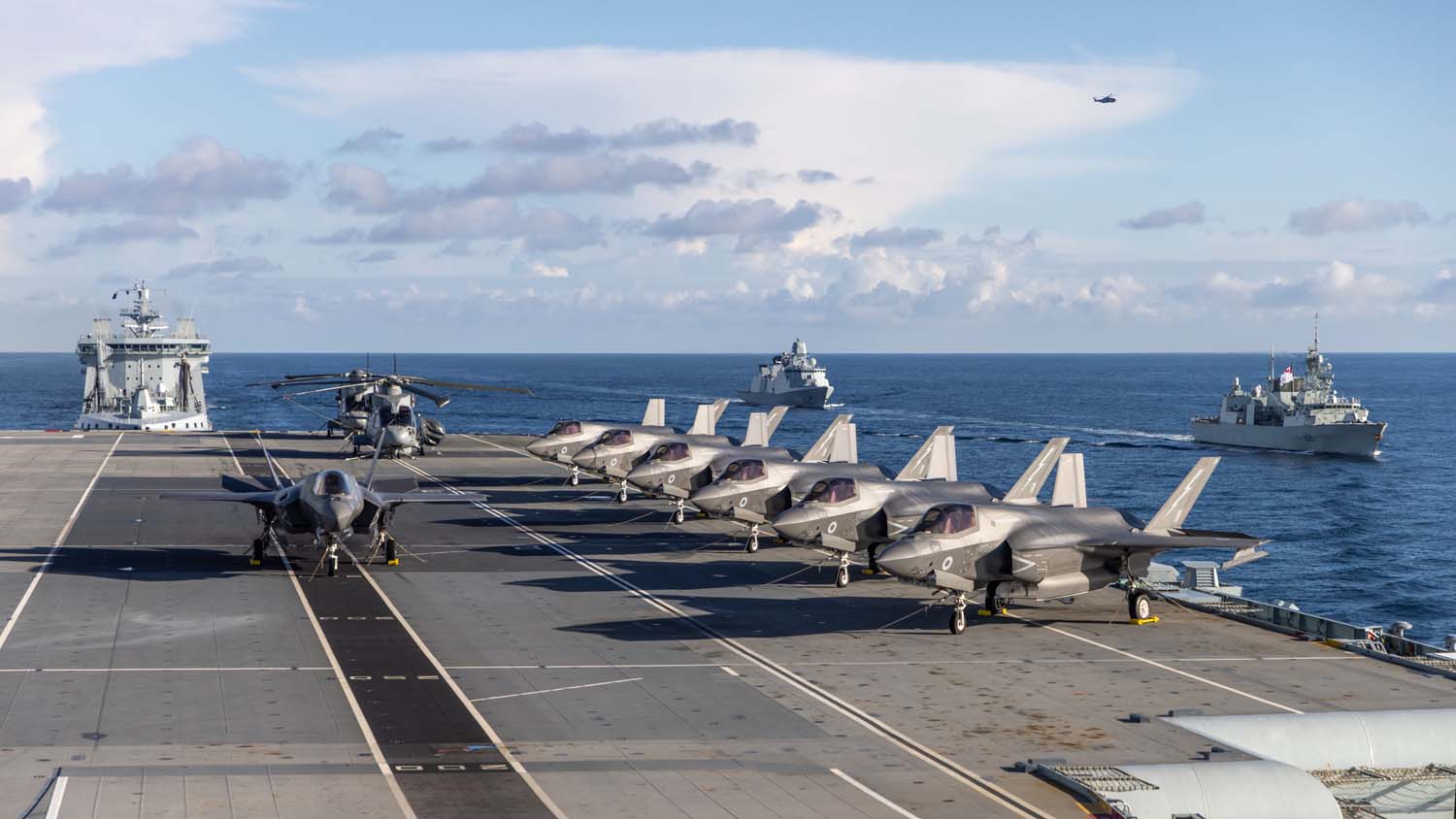
British F-35 jets will fly from HMS Prince of Wales in the Arctic and North Atlantic when the carrier sails from Portsmouth on Sunday, returning fifth-generation airpower to the skies of the High North as part of the second phase of Operation Firecrest, according to the Royal Navy.
The carrier deploys with an air group comprising F-35 jets, Merlin Mk4 Commando and Mk2 anti-submarine helicopters, Wildcat helicopters and Malloy drones, accompanied by the Type 45 destroyer HMS Dauntless and more than 1,200 British personnel.
Louise Sandher-Jones, the Minister for the Armed Forces, placed the air wing at the centre of the message: “The deployment of the HMS Prince of Wales and her air wing to the High North and the North Atlantic, operating under NATO leadership, is a clear demonstration of the UK’s commitment to the Alliance and contribution to the enduring security and stability of the North Atlantic.”
Commodore Richard Hewitt, who commands the UK Carrier Strike Group staff, said the group would work with allies throughout: “Led by the UK Flagship HMS Prince of Wales, the Strike Group will bring together a range of assets and capabilities, while taking every opportunity to train, operate and integrate with our NATO allies and partners.”
They are flown by a joint Royal Navy and Royal Air Force force based at Marham.
Operating them in the Arctic brings problems the Indo-Pacific deployment did not. Deck icing, salt spray freezing on surfaces, low cloud, short daylight and a sea state that moves the landing spot all bear on an aircraft that lands vertically onto a moving deck, and the maintainers work on an exposed flight deck in conditions that degrade both people and equipment faster than warm water does. Running a fifth-generation aircraft in that environment, and proving the stealth coatings, the sensors and the logistics chain can take it, is a large part of why the deployment is worth doing.
Russia’s Northern Fleet operates from the Kola Peninsula and the government’s Arctic Policy Framework, published this week, described it as capable of threatening Britain, Western Europe and North America, with expanded patrols and new capabilities across multiple domains. The same document committed Britain to stepping up its defence contribution in the region, including doubling the number of troops deployed to Norway to two thousand over the next three years and taking on a role in NATO air policing from Iceland.
The strike group will operate under NATO command and contribute to the alliance’s Neptune Strike series of exercises, working with Norway, Denmark and Germany. The Royal Navy said the focus of the phase is operational readiness, interoperability and preparedness to respond in a region it calls increasingly important.
Prince of Wales will also host the Atlantic Future Forum and the International Sea Power Conference in Oslo during the deployment, bringing defence leaders, industry and policymakers aboard to discuss Euro-Atlantic security.
The ship is due to leave Portsmouth Naval Base at 1700 on Sunday 18 October, weather permitting.


What size air wing can we deploy?
Andy, I don’t now. However….we had 24 F-35Bs for much of CSG25…and an unknown number of helicopters. No other nation on the planet, including the US, has deployed as many 5th gen stealth aircraft on a carrier.