

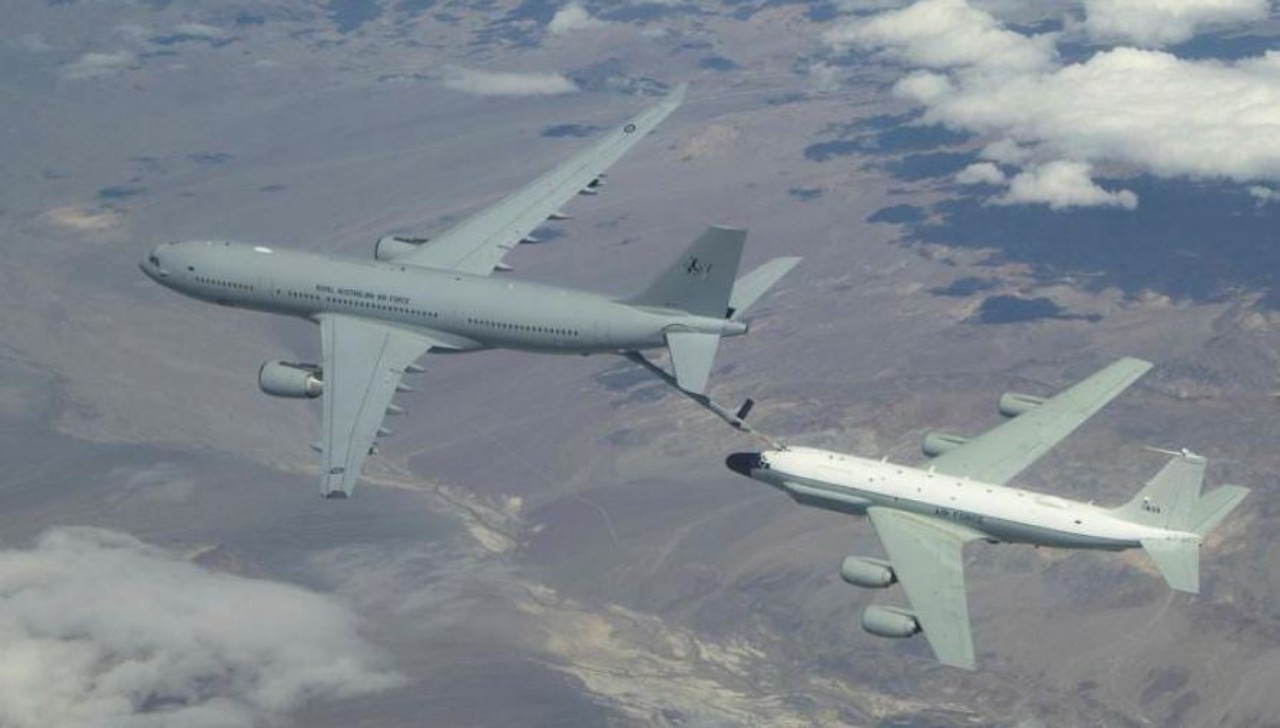
The Royal Air Force will develop a boom air-to-air refuelling system to complement the probe and drogue arrangement it currently operates, in a change that would allow it to refuel American-pattern aircraft in British service without relying on allied tankers, according to a written answer published this week.
Luke Pollard, Minister of State for Defence Readiness and Industry, was responding to Ben Obese-Jecty, the Conservative MP for Huntingdon, who had asked what assessment had been made of the demand for a solid boom capability to refuel the future F-35A, the E-7 Wedgetail, the P-8A Poseidon and the RC-135 Rivet Joint.
Mr Pollard said: “The Royal Air Force currently operates a probe and drogue air-to-air refuelling system and will complement this with the development of a boom system. This will ensure we have a sovereign air-to-air refuelling capability for the future Royal Air Force fleet that enhances interoperability with NATO Allies and partners.”
Two ways of passing fuel
Probe and drogue refuelling works by trailing a flexible hose behind the tanker with a funnel-shaped basket on the end, into which the receiving aircraft flies its own probe, an arrangement that puts the work on the receiver, allows several aircraft to be refuelled at once from wing pods, and is used by the Royal Air Force, the Royal Navy, the French air force and most of the world’s naval aviation.
A flying boom is a rigid telescopic tube lowered from the tail of the tanker and flown into a receptacle on the receiving aircraft by an operator aboard the tanker, transferring fuel considerably faster, which matters a great deal for large aircraft, and it is the standard across the United States Air Force and among most NATO air forces operating American-built types. An aircraft built with a receptacle cannot take fuel from a drogue, and one fitted with a probe cannot take fuel from a boom, so the two systems have to be provided separately.
The aircraft concerned
All four of the types named in Obese-Jecty’s question are American in origin and all four are refuelled by boom. The E-7 Wedgetail, the P-8A Poseidon and the RC-135W Rivet Joint are either already in Royal Air Force service or entering it, and have depended on allied tankers for air-to-air refuelling, in practice usually American ones. The F-35A, which Britain committed to buying under the Strategic Defence Review, is refuelled the same way, unlike the F-35B flown from the carriers, which carries a probe.
The Voyager fleet, based on the Airbus A330 and operated under a private finance arrangement, was ordered in probe and drogue configuration only, although the airframe can accommodate a boom, since the A330 MRTT is offered in that fit and operates that way with several other air forces.
The Global Combat Air Programme adds a further dimension, since the aircraft being developed with Italy and Japan is expected to use boom refuelling, which on the current fleet arrangement would leave the Royal Air Force operating a new fighter that its own tankers could not service.
Sovereign capability
The phrase Mr Pollard uses in his answer, sovereign air-to-air refuelling capability, is the language the department has applied to this area for some time, and it reflects the practical difference between coalition operations, where allied tankers are available by arrangement, and national ones, where they may not be.
Obese-Jecty has put a series of questions to the department on Royal Air Force capability in recent months, including on directed energy weapons beyond DragonFire, where Mr Pollard’s answer confirmed £490 million of funding over four years and said further announcements would be made when appropriate.





Good news!
I presume this is upgrades to Voyager; I can’t see any new AAR aircraft being developed in Europe and boom refuelling is harder to automate than probe and drogue.
Have you not been following Airbus and their MRTT+ (A330-800 or Neo/New Engine Option) and the automated refuelling with the Singapore Airforce F-15s, which, incidentally are all boom capable. So ummm, I’m gonna comment this now and reply further with Press Releases from Airbus and whatnot.
I suspect not, the Airtanker contract expires in 2035, so they are probably going to include the system in its replacment.
Hopefully an owned fleet this time around.
About bl**dy time!