

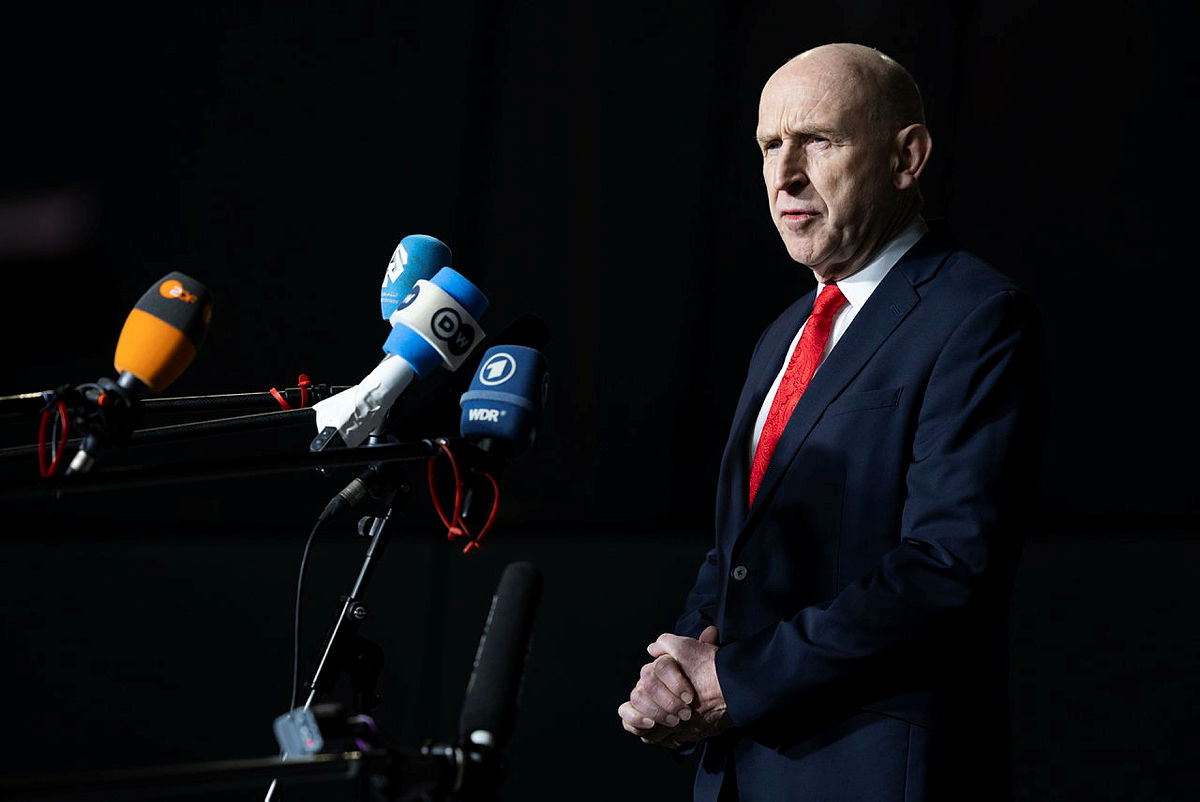
Chancellor John Healey has said the government is spending £1 in every £10 on debt interest, arguing that the bill is now larger than spending on Defence, the Home Office and Justice combined as he set out a new drive for economic growth.
Speaking at the Manufacturing Technology Centre today, Healey placed fiscal discipline alongside investment, innovation and devolution at the centre of his economic programme, saying Britain needed stronger growth to reduce the pressure created by high borrowing and debt costs.
Healey said: “There’s nothing progressive about the government spending £1 in every £10 on debt interest.
“If debt interest were a government department, it would be the second biggest in Whitehall, after Health – bigger than Defence, the Home Office and Justice put together.”
He said controlling government spending remained necessary despite the administration’s wider ambitions, adding: “That’s why staying true to our values means being honest about the need to control government spending.”
Healey said fiscal discipline had been his first priority on entering the Treasury and that he and the Prime Minister were committed to meeting the government’s fiscal rules at the upcoming Budget.
He said: “The Prime Minister and I are in lockstep in our commitment to meeting the fiscal rules at the upcoming Budget:
“To balancing the books, with a buffer to protect against uncertainty,
“To controlling borrowing to bear down on inflation,
“And reducing long term pressures on our public finances.”
The Chancellor also set growth as the central objective of his tenure, describing the UK as strong in areas including defence technology, life sciences, financial services and advanced manufacturing.
Healey said: “And while Britains growth trajectory has been weak this now must change. This is essential, it is possible, it is central to my purpose as Chancellor.”
He added: “I dedicate myself to this mission as Chancellor, to make Great Britain, Growth Britain again – with more investment, more innovation and more jobs.”
Among the measures announced was a planned roadmap to fiscal devolution at the Budget, including greater retention of business rates by local authorities and a share of local income tax for mayoral strategic authorities from 2028.
Healey said: “That is why at the Budget I will set out a roadmap to fiscal devolution – a permanent transfer of power and resources from Whitehall to our regions,
“With greater business rates retention for local councils and strategic authorities…
“…grants from central government replaced by a share of local income tax for every Mayoral Strategic Authority beginning in 2028.”
He also announced £150 million through the British Business Bank for scale-up companies in the North and said South Yorkshire, Liverpool City Region, North-East England and Cardiff Capital Region would become strategic partners of the National Wealth Fund.
Changes to government investment appraisal are also planned, with the Treasury Green Book discount rate due to fall from 3.5 per cent to 3 per cent. Healey said the change would give greater weight to projects with longer-term economic potential. The Chancellor also promised to reduce the regulatory burden on business by 25 per cent by the end of Parliament and extend reforms to judicial review beyond energy infrastructure.
He said: “And I can today announce that we will extend our reforms of judicial review from energy to all major infrastructure so that vexatious legislation and vexatious litigation cannot block economic growth.”
Healey added: “So I will end the consultation culture at the Treasury and beyond – supported by new guidance from the Attorney General today that legal risk is not the be-all and end-all of ministerial decisions.”
Defence also featured in his plans for growing British technology companies. Healey set an ambition to double the number of UK unicorn companies and said government could act as an early customer to help promising firms scale.
He said: “Together, with Johnny Reynolds I will identify the next wave of unicorns, with the state as an early first customer to ensure they have the necessary backing to scale. I did this at Defence, I announced this for Sovereign AI last week, we’re doing it with today’s scale-up fund for the North.”
Healey also linked industrial capacity with national security, arguing that the UK had become increasingly dependent on external sources in strategically important areas. He said the country had been “deindustrialised, as the cost to make anything, to build anything here soared, and our dependence on unreliable sources grew including in areas critical to our national security and sovereignty.”
On artificial intelligence, the Chancellor said the government wanted to exploit its economic potential while retaining oversight of risks to national and business security, pointing to the AI Security Institute and AI Economics Institute as part of that approach.
Healey closed by saying: “We will not deliver all this tomorrow. But we’re delivering the start of it today.”












So no extra funding for defence then.
With what money? Borrow more? We’re already crippled from bailing out obscenely greedy bankers and supporting the country through covid. Spending more of what we don’t have will make things only worse for longer.
I for one was full of Mr Healey’s praises when he resigned as Minster of Defence saying that he must be a man of principle, what a fool I was to think there are such people in politics today.
Yes the UK debt is high but there is plenty of ways the government could be saving money and one would be cutting the numerous amounts of middle management there is running just about every governmental department this and the previous governments have seen fit to put in place now he (Mr Healey) is talking of introducing more middle management not less. I just wonder is there any one in politics today that has the vision and the drive to bring the country back from the abyss.
Getting rid of a few middle managers in Whitehall isn’t giing to make any difference to the economy or public spending.
Few? you need Milei chainsaw…
They actually did that to the NHS and department of health.. 20,000 management and administrative posts cut.
“They actually did that to the NHS and department of health.. 20,000 management and administrative posts cut.”
Peanuts. The point is that the Government needs to do less, its scope need to be much smaller.
Today governments even promise to control the climate something that even a religion do not.
Oh please that worked well with Musk’s chainsaw didn’t it. Even Trump couldn’t defend the damage and incompetence. Now research has estimated that after taking in to consideration all the massive damage, job losses, personal information grabs, disruption and likely deaths he caused he actually cost the Govt money rather than saved the billions he mindlessly boasted he would achieve. And as we know many of the people he sacked had to be re-hired to keep many vital departments working including the nuclear safety authority. So probably better to do cuts in a rather more calculated manner than idiotic chainsaw metaphors. Oh and bad choice in Milei, of late he is covering up his economic failure with threats on the Falklands last I looked, so I suspect the chainsaw metaphor is well past its sell by date in both instances.
Correct in every way
Maybe you should check how much less federal workers are now
That sentence doesn’t make sense in English.
Completely correct.
It is not just Whitehall that needs slimming down, companies like Capita which operates across most departments from the MoD to the NHS need cutting back or better still cutting out all to together, Reed now in bed with the DWP need cutting out, In the MoD itself companies like Serco need cutting back also we need to look at the proffits of these private companies and where they end up, in most cases overseas so if we are to have private companies working in the public sector then their profits need to stay in the UK with investment in the UK infrastructure woven into the contracts.
Mate they have massively done this this, the NHS has cut about 20,000 management and administrative posts from the DOH, NHS and integrated health boards.. the only government to have done such a radical thing since I started as a nurse 30 years ago…
They have done it under the radar.. because cutting 20,000 jobs is not always seen as positive..
Its a start Jonathan, but as I have said above it is companies like Capita, Reed, Landmarc, Serco to name the most notable ones but there are many more in-bedded in the system taking Billions out of the system and in most cases sending their profits overseas not to mention the rather large wages for the top tears of their work force all sitting smug while saying they can do a better job than the people who would have done the job for half the price originally.
What an incredibly over simplistic idea. There’s £30 billion a year in middle management is there? Talk about out of your depth.
wow Mr Rake, great idea, how didn’t anyone else think of that, it’s all so simple 🤦♂️
😂🤣
Oh grate, just what this site needs yet anouther idiot.
You reap what you sow…
Trump added $7.8Trillion to the US national debt in his first term…. That’s $7,800,000,000,000.
US National debt is over 40 Trillion. That’s 125% of GDP. The UK, for comparison is 101% of GDP. The US budget deficit is also larger than the UK’s meaning it’s debt as a proportion of GDP is growing faster than the UK’s. US budget deficit is 5.8% of GDP. The UK’s is 4.3%.
Can’t say I take any chancellor seriously unless they’re talking about raising taxes on corporations and wealth in line with other developed countries.
“I’ve tried nothing and I’m all out of ideas”
All labour MPs lie it’s part of labour DNA blame others .
Always good to raise the intellectual tone of the debate I guess.
What can you say with intellectually severely challenged such as him. V kind of you to even acknowledge this simpleton.
If this country got serious about defence thus increasing the deterrence perhaps the market might settle down a little.
Complete rubbish. Additionally, they have increased spending on defence and announced continuing real terms increase over the next 10yrs
The Laffer Curve:
‘Rachel Reeves, in her first Budget, raised the standard rate of CGT from 10% to 18% and the higher rate from 20% to 24% while also increasing the rate paid by entrepreneurs when they sell their business. The left of the Labour party is pushing for an even bigger increase, pressing for CGT rates to be equalised with income tax, which would take the top rate to 45%.
The results are now clear. According to the latest update from HMRC, in 2025 the amount collected from the tax actually fell by 8%, or by £1.3billion’
Additionally, losing the idiotic idea of net zero would free up tax revenue for defence, reduce electricity prices to encourage growth and encourage North Sea oil and gas production, increasing tax revenues.
Not easy but very simple.
Very true!
Also, Economic historian Niall Ferguson popularized the concept known as Ferguson’s Law, which warns “any great power that spends more on debt servicing than on defense risks ceasing to be a great power.” Historical empires including Spain, France, the Ottoman Empire, and Britain—experienced noticeable declines in global influence and military projection capacity after their debt service costs permanently eclipsed their defense budgets.
Typo: popularised.
Spending what we dont have is why we ate in this mess, albeit to bail out obscenely greedy bankers and supporting economy through covid. Defence spending has increased and will continue to do so, the 1st time in over 15yrs. If we dont break even v v soon the same bankers will send the economy into free fall with increased interest rates. Then we wont be able to pay for anything.
Very interesting. Thank you. I was not aware of ‘Ferguson’s Law’.
The article discussing it makes depressing reading.
‘That a mere 14 years elapsed at Avro between the first flight of the lumbering piston-engine Lancaster and the tailless, delta-wing, jet-powered Vulcan showed just how advanced Britain’s aerospace industry was after the war’
‘Britain crossed the Ferguson limit for the third time in its modern history, in 2010. As in Baldwin’s time, it was Conservative politicians who prioritized debt service over maintaining the country’s military capability.’
But the remedy is clear:
‘There are, in short, ways out even after a great power violates Ferguson’s Law. However, to achieve this, the real growth rate needs to exceed the real long-term interest rate for a sustained period.’
Ferguson’s Law: Debt Service, Military Spending, and the Fiscal Limits of Power (Sir Niall Ferguson 2025)
Not easy, but (Laffer curve) simple.
FFS please don’t get the Munro bot on the Laffer curve, life is just so simple, every time we cut taxes, we should get more revenue. Let’s cut taxes to 0% and give everyone a million-pound pension with all the tax money we raise 🤦♂️
Great one 😂
The Laffer curve in action:
‘Rachel Reeves, in her first Budget, raised the standard rate of CGT from 10% to 18% and the higher rate from 20% to 24% while also increasing the rate paid by entrepreneurs when they sell their business. The left of the Labour party is pushing for an even bigger increase, pressing for CGT rates to be equalised with income tax, which would take the top rate to 45%.
The results are now clear. According to the latest update from HMRC, in 2025 the amount collected from the tax actually fell by 8%, or by £1.3billion’
Genius!…or not really…
The entire UK state is grossly inefficient, as evidenced by the dire public sector productivity figures. The civil service has taken on 100,000 more people in the last ten years, all while output has dropped! Its a national scandal. All the while we are constantly told departments and services are being cut to the bone, its total horse shit. We see this in defence of course all the time, its been run so badly its like a Monty Python skit. Theres no lack of money, theres a lack of competance to spend the money we do have. Off the back of that taxes are the highest they have been since 1947, and growth is dire because of it. And we also have run a deficit since 2001, each and every year we have juiced the economy with money printing to keep the show on the road. Keynes talked about deficit spending during recession, he never once advocated running a permanent budget deficit. The country is being run by fools that don’t have the slightest clue what they are doing.
Laffer curve is obviously true. Its been proven over and over again everywhere. Only a retard would disagree. Labour are putting taxes up and its having the opposite effect. A tax raise that slows economic activity gets less revenue not more. Its basic economics.
In the end most of what the government can do is playing around the edges because nobody wants to face the truth elephant in the room which is killing economy and is just getting worse..
Unless we are willing to have a serious conversation about this problem the nation is fucked..
That problem is life expectancy.. the simple truth is our economic and social social care systems were built on the assumption that the median life expectancy was about 65…the simple truth was when we set up the NHS, pensions and social care half the population died by the time they had hit 65.. so what did this mean and only 10% of the population was over 65.
So in the 1950s
1) The NHS budget was about 4% of GDP and almost that entire budget was on looking after the health of working age people and children as essential the care of that over 65 population was not about extending life, but providing care.
2) the pension budget for that 10% population was about 2% of GDP..
Essentially we spent about 3% or less caring for the over sixties..
Now even when you got to the 1970s- 1980s the figures had not changed that much.. life expectancy had crawled up to 72 and the population over 65 was 13.5 percent or so..
But move to 2025 and we have shifted life expectancy to 83 and 20% of the population are over 65.. being kept alive in those extra 18 years or so by massive levels of health interventions. This means..
1) from almost all NHS spending being focused on the working age people and children now almost 50% of costs are directly attributed to healthcare for the over 65s so that’s about 5.5% of GDP for that groups healthcare up from less than 1% in 1950.. those extra 18 years of like cost vast amounts of money ( the elderly with multiple long term conditions can cost 20k average a year vs about 1.5k for a working age person).
1) pensions are now 6% of GDP from that 2 %
That’s almost 12% of our GDP on state pensions and state health costs for the over 65s.. that’s before bus passes, social care, winter fuel ect..
It’s gets worse because by 2070 we are looking at 27%of the population being over 65 with the state pension bill looking at 9% of GDP and healthcare for the over 65s at 10% of GDP.. so with massive increases in care we are looking at a massive 25% of GDP being used for state pension, NHS and social care for the over 65s
And we cannot really shift the state pension up more age wises because although we live far longer are healthily life years have hardly shifted.. we are not a very healthy population.
This is the the question.. everything else is just window dressing..
Very true. But unfortunately, it will take a very brave government to make such changes. Because who goes out and votes. Yep, the grey vote. My parents are 79 and 81. Healthy for their age. They moan about government spending and debt, but heaven forbid if anyone touched their state pension. They weren’t happy about losing the winter fuel allowance at the time even though they didn’t really need it. They have worked all their lives and paid tax/national insurance so can understand why they would feel seen off. My dad hates that he still has to pay tax on his private pension at 81 years old.
The useless cunts take 80% of what we earn by the time we die.
There is no more to take
Deregulation can achieve a great deal; for example, healthcare:
‘In terms of outcomes, quality and efficiency, social health insurance systems are consistently ahead of the NHS on almost every available measure. They combine the universality of a public system with the consumer sovereignty, the pluralism, the competitiveness and the innovativeness of a market system. We do not see any one particular country’s health system as a role model, because they all have flaws and irritating aspects of their own.’
IEA Paper: Universal healthcare without the NHS
Net zero spending is another example
There is plenty that could be done. As with Britain in 1979, all that is required is a government that does not pursue Clinton style permanent electioneering, origins around 1994 so that would be, in Britain, Major, then Blair and so on and so forth….
There is a way around some of that: if NI was paid into a sovereign wealth fund and pensions were paid out of the lifetime’s input, like from a private pension pot. That means whatever the current demographic, pensions could be paid without increasing the burden on the working age. The obvious problem being, the NI inputs now are used to pay pensions now. You’d have to swap over very slowly, and during the decades of swap over working age people would be a bit worse off, not better. The last leader who had a chance of doing this reasonably quickly and painlessly was John Major, seeding the process using North Sea Oil, but he refused to go the wealth-fund route, which Norway famously took. I think this is one of those “the sooner you start, the sooner you get there” policies.
By the way, you keep talking about over 65s. By the end of this year it’ll already be the over 67s and by 2070 it will probably be over 70s.
I agree it wouldn’t help pay extra from the NHS for long periods of ill health toward the end of life or managing chronic conditions. Perhaps that’s what the NHS needs to rethink.
So we can’t fathomably waste money on Foreign Aid or paying people to sit on their arses all day for no benefit to the state.
Healey has signalled increased reliance on PublicFinance institutions for lending for infrastructure projects and a relaxation of the Treasury Green book test for return on investment from 3.5% to 3%. These changes will favour longterm projects and enable more borrowing without breaking the govts self imposed financial rules. My guess for the budget is a windfall tax on bank profits. Rosebank oil exploitation will be approved – more tax revenue. Together with the mansion tax this will raise a few £billion. And if Milburn publishes the 2nd part of his review into ‘young people and work’ before the budget Healey might able to forecast a reduction in anxiety related sickness benefits. Ditto for the education SEND spending. A few billion here, a few billion there and a lot of juggling , fingers crossed , might create enough for an earlier increase in defence spending.
Thanks Paul a good post. At least he agreed with many of us that the City is not doing enough to invest in innovation and technology start ups, or when they do sustain them for long they are indeed almost falling over themselves to enforce sell offs for a quick return and in a great many cases losing uk IP in the process to foreign competitors, in particular the US. That Country would never allow such a blasé approach to ‘encouraging’ new technology that could so benefit the Country. Hey Trump is even going all Communist in his attempts to buy stakes in many of these Companies ‘for the sake of America’. Geez the man’s so selfless.
We could never rely on the City for any high-risk funding. Look at Harland and Wolff as a mostly non-tech case study, having to go to the US to get expensive interim funding, never getting the long-term funding in the UK they were after, and eventually going bankrupt as the interim loan rate was too high to sustain for more than a year. I usually blame the governments for their failure to guarantee the loan to bring the rate down, but UK financial institutions are also at the centre of it. That’s why businesses have to rely on the vulture capitalists which demand a speedy out. And there’s nowhere near enough VC money around.
Having said all that, it’s comparing ourselves to the US and the Far East. In many European countries, innovation seed funding is even harder to come by.
Getting rid of NET ZERO would be a by start if he’s looking for money for Defence .
At some point in the future the “Welfare System” is going to collapse under its own weight as it’s completely unsustainable.
The NHS will also be forced to make massive cuts as it too is completely unsustainable – it’s already on it’s knees and will not get back up.
The country will also have to stop investing in major infrastructure projects simply because there will be no funds available.
Good News – Illegal immigration will eventually come down when the scavengers can’t claim their free money and benefits because there will be no free money or benefits for anyone in the U.K – the system has been throughly abused and everyone is going to suffer.
No point spending much on defence either who would want to invade or bomb a third world shît hole? – besides none of the legacy political parties have any interest in defence anyway – they have decimated the British military with their massive underfunding and cuts over the decades – it’s traitorous what they have done.
My advice to anyone who is young enough “leave the UK/Europe” asap.
Those of us that remain in the U.K we can look forward to vastly higher taxes (got to pay that interest somehow) – horrendous crime rates – less support and ever increasing decline.
Fun times 🎉
Take it you haven’t visited many other countries. Maybe Benidorm. We take so much for granted in this wonderful nation of ours. Petty arseholes like you can’t understand that. So maybe you should set sail off to a real third world nation and see how long you last.
Completely agree with you. This very limited cretin needs to stay looking at the pics in The Sun than attempt to contribute to an adult conversation.
“No point spending much on defence either who would want to invade or bomb a third world shît hole?”
The US&A, they revel in it
. There is an upside though, they usually lose the war.
There is going to be a war in the near future. We have to concentrate on that. We were paying ww2 dept up untill a few years ago but we 100% couldnt have done without it. The country is only as good as its military and at the moment its very bad.
We are by percentage of gdp in much more debt than we were after WW2. That debt was also given on very favourable rates, unlike now when they keep getting pushed up. If we dont clamp down now no one will lend to us in times of war.
The war is a result of the debt, it’s their way of wiping the slate clean.
The only war that is on the way is civil war
That is probably true my friend. The British are starting to assemble
It shouldn’t be a surprise, every single government since John Major in 1997 has borrowed heavily and passed the baton on for the next government to do the same.
Does it really come as surprise when you spend decades running the country with the financial wit of a teenager with a credit card.
What could possibly go wrong?!
This isn’t talked about enough. Tony Blair inherited a surplus, and then asset stripped the NHS and Defence, privatised many areas of both, gave away billions to other nations took us into 2 wars (one illegally) and now we find ourself in a continual spiral of debt while both the NHS and Defence have been run into the ground.
They gave him a knighthood when it should have been a prison term.
👍 Damned Tories!
Yep, it was all so very simple, the economy ( circa 2000) was growing at a predictable annual rate, so let’s borrow against the growing economy, because that will surely carry on forever won’t it??
And that was New Labours ‘entire’ economic strategy in a nutshell.
Almost incredibly you still get people who think borrow and spend forever is a tip top idea….
Debt was at a very decent very manageable level until the bankers crucified us in the 1st decade, Then covid did even worse damage in the third. Looking at Blair is like looking at a snowball when there’s an avalanche coming behind it.
The money tree is struggling and the money markets are concerned. Its not just about the UK. Far from it – its a lot about the US and people are shifting out of US exposure ( dollars and assets). As a result bond yields are going up and tbh for the UK to lessen the impact it really need to start repaying debt ( markets happy, gilts go down, govt happy). Yes defence needs more ( and it needs to spend much more effectively what it given) but there does need to be cost cutting snd yhat should mean welfare. But that won’t happen until after the next general election and only if the UK has a functioning govt then!
They’re not even covering the interest, let alone paying the debt off.
Imagine being given an almost limitless supply of money, and being that shit at managing it, you end up broke.
Absolute clown show. This is why they want WW3.
Perhaps they hope we will be on the loosing side and have the national debt written off like Germany post war???
What the fools who advocate borrowing money forever dont see is the 25 years worth of interest that’s ballooned to the point that we will be unable to make the payments.
What happened then? We default, our credit rating slumps, we have to go cap in hand for a bail out and that comes with strict repayment terms.
Net result, deep, deep austerity, just to get to a point you can start paying back the interest!
Every government promises growth, but none of them have the stones to actually implement it. His says his first priority is fiscal discipline, so not growth then. You can’t have austerity-based fiscal rules and expect to get significant growth through just cherry-picking a few favourites. As long as unemployment stands at 5%, that’s a significant chunk of the workforce who aren’t producing anything and want to. For a healthy economy getting people working is more important than feeding the bond markets. We’ve just set up the system in a way that always turns to the bond markets. They know that and can therefore expect a necessity premium on yields.
You can’t tax an economy to properity. Governments do not and never will drive growth. We’ve had taxation through the roof for decades and growth has been shite throughout. Taking money from the productive part of the economy and giving it to the non productive part has been a disaster. Look at the ONS own productivity figures. The public sector is total shit and it dragging the country down with it.
The entire UK state is grossly inefficient, as evidenced by the dire public sector productivity figures. The civil service has taken on 100,000 more people in the last ten years, all while output has dropped! Its a national scandal. All the while we are constantly told departments and services are being cut to the bone, its total horse shit. We see this in defence of course all the time, its been run so badly its like a Monty Python skit. Theres no lack of money, theres a lack of competance to spend the money we do have. Off the back of that taxes are the highest they have been since 1947, and growth is dire because of it. And we also have run a deficit since 2001, each and every year we have juiced the economy with money printing to keep the show on the road. Keynes talked about deficit spending during recession, he never once advocated running a permanent budget deficit. The country is being run by fools that don’t have the slightest clue what they are doing.