

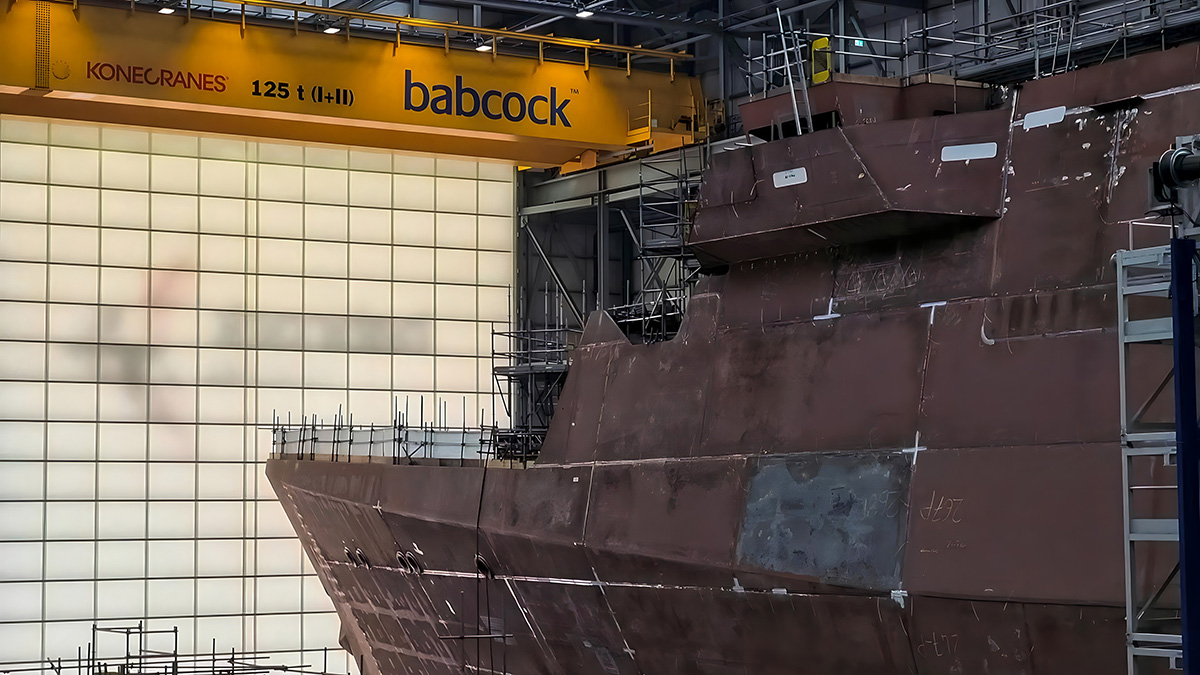
The Government will publish a new Shipbuilding and Maritime Technology Action Plan later this year as the Royal Navy manages the retirement of its Type 23 frigates and the arrival of new Type 26 and Type 31 ships.
The commitment was set out in a written parliamentary answer to Labour MP Luke Akehurst, who asked how Defence was assessing the long-term sustainability of Britain’s naval shipbuilding capacity once programmes funded through the Defence Investment Plan are completed.
Defence Readiness and Industry Minister Luke Pollard said the National Shipbuilding Office, now part of the National Armaments Director Group, was continuing to assess the workforce, infrastructure and industrial capacity required to sustain the sector.
He said: “The Government assesses the long-term sustainability, capability and capacity of UK naval shipbuilding through the ongoing work of the National Shipbuilding Office (NSO), as part of the National Armaments Director Group, and the Royal Navy.”
Pollard added: “The Defence Investment Plan provides a significant forward programme of naval procurement, and the NSO, RN and wider NADG will continue to work closely with industry to understand future workforce, capacity and infrastructure requirements in the immediate and long term.”
The forthcoming action plan is intended to set out the Government’s approach to maintaining and expanding the shipbuilding sector beyond the current programme of frigates, support ships and future autonomous vessels.
Pollard said: “The NSO will publish a Shipbuilding and Maritime Technology Action Plan later this year which will detail this government’s approach to ensuring the long-term growth and sustainability of the UK Shipbuilding sector.”
Frigate transition
Separate questions from Akehurst focused on the risk of escort numbers falling as Type 23 frigates leave service before their Type 26 and Type 31 replacements arrive. In both cases, Pollard referred back to a July parliamentary answer setting out the transition plan.
Pollard said in July: “The Government is investing in: new autonomous surface vessels; autonomous sub-surface; an amphibious fleet with the Netherlands; future Common Combat Vessels; and delivering a combined force of 13 Type 26 frigates with Norway expected to enter service from the late 2020s; five Type 31 frigates expected to be in service by the early 2030s; and new Fleet Solid Support ships.”
The combined Type 26 figure includes the UK and Norway, rather than 13 British frigates alone. On the question of maintaining enough escorts during the changeover, Pollard’s earlier answer said the Navy would not normally publish individual ship retirement or service-entry dates because doing so could reveal elements of the fleet’s longer-term schedule. He added: “However, the Royal Navy continues to ensure that it has sufficient assets available to deliver operational outputs.”






Put simply, we need to order more ships and train/retain more sailors. Anything else coming from the government is just white noise.
Hi Andrew
If they don’t start putting some proper planning and funded concept work into place soon for the CCV there will be a gap in demand at Rosyth, unless Babcock can land an order from Denmark. My guess is the HMG is keeping it’s fingers cross for the Danish order while is faffs about ‘discussing’ the CCV.
The RN’s escort fleet will still be too small even when (if) we get back up to 19 frigates and destroyers. If we do end up in some kind of conflict with Russia there has to be a real risk of it escalating and that escalation will likely focus on NATO’s week points and the UK maritime environment has got to be high on the target list given state of the RN (and most other NATO navies to be fair).
We need a bigger navy, a much bigger navy and drones alone will not cut it. Given the 20:40:40 crewed ships to reusable to consumable drones the escort fleet size will have a limiting factor on the number of drones, both reusable and consumable, that can realistically be deployed in a controllable manner.
So the RN should consider ordering another 3 or so T31, given BAE Systems yards on the Clyde will be busy for the next 10 years or so with T26. We also need more people across the board…
Cheers CR
Ordering 3 more T31 would make a lot of sense. If the RN end up not keeping them we could offer New Zealand Venturer, Active and even maybe Formidable at a price they couldn’t turn down. Building in anticipation of being able to sell is the way the French have done things.
If we are going to give 3 type 31s away then they’d be better off ordering a whole batch of 6 type 31s. The fact is with the Norwegian purchase of type 26, the RN won’t get upto its intended 26 or more escort warships until 2040 at this rate. More type 31s are most definitely needed.
That’s hot the nail on the head, more noise about autonomous vessels and ambition until it comes to ordering them and put your money where your mouth is. The way they say up to 12 subs, this includes 1, 2, 3… 12 and is meaningless, they could say up to 100 I’d they wanted.
It still feels to me that after the type 26, destroyers will be needed and then start a new type of frigate – whatever that will look like at that time.
The type 83 is dead and gone. Government have admitted they can’t afford a high end BMD capable destroyer, after the type 45s leave service. Although the type 45s haven’t been stressed and must be in good material state and therefore capable of serving into the late 2040s or 2050 with upgrades.
Could not have put it any better. No more plans, no more by 2030 or 2035. Now today do it. Our yards what there is of them are not working 24/7. Retention is a key, get the job pay and conditions right and take back recruitment from civilian contractors. Do it today though.
Ah, good. More research, more reports, no orders. That’s a real startegy.
Timely. Confirmation that CCV will be built at Rosyth; that Norway will build the 3 MCMV motherships; that MRSS will be built in Belfast; of where the T9x will be built???
I think the sloops. So type 91, 82 and 93 could be built in Appledore. They won’t be any bigger than the Irish naval service Samuel Beckett class.
The government keeps banging on about the future drone fleet.
It is unknown undeveloped and unproven technology and its not going to be quick to develop and test.
Building the type 83 in parallel with the drone fleet research would have been the ideal mitigation strategy.