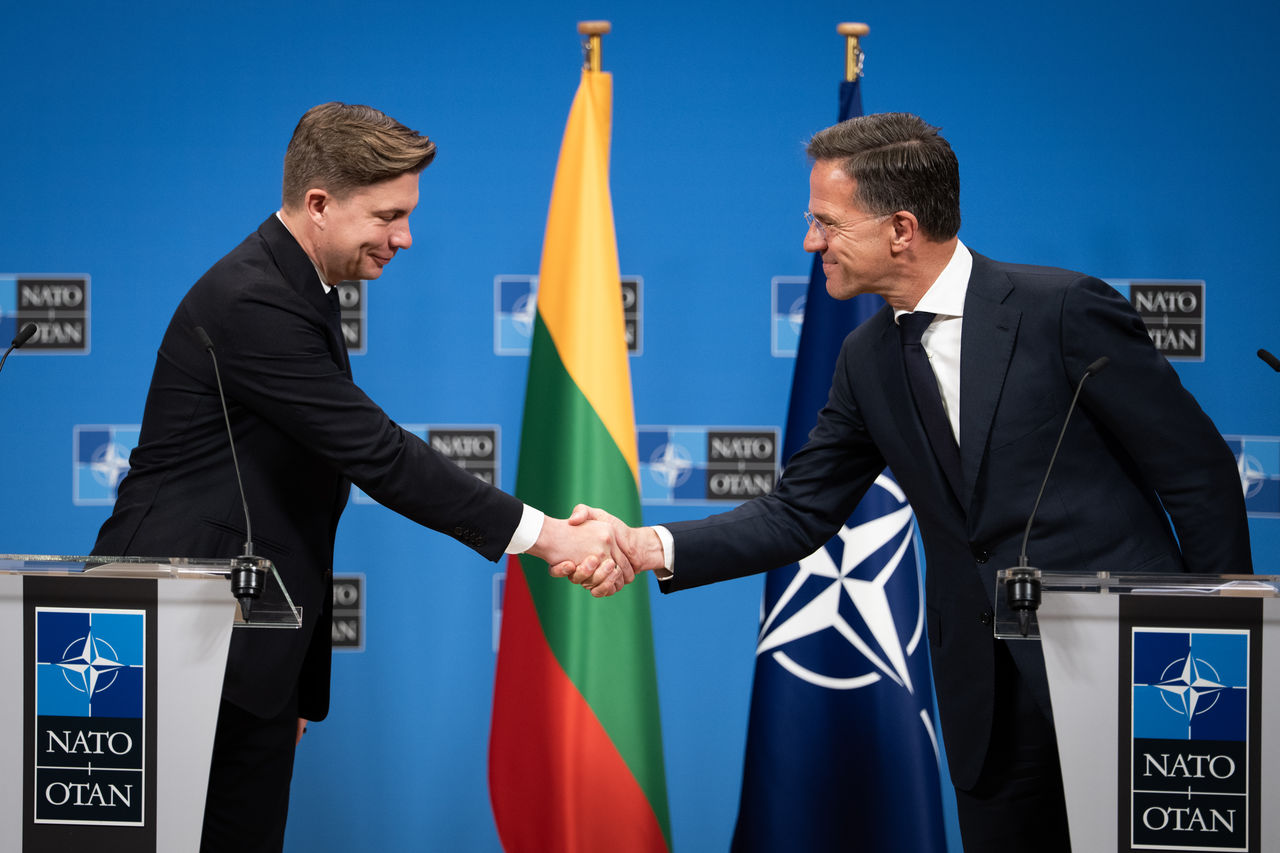
The destruction of a drone that violated Lithuanian airspace by Italian jets flying from Šiauliai was collective defence in action, NATO Secretary General Mark Rutte said after meeting the Lithuanian prime minister in Brussels, according to NATO.
Rutte received Mindaugas Sinkevičius at alliance headquarters on Tuesday, the prime minister’s first visit in the role, and said the two had discussed how to keep NATO strong and Lithuania safe. “NATO defends every inch of Allied territory, against any threat, from any direction,” he said, before turning to the aircraft NATO has deployed to the Baltic state. Of the shootdown on 15 September he said: “This is collective defence in action.”
The alliance is strengthening integrated air and missile defence and adapting its posture against drones through a set of initiatives that include one called Drone Edge, according to NATO, which gave no further detail on what that programme covers.
Rutte also referred to the alliance presence in the Baltic Sea and to the Forward Land Forces stationed in Lithuania, welcoming Lithuanian investment in the Rūdninkai training area that will host those troops. On what Lithuania spends on its own defence, the Secretary General was unambiguous. “Lithuania leads by example on defence investment,” he said. “This year, you are expected to reach 5.38% of GDP for core defence spending. Lithuania doesn’t just meet its commitments; it sets the standards.”
That figure sets a marker no other ally is close to matching, since the alliance agreed a headline target of 3.5 per cent of GDP on core defence by 2035, which Wes Streeting restated from the Labour Party conference platform this week as a cast iron British commitment, and Lithuania expects to be spending more than half as much again on top of that this year.
On Ukraine, the Secretary General listed Lithuania’s commitment of at least 0.25 per cent of GDP a year in military assistance, 38 million dollars contributed to the Ukrainian defence industry, and support for energy infrastructure and railway locomotives. “Russia is failing,” he said. “It is failing on the battlefield in Ukraine, and it is failing to undermine our unity and support for Ukraine. Our message to Moscow is clear: we will do even more for Ukraine, not less.”
Šiauliai has hosted NATO’s Baltic Air Policing mission since 2004, with allied detachments rotating through on four-month tours because the three Baltic states operate no fast jets of their own, and Italian aircraft have been among those taking their turn. What has changed is the nature of the work, which for two decades consisted largely of intercepting and escorting Russian aircraft transiting to Kaliningrad rather than engaging anything.
The Forward Land Forces in Lithuania are led by Germany, which has committed to stationing a full brigade in the country, and Rūdninkai to the south of Vilnius is the training area being built out to support it. Britain contributes to the same framework further north, leading the multinational battlegroup in Estonia.
Neither NATO nor the Lithuanian government has attributed the drone shot down on 15 September to any state, and the alliance statement does not say what type it was.