

EXCLUSIVE – An independent Scotland would hold the Greenland Iceland gap on NATO’s behalf and would have to demonstrate what it brings to the alliance beyond its geography, the SNP Westminster leader told me when I sat down with him to chat all things defence.
Dave Doogan, the member for Angus and Perthshire Glens, said his party’s policy of NATO membership carries obligations that cannot be assumed. “You can’t just want to be in NATO. You have to demonstrate that you’re worthy to be in NATO. NATO is a collective assurance and defence pact, and so if we are asking those current members of NATO to let us into that club, then we need to know, they need to know rather, that, well, what are you going to do over and above your geography, Scotland? And we need to be able to answer that question and answer it clearly.”
The geography itself would change name and meaning on independence, and Doogan set out what that would leave Scotland responsible for in the North Atlantic approaches: “If you look at an independent Scotland, the Greenland Iceland UK gap would then be the Greenland Iceland Scotland gap, and you and I both know that the corridor of principal tension between Russia and NATO is in that environment, that Euro-Atlantic region. So Scotland would have, working with their allies, a role in that.”
Doogan argued that Scottish membership would be an addition to the alliance and not a subtraction from it. “An independent Scotland within NATO makes the United Kingdom greater than the sum of its parts. There’s an additionality with an independent Scotland. We won’t be spending that five and a half billion annually, recurring and growing, on something else. We’ll be spending it on defence of the realm and defence of the Euro-Atlantic zone in cooperation with our allies, just like Denmark does, just like Norway does, just like Finland and Sweden do, and the UK do.”
He warned against treating the Typhoon force at Lossiemouth as a Scottish asset in all but name, arguing that the station exists for a job wider than Scotland: “Let’s not think for one minute Lossiemouth is there to defend Scotland alone. Lossiemouth is there to protect the UK’s northern flank.”
Doogan has already done the arithmetic behind that offer, having drafted and costed a plan for an independent Scotland with an army, a navy and an air force funded by around five and a half billion pounds a year. He wrote it about two and a half years ago, said it now needs updating, and corrected the suggestion that the work was unfinished, saying it simply needs a refresh. He is holding it back until the next independence referendum debate.
Asked why he has not published it, he said: “All of these things are about timing, and you know we can’t all see defence as a priority. I accept that, but actually, if we unpack these things, if we don’t have security, then we don’t have anything. And security isn’t just about territorial integrity and freedom of movement. It’s about food security, energy security, and a whole range of other things.”
He added that the document is written to answer a question that has not yet been asked in earnest: “Why not release the defence plan now? Well, a good reason is that it needs a refresh, but it’s designed to answer a question when enough people are asking that question, and that will come when we’re having the next independence referendum debate. Because I believe that it’s a cogent and sensible plan.”
Doogan described the document as “a signpost and a clarion acceptance that Scotland has a responsibility to defend itself as an independent state, and it has a responsibility to be a responsive and reliable partner to our allies.”
On the shape of the force, he said the plan assumes a conventional structure built up over a number of years: “The proposal that I’ve drafted and costed shows Scotland with a traditional three main service, army, navy and air force, and of course that needs generated over time. You don’t start with that, but you can have it on the drawing board.”
The budget comes from Scotland’s existing share of British defence spending, money he says is already being spent on Scotland’s behalf: “Scotland would be in a position to spend what it currently is exposed to in terms of the UK fiscal environment on defence, which is circa five, five and a half billion per share of the UK defence budget. That would be on a rolling year-on-year recurring with inflation, a budget that would generate a substantial defence force across three services.”
Doogan argued that the headline percentage tells you very little on its own, telling me “I often think two or three per cent of GDP is pretty abstract. Sometimes it’s not what you do, it’s the way that you do it. And the same is true, it’s not what you spend, it’s what you spend it on.”
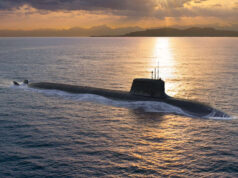
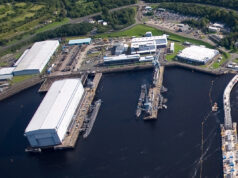
He made the case for the naval component on industrial grounds, arguing that Scotland is among a small group of countries with the yards to build its own warships: “If you look at the amount of countries around the world that could have a stab at building a complex warship, there’s about twenty maybe at a push, and Scotland’s one of them. In fact, we’ve got two sites that can build complex warships on each side of the country.”
Doogan said he would be happy to go into where an independent Scotland would source combat aircraft, train its pilots and secure interoperability, while declining to treat those as prior conditions. “These are all legitimate operational questions, which I would quite like to answer, but I don’t feel the need to answer them because actually these are challenges that every sovereign state faces, and every sovereign state has to shop around for these platforms.”
On the division of existing British military equipment, he said the ownership position is clear but the practical answer is not. “It’s important to remember that we own the assets, all of them proportionately, at the disposal of the UK defence forces, and so we’ve got a call on them. But why would we make problems for the UK by taking our share?”
He set that against the state of the British inventory, where he argues the margin for giving anything away has long gone: “You know as well as I do that there is very little redundancy in any platform in the United Kingdom. You know, just look at what they were trying to do to get a functioning Type 45 out to the Mediterranean recently. If we think that there are squadrons of Typhoons up and down these islands ready to go at a moment’s notice, that’s not how it is.”
On that basis he ruled out pressing a claim that damaged what remained of the UK, telling me “So if we were to claim our share of eight per cent or whatever of UK assets, and that caused major difficulties for the UK, well, we just wouldn’t do it because it’s not intelligent.”
Division of assets has been one of the hardest parts of the independence argument to pin down since 2014, when the Scottish Government’s white paper assumed a share of equipment would transfer and the then British government declined to negotiate before a vote. The eight per cent figure Doogan uses reflects Scotland’s rough share of the British population, which was the basis the 2014 prospectus worked from.
On relations with what would remain of the United Kingdom, Doogan expects cooperation to follow from mutual interest. “Let’s not pretend for one minute that the United Kingdom, once all the heat has gone out of an independence debate and Scotland has chosen to be independent, the rest of the UK will cooperate with Scotland just in the same way it cooperates with every other entity and jurisdiction that used to be governed from London. It’s entirely predictable, because it’s to England’s and the rest of the UK’s self interest to cooperate with Scotland, and it’s in Scotland’s interest to cooperate with the rest of the UK.”
He added that the hostility between the two governments is a product of the constitutional argument itself: “This enmity that exists just now is a function of trying to keep the UK together. Once Scotland’s out of the UK, that enmity has no purpose anymore, and we’ll work together like grown-up and respectful states.”
Doogan said that losing jurisdiction over the northern half of the island would present the rest of the UK with a problem, and that he would not want it handled adversarially. “If the SNP or I have got anything to do with that, that won’t be a challenge because we’ll approach it in a cooperative way. How we do that is up for discussion. A brand new independent Scotland would not want to be undefended, but the rest of the UK would not wish a brand new independent Scotland to be undefended either.”
On the deterrent, he said Scotland would have no further say once the system left Scottish waters. “We have got no locus with the deterrent once it’s removed from Scottish waters. It’s not a Scottish asset or system, it’s a UK asset or system. And so what they choose to do with it, where they choose to berth it, whether they choose to sustain and renew it going forward into the future, that’s entirely up to the rest of the UK. Scotland will have no role in that. We’ll respect their sovereignty and their freedom of decision, and they’ll respect ours.”
Where the deterrent goes after independence would be settled in London, and Doogan accepts Scotland would have no say in it once the system leaves Scottish waters. The rest of the case is his to make, and it comes down to a navy and air force built around the North Atlantic, five and a half billion a year spent on conventional defence, and a neighbour the alliance can rely on. On his own test, that is what Scotland would have to show over and above its geography. He says he has the plan to prove it, and he is waiting for the moment to publish it.
Doogan spent his career in defence engineering before entering Parliament in 2019 and has pushed conventional defence up the SNP’s agenda, work he describes as still in progress.




Dreamland. It would be years before they established any armed forces, longer to re-join NATO and at least a decade to figure out how to join the EU if England stayed out.
Just more blah blah blah from the SNP – they know full well they will not be given another independence referendum for decades.
Scotland is remaining in the U.K. for a very long time.
So any talk of independent Scotland joining NATO or earning its place in the alliance is totally irrelevant.