“Sometimes the submarine wins.”
It’s a frank admission from the captain of a warship built to hunt them. But Commander Jason Knowles has been doing this for 30 years, and he knows what HMCS Ville de Québec, the ship he has commanded since November 2025, is up against in the Baltic.
“Submarines are great tools. They are very elusive,” he said. “They are inside the environment and understand it so much better than we do. We’re only on top of it.”
Ville de Québec is one of Canada’s 12 Halifax-class frigates. She has been away from home since the middle of July, and came to Stockholm to join Exercise Dynamic Merlin, NATO’s anti-submarine warfare exercise, a long way from the North Atlantic she was designed for.
Knowles is open about her age. “Ville de Québec is nearing probably the end of its service life, having served for over 30 years, but continues to be relevant because we’re putting the effort into keeping it modernised and keeping it up to date in the ways that we need to stay operationally impactful.”
Look out the window
A tour of the ship starts on the bridge, where Knowles said the basics of seamanship matter as much as any sensor. “I think it’s very easy in modern warfare to picture that the cool tech and the radars and everything are how naval operations unfold. The reality is that you still need to look out the window, and you still need to understand the sea in the same way that they would have [centuries] ago.”
Sometimes, he said, a lookout is the first to spot a threat, “because your adversary has done such a good job of masking themselves until the last minute they can’t, because they’re visually sighted”.
In the Baltic, there’s a lot to look at. Asked by the UK Defence Journal how it differs from the North Atlantic, the ship’s operations officer, Lieutenant Davick, pointed to its traffic and its shallow water. “The Baltic has a higher traffic density than a lot of areas in the North Atlantic. […] There’s more neutral shipping. There are more warships around. There are [more] navigational hazards, and in general, the Baltic is quite shallow compared to where this ship was designed to traditionally operate.”
The operations room
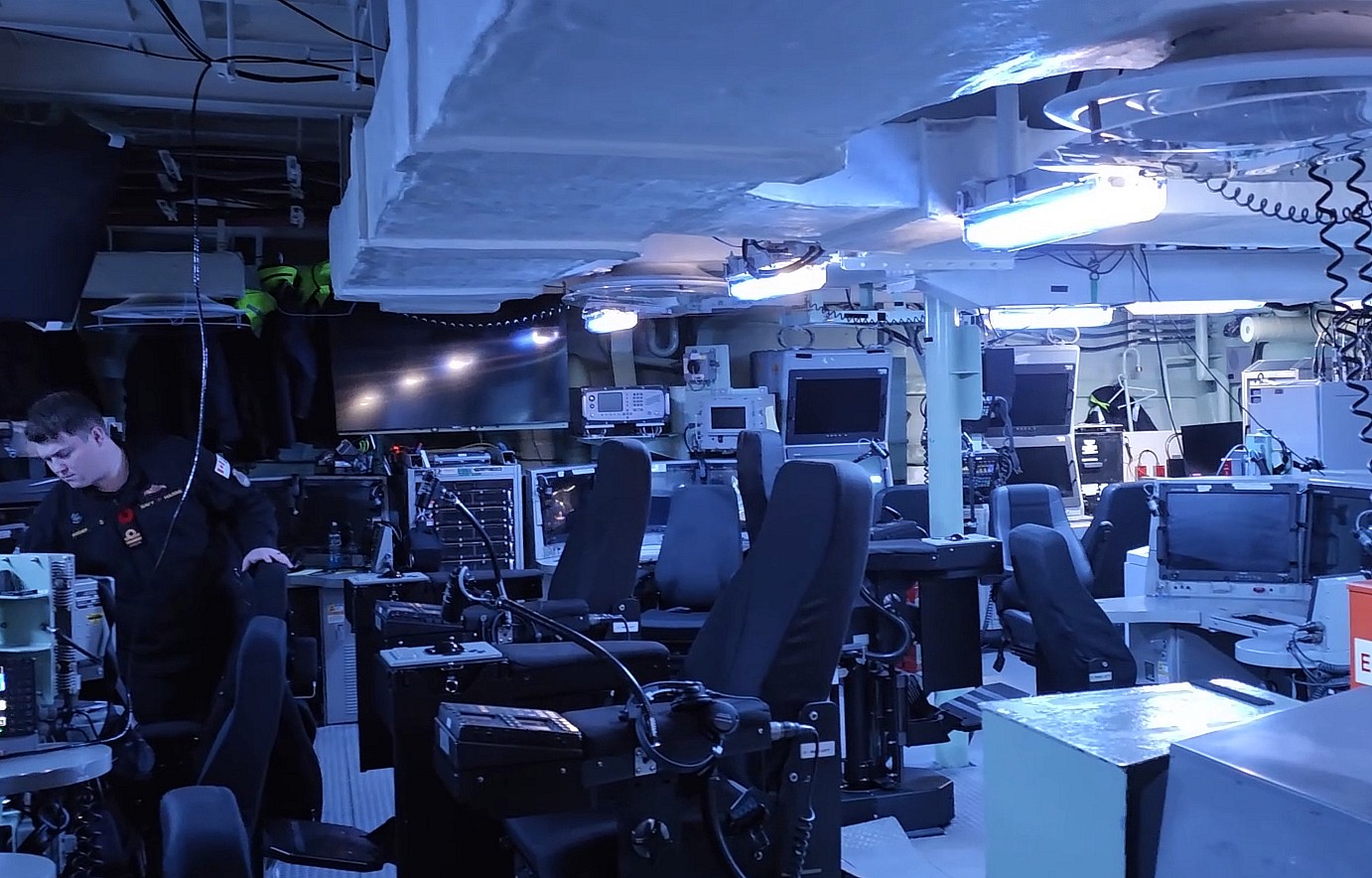
The ship is fought from her operations room, a dark space lined with consoles. “When this is flashed up at sea, it can be a little bit overwhelming visually, because all of these screens are on,” Davick said. The system can be reconfigured to suit the task, and if equipment fails, “we have redundancy. We’re able to shift personnel, maximise our ability to carry on the [mission].”
Weapons decisions are made here. Davick said the speed of modern threats means more automation, but never without a person. “Things are faster. You know, there’s less time to react in the event of a threat. […] There are various levels of automation available. There’s always a person in the loop.”
He said keeping allies in contact when communications are disrupted, “that could be adversaries, it could be equipment faults, could be environmental”, was one of the focuses of Dynamic Merlin.
The hunt
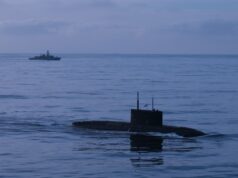
Finding a submarine starts with a sailor in headphones. “You hear the different noises that a submarine can make,” Knowles said. “It can be as simple as somebody dropping something or opening and closing a door. Otherwise, it’s mainly machinery-based.”
The operator and their team then have to make sense of it. “Is that a submarine? Is it a whale? Is it another ship? […] If it is, where is it? What’s it doing? Is it diving? Is it ascending? Is it moving? Is it stopped?”
Knowles describes anti-submarine warfare as “very much a thinking game”, like chess. “Your opponent isn’t just a rocket; it’s another vessel with people in it that are also trying to outsmart you.” Is it possible to miss one? “Absolutely, they’re designed to be missed. But at the same time, sometimes we find them even when they don’t want to be found.”
The sonar
What gives Ville de Québec her edge is below the waterline. She is one of only two Canadian frigates fitted with a more advanced sonar than the rest of the fleet. It’s called the Towed Low Frequency Active Passive Sonar, part of Canada’s Underwater Warfare Suite Upgrade. Its maker describes it as the first time the Canadian surface fleet has combined passive listening with low-frequency active sonar, to find quieter submarines at longer range.
“This ship specifically of the Canadian fleet has been retrofitted with a more advanced sonar [than] you would see on most of our frigates. There’s another one in the Pacific fleet as well,” Davick said. “This upgrade has really allowed us to [build] the body of knowledge in anti-submarine warfare within our Navy, and we’ve gotten a lot of good training with this sonar since we left home in the middle of July.”
The ship streams a low-frequency active towed array behind her, though it can’t always be used. “In some waters, you won’t want it deployed because it restricts your ability to manoeuvre without damaging the array,” Davick said. “For example, if the water is too shallow, the weather’s too rough.”
Uncrewed targets
The ship has also been working with uncrewed systems on this deployment. In October, during Exercise Strike Warrior 26-2 off north-west Scotland, Ville de Québec deployed and remotely guided a QinetiQ Hammerhead MkII uncrewed surface vehicle, a high-speed target boat. In a live-fire serial, a German Navy NH90 helicopter flying from the supply ship FGS Berlin chased and destroyed it.
Two of the craft were on deck during our visit, and we were able to take a look around them. Knowles said they are very useful, both for training and for other tasks.
The helicopter
The ship’s CH-148 Cyclone helicopter extends her reach far beyond the horizon. “We are a tool to extend their reach well beyond what they would be able to see,” said Captain Devin Nicols, the helicopter’s airborne anti-submarine warfare officer.
Radar, camera, electromagnetic receivers and acoustic sensors feed a tactical console, with the picture sent back to the ship “most of it in real time […] so that they know everything that we know”. Flights last two to three hours, and Nicols said that in that time the crew can scan areas “of nearly half the Baltic”. The Baltic’s traffic is a challenge for them too. “The other day we saw probably upwards of 50 to 60 ships in an hour,” she said, explaining that in busy waters their search is limited “just by manpower, by how quickly we can get through things”.
For Knowles, the helicopter is also the crew’s lifeline. “One of the things that I’m always most concerned about is somebody getting hurt beyond our capabilities of making them better here,” he said. The Dutch flagship Den Helder and the German support ship Berlin carry more medical staff and equipment, “and the safest and easiest way to get [them] there is a helicopter”.
Life on board
Around 250 people live on board, drawn from the navy, air force and army, and every one of them needs space. “Those 250 people have to live somewhere, they have to eat somewhere. The food that they eat has to be stored somewhere,” Knowles said. “Laundry, even a gym. All have to be factored into the ship. […] The combat equipment is layered in on top of that, to make it so that there’s just stuff everywhere.”
Getting a crew ready takes time. Knowles said they spend about 12 months preparing for a six-month deployment.
Canada has kept a frigate or minehunters with NATO’s standing maritime groups since Russia’s annexation of Crimea in 2014. “We’ve had either frigates or mine hunters deployed to one of the four groups in both the north and in the Mediterranean,” Knowles said.
Ville de Québec sailed with the UK Carrier Strike Group in 2025, and another Canadian frigate, HMCS St John’s, took part in last year’s Dynamic Merlin. “Another Canadian frigate that looks just like this one, there’s just a different number on the side, was here this time last year doing this exercise,” Knowles said.
More than 30 years after she entered service, Ville de Québec is still out there listening.