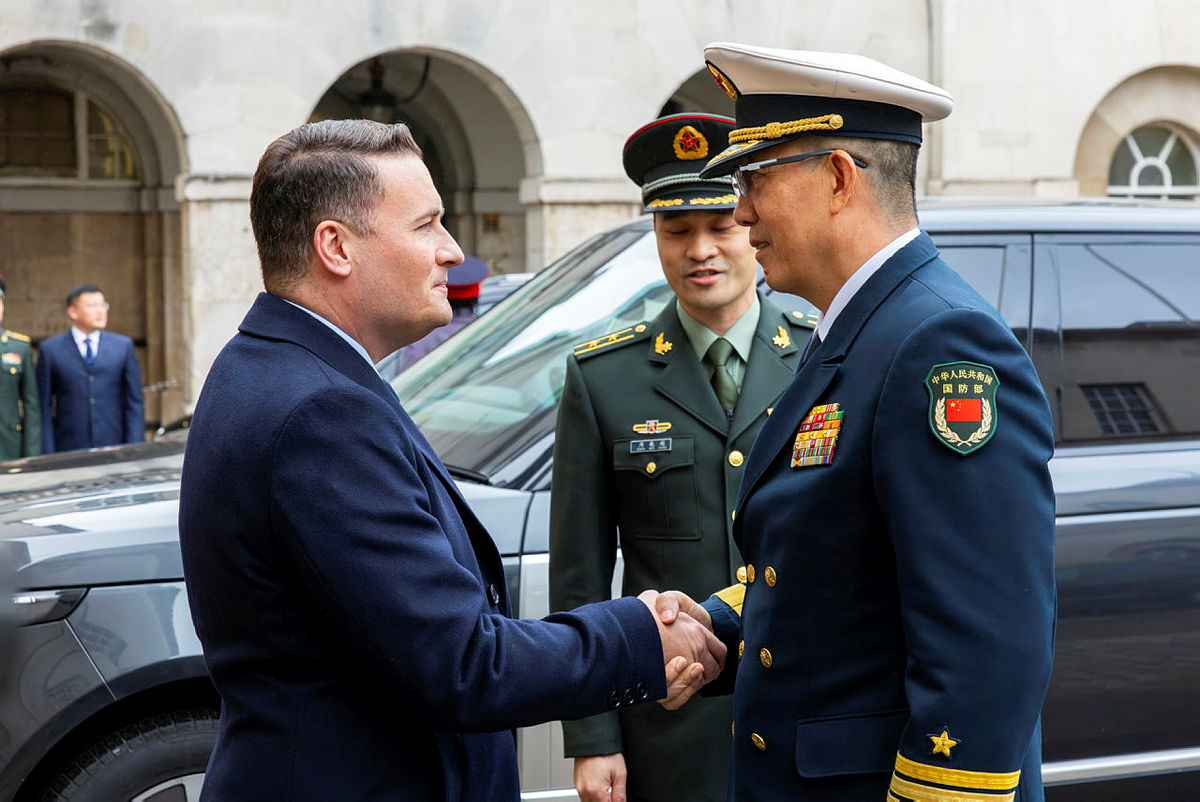
Wes Streeting, the Defence Secretary, has hosted China’s defence minister, Admiral Dong Jun, in the first such visit for 26 years, saying direct channels are needed so rivalry does not become confrontation through miscalculation, according to a written statement to Parliament.
In a written statement to Parliament, Streeting said: “Today, I am hosting the Chinese Minister of National Defence, Admiral Dong Jun. It is the first visit of its kind for 26 years, when Labour was last in government.
“Some will ask whether we should engage so directly with a country whose political system, strategic ambitions and conduct differ so fundamentally from our own. Over the years, Britain’s answer to that question has been inconsistent. This has undermined our economic and security relationship with China and confused our allies, especially those in the Indo-Pacific region who look to us for support, security and stability.
“Since coming to office, this Government have taken a responsible and clear-sighted approach. We have stepped up our engagement in a consistent and co-ordinated way, led by our values and our interests. As a result, our bilateral relationship with China—despite some difficult issues—is now on a more stable footing, underpinned by a realistic assessment of both the opportunities and the risks involved.
“China’s influence is simply too great to ignore. That is the reality. But we do not mistake recognition of China’s importance for acceptance of its conduct. Nor will economic engagement ever become strategic dependence under this Government.
“Britain will continue to speak plainly about human rights, insist that China honours its international commitments and oppose coercion in the Indo-Pacific. Our security services have been open about the risks arising from cyber-attacks, espionage and foreign interference. This Government will protect critical technologies, defend sensitive infrastructure, diversify vulnerable supply chains and challenge unfair trading practices.
“As Defence Secretary, I have an additional responsibility to ensure that strategic rivalry does not become military confrontation through misunderstanding or miscalculation. In an increasingly contested world, reliable channels between global powers are not a diplomatic nicety; they are a strategic necessity. Engaging directly with Admiral Dong is the same approach my counterparts in the USA, France, Germany and Italy have taken in recent years.
“The differences between the United Kingdom and China are profound. Our country is strengthened by our belief in parliamentary democracy, the rule of law, accountable Government, independent institutions and essential freedoms. But recognising the depth of our disagreements must not lead us to the dangerous conclusion that co-operation is either impossible or undesirable.
“China is a 21st century superpower. It is the UK’s third largest trading partner, which supports 370,000 British jobs. China’s scientists and companies are at the cutting edge of the technological advances that will shape the future. Like the UK, China is a permanent member of the UN Security Council, and it maintains the world’s largest active military force. If the world is to deal with the threat of climate change and the challenges of AI, pandemics, nuclear proliferation, the prevention of conflict and more, then China’s participation is indispensable.
“The central paradox of our age is that strategic competition between great powers is intensifying at precisely the moment when the world’s most serious challenges demand greater international co-operation. Against that backdrop, there is a profound difference between extending the hand of diplomacy and lowering our guard. The first is an expression of confidence. The second is an invitation to risk. In our dealings with China, the United Kingdom must never confuse the two. We will co-operate where we can, and challenge where we must.
“This is the approach of a country confident in our values, meeting the world as it is, while helping to shape it as it ought to be.”
The visit follows the first trip to China by a British Prime Minister in eight years in January, when the government announced about £2.2 billion in export deals and described its approach as bringing “stability, clarity and a long-term strategy” to engagement with China, according to the government. Streeting said this month that he also wanted military backchannels with Russia to reduce the risk of miscalculation, though ministers told MPs this week that Russia has ignored or rejected British efforts at senior military communication.
The day after the visit, Lieutenant General Matthew Jones, Chief of Defence Intelligence, listed among the threats facing Britain “the mind-boggling scale and pace of the military capability build-up in East Asia” in a speech at the Cambridge Intelligence Seminar. MPs and peers were told on 16 November that Russia and China have increased their counterspace arsenals by 70% since 2021.