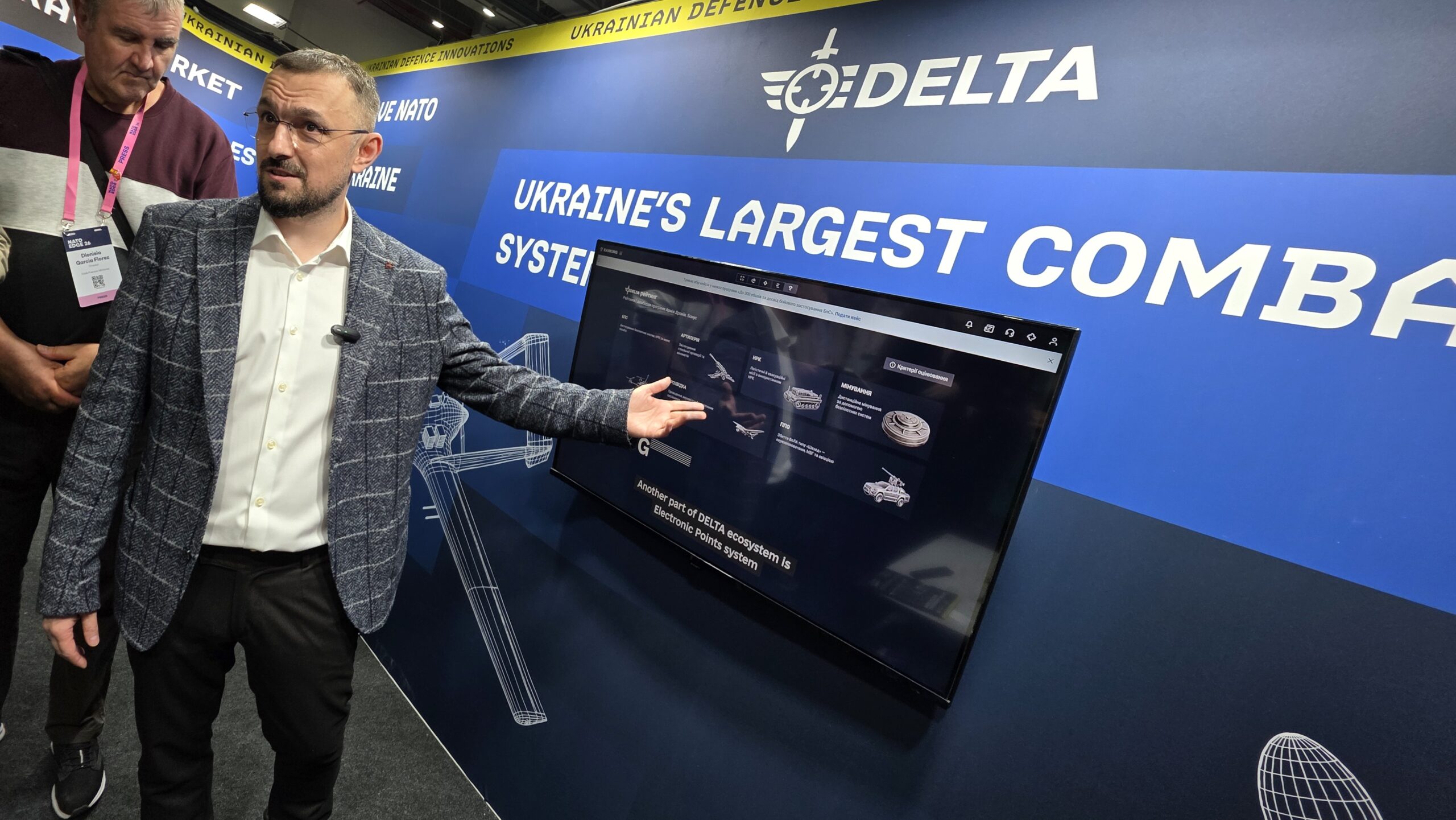
A list of countries is waiting to receive Ukraine’s Delta battlefield management system, with the first expected to be given access next year under a scheme that would share its source code with allies, according to the chief technology officer of the team that builds it.
Asked by the UK Defence Journal during a tour of the Ukraine stand at NATO Edge 26 in İzmir whether there had been much interest in what Ukraine calls Delta for Partners, and whether any countries or organisations had enquired, Serhii Zahriichuk, chief technology officer at the Ukrainian Ministry of Defence’s Centre of Innovations and Defence Technologies Development, which develops Delta, said there was, but declined to name them.
“I cannot show how many, what kind of countries, but we have list of countries which are in waiting list, and some of them, like first one, which will be given by us the Delta next year,” he said. “I cannot say more. When it happened, I think everybody will be notified.” He said the technical work was already done, and that the plan was to open it first to Ukrainian companies by the end of this year, test it inside Ukraine over the following months, including from a security point of view, and then share it with other countries.
The approach goes further than simply selling or installing software abroad. He said the idea was to share Delta’s source code in something like an open-source community between countries, with a full cycle of updates so that partners received new features as Ukraine developed them and could add their own. “It’s not just to share a code. I mean Delta as an installation, so you install in some country and forget about it, but bring the capability to have the full loop, full cycle for updates and delivery new features which we develop, and maybe countries will add something new, and we can collaborate,” he said, describing it as “a little bit collaboration platform between countries”. Delta for Partners was the team’s main goal for next year, he said, though he expected early users abroad to be testing it rather than relying on it operationally. “Delta, first of all, it’s a product which is developed for war, and I hope you will not use it at all. But to be prepared for this, it is mandatory.”
Asked whether Ukraine expected something in return, Zahriichuk said the commercial and legal terms were being handled by a separate team and would be set out in agreements between defence ministries. “Technically, it will be like open source,” he said. Ukraine first said in April 2025 that a NATO member had asked to buy Delta, and the Ministry of Defence said at the time it was creating a model for exporting the system, likely involving licensing and an intergovernmental agreement. That country has still not been named.
A system used around the clock
Delta began as a volunteer project before being adopted across Ukraine’s defence forces in 2024, and now combines a live map of friendly and enemy forces, drone video, target cards, mission planning and secure chat. Zahriichuk said more than 300,000 people use it, day and night, which shapes how his team works. “We have no capabilities to stop use the system. So the main challenge which we have is to bring everything which we can bring to these people without breaking the system,” he said. The team had originally built separate modules for mapping, video streaming and targeting, but moved towards linking them into end-to-end processes that mirror how Ukraine’s army actually fights. Its significance has not been lost on allies. In May, US Army Secretary Daniel Driscoll told the Senate Armed Services Committee that Delta connects every Ukrainian drone and shooting platform on one network, adding of the American equivalent: “Ours does not.”
He described Delta as deliberately light and independent of any single supplier. It is cloud-based but cloud-agnostic, meaning it can be hosted in different clouds without major issues, and it will use whatever communications links are available. “Because we have no a lot of money, we try to find the capabilities and connections in any places where we can find it, and if we have solution which we can consume from US, from UK or from different countries, we can combine it and use it,” he said, adding that Ukraine was preparing several communication channels so it did not depend on just one, though that responsibility sits with other units rather than with Delta itself.
On artificial intelligence, Zahriichuk was careful to separate useful tools from hype. Almost every part of Delta now has some AI capability, he said, from detecting objects in video to helping commanders make sense of large volumes of data, but the system is not designed to tell commanders how to fight. “We are not bringing the full capabilities like you open Delta and push a button and say how I can win a war, and you will get an answer that you need to do one, two, three, four, five. No, we are not bringing this. We are bringing the pragmatic capabilities where the AI can be used,” he said.
Training on the front line, without sharing the data
The data flowing through Delta has also become the basis for Avengers Labs, the platform Ukraine has opened to its own companies and now to allies so they can train AI models on real battlefield footage. He said around one petabyte of traffic passes through each day, which the team filters and turns into datasets of enemy vehicles, equipment and other objects taken from the front line. The data itself never leaves Ukraine’s control. “We are not sharing the data sets. Data sets is inside the field. It is protected by us. We are sharing the capabilities where you can train your model on top of these data sets,” he said. “Today we will share data sets, tomorrow these data sets will be in enemy hands.” Any model trained that way would also date quickly, he added, because the data changes constantly and Ukraine keeps retraining its own.
Britain is the first foreign partner to join. Under an AI partnership agreed between London and Kyiv in September, up to 12 British defence companies, selected through a competition run by the Ministry of Defence’s Rapid AI Delivery Task Force, are to train models on Avengers Labs, initially for drone swarms and for systems that must work where links to operators or satellite navigation are degraded. Ukraine’s Ministry of Defence says the dataset holds more than five million annotated frames, that more than 30 Ukrainian companies already train on it, and that companies cannot view or download the footage, working only inside a secure environment with anonymised and delayed data.
Companies that train models there are reported to have to license what they build back to the Ukrainian military, and the arrangement has drawn questions from human rights groups about accountability for weapons that select their own targets, an issue being debated at the UN in Geneva this week.
He said Ukraine’s own detection models, trained on the same data, now run automatically across live drone streams to spot enemy vehicles in real time, far faster than a person watching a screen. “Using eyes to detect, to understand that in this stream you see a tank or any other vehicle, is really hard to do. So the AI model is detecting much, much, much faster and quality much, much higher,” he said.
NATO Edge is the main conference of the NATO Communications and Information Agency, bringing together allied officials, militaries and industry, and Ukraine’s experience has been a recurring theme this year, from the defence ministry’s own sessions to NATO’s Fight Club experiments pitting Ukrainian teams against allied forces. For Delta, the question allies are now asking is less whether it works than when they can have it.