


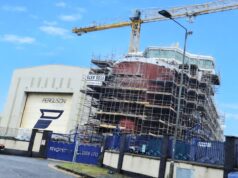
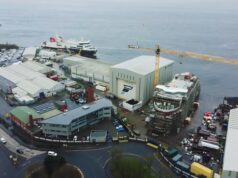
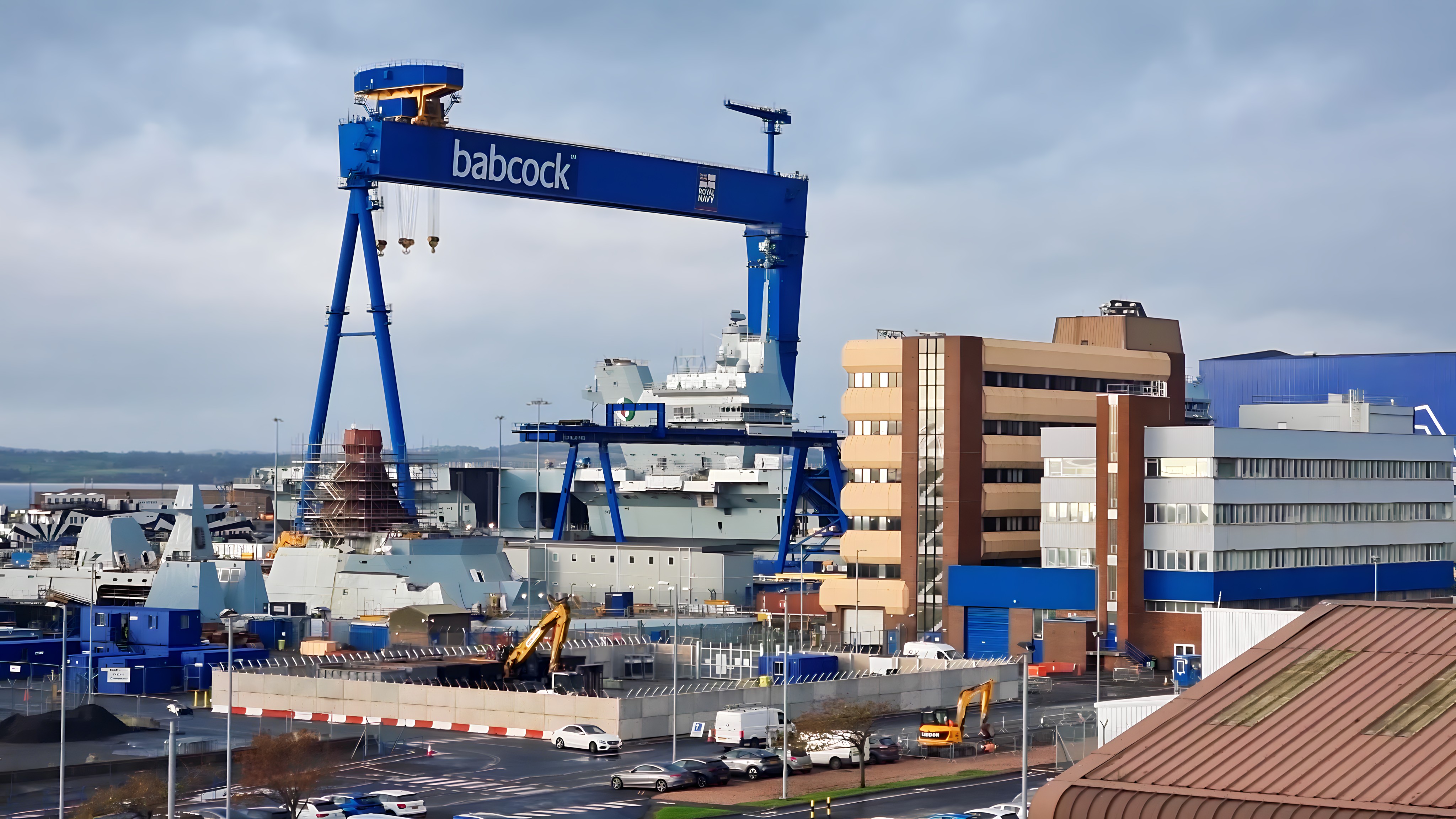
During a recent visit to Harland & Wolff’s Belfast yard, the company were clear that they see the site’s future extending beyond producing sections for immediate work.
They spoke about building what they describe as a “third UK naval prime”, linking the ambition to questions of national shipbuilding capacity, engineering depth and the longer-term shape of Britain’s naval industrial base after decades of consolidation.
Ben Murray, Chief of Staff at Navantia UK, described the current investment as the basis for that ambition. “Since Navantia UK acquired the four yards, Belfast, Appledore, Arnish and Methil, what we’ve got going on behind us is a really significant transformation,” he said. “We’ve got £115 million pounds of investment, £90 million pounds of that here in new equipment, new machinery, huge amount of knowledge transfer from our Spanish colleagues, systems, process technology, tools that we just didn’t have before.” He linked the investment to the role the company wants to play in UK shipbuilding. “All of that is about creating a third credible prime here in the UK,” he said, “the capability and the capacity to support the country with its requirements.”
Derek Jones, Navantia UK’s Chief Commercial and Business Development Officer, connected that argument to the fleet programmes expected to follow Fleet Solid Support. “FSS is the start of the recapitalization of RFA fleet,” he said. “Strategic sea lift comes along, and then the rest of the RFA fleet.” He also referred to the amphibious debate. “The UK, at the moment, has no amphibious capability at all,” he said. “Whether it’s a 220 metre ship or it’s a 200 metre, 180 or 60, there’s going to be a requirement.” On timing, he added: “Working back from that, you’d need to start some work this year.”
Part of the argument rests on the UK–Spain structure behind Navantia UK and the access it provides to existing designs and engineering knowledge. When asked about design authority and intellectual property, Jones said Navantia UK operates as a separate British company but can draw on the wider group’s designs when appropriate. “If we wanted to build one of those Spanish… design vessels here in the UK, the IP is unrestricted from Spain, we could get free access,” he said, noting that security limits may apply depending on customer requirements. He added that the arrangement can also work in the other direction, with UK-developed work shared across the group where customers and security conditions allow.
Prime contractor status in naval shipbuilding includes responsibilities beyond fabrication. It involves design authority, programme management and control of the technical baseline throughout the life of a vessel. Jones later described the digital side of that in practical terms, referring to a thread linking design tools with manufacturing systems and carrying an accurate as-built record into support so that upgrades and maintenance can be planned against a reliable baseline.
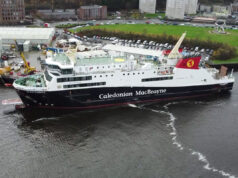
The four-yard footprint forms part of the same structure. Jones pointed to Appledore’s role on Fleet Solid Support and described Belfast as the integration point. “Appledore… building the bulbous bows for FSS… and then we shipped up to here, then to Belfast for integration,” he said. He also referred to Arnish and Methil as parts of the wider industrial network, with Methil positioned for larger structures while Arnish continues work in the energy sector alongside other potential activity.
Jones also discussed export prospects. The company, he said, sees potential to build in the UK for customers who prefer British supply chains, while acknowledging that credibility has to be established first through domestic delivery. “We need to walk before we can run a wee bit,” he said, placing Fleet Solid Support as the immediate proof point. He cited Ireland’s planned multi-role vessel as the kind of programme that could fit the company’s portfolio. “Irish MRV… hits the sweet spot,” he said, describing a space between lightly armed patrol-type vessels and more complex frigate designs.



UK naval industrial capacity is unbelievably essentially set come close to rivalling the US and essentially bettered significantly only by China in the 2030s… if we have the will to take that opportunity keep the capability up we could again become the undisputed 3rd largest blue water navy as well as being the warship supplier of choice for western allied nations that need a well priced frigate..into the late 2030s… if we take the opportunity.
I agree, but I still don’t believe the will is there. We are embarking on a third naval prime with a budget insufficient to sustain two and a political establishment that thinks drones will do everything in the future while desperately hoping that our un subsidised yards can win contracts against other foreign subsidised yards.
Unfortunately it’s likely to be the people of Belfast and Glasgow that once again pay the price of de-industrialisation.
Just need to accept that NATO doesn’t need our army but they really need our navy and air power, and be willing to screw the retired generals over if necessary. Any 50/50 choice in spending between the Army and the Navy or RAF should be obvious.
Also we need to squish the French, that their navy is bigger than ours is sacrilegious.
It’s an extreme (and simplified) example, but the British Army’s Challenger 3 programme had cost in 2024 some £400 million. Over its life, it’s expected to cost more than £2 billion.
Would the UK gain more from a couple of extra frigates, a a hundred tanks? In the NATO context, what would serve the alliance better? I’d say the former.
Challenger 3 is not representative of most Army programmes, just compare the cost per tank to Leopard 2 or similar. We got very lucky with that programme but upgrades of a selected fraction of an existing fleet is not how most programmes go.
To compare CR3 to other standalone capabilities £400M would get us 2-3 Proteus equivalent for a transformational effect on NATO seabed warfare.
Leh, look at the threat. Every serious military analyst considers that Russia is NATO’s (ie Europe’s) most significant threat and they major on land or air-land interventions in Europe and its fringes, and have done since 1953.
Torpedo, NATO doesn’t need our army? SACEUR has two strategic reserves, one of which is the ARRC and we are framework nation, contributing the Commander, HQ, various Corps Troops units and two divisions.
Don’t forget that our army actually gets used at regular intervals for kinetic ops at medium scale.
As an island nation we need to be more expeditionary. The navy comes first in that then the air force, followed by the army. Tough choice’s need to be made if they won’t radically increase the budget and the army need told that their future vehicle procurement need to be in line with the navy and air forces future lineup, if it can’t be made amphibious or fit inside an Airbus then I’m sorry but it shouldn’t be ordered.
Long gone are the days in which we could field a few divisions in Europe, we barely have 1 with 148 MBTs, and that will take The best part of a decade to sort itself out. Europe can look after itself, they have the numbers where we don’t the best and biggest bang for bucks we can provide NATO are more vessels stuffed with drones, missiles and marines.
Fosterman, our army (and navy and some of the air force) has really always been expeditionary over hundreds of years. We deployed a largely army British Expeditionary Force at the commencement of both world wars. Arguably BAOR/BFG was not expeditionary as it was considered to be a ‘Home posting’ and was supported from permanent in-country British bases…so a blip, even if a long blip. Currently 3,000 soldiers are deployed worldwide on 39 Operations across 46 countries ranging from deterrence to peacekeeping to training.
The ARRC is one of only two SACEUR’s strategic reserves – as framework nation we provide the Commander, HQ, most Corps Troops units and two divisions (an ‘armoured’ division and an ‘infantry division’). 3 (UK) Div does not yet have its CR3 tanks as they are in build but FOC is late 2030; they currently have CR2s. Do you want to tell SACEUR that we are reneging on providing the framework for the ARRC for warfighting in Europe (possibly an air-land war against Russia) but instead he can have loads of ships stuffed with drones, missiles and marines?
Glad to see NI, H&W back in the shipbuilding game. Hope they can help rebuild the wickedly neglected RN back to what we need it to be. If HMGs over decades hadn’t run down naval shipbuilding so far we wouldn’t have needed Spanish Navantian assistance, but here we are & their help is vital.