

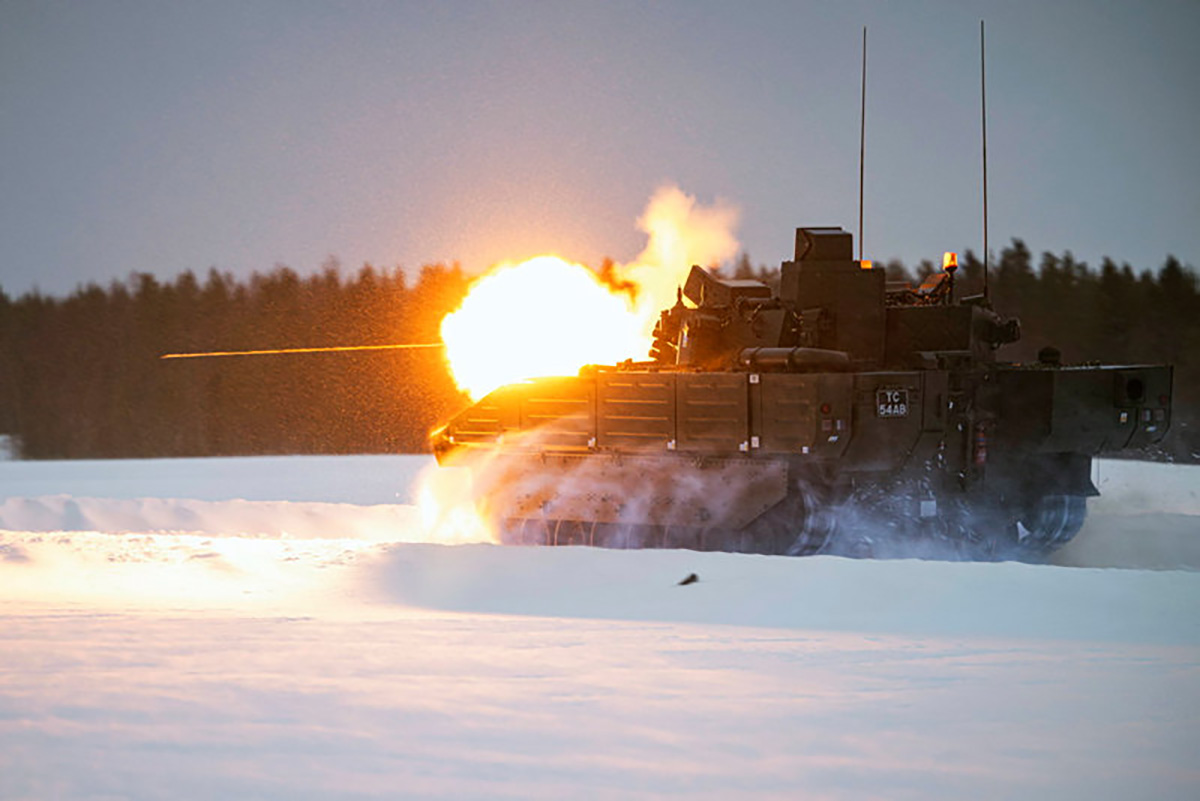
Parliamentary answers and Commons exchanges have highlighted continued uncertainty over the Ajax armoured vehicle programme, amid signs that unresolved issues may be contributing to delays in wider defence planning.
In a series of written questions answered this week, the Ministry of Defence repeatedly declined to provide detail on the future of Ajax while safety investigations and reviews remain ongoing. Asked by Conservative MP Mark Francois whether the government had discussed suing General Dynamics for liquidated damages linked to the programme, Defence Minister Luke Pollard said it would “not be appropriate to pre-empt the outcome of the ongoing investigations or to comment further at this stage.”
Pollard took a similar line when questioned by shadow defence secretary James Cartlidge on whether decisions relating to Ajax in the forthcoming Defence Investment Plan had changed as a result of recent safety investigations. He replied that the plan would be “released in the near future” and that it would be “inappropriate to comment on its content at this stage.”
Other written answers shed light on the tightly controlled nature of Ajax activity. Lord Coaker confirmed that ministers have ridden in an Ajax vehicle on two occasions during this parliamentary session, on 17 July and 5 November 2025, with both taking place “on a concrete hard surface test track”. Separate questions confirmed there have been no cross-country or off-road rides by ministers.
On safety oversight, Pollard confirmed that assurances on Ajax were provided to ministers prior to Initial Operating Capability being declared, but said he had commissioned a review into the advice given. “It is vital that advice given to Ministers is timely and accurate,” he said, adding that no further detail would be released while the review is ongoing. He also said the department is assembling a group of industry experts to provide external advice on the causes of medical issues reported during a recent Ajax exercise on Salisbury Plain.
The sensitivity around Ajax was also evident during Defence questions in the Commons. When pressed by Cartlidge on whether the Defence Investment Plan would be published before the Christmas recess, Defence Secretary John Healey declined to give a date, instead saying ministers were “working flat out between now and the end of the year to finalise the defence investment plan.” He added that Cartlidge, “having been responsible for deep problems, and programmes beset by deep-running failures, such as Ajax,” would appreciate the scale of the challenge.
In a separate exchange, Conservative MP Ben Obese-Jecty warned that with Ajax undeployable, the Army lacks a formation reconnaissance capability and therefore cannot field a deployable armoured brigade, putting NATO commitments at risk. Defence Minister Al Carns acknowledged that a review of Ajax is under way and said the programme has been “overspent” with requirements that “changed and oscillated from left to right for the past 10 years.” He argued that lessons from Ukraine show modern warfare is “not just about armour” but a mix of crewed and uncrewed systems.
The linkage between Ajax’s problems and the scale of decisions facing the department points to the programme as a complicating factor in finalising the Defence Investment Plan, even as the government avoids stating this explicitly.



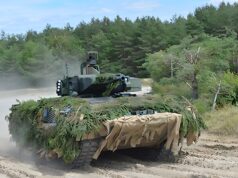




‘modern warfare is “not just about armour”
Quite so.
‘Warfare is tri-dimensional and has been since at least the Spanish Civil War. To distinguish between surface and air, whether the struggle is for control of a sea area or a land mass, seems wrong. Making a distinction between an “air” battle and a “land” battle is not possible except at the lower tactical or procedural levels, certainly not at a strategic level. There is one air-land battle, one thing, one operation. So in my references to “land” forces, please recognize that I am including tactical air forces in the very same sense I include infantry, cavalry, armor, field artillery, and air defense artillery.’
Lt Gen DeWitt C. Smith JR. 1977
In 2025, we might add ‘and drones’ after ‘tactical air forces’ in the above quote.
Nevertheless, ‘Conservative MP Ben Obese-Jecty’ is absolutaly correct:
‘with Ajax undeployable, the Army lacks a formation reconnaissance capability and therefore cannot field a deployable armoured brigade, putting NATO commitments at risk.’
Not even one armoured brigade? And our NATO commitment?
’41. The Army must modernise the two divisions and the Corps HQ that it provides to NATO as one of the Alliance’s two Strategic Reserves Corps (SRC). The SRC should be led by the Corps HQ (Allied Rapid Reaction Corps) and enabled by, and command, Corps-level capability. The first division should comprise a fully deployable Headquarters, three manoeuvre brigades with armoured and mechanised capabilities, support brigade, and associated enablers. Planning should include the integration of the Royal Marines Commando Force into the SRC when appropriate (Chapter 7.2).
42. The Army must accelerate the development and deployment of its new ‘Recce-Strike’ approach—combining existing capabilities and technologies, such as armoured platforms, with constantly evolving technology—as part of its efforts to modernise the SRC. It should be bolder in its ambition, seeking to increase lethality ten-fold, measured against a conventional armoured brigade model.’
UK SDR 08 July 2025
‘The triumph of hope over experience……’
UK SDR was a wind bag of words not backed up by money, a talking shop full of wish lists and hope. Its going no where and we will have make do and mend like always with what ever we scrap together and hope its enough.
Any old excuse not buy any thing and just talk it up and save money. Really is full on farce and mess more so the Army that is out dated, out gunned, out numbered and not fit to deply as a Div. E
Even if a we could get a single miss match Div in the field made up light units, light guns and backed by a whole 8 Archers at a push 10 or one war time Btys worth we’d be out of ammo in days.
Bigger issue that just Ajax here that no one in the MOD wants to address its smoke and mirrors, theres no money!
Does this mean that job transfer market from CGS, MoD down to ATDU, REME et al to GD is finally at an end? If so the NCA & SFO ought to carry out a full investigation into GD its wider activities and the Army accepting products that are not safe or functional. Alfie @militarybanter & Larisa Brown at the Times would be glad to help I’m sure.
THIS+++
British defence procurement isn’t broken – it’s fixed
Straight corruption. Tell them to cancel it now or else take your chances with the SFO
Ok, for those that are in the know if Ajax fails or is binned what would the Army do? what is suitable to replace it and how long will it take?. I ask as its at least a year untut until Ajax is fixed so until then we really have some clapped out 40 year old Warriors for recce or some land rovers.
If as stated Ajax is holding back other orders not that beleave a word of it as i fail to see how it stops us buy GBAD or SPG’s or Drone defence, then the Army really is in a mess what is picked for any of that is years away as is any Ajax replacement and some thing to fully replace Warrior apart from a van with a machine gun on it.
There isn’t really a realistic option. Any platform they choose from warrior to cv90 or boxer would take at least a decade to deliver anything. As you either have to set a new production line for them or have to be behind all the existing customers in the production order. Then there is the policitcal topic of having them built abroad being an issue.
My guess the answer would be boxer, as there is an existing UK production line and a few hundred could be added to the back of the existing order, whilst in the meantime the mod /gov can tripple count stating already produced boxers are replacing Ajax and warrior (no new order was added when the program was expanded to cover warrior) and all the other platforms they were originally meant to replace. Aka quietly drop the capability.
Would make sense alround, be interesting to see what is done about Ajax and all the other kit either not working or out of date or missing.
Slightly tongue in cheek here, but I recall someone else on here (DavyB maybe??) mentioning a modern CVRT. Keep it simple, use what we know and go from there.
I know your just joking but it does highlight the mess we have got ourselves into.
Even that would likely take a decade, you would need to create a factory to build them, train up staff etc, but before that endless consultations and tenders and governmental committees etc around what a cvrt was and what needs to be redesigned. Ending up with a completely bespoke new platform that we could called Ajax 2.
Looking about the only thing that could be done reasonably quickly is fitting Boxer with the Recce module.but of course that entails speeding up the build and delivery of them!Then we would have a platform that we would not buy in the numbers required so the ones we do get would be pushed from pillar to post trying to be all things to all men😡!Everything else has a queue a mile long!
Very true every thing else is on order for some one else with a few year back log. Boxer though not great would make all the sense for Ajax replacement, Makes the idea of an Ajax IFV more and more un likely, pity it would have made sense had Ajax of worked. Stuffed either way as it delay on top of a delay to get an Boxer mod, and the slow build rate is not helping.
23 out of 61 vehicles involved in the exercise appear to have caused problems thought to have been solved. We don’t know whether particular variants had issues whilst others didn’t or whether some manufacturing defect is responsible. But 38 vehicles didn’t cause problems.
GD must be compelled to complete the contract and deliver what was ordered. There is no viable alternative.
Interesting that GD has had the M10 contract terminated with some problems echoing those of Ajax, including excessive weight
Totally agree; there is no viable alternative. It looks like about 1/3 of the vehicles are unsatisfactory. Is it co-incidence that the Ajax turreted version is roughly 200 of the 600 ordered? If the problems are limited to Ajax itself, then proceed with building the other variants and initiate a fix program for the Ajax variant asap.
Seems the problem is in Ares as well,so it stands to reason all variants are affected!
Bu***r
The first Aries at Bovington ADTU was very loud and clanky, the sixth road wheels were being dragged back and springing forward indicating rotary damper failure. This was observed on several occasions as it used to be marshalled in and out passed DSG main gate, either they did not bother to fix it or a recurring problem. As the track link dropped into the sprocket tooth root you could see the judder as the tension energy was released as noise and vibration, to anyone who has worked on armoured vehicles this was clearly a major problem. You would not expect it to have been ignored since it was first known about in 2018, it may say more about GD’s finances that they tried to use mitigation rather than change the suspension. When the Government stopped payments GD UK took out loans, in 2023 they made around a 6k loss and 10k in 2024.
Beggars belief doesn’t it?
As John has mentioned below,rubber tracks anyone?
M10 Bookers cooling issues and firing fume problems were addressed, the tank was too heavy to be air portable at 38 tons so not fit for purpose. Some General signed away right to repair in the contract meaning GD can extract excessive prices for parts which often the army could machine or 3D print themselves and excessive delays to get parts. Defence companies often keep all I.P. meaning they have to approve and can charge for changes and mod’s to vehicles. Like AJAX it got too heavy for its role.
Please can someone take an Ajax, fit it with rubberised tracks & the most high performance versions of the Spanish rotary dampers & see if that fixes it. Otherwise we will go round in circles with GD blaming the Army & the Army blaming GD.
Just read on Army Technology that rubber tracks will be trailed on ‘Blackjax’ the Ajax technology demonstrator! Trails should be going on now as the article said the first weeks of December.👍
There is a growing opinion that the German Lynx armoured vehicle could be the best option on the modern battlefield? The MBT has been the backbone of frontal attack since WW1; however, the new fighting methods deployed in Ukraine, such as drones and creative mine laying and precise artillery targeting, have effectively shut down their conventional use. The Lynx, on the other hand, demonstrates abilities that make it a more difficult target due to its mobility, countermeasures and protective armour. With this in mind, should NATO consider such vehicles if and when stalemate conditions arise on the battlefront? We know that placing temporary structures on tank turrets to deter drone attacks have mostly failed and have eliminated what stealth the MBT has.
The CH3 will be one of the most potent MBTs once in service, and the much criticised fleet numbers may prove to be a fortunate outcome if the MBT is to be relegated in preference for lighter, more agile gun platforms. War planners must take on board what has been observed in Ukraine and how cheaper methods of fighting could significantly change the paradigms of war fighting. Should the British be looking at purchasing the Lynx to augment the CH3 regiments?
Same problem! €10m+ depending on variant and again a long queue!
Tanks at Hamel and Amiens 1918 operated as part of combined arms groups relying on air superiority/close air support and massive arty counter battery.
Successful combined arms manoeuvre warfare has, typically, relied on air superiority. Neither side possesses that in Ukraine. The very low level air threat from drones is an air superiority contest. As in 1918, if and when one side or the other establishes dominance, quite possibly by means of counter drone UAVs, AFVs, tanks, may then have more freedom of action. Nevertheless, even with air superiority, Allied forces lost about 10,000 tanks in 1944/5. Tanks are but one part of the land/air battle. Their utility ebbs and flows. Compare and contrast the fortunes of German armoured operations in the Ardennes in 1940 and then 1944. They had air superiority in 1940. In 1944, they did not.
Russian tank operations have had some success recently in conditions of low visibility. Of course, there are significant constraints on tank operations on the battlefield in Ukraine today but those constraints, mines, air, arty and so on, have always been there.
As for a replacement for Ajax, refurbished Bradleys might be an option but there appears to be little appetite for the taking of difficult decisions. Apparently the Treasury was a major obstacle to rearmament in the 1930s, believing that the German economy would implode under the weight of its own defence spending.
Plus ça change….
I’d be cautious about drawing the conclusion that Ukraine proves heavy armour is obsolete.
What Ukraine really demonstrates is that poorly employed armour, without adequate enablers, is highly vulnerable — not that the MBT itself has no future. Losses are largely the result of tanks being used without air superiority, layered air defence, electronic warfare, counter-reconnaissance, effective engineers, or protected logistics. Strip any system of its combined-arms context and it will fail.
Heavy armour still offers things lighter platforms cannot: survivability under fire, shock effect, and the ability to operate in high-threat environments where attrition is unavoidable. In Ukraine, tanks that are properly supported, dispersed, camouflaged, and integrated with ISR and EW remain effective, particularly in defensive fighting and counter-attacks.
We should also be careful not to over-generalise from a single theatre. Ukraine is characterised by dense ISR, permissive airspace for drones, and massed artillery — conditions that NATO would actively seek to suppress through air power, SEAD, EW, and cyber. In a NATO context, heavy armour would not be advancing alone into a drone-saturated battlespace.
Rather than replacing MBTs with lighter gun platforms, the lesson seems to be that heavy armour must evolve: better active protection, organic SHORAD and EW, tighter integration with drones, and revised tactics. Lighter vehicles may complement this, but they cannot substitute for the protection and deterrence value that MBTs provide.
But Germany hasn’t ordered Lynx and has had major failures in Puma, forcing a return to using old Marder models.
We should have never entered into this Project we are crap at Building Tanks and Aircraft and Ships and back in 2010 we done the same with Nimrod The UK’s Nimrod MRA4 maritime patrol aircraft project was controversially scrapped by the government in 2010 as part of defence cuts, leading to the dismantling (scrapping) of the nearly complete, multi-billion pound aircraft, creating a significant maritime surveillance gap, We had the same issues with TYPE 45 not being able to operate in Hot Climates The government was suppose to looking at replacing SA80 under Project Grayburn by 2030 still nothing done still deciding on which Ammo to buy 5.56mm SIG MCX or the 6.8mm M7. Other countries are pushing ahead with Tanks and Weapons for there Armies. Sweden is evaluating the purchase of South Korea’s K9 Thunder self-propelled howitzer as it reassesses its artillery mix and considers adding tracked platforms alongside its well-known wheeled Archer systems, according to reports citing internal documents and regional defense coverage. We had this K9 in our sights and the UK Government didn’t even go along and look at it. Bought Archer instead Sweden cannot get Archer to operate in deep snow hence K9. This country needs to pull its finger out we could have bought K-21 infantry fighting vehicle (AS21 Redback IFV I am sure they could have got a good deal they where going to buy K9 they would have taken delivery by now Putin is eyeing the west and NATO he will start something very soon other countries are pushing for call up we haven’t thought about it even if we did not enough Small arms to give out
BAE advised against using corroded hand built ex -Saudi comet air frames for Nimrod, they were hand built and dimensions varied. You have to ask if whoever made the decision had an interest in the company that restored them, this cost more than new air frames. It was a well known joke in the aircraft industry that this was stupid, no surprise that neither the wings fitted and the Aim Aviation interiors only fitted the one measured. If the person who made the decision was jailed it might have improved future decisions.
‘In a separate exchange, Conservative MP Ben Obese-Jecty warned that with Ajax undeployable, the Army lacks a formation reconnaissance capability and therefore cannot field a deployable armoured brigade’,
Some Warriors were re-roled to the recce role to cover the gap between withdrawal of Scimitar and fielding of Ajax. So how does the army lack a formation recce capability?