

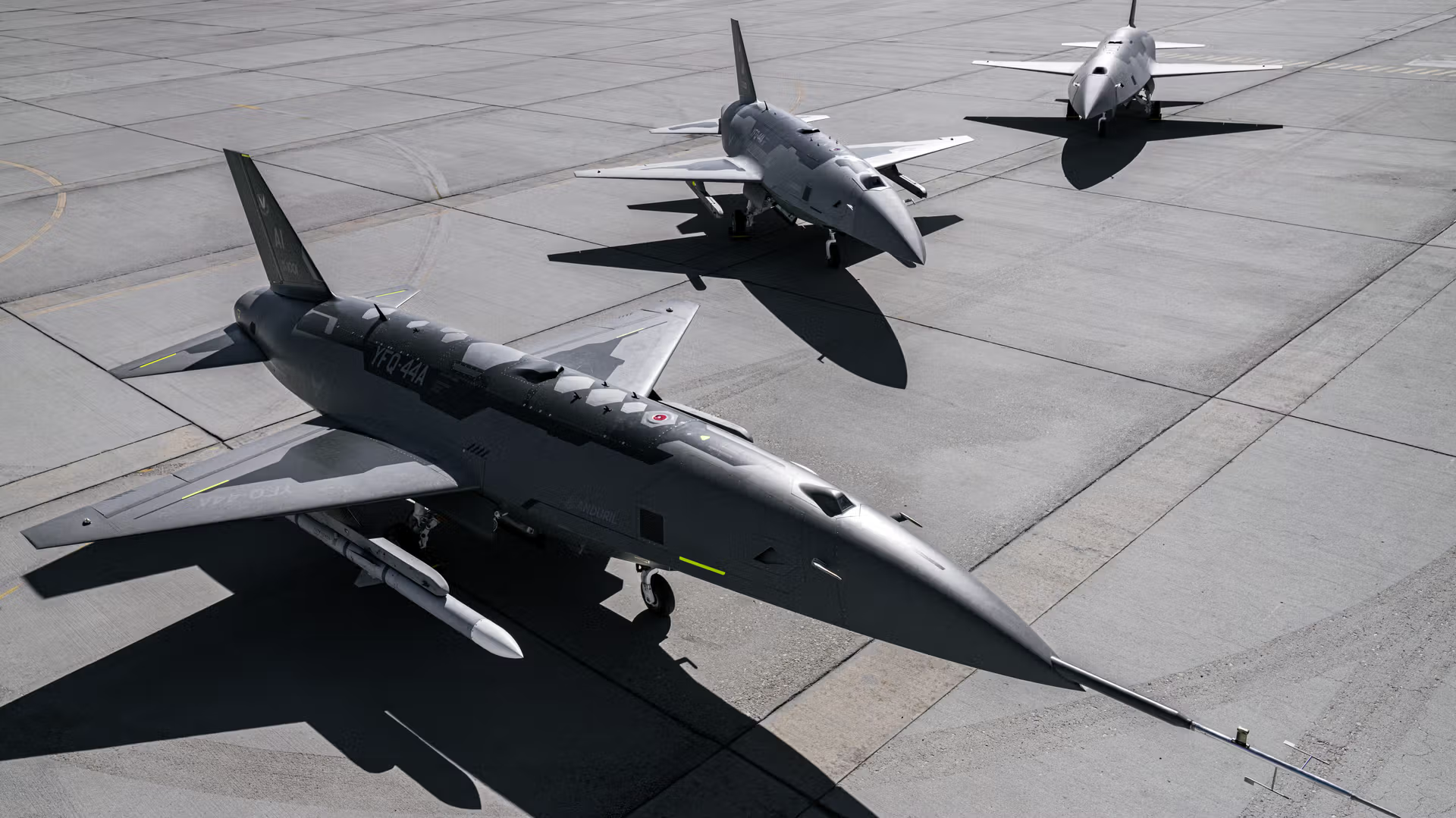
The U.S. Air Force has selected Anduril for the production phase of its Collaborative Combat Aircraft program, with the company set to deliver an initial batch of production FQ-44 semi-autonomous fighter aircraft to support continued testing, validation and eventual operational fielding, the company stated.
The contract also establishes a framework under which the Air Force can purchase additional lots of production FQ-44s over the coming years. Anduril described the aircraft as the first semi-autonomous fighter to move into serial production, and said the decision arrived months ahead of schedule.
The FQ-44, previously designated YFQ-44A and known as Fury during its early development, is one of two designs selected in April 2024 for the first increment of the CCA effort, alongside General Atomics’ YFQ-42A. The programme is intended to field large numbers of comparatively affordable uncrewed aircraft to operate alongside crewed fighters, expanding combat mass at a pace and cost that conventional fighter production cannot match.
Anduril set out the timeline behind the award: prototype contract in April 2024, ground testing from April 2025, first flight in October 2025 and a production contract in June 2026. The company characterised this as “the fastest path from prototype to production for a fighter aircraft in more than 50 years”, as quoted in the press release.
On performance, the firm said the aircraft in its current configuration has the ferry range to deploy worldwide, can operate from short fields, and offers a combat radius that exceeds that of current crewed fighters, according to the company. Anduril added that multiple aircraft are now flying regularly, with dozens of sorties completed from multiple airfields in different mission configurations. The company said it has flown two different mission autonomy software suites and switched between them mid-flight, and has integrated and flown the aircraft with inert air-to-air munitions.
Testing has also extended to operational handling on the ground. In a first exercise with the Air Force’s Experimental Operations Unit, Anduril said a small crew with only days of training was able to launch, recover and turn multiple FQ-44 sorties without the infrastructure of a large established base.
Production will take place at Arsenal-1, the company’s manufacturing facility in Ohio, where work is already under way. The line is capable of delivering up to 150 aircraft per year in its current configuration, according to the company, which said its full rate production processes and tooling were implemented on prototype aircraft in order to identify and resolve issues before the transition to serial manufacture.





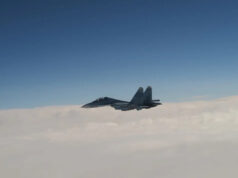
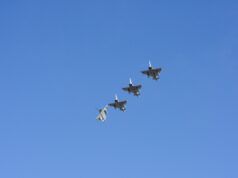


Good example of a target drone that became a CCA. It’s a pity Quientiq didn’t take its jack Daw concept further. Could have given us something very similar and very cheap.
Got a 1960’s retro mod look.
Exactly my first thoughts – mostly F-100, maybe a bit F-105 too.
I see an F16 with a haircut and that has eaten too many pies
Thunderbirds 2?
a bit like me!
not enough chrome mirrors.
Vibes of BQM-34 Firebee
yeah a real mig 21 vibe going on there!
It is interesting that even the U.S. are approaching this from a keep it cheap and simple then spiral instead of the search the gold plated silver bullet drone like the X-47B programme of last decade.. I do wonder if they feel they got their fingers burnt with RQ-170 a load of very cutting edge technology they essentially gave to Iran ( and so china and Russia ) on a plate when Iran managed to subordinate the control of a RQ-170 and crash land it.. then reverse engineer a lot of it into the Shahed 171 Simorgh. I get the impression everyone is coming to the same conclusion with drones.. keep it simple as you can.
It is back to – mass has a quality of its own to overwhelm defences.
There are also poorly defended targets that just need to be hit with cheap munitions.
With cheap drones certain loss rates are acceptable which moves the needle on £/kill which is really what this is about statistics.
What is the cheapest way of taking out the 60% [made up %] of the most poorly defended targets. Then work backwards from that to that.
IRL it slices and dices into more tiers than that as it is possible to use even cheaper munitions on the essential undefended targets. The cheaper they are the easier they are to mass produce from common as dirt parts.
Affordable mass.
It’s the same with a truly effective navy… it’s about being able to hit everything, everywhere, every time with just enough capability.. the navy that gets closest to that wins…
It’s why the flowers class corvette and the ASW frigates on the RN side and the nasty little Uboats on the German side really decided WW2 in Europe..as Admiral Karl Dönitz said if he had a fleet of 300 U-boats he would have to successfully blockade, starve, and defeat Great Britain.. as it was they build 4 battle ships and battle cruisers and 3 pocket battleships.. all of which were hunted down and destroyed or contained and had no real impact on the war…. If they had turned that steel and industrial capacity into Uboats the RN and Britain would have been in the shit deep….. sometimes bigger or more advanced is not better.. simply more is better.
I’m not so sure. By the start of the war we pretty much knew the composition of the Kreigsmarine. This was later confirmed by Recce flights by Spitfires. If Germany had diverted its manufacturing towards U-boats this would have been detected earlier. I’m pretty certain, the RN would have prioritized the building of the River and Black Swan classes as these were the primary ASW vessels. There’s likelihood that the Flowers and Castles would have come along as well, as these could be built by the smaller yards. Additionally the U-boats pens and shipyards would have been more heavily prioritized by the the fledgeling bomber command.
If the Kreigsmarine started off with 300 U-boats, life would have been very difficult for the RN and the UK. But I don’t think it would have been a slam dunk!
Except that didn’t happen. The RQ-170 suffered in-flight power problem that essentially turned it into a glider which just so happens to land on Iran. Remember if there was any truth to this the Iranians would have alot more MQ-9 & -170 landed.
For AA/CAP just need something that can stay aloft for min duration of Wedgetail sortie, carry x meteors and fly hundred miles in front of wedgetail. doesn’t to be able to carryout high G turns. just launch and then if AWACs under threat turn on large transponder/heat source to mask wthdrawal.
for strike just need heavy that can launch lots of one way drones that can loiter. which are either tv or gps guided
Does the Royal Air Force have anything like this in their future plans?
Lots of talk, nothing concrete…
The Issues effecting the RAF are quality/ capability/ carrier capability/cost.
One drone for all, or two types for land and sea ops.
Now they have pretty much redacted the promising project Ark Royal, they seem to limiting the RN to slow STOL types, as you simply cant have fast relatively heavy, jet powered drones landing on a QE class, bolting straight down the centre line and trying to break to a halt…
Far too precarious…
Civilian here, would think catapulted take off weight is higher than stovl. Landing weights maybe closer. We are all thinking where this drone stuff will end up. Maybe fast heavy expensive drones are more long term, think it’s cheaper tech, more immediately but as a poster has said there maybe value to have drones with flying endurance
Ark Royal being canned, effectively means any really significant use of the QE class canned too.
We can hope funding is restored for a version of Ark Royal in SDSR30 I guess.
We need an angled deck, a catapult (of some sort) and traps, to operate heavy effective combat/AEW/AAR drones, to really unlock the capabilities of these massively underutilised large hulls.
I suspect, if they are passed over for serous funding again in 2030, they will likely be sold off by 2040 along with the F35B fleet.
I currently have little confidence anything will happen to them, but we can always hope.
lets be hopeful. QE carriers without catapults, obviously emal catapults are optimal but its an expensive exclusive club to be in. france have decided to stay in it, and we wish them well. what type of market for catapult launched and recovered drones is there likely to be, it won’t be cheap? unsure why the delays but hopefully some decent stovl or vtol drones will come in nearish future for use on QE’s. agree no on board AEW a major flaw, but for atlantic and high north waters we will have to rely on land based long range AEW
Technically you can, but the costs will be high. The answer would be a laminar flow control wing along with vectored thrust. The laminar flow wing or circulation control wing, is a further development of the idea behind blown flaps. It uses high pressure air generated by the engine, to blow through slots in the wing’s leading edge, mid-chord and trailing edge. With the idea to prevent or delay turbulence over the wing. Think of the Buccaneer’s blown flaps, but brought up to today’s knowledge of aerodynamics.
NASA has tested this principle on a number of aircraft including a Boeing 737. Where the additional lift generated ranged from 50 to 80%. The blown wing has a significant affect on not only reducing the stall speed, but also shortening the take-off and landing distances.
The problem is that the blown wing needs a lot of power. If I remember correctly up to 40% of the engine’s max dry power. However, using a ski ramp and vectored thrust will help to mitigate this. It is definitely doable however, but will require a lot of funding to do the modelling, wind tunnel testing and trials. The Ghost Bat could be a candidate, but the FJ44 engine it uses would need replacing with something with a lot more oomph.
Evening mate, but creating such a beast would be exquisitely expensive, so it will simply not happen.
At a minimum, we need an angled deck, that would allow higher speed RVL by the F35Bs and anything else we fly off and onto the deck, fast or slow.
It’s really not very clever going straight down the center line, you want your malfunctioning naval Protector variant going over the side, not straight down the deck trashing everything it bounces off.
I think unless funding is set aside for the QE class mods in 2030, then the best they will get is Reaper type variants, alongside the F35B fleet.
The ‘group think’ is so fixated on drones and missiles and countering Russia in Europe now, that the carriers and ‘ out of area’ ops seem to be sidelined.
Totally agree on the angled deck mods, especially if the carrier’s going to operate drone aircraft. Separating parked aircraft from landing aircraft, was one of the more important lessons learned the RN quickly adopted following WW2.
The MQ28 Ghost Bat makes for an interesting case study. The “Mk3” version will have an internal weapons bay. So it will have a much lower radar cross section, than when carrying weapons externally. It has a pretty high Mach cruising speed, a range of around 2000 miles and can operate up to 40,000ft. But is pretty light with a max all weight of 7000lbs. In principle it would be a good force multiplier for the F35. However, its FJ44 weedy engine is not powerful enough for an unassisted take-off from a carrier. It would need either catapult or expendable rocket assistance.
For an unassisted take-off from the carrier, it needs ideally a power to weight ratio of 1:1, but aircraft such as the Mig29K can get away with 0.98:1. We can quickly discount the EJ200, it would be far too powerful and is over 3 time heavier. Rolls Royce produce an engine that would give a greater than 1:1 advantage, with the AE3000 series turbofan. However, its weight is roughly twice that of the FJ44. So the airframe would need a lot of beefing up. I’m not sure if even the 9000lbs thrust version would be suitable for the blown wing demand. The numbers say it will be tight.
Payload wise, the Ghost Bat’s weapons bay will be able to hold either two AMRAAM class weapons of four SDB (possibly 4 Spear-3s) weapons. Plus it has 3 external hard points to carry a similar load. So does have a useful multiplication factor for a F35B, which is sorely needed for fleet defence and offense.
The recent announcement by the Chief of the Air Staff for a collaborative Combat Aircraft (CCA) will likely be of a size between the Anduril FQ44 and the Ghost Bat. I don’t see anything being much bigger, as the costs become less attractive where the CCA could be used as an attritable asset. But reality will soon hit the MoD, as the lack of a catapult system on the carrier will significantly limit not only the size of drone being used as a F35 CCA, but also what it can carry!
Anduril Industries is becoming a seriously impressive MIC heavyweight. Not too shabby, considering that it is a 2017 start-up. Presumably, RAF and RAAF will ultimately benefit from this program, via AUKUS Pillar 2 collaboration.