Author: George Allison

  • British C-17s supplying Brimstone 2 missiles to Ukraine

    British C-17s supplying Brimstone 2 missiles to Ukraine

    Brimstone 2 is being supplied to Ukraine by Britain.

    Video of Brimstone 2 missiles being delivered by the Royal Air Force to assist Ukraine in repelling Russian soldiers has surfaced.

    Typically, the missiles are launched from the air. However, to use as mobile launch platforms for long-range missile attacks against Russian tanks and other vehicles, the Ukrainian military has adapted trucks.

    About six months ago, Britain first provided Ukraine with Brimstone missiles. But a video made public by the British Forces Broadcasting Service last month showed the more sophisticated model being readied for shipment at RAF Brize Norton.

    The missiles can select their own target from a pre-programmed list using an extremely high-frequency millimetric wave radar, or they can track a laser fired by soldiers, aircraft, or vehicles to hit their target. Each missile costs roughly £175,000. Brimstone can be used with extreme precision in densely populated regions when guided by a laser fired by friendly soldiers, reducing the possibility of collateral damage among civilians.

    British weapon supply flights, the first taking off before the invasion started, continue day and night to supply Ukraine with weapons with which to defend itself against invading Russian forces.

    The supply flights started before the invasion and have not stopped since. However, they now land in Poland near the Ukrainian border.

    The UK recently announced that it would supply “scores of artillery guns, hundreds of drones” plus 50,000 rounds and more anti-tank weapons to Ukraine in the coming weeks.

    “The delivery of the new equipment will significantly step up the UK’s support as the country fights to repel Russia’s brutal and unjustified invasion.”

    More than 20 M109 155mm self-propelled guns and 36 L119 105mm artillery guns will soon arrive from the UK, Defence Secretary Ben Wallace announced in an update to Parliament today. Counter-battery radar systems and more than 50,000 rounds of ammunition for Ukraine’s existing Soviet-era artillery will also follow, he added.


  • Huge increase in number of American submarines in Scotland

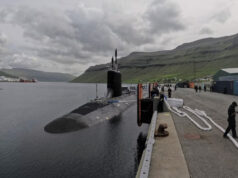
    The number of sightings of American nuclear submarines visiting Scotland this year has doubled over the same period last year.

    We reported previously that while visits themselves are common, the frequency of visits is not common. Neither is it common for visits to be publicised by the U.S. Navy or Royal Navy unlike the visit of the USS Rhode Island, a Trident-armed nuclear submarine, that arrived (and departed) earlier this year.

    In figures reported here, it is claimed that double the usual number of NATO submarines have been spotted heading to and from the key Faslane naval base.

    “Sightings so far this year stand at 85 compared with 43 for the whole of 2021, and include a string of America’s most advanced Virginia-class fast-attack submarines.”

    The U.S. Navy said previously that port visits to Faslane reflect the United States’ “commitment to our allies and partners in the region and complements the many exercises, training, operations, and other military cooperation activities conducted by Strategic Forces to ensure they are available and ready to safely and effectively operate around the globe at any time”.

    Third American sub visits Faslane in space of two weeks

    The last time a U.S. Navy SSBN like the USS Rhode Island conducted a port visit to Faslane was when USS Alaska (SSBN 732) visited in July 2019.

    In a visit to BAE in Glasgow, where the Royal Navy’s new anti-submarine frigates are being constructed, Defence Secretary Ben Wallace said:

    “The one thing Putin is going to have left after his illegal invasion is a navy and an air force. He uses his submarines, and they are good submarines, very well to intimidate. We’ve seen worries about critical national infrastructure, gas pipelines, internet cables. We need ships that are going to hunt those submarines or deter them, and that’s the role the ships are going to take.”

    Frigate moved onto barge in Glasgow ahead of ‘launch’

    Russian submarines will “stay away” if they know a type 26 frigate is in the water, he added.


  • Aircraft carrier ‘opens fire’ with Phalanx gun

    Aircraft carrier ‘opens fire’ with Phalanx gun

    HMS Queen Elizabeth has fired her Phalanx close-in weapon system as part of a training exercise.

    The Phalanx CIWS is a close-in weapon system for defending against anti-ship missiles. It was designed and manufactured by the General Dynamics Corporation, Pomona Division (now a part of Raytheon).

    Consisting of a radar-guided 20 mm (0.79 in) Gatling gun mounted on a swivelling base, the Phalanx is used by multiple Navies around the world, namely the Royal Navy and the United States Navy on every class of surface combat ship, by the United States Coast Guard aboard its Hamilton-class and Legend-class cutters and the navies of 16 allied nations.

    Aircraft carrier HMS Queen Elizabeth recently visited Oslo, the capital city of Norway, for her first-ever visit to the city.

    There’s video footage of the arrival courtesy of Norwegian TV channel VG. You can watch it by clicking here. HMS Queen Elizabeth is leading a Carrier Striker Group of warships, helicopters and F-35B stealth jets on Operation Achillean.

    The ship is proving popular in Norway.

    https://twitter.com/dlysearchtrends/status/1593816484177903616

    According to a Royal Navy statement:

    “The Carrier Strike Group will work closely with NATO and Joint Expeditionary Force allies as the UK underscores its commitment to safeguarding European security. The Joint Expeditionary Force (JEF) is a coalition of ten like-minded nations, which are dedicated to maintaining the security of northern Europe. This latest deployment builds on a range of operations and exercises with JEF allies this year for the Royal Navy, including maritime patrols in the Baltic Sea. 

    HMS Queen Elizabeth will be at the centre of the Carrier Strike Group, with the Commander UK Carrier Strike Group, Commodore Angus Essenhigh, and his staff commanding from the aircraft carrier. F-35B Lightning jets from 617 Squadron will carry out flying operations, while helicopters from 820, 845, 815 and 825 Naval Air Squadrons will be undertaking sorties from a bustling flight deck.”

    British aircraft carrier visits Oslo

    Commodore John Voyce, Portsmouth’s Naval Base Commander, was quoted as saying:

    “We wish HMS Queen Elizabeth and all the Carrier Strike Group the best of luck on their upcoming deployment. All at Portsmouth’s Naval Base are proud to support the Royal Navy’s flagship and prepare her for Operation Achillean. We look forward to welcoming her home when it is complete.”

  • British jet tracks Russian units in occupied Ukraine

    British jet tracks Russian units in occupied Ukraine

    A British RC-135 ‘Rivet Joint’, a dedicated electronic surveillance aircraft, was once again conducting surveillance of Russian forces in occupied Ukraine.

    The UK has been conducting these flights to gather intelligence about Russian forces in the area.

    The RC-135W Rivet Joint and its sensors are designed to undertake ‘signals intelligence’ missions. In other words, they ‘soak up’ electronic emissions from communications, radars and other systems.

    This isn’t the first deployment of this type by any means, this has been ongoing for months now, but activity has increased recently due to the Russian invasion. The UK has been increasing the frequency of such flights over the last few months in order to gather intelligence. US aircraft are also present.

    As we need to post this each time, here’s the usual disclaimer. This isn’t a new occurrence. In fact, it is pretty routine. The UK has long been gathering intelligence about Russian forces since long before the invasion of Ukraine, and it should be noted that these flights are designed to be visible so that the public and Russia know they’re happening. If it were a secret, I would not know. Also, for those remarking ‘this isn’t new’, that’s right, but people only know this often happens because it is reported often.

    British surveillance aircraft being over the area isn’t unusual, but we are seeing a significant increase in the frequency of the flights over the last few months for obvious reasons.

    What does the RC-135W do?

    According to the Royal Air Force website, the RC-135W Rivet Joint is a dedicated electronic surveillance aircraft that can be employed in all theatres on strategic and tactical missions. Its sensors ‘soak up’ electronic emissions from communications, radar and other systems.

    “RC-135W Rivet Joint employs multidiscipline Weapons System Officer (WSO) and Weapons System Operator (WSOp) specialists whose mission is to survey elements of the electromagnetic spectrum in order to derive intelligence for commanders.”

    The Royal Air Force say that Rivet Joint has been deployed extensively for Operation Shader and on other operational taskings. It had been formally named Airseeker, but is almost universally known in service as the RC-135W Rivet Joint.

    The UK operates three of these aircraft.

  • Frigate moved onto barge in Glasgow ahead of ‘launch’

    Frigate moved onto barge in Glasgow ahead of ‘launch’

    Photos show HMS Glasgow, the first of eight Type 26 Frigates, being moved from land onto a submersible barge before being floated off downriver.

    BAE Systems say that over the coming days, the ship, currently weighing nearly 6,000 tonnes, will undertake a series of complex manoeuvres that will move her from BAE Systems’ Govan shipyard, onto a barge before being towed downriver to a deep-water location in the West of Scotland and lowered into the water. The frigate will then be brought back upriver to Scotstoun to continue fitting out.

    Not quite a conventional launch, but a launch nonetheless.

    “Once in position, the float off will involve the base of the barge being slowly submerged over a number of hours until HMS GLASGOW fully enters the water. She will then return to BAE Systems’ Scotstoun shipyard further along the Clyde, where she will undergo the next stages of outfit before test and commissioning.”

    I went to gather photos of the first part of the move before having to leave to head elsewhere for personal reasons but don’t worry, I’ll return soon to collect more imagery and video once the ship is fully secured to the barge.

    [su_custom_gallery source=”media: 42541,42542,42543,42544,42545″ limit=”30″ link=”image” target=”blank” width=”400″ height=”200″ title=”never”]

    Ben Wallace, Secretary of State for Defence, said:

    “HMS GLASGOW entering the water for the first time marks a major milestone for the Type 26 programme which supports thousands of highly skilled jobs in Scotland and more across the wider UK supply chain. We’re continuing to invest in the British shipbuilding industry to maintain the Royal Navy’s cutting-edge ability to defend our nation, while strengthening our partnership with allies.”

    David Shepherd, Type 26 Programme Director, BAE Systems, said:

    “Seeing HMS GLASGOW in the water for the first time will be a proud and exciting moment for the thousands of people involved in this great endeavour. She will soon transfer to our Scotstoun yard in Glasgow where we look forward to installing her complex systems and bringing her to life.”

    For those wondering how they moved the ship, little wheeled vehicles under the vessel shown below.

    The submersible barge was tested last month ahead of the upcoming launch of the new warship.

    Frigate carrying submersible barge tested in Glasgow

    According to Malin Group, the barge will initially be used to transport and ‘launch’ the Type 26 Frigates being built by BAE Systems for the Royal Navy and then berthed on the Clyde and made available to industry as required, “catalysing further opportunities for the wider supply chain in fields including shipbuilding, civil construction and renewable energy”.

    I went along to watch the barge arrive. Here’s the video.

    John MacSween, Managing Director of the Malin Group, said:

    Securing this piece of equipment marks another positive step forward in the reawakening of the shipping and large-scale marine manufacturing industry in Scotland.  This versatile asset, based on the West Coast of Scotland, can be used for launching and bringing ships ashore, docking vessels locally or at remote locations as well as being used to relocate large structures around the UK and further afield.

    We are delighted to continue our long-standing relationship with the internationally renowned tug and barge owner specialists Augustea, as well as work with Hat-San who are bringing years of shipbuilding experience to the conversion. We are also extremely grateful for the support we have had from Scottish Enterprise in making this project a reality.”

    The barge is a joint venture between the Malin Abram and Augustea and, now modified, represents one of the largest in Europe – it can submerge to load vessels and cargo with draughts of up to 12m and over 137m in length.

    It will be based on the Clyde between projects.

  • Britain to buy Naval Strike Missiles

    Britain to buy Naval Strike Missiles

    The Defence Secretary is visiting Norway, where he is hosting a meeting of the Northern Group of defence ministers onboard aircraft carrier HMS Queen Elizabeth.

    The meeting covered the implications of Russia’s illegal invasion of Ukraine, security developments in Northern Europe, and Sweden and Finland’s NATO membership applications.

    The Naval Strike Missile is an anti-ship and land-attack missile developed by the Norwegian company Kongsberg Defence & Aerospace.

    According to the builders, “the Naval Strike Missile is a long-range, precision strike weapon that seeks and destroys enemy ships at distances greater than 100 nautical miles. The Naval Strike Missile eludes enemy radar and defense systems by performing evasive maneuvers and flying at sea-skimming altitude. NSM uses an advanced seeker for precise targeting and carries a 500-pound class warhead with a programmable fuze.”

    A Ministry of Defence statement reads:

    “Royal Navy frigates and destroyers will get a significant boost to their long-range precision strike capabilities following a new partnership between the UK and key NATO and Joint Expeditionary Force (JEF) ally, Norway. Strengthening defence ties between the UK and Norway, the Royal Navy will receive the Naval Strike Missile (NSM), outfitted on a total of eleven Type 23 frigates and Type 45 destroyers, in a collaboration with the Norwegian government.”

    Defence Secretary Ben Wallace said:

    “We have a long history of defence cooperation with Norway. This new agreement cements our partnership with one of our closest allies, whilst strengthening our Royal Navy with a new surface to surface strike capability.”

    Replacing the Harpoon surface-to-surface weapon, due to go out of service in 2023, “the world-class anti-ship missile will be fitted to three vessels at pace and will be ready for operations onboard the first Royal Navy vessel in a little over 12 months. The collaboration will result in more ships equipped with the highly sophisticated naval strike missiles which in turn will contributes in enhancing the security in our common areas of interest”.


  • Britain takes delivery of more F-35 jets

    The arrival of three F-35B jets means the UK has now taken delivery of 30 jets. With one aircraft lost in an accident and three test jets in the US, there are now 26 of the type in operational service in the UK.

    Seven more will arrive in 2023 with an expectation that all of the 47 in the first batch will be delivered by the end of 2025. Note that it would have been 48 if one didn’t crash.

    After that, the Ministry of Defence expressed the intention to purchase another tranche of jets.

    Funding has been delegated for an additional tranche of F-35B jets for Britain beyond the 48 already ordered.

    Jeremy Quin, then Minister of State at the Ministry of Defence, stated last year:

    “Funding for a second tranche of F-35 Lightning has been delegated to Air Command as part of our recent annual budget cycle. Funding for Atlas A400M which not yet been delegated. A decision on future tranches of F-35B will be made in due course.”

    For more on the planned additional A400M purchase see here, now, on to the F-35B.

    “As you know, we are going to acquire 48. We have made it absolutely clear that we will be acquiring more. We have committed to have 48 in service by 2025, and we will be acquiring more. We have set that out in the IR. We will set out the exact numbers in 2025. The 138 number is still there. That is a defined number and we are looking at keeping these aircraft carriers in operation for a very long period of time. I am not dismissing that number either. We know that we have 48 to which we are committed, and we know that we will buy more beyond that.”

    How many are expected?

    The former First Sea Lord said during a webcast earlier this year that the UK intends to purchase ‘around 60’ F-35B jets and then ‘maybe more up to around 80’ for four deployable squadrons. A defence insider informed the UK Defence Journal of a live webcast given by the previous First Sea Lord.

    “The First Sea Lord has just said 60 F-35, then maybe more up to around 80 for 4 deployable squadrons.”

    According to the Defence Command Paper titled ‘Defence in a Competitive Age’, the UK intends to increase the fleet size beyond the 48 F-35 aircraft it has already ordered.

    “The Royal Air Force will continue to grow its Combat Air capacity over the next few years as we fully establish all seven operational Typhoon Squadrons and grow the Lightning II Force, increasing the fleet size beyond the 48 aircraft that we have already ordered. Together they will provide a formidable capability, which will be continually upgraded to meet the threat, exploit multi domain integration and expand utility.

    The Royal Air Force will spiral develop Typhoon capability, integrate new weapons such as the UK developed ‘SPEAR Cap 3’ precision air launched weapon and invest in the Radar 2 programme to give it a powerful electronically scanned array radar. We will integrate more UK weapons onto Lightning II and invest to ensure that its software and capability are updated alongside the rest of the global F 35 fleet.”

    The potential total of 80 is welcome news, given the speculation the buy could be capped at 48.

  • Atlas crosses continent to parachute in supplies over Morocco

    Atlas crosses continent to parachute in supplies over Morocco

    A Royal Air Force Atlas transport aircraft has flown from Oxfordshire to Morocco to parachute essential supplies to British soldiers on the ground, in what the RAF say here is the longest-range airdrop performed by the RAF’s Atlas Force.

    According to a news release:

    “The Atlas C1 (A400M) departed from RAF Brize Norton and a few hours later was 1,400 miles away dropping multiple packages to a small drop zone near Marrakech. Once on the ground the packages, known as Container Delivery Systems or CDS, were collected by paratroopers from the British Army’s 2nd Battalion The Parachute Regiment, known as 2 Para, as part of Exercise Jebel Sahara.”

    Flight Lieutenant Kay, Co-pilot, was quoted as saying: 

    “The large and agile Atlas was operated by pilots and load masters from 30 and LXX Squadrons based RAF Brize Norton. This is the first long-range insertion of Container Delivery Systems by Atlas, showing the aircraft’s reach and speed, and its capability to deliver large and heavy cargo to a precise coordinate without landing.

    We can deliver wherever help is needed, such as humanitarian aid, flood relief, or in this case, military resupply. Sometimes to deliver by road or sea would take too long or is just not possible, and Atlas has the ability to deliver over long distances, quickly and with precision.”

    The RAF add that the three-week exercise near Marrakesh has “provided an opportunity for the paratroopers to learn from the Royal Moroccan Armed Forces’ experience of operating in the hot, dry and demanding conditions of the desert. In return, 2 Para have shared their hard-earned skills in patrolling, both on foot and in vehicles, as well as marksmanship, demolitions and casualty care.”

    You can read more from the RAF here.

  • Contract awarded for Type 31 Frigate gun ammunition

    Contract awarded for Type 31 Frigate gun ammunition

    Technical support, simulators and ammunition for the 57mm Mk3 and 40mm Mk4 naval gun systems have been ordered for the five Type 31 General Purpose Frigates.

    According to a contract notice, the £65m contract was awarded to BAE Systems Bofors for “Provision of qualified ammunition, gun simulators and associated support for T31 Naval Guns”.

    The award notice reads:

    “Ship Acquisition, part of the UK Ministry of Defence (“the Authority”), proposes to place a contract for a duration of seven years with BAE Systems Bofors AB (“the Company”), for the supply of technical support, gun simulators to be commissioned into a Land Based Integration Facility (LBIF) for T31 Frigate and qualified 3P (programmable) ammunition for the 57mm Mk3 and 40mm Mk4 naval gun systems that will be supplied with the five Type 31 General Purpose Frigates.

    In accordance with regulation 4 of The Defence and Security Public Contracts (Amendment) (EU Exit) Regulations 2019 (SI 2019/697) this procurement falls to be regulated under the provisions of the Defence and Security Public Contracts Regulations 2011 as amended (in particular by SI 2019/697 and SI 2020/1450). Prior publication of a contract notice in the Official Journal of the European Union is no longer appropriate.

    It is considered that the award of the contract without prior publication of a contract notice in the UK e-notification service is lawful in accordance with Regulation 16(1)(a)(ii) of the Defence and Security Public Contracts Regulations 2011 for Technical Reasons.

    The Company is the supplier of the 3P ammunition that is currently being qualified by the ship builder and is the only economic operator with the necessary know-how, proprietary processes, and equipment-specific tooling and test equipment to ensure that the qualified T31 3P ammunition is safe to be utilised in the Type 31 naval gun systems at ship acceptance.

    The Company also owns the Intellectual Property Rights for the both the 57mm and 40mm 3P ammunition. The testing and integration facility must be constructed and configured for the gun systems which are to be fitted to the T31.

    The Company is the supplier of these gun systems and is the only economic operator with the necessary know-how, proprietary processes, and equipment-specific tooling and test equipment to supply and ensure the T31 gun system simulators can be integrated onto the Type 31 frigate LBIF.”

    What weapons will be fitted to the Type 31 Frigate?

    Last year Jeremy Quin, then-Minister for Defence Procurement, stated in response to a written Parliamentary question:

    “It is intended that the Type 31 frigate will be equipped with the Sea Ceptor missile system and will be equipped with one Bofors 57mm Mk3 and two Bofors 40mm naval guns, in addition to a range of highly advanced weapon and sensor systems. These include a sophisticated combat system with 4D air and surface surveillance, target indication radar and the capability to operate a Merlin or Wildcat helicopter.”

  • UK and French jets train to respond to ‘Channel threats’

    UK and French jets train to respond to ‘Channel threats’

    The Royal Air Force say that their Typhoon jets and French Mirage fighter jets worked together over the Channel yesterday to practise their response to an aircraft posing a simulated threat to the UK or France.

    According to a news release:

    “The front-line fighter aircraft met over the English Channel, known as La Manche or ‘The Sleeve’ in France, to intercept a jet simulating a potentially non-friendly military aircraft. The RAF and Armee de l’Air collaborated as part of routine NATO Air Policing training to recognise a potential threat and coordinate the response.

    Known as Quick Reaction Alert, the process is similar whether inside UK airspace, on the maritime border with France, or as part of NATO Air Policing duties in Eastern Europe.”

    Wing Commander Misiak, Officer Commanding 19 Squadron, was quoted as saying:

    “The ability for us to train with our NATO allies is vital in assuring the task of responding to threats within our area of responsibility. 

    As a neighbouring country, our effective and efficient interaction with the French is key to ensuring mission success.”

    The RAF add that air-to-air refuelling was provided by the RAF’s Voyager aircraft to both the UK and French jets during the exercise.

    You can read more about the exercise by clicking here.