

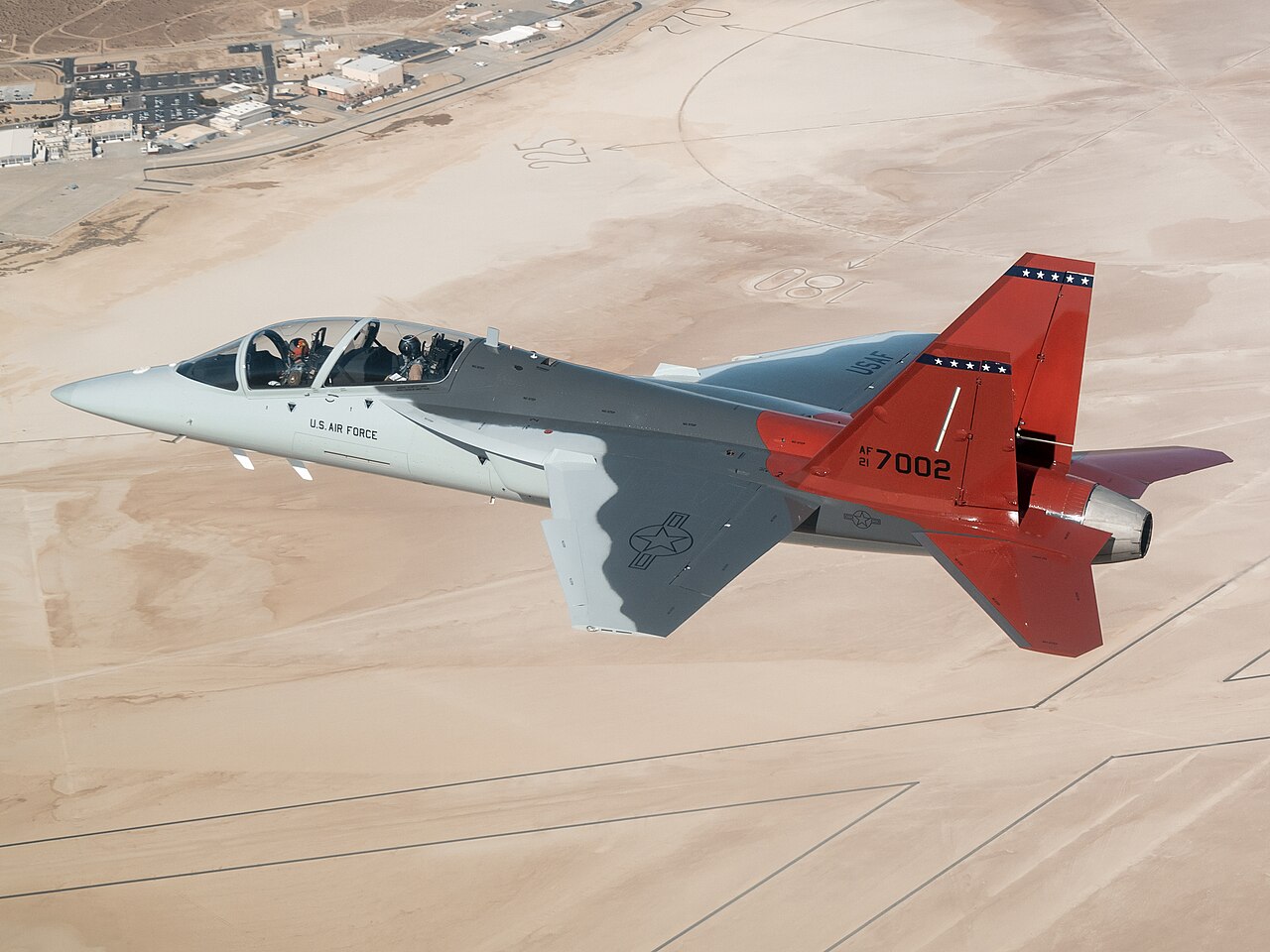
BAE Systems, Boeing and Saab have signed a teaming agreement to advance their partnership on a next generation pilot training offer for the UK, anchored by the Boeing T-7 system and committing to a new UK-based final assembly and integration facility, the companies stated.
The agreement formalises the partnership established through a letter of intent signed in November 2025, since when the three companies have started work to identify the location of a UK final assembly facility and to establish a British supply chain built on their existing industrial foundations. The partners say they are ready to offer a solution that would create hundreds of high-value jobs, positioning a UK supply chain to take a role throughout the lifecycle of an RAF T-7 programme and ensuring the UK has sovereign control over its own training requirements as it meets its next generation combat air needs.
“By bringing together this international team of leading defence companies, we are in an excellent position to support the UK’s future training requirements. Our offer represents a modern, integrated training solution which aligns with the ambition of the Defence Investment Plan, while strengthening the UK’s sovereign industrial capability,” said Charles Woodburn, Chief Executive Officer of BAE Systems, as quoted in the press release.
Steve Parker, President and Chief Executive Officer of Boeing Defense, Space and Security, called the collaboration “an important step in advancing the United Kingdom’s future fast-jet training capability,” adding: “With the T-7 as its foundation, our modern training system can help deliver sovereign pilot training solutions while supporting high-value jobs and industrial capability across the UK.” Micael Johansson, President and Chief Executive Officer of Saab, said the company was delighted to continue its co-operation with BAE Systems, with the three-way collaboration promising “to strengthen the T-7’s position for the UK as the future-proof solution for the RAF.”
The T-7 is undergoing flight testing with the US Air Force, and an initial production decision, known as Milestone C, was achieved in late April, which the release says signals the service’s confidence in the aircraft’s design and readiness. The training system combines flying with advanced simulation to enable training for the RAF’s Typhoon and F-35 frontline jets, with an adaptable design intended to let the platform and simulators evolve alongside future aircraft and mission requirements, supporting the RAF as it prepares for future combat air capability including sixth-generation platforms.






Doubles up as an excellent lightweight fighter when required
Uk would never do something that practical. We spend billions on gold plating every platform even if we only get one of them
Isn’t this already gold plated by the Americans, which is why it has had so many bumps in the road to shake off. If they solve all the problems then one hopes this might be the best option in the long run mind.
We had armed hawks in Cold War as second line of defence. Makes perfect which is why our goverment and raf will never do it.
They don’t understand “good enough” and that numbers not just quality matters
In exercises, the sidewinder equipped Hawks were shown to be useless so they were dropped.
Actually, you are just making this up, avoiding the facts to fit a subjective viewpoint. Reality is they worked very well, both operationally and cost effectively. Sorry if that does not fit your agenda
Actually I’m not. The radar-less Hawks couldn’t intercept anything. The idea was quietly dropped.
Hello Grinch.
Any chance you can share this Info please ?
Really? I was into defence at the time and have never read that.
Could you share sources??
They would be useless against other fighters, but could work well for intercepting long range drones over large areas of airspace.
Sure, if they could find them. Which they couldn’t. Do you see any RAF Sidewinder equipped Hawks today?
Cold war was a long time ago, though. Jet like a Hawk or T-7 Red Hawk would basically be target practice for any enemy Gen 4/4.5/5/6 aircraft in combat these days. Best it could do is shoot down some drones, and there are far better and cheaper options for that.
These days it’s just not a viable option; all we’d be doing is throwing away the lives of pilots and the training aircraft that could go to training more fast-jet pilots. A much better option is drones; even if they’re shot down, no lives lost and can easily be replaced by another.
I could believe that but countries do use them for light air support and strikes in non contested and COIN ops
Also nations have 2 tier forces to provide numbers both in air power, warships or land forces.
Spyinthesky,
The T-7 Red Hawk is the exact opposite of gold plated … by design. The T-7 was intentionally engineered to be a ‘breaking the cost curve’ aircraft. It is stripped-down, affordable, and mechanically simple, it uses a simple, off-the-shelf design instead of inventing expensive new technologies.
The T-7 uses a single General Electric F404 engine, the same workhorse engine that has reliably powered the F/A-18 Hornet for decades. There are no built-in weapons, the baseline T-7 is a pure trainer. It has no internal cannon, no heavy radar absorbent stealth coating, and no highly complex radar hardware. It is a sleek, metal and composite shell designed specifically to be cheap to fly and fix.
The T-7 was the poster child for ‘e-Series’ aircraft, designed entirely using 3D digital modelling. Saab built the back half in Sweden, Boeing built the front half in the US, and because the digital math was so precise, the two halves literally snapped together in less than 30 minutes on the assembly line with minimal drilling. This kept the projected unit cost remarkably low … roughly $20 million to $28 million per jet, which is incredibly cheap for a modern military aircraft.
All the gold is in the software, not the hardware, if there is anything high end about the T-7, it is its digital cockpit and software architecture. The jet uses virtual simulation to pretend it has advanced radars, electronic warfare systems, and weapons. Instead of buying a gold plated jet with a $5 million physical radar, they bought a cheap jet that uses software to simulate a $5 million radar.
The contracting strategy backfired spectacularly on Boeing! They had won the U.S. Air Force contract by aggressively underbidding Lockheed Martin, locking themselves into a ‘Firm Fixed Price’ contract worth $9.2 billion. Under this deal, the U.S. government paid a flat fee, and Boeing has to cover any development issues out of its own pocket. When the program hit standard aerospace delays, such as tweaking the pilot ejection seats (not Martin-Baker), software bugs, and supply chain issues, Boeing was forced to absorb over $2 billion to $3 billion in losses … Plus Boeing got into a brutal ‘war’ with the Pentagon regarding IP ownership and eventually got kicked off the 747-8i “Doomsday Plane” (SAOC) bid, the U.S. Air Force actually eliminated Boeing from the $13 billion competition to build the new Doomsday Plane after forcing Boeing to hand over the proprietary engineering blueprints and structural data for the commercial 747-8i platform.
Like any massive aerospace company, Boeing is a prime contractor. They design the basic jet, but they buy thousands of the individual parts from a complex web of sub-tier suppliers. When Boeing signed the initial, hyper aggressive contract in 2018, the wording required them to hand over complete data rights for “organic sustainment”, meaning the military could maintain everything themselves. However … Boeing failed to write those exact same data sharing requirements into their contracts with their subcontractors. wtaf!
When the Air Force demanded the blueprints and maintenance manuals for critical safety parts, Boeing went to its suppliers to ask for them. The suppliers essentially said “Absolutely not. That is our proprietary intellectual property. We spent our own money developing these parts, and if we give the blueprints to the Air Force, they can give them to our competitors”.
Boeing was legally trapped in the middle with an empty hand and this and their hubris has eventualy led to BAE / UK gov. being in an excellent position to dictate their terms for Boeing to gain access BAE’s traditional clients and the broader international market.
… While the baseline T-7A currently rolling out for the U.S. Air Force is a pure, unarmed trainer, Boeing and Saab designed the aircraft from day one with the structural margin to evolve into a light combat aircraft. They are actively developing and pitching an armed version. The U.S. Air Force is exploring a combat variant conceptually dubbed the F-7. Although the US Air Force will likely avoid buying the F-7 in massive quantities as a mainstream combat fighter for a single, defining reason … drones, the Pentagon’s absolute priority for building bulk fleet capacity is the CCA programme, autonomous, pilotless loyal wingman drones designed to fly alongside F-35s / F-47’s. The Air Force wants thousands of mass produced, cheap, uncrewed aircraft to absorb enemy missiles and expand their radar networks.
This is where the BAE Systems / UK alliance hits overdrive, Boeing and Saab designed the armed variant specifically to capture the global export market looking to replace fleets of aging Northrop F-5s and Alpha Jets. To turn the trainer into a fighter, the armed version adds underwing hard-points to carry air to air missiles, precision guided bombs and external fuel tanks. It swaps out the blank nose cone for an actual physical radar system … like a lightweight AESA. Many smaller nations cannot afford a $100 million F-35 or Eurofighter. An armed T-7 variant offers a supersonic, modern, digitally advanced light attack jet for a fraction of the price.
So while the RAF’s initial interest in the T-7 focuses heavily on fixing their pilot training pipeline, the factory line being set up in the UK is perfectly positioned, if the UK or international allies want a cheap, light combat version down the line, the hard-points, wiring, and architectural bones are already built right into the frame.
The T-7 isn’t an over-budget, gold-plated luxury item for taxpayers; it’s a remarkably budget conscious, practical jet that Boeing simply underpriced to win the bid.
The T7 doesn’t it’s training only the T7-A can carry weapons . It’s the T7 cheap version with no weapons being talked about no surprises.
We will need the armed version for weapons training
No, why would you think that? The Hawk T2 is unarmed.
Yes, not had any TWUs in decades.
The T-7A was specifically stated in the announcement.
Uh no. There are even M346 version with radar. None for T7.
That would require a separate development program.
Price and effectiveness should be the only consideration for this platform and not UK production. Having Boeing and Saab and BAE sound like a recipe for expense.
Yeah I’m sure taking Bae out of the mix leaves Boeing as the perfect expense free asset. So far there has been little to no sign of that, just another troubled Boeing effort that’s riling Congress big time. As I say though if they can sort that out by the time we need it then great, but for me production here is an absolute must, don’t want to rely on the US for yet another lever of direct manipulation and will at least preserve some of the skills of producing training aircraft that we are allowing otherwise to slip away. Might need that in the future.
Whilst I generally agree on pivoting away from purchasing American equipment and either building it at home or going to Europe or other partners instead, in this case I’d prioritise getting a decent amount of training jets as quickly as possible; we desperately need more pilots, and fast-jet pilot training is taking far longer than it needs to due to the shortage of training aircraft.
The quicker we can get them in service, and the more of them we can purchase, the quicker we can get the pilot training pipeline in order and start getting more pilots trained.
Yeah, best not support UK industry. Idiot.
Paying extra for local assembly of a foreign product ain’t supporting British industry. This is supporting more piggy’s in the trough.
It can be either it’s a choice not a necessity. France made Renault one of the biggest and most respected car companies in the World by doing it right, we made BL a joke and finally a dead duck by doing it wrong. In other words nuance is everything, Britain struggles to comprehend that.
Doing the work in the UK by British workers doesn’t help British industry?
Don’t be so effing stupid.
You are wrong on this issue Jim. Yes, value for money is desirable, but in the case of defence expenditure, its contribution to the development of the economy is outstanding and, where at all technically feasible, keeping it domestic should take precedence.
Disagree. If there is industrial co- operation and assembly in the uk – then more of the money is cycled back through the UK economy and 1) is actually better for the UK exchequer and 2) high end engineering employee skills and industrial capacity in the Uk are also increased. Especially in terms of spares, maintenance and support over the life span of the system.
Getting a cheaper “off the shelf” version direct from the US just spaffs all the money into the US economy, and losing it from ours.
The high end skills are in the R&D development, engineering & systems design and integration. There are no High end benefits in bolting an American Engine onto an American airframe with American ejection seat (which isn’t even safe Alledgedly) American Systems, American Avionics with US spec fasteners, connectors, cable etc. we are just a third world assembly operation.
The high end skills are in the R&D development, engineering & systems design and integration. There are no High end benefits in bolting an American Engine onto an American airframe with American ejection seat (which isn’t even safe Alledgedly) American Systems, American Avionics with US spec fasteners, connectors, cable etc. we are just a third world assembly operation.
Xenophobic rubbish. Aircraft manufacture is high skilled work.
Any chance then for a UK engine and ejection seat to be incorporated on the T7A? What type seat does the UKs F35As have?
Sure. Spend enough money and it can be adapted to fit anything.
As someone that has worked at Warton, Brough, Kingston, Dunsfold, Salmesbury Filton, Hatfield and Lostock I have a good understanding of the skills involved. Developing, designing & manufacturing is orders of magnitude different from bolting together a kit of parts from a foreign manufacturer
And I’m the King of Siam and I know you’re talking out of your ass.
I’m inclined to agree with LB, what he says isn’t a “strong, irrational fear, hatred, or contempt” in this context! The high end skills ARE in R&D, development engineering, system design and integration. All that I believe is being proposed here is we’d be learning how to bolt specific engines to specific airframes, install specific flight control and avionic systems, attach paneling and then test it all but there are various outfits around the UK that could potentially do this already. So, skilled, yes to some extent but it’s not development of Tempest, even Typhoon level high-end skills where we can become real technology leaders. Now I’m not taking anything away from the opportunity this offers us in the UK, I’d prefer us to take up any option like this, yes, there are benefits to our economy from employing UK technicians and engineers in doing this. It allows development of apprentices from final assembly roles into the more complex programmes BAE operate but the real intellectual skills are in a aircraft design and development.
Apply for a job on the fighter line at Bae and let’s see how qualified you are.
Ahh I see, the all knowing but then all assuming Grinch, you’ve shown your colours. I’ll not waste anymore of my time on you.
$23m each according to FY27 budget request.
Is that comparable to anything else like the Italian trainer?
Copied from Google:
“The Leonardo M-346 advanced jet trainer and light combat aircraft has a flyaway cost of roughly $25 million to $40 million per unit. However, when purchasing full procurement packages—including simulators, weapons, logistics, and maintenance support—the price ranges from $92 million to over $140 million per aircraft”
Insanity! So that is all the UK is? an assembler for an US project which is riddled with air safety problems. Fitted with competitive products to British companies (which have proved unsafe), Major quality issues, Air Safety data shortcomings, Process issues, doesn’t work in the rain.
Is anyone seriously suggesting we take on another disastrous Boeing development? Boeing pulled this out of the US Navy program because they know it is unsafe. Look at KC46, Wedgetail, 737, 777x there is no Boeing project on time, on cost, on spec . This wiould end up being another budget busting disaster. Like the verified to 42T and low risk Ajax from GD, Like WCSP LM, like Merlin LM etc NOTE all American companies. T50 would be a better option IF UK work package can be sorted.
On this UK design nothing just bolt together an American engine to US Airframe with US systems and Avionics? The Aircraft doesn’t work and there is no sign of the safety issues being sorted in the near future. Apart from the fact we would be entirely reliant on a very flakey partner with a product where every single component is ITAR’d and none of is UK supply. BIN IT
Utter bollocks. Full of lies and misrepresentation.
The Collins ACES 5 ejection seat used in the T-7A Red Hawk has faced safety concerns that have delayed the program by 2.5 years, as it failed to meet minimum safety requirements for airworthiness certification. Ongoing issues include problems with seat sequencing and canopy fracturing during high-speed tests, necessitating further testing before certification can be achieved
The Collins ACES 5 ejection seat used in the T-7A Red Hawk has faced safety concerns that have delayed the program by 2.5 years, as it failed to meet minimum safety requirements for airworthiness certification. Ongoing issues include problems with seat sequencing and canopy fracturing during high-speed tests, necessitating further testing before certification can be achieved.
Vis-a-vis ITAR are you suggesting there is no ITAR’ attached to Red Hawk?
Redhawk remains at the LRIP stage and clearly has ongoing issues.
T50 would be a much better fit for the RAF and is a much lower risk proposition.
Desperate crap as usual. Aircraft is entering production as we speak, development niggles are in the past.
My understanding is the Wedgetail problems are mostly on our side.
Agree that basically every other Boeing programme is an absolute cluster though (especially KC46)
P-8, F-15, F-47 are all cluster fukks?? Don’t be so frigging ignorant.
I suspect you said the same when Ajax was awarded to GD! https://breakingdefense.com/2026/06/t7-red-hawk-air-force-trainer-secret-struggles-investigation/
The facts are there are massive issues with RedHawk. Boeing are making a big loss. It isn’t verified and it’s high risk. So then you look at Boeings competence on civil, military & space projects over the last few years? What is your view on their compliance, safety, honesty, delivery to promise etc? I’ll wait…
An observation – I find it interesting that when a foreign contractor wins a contract but fails to perform. Ajax, WCSP, Wedgetail the contractor is protected and all fault becomes service branch, MoD, HMG.
However, if a UK company fails to perform they are lambasted from on high by the media, press etc there are immediate calls as why didn’t we buy from the US etc. UK industry has in some sectors invested in Army strategy for thirty years pouring millions into developing products. No orders were forthcoming.
Then when there are contracts to place they are placed to US or German companies. The US companies with zero experience in A vehicle platforms have both failed spectacularly- BUT where are the calls for them to blocked from future contracts, correct their errors? Apologise for their lies? Provide the jobs they promised at the bid stage?
Without R&D, design, and manufacturing we become a client state. The DIP is a start but does not go far enough in securing sovereign capability. We have the skills we need to harness them!
Also HMG, MoD need to set their stall out more aggressively! they need to state what elements they want in the UK, make promises made on work share, R&D, IPR, jobs contractually binding. MoD also need to ensure projects are ITAR and restriction free.
Let me provide an example of typical US protectionism. On ASRAAM, the seeker was developed in this country. Raytheon were awarded the contract to supply. An ITAR was promptly slapped on to block MBDA being able to export the weapon with out US approval. Which of course would be withheld if the US wanted to compete. We went to courts in the US and won the case. Also since batch 6 the seeker has been resourced to Europe. This is just one instance of many many instances I have been involved with. I thought the French parochial when I got into business but they do t come close to the Americans
Xenophobic poppycock.
There’s zero chance of a new UK designed and built trainer. So in your mind buying from America is somehow worse than buying from Italy. Pshaw.
ITAR is a total red herring. The UK won’t be exporting any of its new trainer whoever it’s acquire from.
It’s all about the balance of correct performance, risk and the level of manufacturing work offset and work share. Calling someone a xenophobic who has worked in the US, Germany, Italy, Spain, Scandinavia, Middle East, India and the far east is strange though.
If you don’t think the US seek commercial and political dominance and are protectionist then you are misinformed
So don’t reply to the points I’ve raised. I really don’t care.
Good overview here https://x.com/mtarfal/status/2080012338950762723?s=46 Incidentally F15 is a MsDonnell aircraft, designed and flying years before the merger. P47 is yet to be produced. P8 has had its problems and they had to drop the MAD due to weight issues. It has limited endurance and weapons load ou, Had ‘call me Dave’ listened to BAE and invested in new fuselage for MA4 we would be in a far better position.
Academic really, the Leonardo M-346 is very much the favourite to win this one. Leonardo has a huge UK defence manufacturing presence and Yeovil is ideal for final assembly before the airframe is trucked to RNAS Yeovilton or MOD Boscombe Down for final check out and first flight.
Yeovil is ideal ???? Jeesh.
I suspect you are suffering “Helicopter-Only Blindness”—the common assumption that because Yeovil has built rotary-wing aircraft for decades, it is physically or industrially incapable of touching a fast jet. Yes it is capable both industrially and politically. It is an open secret amongst the defence press and commentators that Yeovil would be the prefered build location. It has the space to absorb M-346 Final Assembly, is adjacent to the iAero Center innovation centre that has office and workshop space. Yeovil is also a key logistics hub for Leonardo in the UK with a huge warehouse facility. It has a suitable workforce as well that can be retrained on M-346 Assembly. Politically it is attractive as it would stabilise the work going through Yeovil that is currently reliant on Wildcat that is a type on borrowed time and AW149 which is shifting final assembly to that facility. Once Wildcat assembly has gone only building AW149 there adds the risk of boom and bust always a problem for the Yeovil facility, adding M-346 eases that issue. The main barrier is lack of a suitable runway but that isn’t particularly a big deal. The M-346 is modular and they can simply truck assembled airframes to a hanger at RNAS Yeovilton which has plenty of space for a flight test and check out hanger or to MOD Boscombe Down. BAE Systems literally trucks Hawk and Typhoon sub-assemblies across the UK, and F-35 centre fuselages are driven all over the globe before final mate. Trucking a modular, wingless M-346 airframe down the road approximately 5 miles to RNAS Yeovilton or 55 miles to MOD Boscombe Down is an incredibly minor logistical task. I actually see them flying them out from Yeovilton to Boscombe Down anyway for flight testing before delivery. The M-346 is already the prefered type within the RAF and used to train RAF pilots in Sardinia, politically with the huge Leonardo footprint in the UK the type is “British enough” to satisfy political concerns about its origin and there are direct synergies with the GCAP/Tempest programme.
Experience in building modern jet aircraft = zero.
Same level of experience as GD UK had in building armored vehicles.
The 345 is painfully slow – not much faster than the prop trainers
The 345 is painfully slow – not much faster than the prop trainers
What? he talks about M346 you misguide with M345? 1090kph not much faster then prop trainers?
Never mentioned the M-345, I was talking about the newer M-346 that is faster than a Hawk T2.
my bad, yes, the YAK is quicker, but F-35 has already killed one
Not the same engine!
It’s going to be really interesting to see where this goes with the RAF.
My personal preference would have been a direct purchase of the Aermacchi M-345, which is in service already and so low risk of cost overruns, and could probably be manufactured in the UK if that’s what the government of the day wants and quickly given the trajectory of the Hawk at the moment.
A single engine aircraft is the best way forward for a training aircraft with reduced maintenance costs.
Like the T-7 then 🙄
Not the M345,should be the M 346 which is the modern one.
T7 is probably the best long term option. But delivered and in service for 2030? That’s a very very tight deadline. I could see the Reds soldiering on with the Hawk T1 for a couple of years after 2030. Hopefully I’m wrong
👍👍👍
To be honest for the trainer I would go for a mature design.. the T-7 is still going through its teething problems.
If i was a betting man. I’d put my money on the M346 getting the gig.
It would be a bit ironic the RAF using what was essentially an aircraft that started life as a soviet programme.
The M346s political baggage isn’t going to help the bid. I don’t think HMG will enjoy the “Red Arrows to fly Putin’s jets” headlines in the tabloid press. The M346 is an older design and has the additional complexity and maintenance burden of two engines. Also when did Yeovil build anything fixed wing? The 1950s?
Mature is another name for old. M-346 is at least 30 years behind the times. The RAF deserves an up to date aircraft.
It would. Maybe the T7 is the best option…😄
T7? Let’s not make things harder than they need to be. The UK govt look to have put a lot of effort into the Leonardo relationship which we would be foolish to betray. M346 ticks all the boxes; functional, domestic political and economic. M346 is selling well; lots of good quality jobs would be created in Yeovil. It would generate UK exports and demonstrate our strategic commitment to Europe. If I were Burnham and Streeting I would accelerate this project rather than push it into the future.
Leonardo makes a shit load of money from the UK, there’s zero logic in handing over more instead of buying a superior aircraft built by a British company.
As for an M346 buy generating exports??? How the heck will it do that??
In what is superior? M346 even has a variant with radar. And lots of weapons already certified.
It’s a trainer dude. Won’t be carrying weapons in UK service.
You said T7 is superior, in what way? i think a training aircraft should at least have anti drone capability.
So, I’m not an aeronautical engineer, but I might agree that BEA could develop a T7 variant into a viable (British) combat aircraft, even supersonic perhaps. But do we need that, how long would it take, how much would it cost and who would buy it other than the RAF? I’m just trying to think with my head rather than my heart. If there was a real possibility that Boeing would hand over all the intellectual property of T7 to BAE Warton and the govt would give BAE a T31 style wadge to get it done, I might be tempted.
The M346 is only an incremental upgrade with comparison to the T2. The T2 is long overdue a midlife upgrade, but is still a capable aircraft for Fast Jet and simulated combat training.
The T7 would be a logical next generation advancement to become T3, rather than the M346 that would be regarded as a T2.5 platform.
Had the UK governments (Wavy Davey era to present day) supported and invested further in advancing fast jet training – additional aircraft; additional spare engines; better support deals with Rolls Royce; better funding for engineering apprenticeships, etc – perhaps the life of the BAe T2 would have been evolved and extended. Bae had plans to develop a fully digital glass cockpit, fly by wire, composite airframe T3, but they had been whitewashed by the government since the Middle East finance corruption investigation shambles.
As for the RAF – they don’t know what they want or what they want to do with anything shiny and new. They hated the T2 because initially, it’s not supersonic and also its a T1 airframe with a longer nose and a slightly bigger engine. They use the M346 in Sardinia, they like it as it’s similar to the T2, but I’d bet that if we bought a load for them, they will nit-pick holes and grumble that it can’t do this, that and the other thing.