

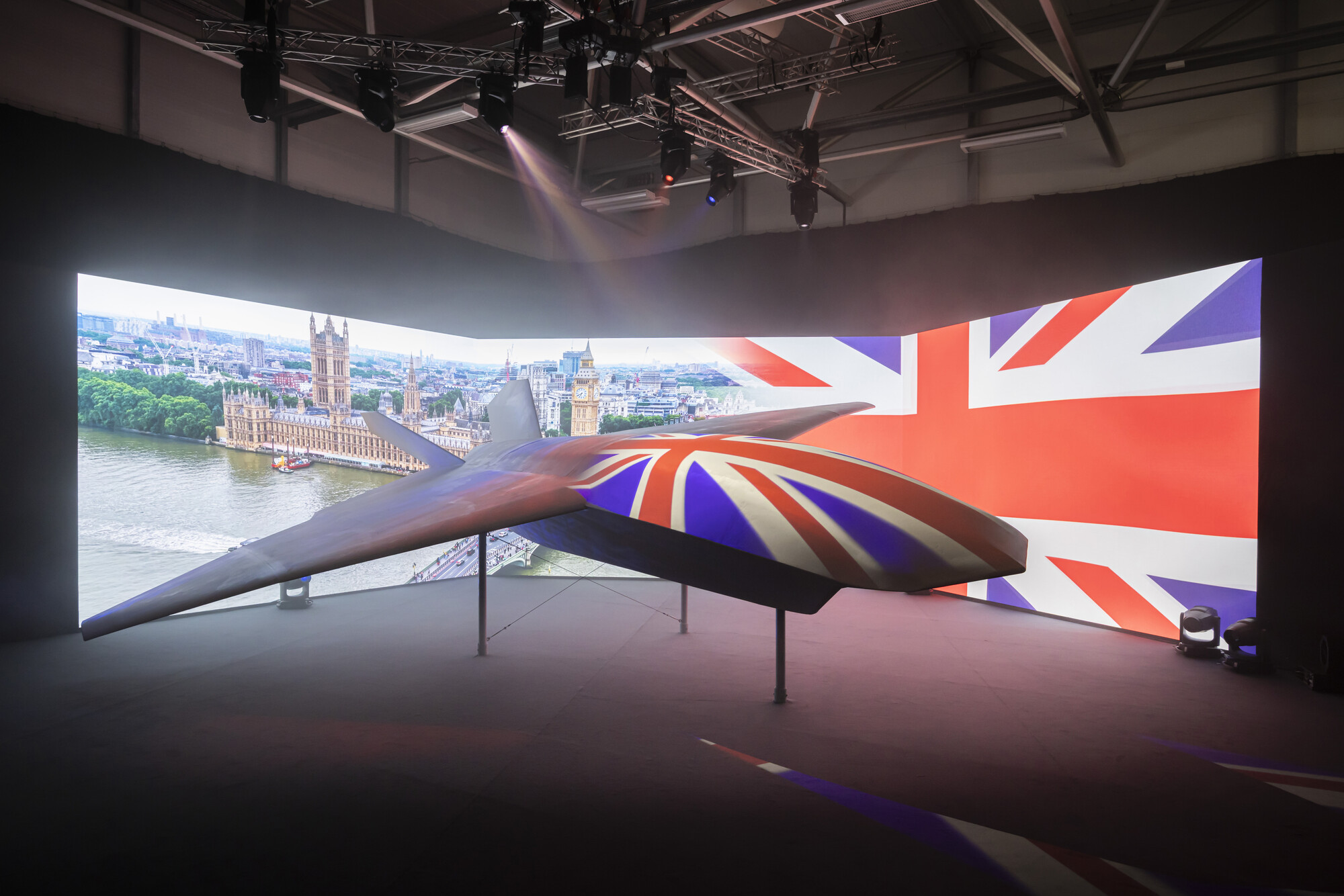
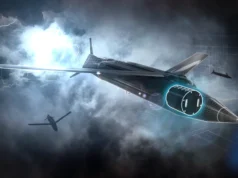
BAE Systems has unveiled the UK’s first uncrewed autonomous Collaborative Combat Aircraft at the Farnborough International Airshow, a prototype named Brontanax designed to extend combat mass by complementing crewed aircraft at lower cost, the company stated.
The aircraft was designed and built by engineers at BAE Systems’ site in Warton, Lancashire, which the company describes as the home of the UK’s sovereign combat air industrial capability. According to BAE Systems, more than 500 of its employees have been involved in the aircraft’s development to date, working with over 75 large companies and SMEs from across the British aerospace sector.
🇬🇧 Meet Brontanax: BAE Systems has unveiled the UK’s first uncrewed autonomous Collaborative Combat Aircraft at Farnborough. Designed to fly alongside Typhoon and extend combat mass at lower cost, it’s set for ground testing at Warton ahead of a first flight next year. 🎥👇 pic.twitter.com/SKRTP1Yf4W
— UK Defence Journal (@UKDefJournal) July 22, 2026
Brontanax is intended to provide electronic warfare and precision strike capabilities against airborne and ground targets. Operating with frontline combat aircraft such as the Typhoon, the company says it will enhance combat mass and operational effectiveness, with planned availability to enter service before the end of the decade. Similar in size to a BAE Systems Hawk, the aircraft is designed to be operated by a Typhoon pilot or mission commander from range, allowing crewed and uncrewed aircraft to operate as a team. It has been developed with an open architecture and modular design that, according to the company, can be adapted as threats evolve.
Defence Secretary Wes Streeting said: “The unveiling of Brontanax, the UK’s first uncrewed autonomous Collaborative Combat Aircraft, is a testament to the extraordinary talent and innovation across our sovereign defence industry. Built at BAE Systems in Warton by British engineers, backed by British businesses large and small, this aircraft demonstrates that the UK has the skills, the technology and the determination to lead the world in combat air power. We’re investing £300 million in our StormFighter programme to develop an autonomous combat aircraft here in the UK. This launch shows the depth of industrial capability we have here in Britain to help deliver our ambition to become Europe’s first sixth generation air force.”
Chief of the Air Staff Air Marshal Sir Harv Smyth was quoted as saying: “The RAF is determined to become Europe’s first 6th Generation Air Force, driving innovation and accelerating the adoption of cutting-edge technology to stay ahead in an increasingly complex and contested battlespace. Working alongside BAE Systems, we are taking a major step towards that ambition, with a prototype expected to fly next year. Backed by £300 million through the Defence Investment Plan, our StormFighter programme is transforming future capability, while the launch of Brontanax, the UK’s first autonomous uncrewed Collaborative Combat Aircraft, shows how sovereign defence industry is delivering at pace to support us in being agile, integrated and ready to fly, fight and win.”
Simon Barnes, Group Managing Director of BAE Systems’ Air sector, was quoted as saying: “We recognise armed forces are being challenged to meet the demands of speed, adaptability and scale. Our Collaborative Combat Aircraft will provide the ability to extend the reach of crewed aircraft, generating greater combat mass at lower cost, while keeping pilots out of harm’s way. This capability represents a significant company investment in the UK’s future of air power and builds on our long-standing commitment to innovation. Alongside supporting defence priorities, it will strengthen the UK’s sovereign defence ecosystem by creating opportunities for SMEs, suppliers and partners across the country.”
The unveiling follows the publication of the government’s Defence Investment Plan, which confirmed a £300 million commitment to the StormFighter sovereign autonomous CCA programme, intended to provide the Royal Air Force with what the government describes as Europe’s first sixth generation capability. BAE Systems states that Brontanax builds on more than 25 years of company experience in uncrewed and autonomous systems, and has been developed through its FalconWorks team and funded to date through self-funded research and development. The company invested more than £400 million in self-funded R&D in 2025.
The prototype name is derived from the ancient Greek words for thunder and king. The aircraft is now being prepared for ground-based testing at Warton ahead of flight testing within UK airspace, which the company and the RAF expect to begin next year.





Perhaps HMG will get behind British industry this time. Cameron doomed Taranis which was incidentally a very successful program. Cameron doomed many thing in fact when money was free he and his chancellor went on an austerity drive. And destroyed much of the Brish defence sector. Allowing foreign predators to buy critical industry for peanuts
I wonder how many eurofighters will get integrated with it, perhaps only the ones getting the new radar?
I also imagine that LM will make integrating this with F35 an uphill battle. But besides that it looks very interesting, if it does fly next year I can easily see it being in service by 2030 which will do a lot to add back to the combat mass we’ve lost over the last few decades.
Silly name, but a very good project and BAE’s video shows it taking off from an aircraft carrier over the ramp which is nice.
I wonder if this is the jet powered drone that the First Sea Lord said would be taking off from a QE carrier in 2026.
It would not surprise me, there seems to be a level of alignment.
The name is terrible. 😢
Apparently it means “King of Thunder” in Ancient Greek. Which is sad, because we could just call it “Thunor” which is the Old English god of thunder. Or indeed, “Thunder” which could fly with our Lightnings…
I wonder how it will land on the carrier.
Im guessing Brontanax as its ancient Greek and thats the only language the Beancounters understand having all done classics at Oxbridge
Such craft as these must result in huge savings in personnel training, infrastructure and in-service expenditure. With autonomous weapon systems reduction in personnel could be significant, though initially the transition will probably be sobering as some fail to achieve objectives whilst others make significant steps to crewless systems. If one looks at an average RAF station and its infrastructure based on conventional operations, they are huge and a considerable amount of acreage is required for housing. Future bases could be more compact and easier to transport using remote vertical drones and F35B’s operating from makeshift bases, without the footprint of a typical station. The Harrier was built around the ‘shoot and scoot’ principles now vital for the RA, and these ideas could form part of future vertical drone operations. Obviously, the Brontanax will require a runway; this could also be a motorway or appropriate open space. Pop-up air bases could be an additional option for the RAF to develop thanks to the rapidly developing drone technology.
Motorway service stations. Or, on A roads, who fancies a Little Chef?
The support crew can stay at the Travel Lodge.
A pop-up air combat field may sound odd but current RAF airfields are fixed, fat targets. I guess the MOD has a dispersal plan to civilian airfields, etc., but vertical drones and F-35s could operate from quickly established field bases. The drone could change many current operational paradigms, and the possibility of flying Brontanax from alternative sites could be considered with the relevant support crews.
P.S. The Travel Lodge idea sounds interesting.
Didn’t realize drones didn’t need such boring things as refueling, rearming or maintenance. Good to know 🙄
Grinch, I assumed a support crew would be baked in just as it was with Harrier/Army deployments in the last century.
I wonder why they are not done today.
Has it come from Jurrasic Park? A dinosaur was the first thing that entered my mind seeing that name.
Ironic, given how cutting edge this must be.
Just call it a Raptor and be done with it, though I think that names been taken?
Seems they’re going with ancient Greek. Google says it means Thunder King.
It’s encouraging to see industry taking the initiative and producing products, certainly gives the MoD more choice.
Could the quick reaction force be one of the first to go unmanned, at least in part? I can imagine a few of these on a runway waiting for a digital order and taking off several minutes before a Typhoon is ready.
Not for me.
If you mean QRA, they also need to establish contact with errant aircraft flying into the UKADR who are not responding, possibly including hijacked ones.
So a pilot is useful for proper visual inspections, signalling an aircraft, and taking instructions from “London” to shoot it down if a minister makes that decision.
An autonomous machine doing it?
In all out war yes these are useful, but QRA, and a military, need to respond to other situations.
And several minutes for a Typhoon, they’re quicker than that!
You make good points, it’s why I caveated my post by saying it’s replacement could be ‘in part’. I could imagine drones being stationed further north, for example an outer Scottish island and intercepting a Russian bomber faster than a Typhoon. If it’s simply a case of escorting it as a precaution then surely the Typhoon can go home? Saves airframe hours at the least.
Sure mate, that was noted. 👍
I wonder whether those of us (myself included) who’ve been calling for more Typhoons to be bought have been wrong and that this is the quickest and most effective route to greater combat mass.
Absolutely sounds like it at only 20% of the cost!
For me now we DONT need and tyhoons .
Order lots of these then 100-150 tempest from 2035 and we have a credible airforce
However these are hawk size so will we need to reopen more airports
Plenty of Runways still on the MoD estate, with all the supporting infrastructure needed to operate fast jets.
So I’d say no.
Estimated as 25% of the Typhoon unit cost. No doubt will rise. Too expensive to be attritable.
This looks great but the major question is, is it real or just another BAE model?
I suspect it’s another model looking for a few billion to produce another tech demonstration. Hope I’m wrong but I just don’t think BAE is cut out for CCA’s just like Lockheed and other defence primes keep falling on their face with these. They have no interest in any aircraft that’s not a $100million + because it threatens their main business of making $100million + aircraft.
If BAE did get its finger out and build this then there is probably a massive market and they could be the first outside the USA offering something.
A UK only developed CCA able to do electronic warfare and strike missions could be the kind of defence industrial program Andy Burnham is looking to invest in. I just have a hard time believing the MoD is willing to part with the cash instead of funnelling it into some favoured niche capability the Americans want. I also have doubts that BAE can deliver. It’s too cosy being a sub contractor.
It’s a real airframe. They unveiled the actual, flying model at Farnborough, apparently first flight is expected next year for participation in NATO exercises.
No. The aircraft revealed at Farnborough is non operational. The flying example is back at the factory getting ready for its maiden flight next year.
Apologies for that minor inaccuracy. Either way, there is a complete airframe, and first flight is next year.
No worries dude.
You mean threatens their profits….the sole aim of the MIC and one reason why I’m so sceptical of them when handed wads of taxpayers money.
All non-charity businesses have profits as their number one priority. Do keep up.
… a lot of ‘charity’ ones too.
If this has come from BAES Warton Special Projects site I’d say it’s very real, has been in development in secret for some time, and will be flying quite soon.
And having just spotted that there’s a video link which I’d missed 🙄 yes, little sign saying Falcon Works.
I’m very excited about this, hope it doesn’t die a death like Taranis, though I have a feeling that this time things will be different.
Fingers crossed mate, last thing we need is yet another program that goes no where.
We are running out of Thunder gods to call it after.
We could always just give up the Classical names and use the literal translations.
Personally, I’m quite fond of Project Thunder King.
There is a competitive flyoff next year for CCA aircraft with a few to getting them in service by 2030, looks like this will be BAE’s entry in the competition.
The thing about this is are they going to be looking at the future best way to run squadrons..
At present the structure is separate drone and manned fighter squadrons, but in the future with drones becoming the wingman of a crewed fighter will be see squadrons becoming a mix of Drone and crewed fighters..
So no more a squadron of 12ish crewed fighters jets and a separate set of drone squadrons but a number of crewed fighters ( say 6 for argument) with 12 Drones..
I also wonder if we could see a return of the 2 seater front line fighter.. after all 2 heads can control a bigger fleet of drones and have better awareness.
Which is why I asked about Tempest possibly being a 2 seater.
I wonder if the RAF won’t be able to resist doubling the Sqn list!
Yes I do wonder if it will end up as such.. when you consider its endurance and the complexity of running it and a fleet of drones and all their weapons and inputs over a long time period… two brains is better.. even if it allows one brain to stand down for 10 mins.
Nah…… We will have R2D2 Droids In the back…..
🤖🤖
I think it will be single seater. The idea being that loyal wingmen integrate seamlessly with the aircraft and its sensors. Like in the F35, the pilot doesn’t know if the information he is seeing is being provided by the radar, or defensive aids, or IRST sensors or offboard. And loyal wingman will just extend those sensors reach and option’s available. The pilot won’t be sat juggling 5 Xbox Controllers 😄
USN experience is the second pair of eyes is still very relevant and an edge in air combat
I never thought about it not being a two seater but not you mention it I don’t think they have ever said. If it’s going to be a large 6th Gen fighter designed to control drones then you would think it would definitely be a two seater.
Isn’t it supposed to be able to fly optionally uncrewed, so two crew is unlikely as the pilot can be supplemented by automated systems. And with recruitment problems, pilot training costs and issues, plus increasing drone use, two crew seems even less likely in the future. Having said this the B21 is supposed to be going with two pilots, although that’s a fully fledged long range bomber.
All valid points, especially the WSO costs of training and paying.
The description of Tempest has been that the crew onboard will be taking much more of a WSO/RSO role than a pilot, so the aircraft will mostly fly itself without them worrying about it. This is also the position taken by the Americans but China and Russia have two seat variants on their 5/6gen aircraft.
I think that is all very well, but I’m not sure how one mind manages the tactical situation of the crewed aircraft and five drone fighters, spread over 1000s of square kilometres of airspace.. for hours on end… that’s getting will beyond human mind fuck up point.. as natural Heuristic thinkers the more you put on a human mind the more it makes decisions with holes.. basically the more you push us the more we fuck up.
We have a flow state point.. just enough stress and pressure makes use sing like a fine tuned engine.. the more you push beyond that the more we become utter fuck-ups.
Senor fusion mate.
Dear MoD
When awarding the StormFighter contract, please bear in mind the following lessons learned:
if you award it to an American contractor, you will be waiting forever to have your own weapons integrated onto the platform; but
if you specify a US weapons fit you will find yourself at the back of the queue when the American scramble to replenish all the inventory they have expended on their latest strategic blunder.
And it can be deployed with the need for access to 4* hotels!
*without*
Even the Ryan Air Force drone guys wear Sky God baby grows
Brontanax… what kind of name is that?? Either the ‘lead engineer’ reads a lot, or produces copious amounts of wind.
😁😁😁
…fhat would work with “Thunder-box”…
Hahahaha… Wow that takes me back a long long time.
Removal of the human, ejector seat, life supoort systems, cockpit controls etc alone should allow +/- 350kg of additional payload / fuel capacity allowing a close to 35% increase in range never mind benefits of modern design and composits etc.
This is a highly encouraging development and reportedly self funded as well, which is seriously good news. The down side of this is that the development costs will have to be recouped at point of sale, which suggests to me that BAE Systems and the support supply chain have been given a very plausible and strong signal from the MOD of a procurement of some sort. These do appear to be high end drones mind you so they may not be attritable on cost grounds.
A big part of developing a combat aircraft is providing for the pilot. There are the life support systems, which are more complex than merely providing an oxygen supply. You need to provide an ejector seat and life preservation equipment e.g. dingy, first aid kit, portable communications and navigation kit, etc.. Finally, integrating the pilot and aircraft is also a complex area these days, with head up and head down displays, smart helmets and lots of data processing. All of which add weight, cost and time to the project. Uncrewed Air Vehicles have significant fundamental cost advantage over crewed platforms as a result, although this can easily be wiped out with gold plating and overly ambitious requirements. The fact that this is a self funded platform would suggest that there is every motivation to leave the gold plating in the safe and kerb over ambitious tendencies.
While a drone gets rid of the first two requirements of a pilot, it is likely to add to the third requirement somewhere in the system as data and information still have to be formatted and presented to a pilot. However, F35, for example, is said to be able to integrate a significant amount of information from other platforms as well as provide it’s own data and information into the wide Recognised Air Picture and it is a single seat aircraft suggesting that it is possible to manage information overload for the pilot in the loop systems. Clearly the drone will be able to fly itself, but how the ‘direction’ of the drone is achieved will have a significant impact on pilot workload.
Hopefully, BAE Systems have put some thought into these issues and the Brontanax is able to effectively interface with Typhoon and F35B without significantly increasing pilot workload. My guess is they will have, as this is probably one of the big potential show stoppers for the RAF and other allied air forces adopting this aircraft and given they have invest £400m of company money as well as having undertaken previous research projects I think they will have a solution implemented.
Daniele and Johnathan have also spoken about squadron structures. This is an interesting question as they rightly point out current drones are operated in their own squadron structure, but given that these drones are operating in the loyal wingman role my suspicion is they will operate in combined or mixed crewed fighters and drone squadrons. There will be a questions around how the drones will be accommodated within the current RAF Station infrastructure, they will need space for basic hangarage, arming, maintenance and accommodation for the extra specialist personnel. Who will take bets on Typhoon numbers being cut to free up space? Any takers? There may also need to be additional mission planning and post mission debrief and assessment capabilities provided. Mission planning is already a team effort, but will the new platform have significantly different capabilities and data requirements as to require significantly more and different mission planning support. The options that I can think of are:
1. Keep the numbers the same, so each squadron is in effect increased in size;
2. Reduce the number of crewed aircraft to keep the personnel numbers roughly the same and maintain the current infrastructure ‘footprint’ per squadron;
3. Set up separate drone squadrons.
My guess is that the degree of integration that will likely be required between crewed aircraft and drones is that they’ll integrate the drones into the existing squadrons. So we can discount option 3.
Option 1 there are around 9 Typhoons available on RAF squadron (out of around 15 or so in total – upgrades, maintenance) and the stated aim of increasing mass, the sensible choice would be retain the current airframe numbers on the squadrons and add in the drones;
Option 3 could entail reducing the number of fighters to about 6 aircraft.
In the first instance option 3 would mean quite a few aircraft surplus to requirements. However, such a reduction could provide breathing space for the RAF and FAA infrastructure to be upgraded to take the larger squadron orbats (although in the case of F35 squadrons that is less of an issue at the moment) before rebuilding the crewed aircraft to original levels.
My guess is that option 3 will be the way forward in the short term. My hope is that there will be a transition to option 2 over the medium term.
The one factor I have not considered is aircrew numbers and availability, but this will likely also have an influence on proceedings.
Cheers CR
Good post, mate.
HAS are in short supply already at remaining Fast Jet Stations, though there are plenty elsewhere still if they want these stored in HAS.
But then they won’t share station with the parent Squadron, yet will still need maintenance and all the other support functions.
Hope these don’t end up a token gimmick buy of a few dozen.
Thanks mate,
Hmm, HAS I forgotten about them 🙂
I did read somewhere years ago that the old HAS weren’t much use against modern precision penetration weapons so perhaps we are faced with another infrastructure issue i.e. how to strengthen or replace the existing HAS? Sounds expensive.
As for numbers my guess is that these things could be sufficiently expensive to make it worth while keeping them for 10 years or more and perhaps upgrading them. Whilst they will be way cheaper than a Tempest or Typhoon (I hope) it is very likely they will be considered a valuable asset so storage in HAS and a conventional major equipment procurement strategy is a real possibility. I guess it will depend on how fast they think the technology will develop but given the cost to develop this thing I think it likely that it is intended to keep it in service for awhile and develop the technology that goes into and on the airframe. So a steady build rate over a period of time with delivery rate in the one or two dozen per year. Not racy by some standards but pretty respectable given the RAF will be on a steep learning curve as well.
I would hope that the total procurement would be around the 100 mark plus a maintenance pool for the Typhoon force to provide at least one loyal wingman drone per aircraft for starters, with the ability to rapidly restart production if required. Of course, I’d prefer 2 loyal wingmen per Typoon 🙂
Cheers CR
Excellent post, and a lot of interesting things to read and note. One of my question would be, when/if completed, who ‘owns’ the craft and more importantly the designs of the finished article?
Did anyone else see a similarity in the design of this and the apparent GCAP design? I have not been convinced by the GCAP models and I don’t know if the similarity with a soon to be flying BAE UCAV (I’m old fashioned) makes them more believable or not…
I choose you, Brontanax. Gotta collect em’ all.
Runny nose? Chesty cough? Sore throat? Take Brontanax!
By the looks of the promotion material, it looks like it could be pushed as part of project vanquish as well.