

Russia lost three tactical and strategic aircraft in the space of a week, a Tu-95MS bomber that crashed after multiple engine failures on a training flight and two fighters destroyed by a Ukrainian one-way attack drone at an airbase five hundred kilometres from Ukraine, according to the latest UK Defence Intelligence update on the situation in Ukraine.
The update said: “Over the course of one week, Russia suffered three tactical and strategic aircraft losses. These airframes have been involved in strike campaigns against Ukraine.
“On 29 September 2026 Russia’s Long Range Aviation fleet lost one of its workhorse Tu-95MS BEAR H on a training flight shortly after take-off in eastern Russia. The BEAR H suffered multiple engine failures before crashing. These aircraft have been used extensively to strike Ukraine over the course of the conflict, almost certainly creating a significant maintenance burden on the fleet.
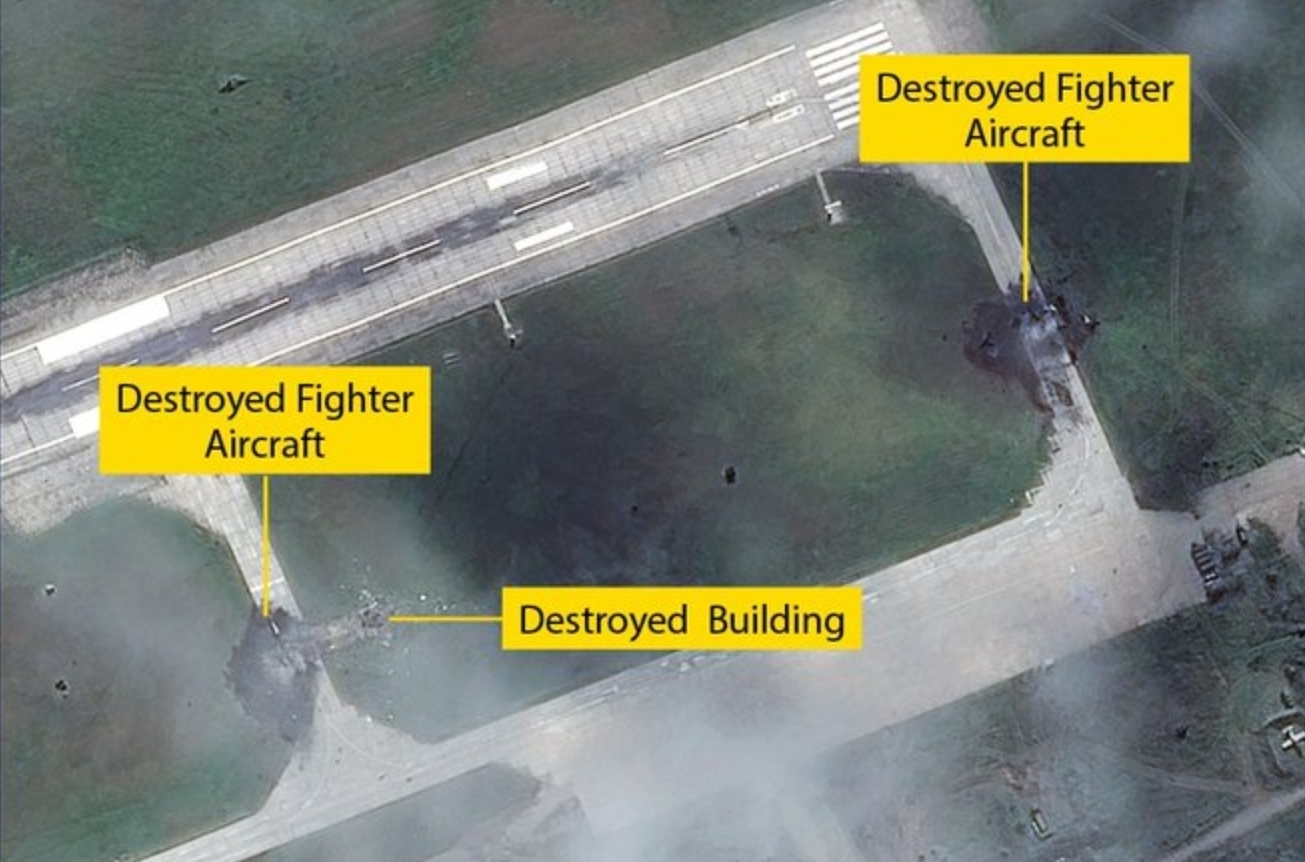
“On 04 October 2026, a Ukrainian one-way attack uncrewed aerial vehicle strike destroyed a Su-35S FLANKER M multi-role fighter and Su-34 FULLBACK fighter-bomber and a munitions depot at Khanskaya airbase, Russia, 500km from Ukraine.
“FULLBACK aircraft are used on daily operations to launch glide munitions into Ukraine. Analysis of commercial satellite imagery dated 04 October 2026 identified the attack had destroyed two fighter aircraft, cratered the parking apron and the taxiway, destroyed one building and destroyed and damaged two munitions’ depots.
“Russia has lost more than 100 fighter aircraft in the Ukraine conflict since February 2022.”
Russia will find the Bear the harder of the two losses to absorb, because production of the Tu-95MS ended in the early nineteen nineties. They fly the Kh-101 cruise missile strikes that have hit Ukrainian cities through the war, launching from well inside Russian airspace and turning for home without entering contested air.
Khanskaya sits in the Republic of Adygea in southern Russia, well outside the range at which Russian commanders had been willing to disperse aircraft earlier in the war. Ukraine’s long-range one-way attack drones have steadily pushed that calculation back, and airfields that were treated as rear areas have had to adopt the revetments, decoys and dispersal that frontline bases adopted years ago.
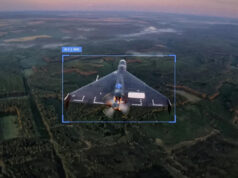




And another 4 brand new SU-34M destroyed, with 2 severely damaged the other night….
But for the Russian Air Force its a whole lot worse in reality…let me explain….
People need to understand that the VKS has been involved in high intensity war for 4 years and 7 months now….every month they are flying many, many thousands of flying hours in combat conditions (loaded, fueled aircraft pulling high g’s) which are far more damaging to availability in the medium and long term than normal peacetime flying…
To illustrate the effect here’s an exercise in maths….hang in there….
The Russian’s are dropping 8,000 UMPK glide bombs per month according to reports, primarily via SU-34. Sometimes they carry 4 bombs, sometimes 2 per sortie (depending on target and size of munition)…so thats c3,000 sorties on glide bomb strikes alone…each sortie will last at least 2.5 hours, with 3 more likely. 3,000 x 3 = 9,000 flying hours…They usually fly the SU-34 as a pair for mutual support, with a single SU-35 flying with them as cover… so you can add another 3,000 flying hours per month for the SU-35 support flights. 9,000 + 3,000 = 12,000 flying hours per month. Now factor in the fact that combat flight hours are far more damaging than peacetime flying to an airframe….I’ll use a multiple of 1.25, which is exceptionally conservative….a multiple of more than 2 would be more likely in practice, and even then might be significantly lower than reality. 12,000 x 1.25 = 15,000 hrs…
15,000 hrs of aircraft life per month….just for the glide bomb sorties, to this you could add all the Defensive and Offensive counter air sorties, training for deployment, other combat sorties (missile, rocket, EW etc) related just to the war in Ukraine…Russian reports indicate that SU-35 fly at least 3-4 times per day when in the ‘combat zone’ and sometimes more….You could double the overall flight hours to 30,000 per month and I still think you’d be adrift by at least 50%…but lets go with 30,000 as a very conservative figure….
The normal lifetime flight hours limit for an SU-27 variant (i.e. SU-27M, SU-30SM, SU-34 or SU-35) is 6,000 hrs before retirement of the airframe….there have been proposals to do service life extension by 1,500 hrs though…(if there is enough engineering capacity/time/money etc to do this). Those flight hours are the normal peacetime hrs though…but again lets be really conservative and pretend that all aircraft get a life extension to 7,500 hrs…but also apply that very conservative 1.25 factor for combat usage, 7000 / 1.25 = 6,000.
30,000 flight hours per month (by SU-27 derivatives) divided by 6,000 = 5 entire SU-27 like airframes reaching their lifetime flight hours per month and needing retirement and replacement. Remember this also is based around all aircraft starting the war at zero flight hours…which is very much not the case… 5 airframes a month = 60 airframes a year using up their lifetime flight hours…again this is very conservative, the real figure is much higher….
This is all in the aggregate. So those 60 airframe worth of hours is spread across the entire fleet of SU-27M, SU-30SM, SU-34 and SU-35 which are taking on the main burden of the war. Now if you’re fighting a campaign like Desert Storm where the air war lasts 43 days (but don’t discount the 3 months of buildup including lots of hard, wartime like training hours, so more like 4 months of combat in total for flight hours) this is manageable across a large fleet of aircraft, you can, over following years, do increased maintenance, adjust flight hours across the fleet and generally try and eke out airframe life to take into account that brief period of high activity….and bring forard later procurements of new aircraft..but that does not work when, like Russia, you’ve been in a high intensity war for 4 years and 7 months (to date)…with many more months/years to come….
4 years and 7 months = c270 SU-27 variant’s entire lifetime flight hours expended….even if they have a service life extension…
Russia currently operates c480 of the ‘modern’ SU-27 derivatives at most (again very conservative figures, probably lower in reality) consisting of 70 x SU-27SM, 130 x SU-30, 130 x SU-34, 150 x SU-35). They have also lost in combat 18 x SU-30SM, 43 x SU-34 and 12 x SU-35 all confirmed…with the likely real figure higher with aircraft damaged beyond repair likely to figure highly. 73 aircraft confirmed lost…with another 10 severely damaged confirmed.
Annual production of all SU-27 variants has reached c40 airframes per year in 2026, but was lower in previous years. Its taken some time to ramp up to those levels…estimates of deliveries since the start of 2022 range from 68 to 100 x SU-27 derivatives in total….(practically all SU-34M and SU-35S).
So you can see that its likely that the Russian Air Forces have in fact replaced all of their combat losses with new production over the course of the war. And to a casual observer that looks fine. But the real picture has to take into account that the new production, whilst replacing losses, has effectively meant that the modernisation of the Russian Air Forces by replacement of even older types (like legacy SU-27, MiG-29, SU-25 and SU-24) with new production has been put on hold for at least 5 years….those aircraft decline in number and effectiveness every year, to the point that they have no combat value whatsoever (which arguably was reached years ago). But even then the true picture of the state of the Russian Air Forces is masked until you take into account the airframe hours of the remaining fleet….480 aircraft with at least half their entire airframe life (in aggregate) gone, and remember its likely to be even higher in reality is a colossal issue both in the short, medium and long term….and can Russia maintain this level of defence expenditure even if, and when, the war ends….production of new airframes will likely have to fall postwar…whcih makes an already dire position even worse…
The Russian Air Force in effect has c650 modern combat aircraft in total, if we include platforms like MiG-31BM, MiG-29SMT, MiG-35, SU-57 and TU-160 in addition to the c480 SU-27 derivatives,….but its highly unlikely that they can sustain even this comparatively low level into the future….production issues, resources and airframe life just won’t allow it….
You rival and exceed security services in your detail / depth. I know roughly how russian air forces are doing but articles like this are pure gold 🙂
A good assessment of the current state of the Russian airforce, they are known to be burning through their airframes at an accelerated rate, combat losses are mounting- it doesnt help when Ukraine destroys 3 high-performance aircraft on the ground really easily.
Russia would not be able to construct any SU34 or SU35 variants were it not for donated microprocessors from China and to a lesser extent India.
I think the notion that Russia’s airforce is a threat to even the JEF countries is a bit of a farce- even the European nations within JEF would put the Russian airforce to the sword.
The real lesson for the RAF and NATO with these types of attacks is the importance of HAS, dispersal, GBAD and effective multi-layered integrated air defence networks- precisely what the UK is lacking.
The attacks by Ukraine on Russian airbases must be having an effect on Russia’s air power and operational capability. The Tu95 bombers, have been slowly upgraded since the 1990’s, but I believe they have lost/damaged up to 12 from a force close to 40 (does not include the maritime Tu142 version), so far in the war against Ukraine. Though the number that are actually airworthy is probably just over 20. I know they still have a large number of Tu22s, but how many are these are actually operational? I did read somewhere that Russia has lost around 100 fixed wing aircraft since the start of the war with Ukraine, though some sites are claiming its nearer 150. It’s similar with their helicopter fleet, which has been hit hardest, with over 200 lost, though they did start with over 1000.
It will be interesting to see what the stats are for aircraft lost on the ground to drones, to those that that have been shot down?
Around 34 TU-22M variants remain…but even with SLEP they will not have huge numbers of hours left.
I’ve put a comment on the true position on Russian combat air above.
As for helicopters….Russia does actually produce significant numbers of MI-8/17, MI-28 and KA-52…even with the heavy losses of these its likely that they have replaced all losses with new production by some margin…but airframe hours, like the fixed wing fleet, will be an issue. Losses of irreplaceble platforms like KA-27 variants is an issue though…
Russian air force losses are music to our ears. They have never come close to achieving air superiority over Ukraine. If they had. Russian ground forces would have a much easier time of it. And precision strikes are still far from precise. Western Air Force’s demonstrated more accuracy 35 years ago in the first Gulf War.
I think it’s one of their biggest failures in this war if not the biggest. They had all the advantages at the start in numbers / equipment / surprise but whereas the Ukrainian air force is now growing with added fighters (both pre-used and newly produced e.g. Gripen) the Russians are struggling especially with the effects of Western sanctions making it harder to source critical components. Ukraine somehow (and we in Europe really) need to close the door on Russian ballistic missiles which are Russia’s only remaining strategic advantage in my view, albeit a very potent one.
Indeed the ability of Russia to deliver anything even approaching a strategic air campaign is farcical.
At best the Russians send up a maximum of 4 aircraft at a time to attack a single target, they attack with little precision and suffer high loses to their own ground based air defences and crashes from a lack of training hours in the cockpit.
Long may the Ruskiis continue to park their pretty fighter bombers in nice neat rows on the tarmac at their airfields. What kind of utter cretins are they? Almost as daft as the Yanks.