

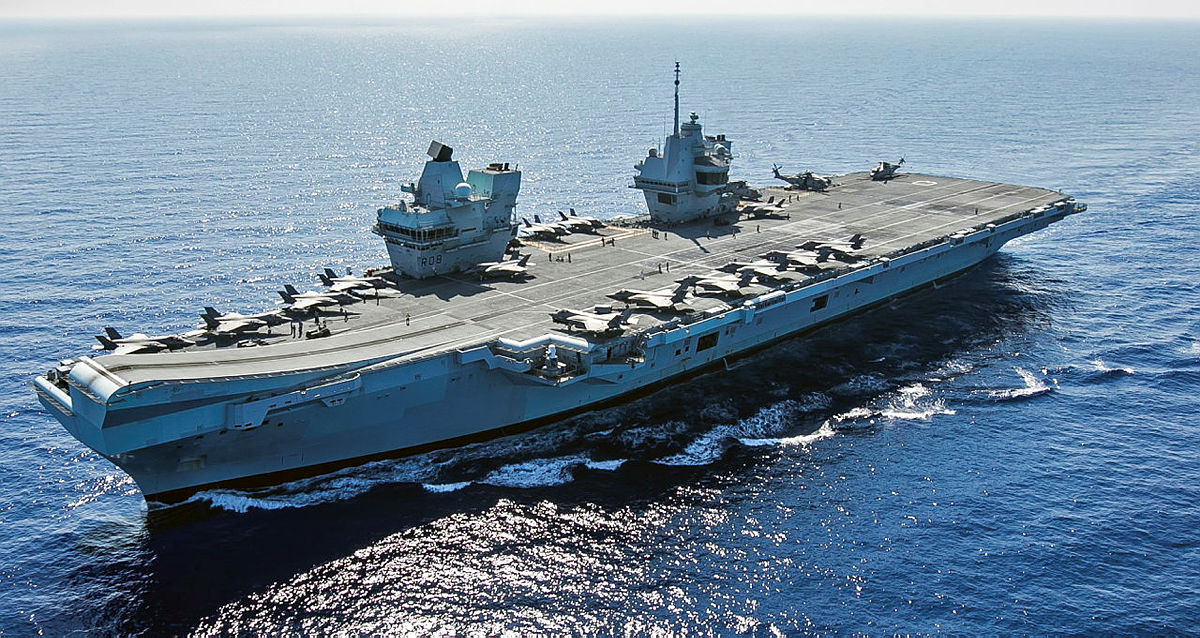
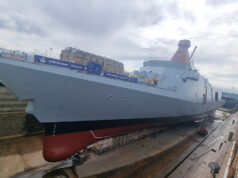
HMS Queen Elizabeth will sail from Portsmouth this weekend for a three-month deployment around the UK and northern Europe, with the Royal Navy saying the carrier will strengthen NATO deterrence, readiness and collective defence.
The 65,000-tonne aircraft carrier is due to begin leaving Portsmouth Naval Base at 6.20pm on Saturday 5 September with more than 800 sailors aboard. The deployment will combine advanced warfighting training with the ship’s new role as NATO’s afloat command platform for the Allied Response Force.
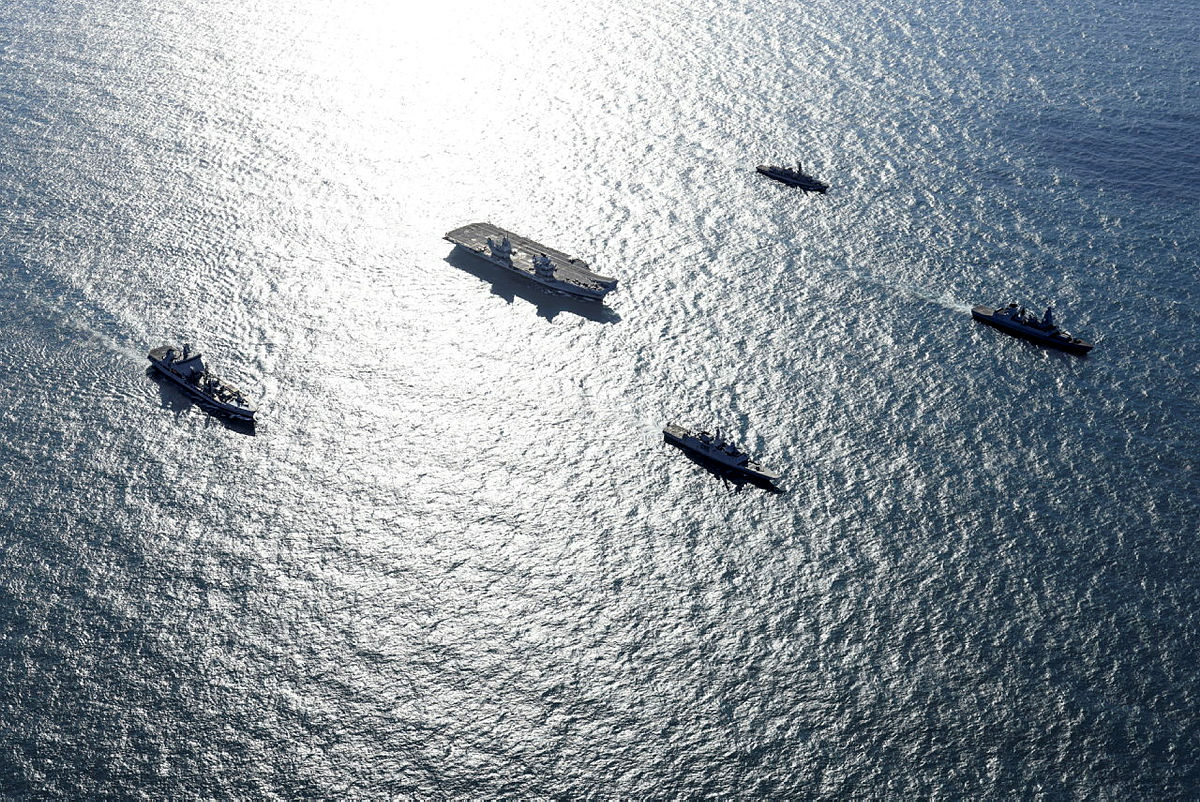
Over the next three months, Queen Elizabeth will operate around British and northern European waters alongside allied forces, developing the crew’s ability to conduct high-end naval operations and command a multinational force in a crisis. The Royal Navy stated that the deployment would see the carrier “conduct an intensive programme of training and operations, working alongside Allies to enhance collective security, deterrence and readiness.”
Queen Elizabeth assumed the NATO command ship role for the Allied Response Force in July, the first time either of the Queen Elizabeth-class carriers has performed the task. During the deployment, the ship will rehearse how an allied naval force would operate together if NATO was required to respond to a crisis.
Captain Claire Thompson, Commanding Officer of HMS Queen Elizabeth, said:
“We’ve returned from summer leave rested and ready for the next phase of our training. Sailing this autumn is a key milestone for both our NATO commitment, as the Afloat Command Platform and also on our journey back to the Royal Navy’s ‘very high readiness’ aircraft carrier, a duty we will resume from our sister ship HMS Prince of Wales in 2027. Sailing with an embarked battle staff, integration and training is essential whilst relearning the skills required to conduct safe and effective aviation as we ensure that we are prepared to deliver operational activity at the heart of NATO should it be required.”
The carrier will also undertake advanced training under the Royal Navy’s Fleet Operational Standards and Training organisation, covering the full range of modern naval warfare. The programme is intended to prepare Queen Elizabeth for higher readiness and eventual return to the UK’s principal carrier role. Training will continue into 2027, including participation in major NATO exercises, before Queen Elizabeth takes over from HMS Prince of Wales as the UK’s flagship and high-readiness strike carrier later that year.
The Royal Navy said British forces are already contributing to NATO deterrence across Europe, with more than 1,000 UK personnel serving in NATO command posts and Britain leading the Allied Rapid Reaction Corps from Gloucestershire.
UK forces also include an 800-strong battlegroup in Estonia, RAF Typhoon fighters deployed to defend NATO airspace over Romania, and P-8 Poseidon maritime patrol aircraft and RC-135W Rivet Joint surveillance aircraft operating around the Baltic.
The UK also assigns its nuclear deterrent to the defence of the Alliance and, under plans confirmed in the Defence Investment Plan, intends to join NATO’s Dual Capable Aircraft nuclear mission with F-35A fighters.
Queen Elizabeth’s autumn deployment will therefore combine NATO command duties with the process of returning the carrier and her crew to very high readiness, while maintaining a British carrier presence in northern European waters as NATO continues to strengthen deterrence and its ability to respond rapidly to a crisis.







And 3 …. 2 …. 1 …….
Where are the jets
Bet there aren’t any jets
We don’t have any weapons
Bet she breaks down again
Wonder how long before she breaks down
What a waste of money
Where are her escorts
It’s a disgrace no escorts
What only 1 t45? It’s a disgrace
I hope that clears the first dozen or so replies in advance, did I miss anything?
The article is somewhat overstated. By itself, and excluding the Vanguard submarines, there is little in Royal Navy’s conventional capability that actually “deters” Russia. The article also references the F35As, which wont be in service until sometime in the next decade.
The reality is that the Royal Navy is today in abysmal shape and there is no point pretending otherwise.
Damn I was wrong! You even replied to my satirical post 😀
Nice one Roy 🤦♂️
what a w****r 😂
“intends to join” future tense.
Presume these deployments will be judged successful even w/out a FSS, no Astute class available and a maximum of one T-23 and,/or T-45 participating?
Yes because the ship is leading NATO SNMG1 so she operates as a flag ship for force of around 5 to 8 NATO frigates and destroyers in the North Atlantic rather than a standing UK Carrier Strike Group.
Our precious few T23’s are needed badly further North in the Bear gap on TAPS. European NATO has over 100 frigates and destroyers and this is the best way to use them as a combined force in the North to deter Russia.
I don’t think we can say there are no asutes available because there probably is now… I suspect the navy does not want to burn its readiness until a second is in a good place readiness wise.
Seems likely to me.
Audacious is a out of drydock now, right? My money’s on her being somewhat operational.
Not without a full workup and noise ranging package first. So, we are looking probably conservitably at 3-4 months after she sails from D’port. The same will be true for Artful, while Ansons work up package should be somewhat shorter as she is only in for a maintenance period . I wouldn’t be surprised if we don’t see the first 2 until 1st 1/4 of 2027. Anson all things being equal should be back at sea by then.
Thanks for the insight Deep32
So next year will see 3 boats available if they actually fund the work ups.
TBH not entirely sure what budget all that comes from, suspect it is somewhat higher up the ladder as OST is a must if you need to deploy any unit/force, same as getting a T23/45 ready to deploy. It’s not the same as a lot of the trg that’s conducted across the forces.
Part of this trial includes interacting with other units, so a lot of things need to align to get any unit through.
Agamemnon will be on a entirely different budget, so she should proceed through her programme when she leaves Barrow.
How many of the five Astutes are sea worthy now. With rotation and fleet escort duties, which are left for patrols, especially off the Falklands.
I’m sure even the Argies can count to five.
As an English man I would prefer our government kept a few secrets so that wankers can throw shit on our forces but yet never really know… And not knowing means you are not telling the enamy….war is not a game and people making comments sitting at home should really just keep mum as we said last war.
It all depends on what needs to be fixed really.
And are there any parts to STOROB.
As a number of people have stated a number of parts suppliers went out of business; or withdrew from military; or lost security clearances.
Combine that with an obsession with just-in-time for ‘cost savings’ and you have beautiful recipe for empty parts bun disaster.
Oh and add lack of dry docks for fixing the stuff you can fix.
As ever it isn’t a singular failure, which can usually be mitigated, but a series of failures that are coalesce into an insoluble opportunity.
😏 👍
Yes …”just another target” a “white elephant” and “responsible for the mess the Army is in.”
Think that’s it for completeness.
Fabulous vessels and capability, though in all seriousness the F35 needs an air launched ASM pronto and we know gaps in ASCS and FSS.
Agree, Daniele. Despite all the constant RN bashing the now fairly seamless deployment of Queen Elizabeth has meant the UK has had one carrier either at sea or on rapid standby continuously for nearly two years including a voyage to the pacific and back.
That’s not something China, Russia or France has ever achieved in the 21st century.
omg stop with your obsession with France FFS
… and FYI according to 3 AI programs, CdG has been deployed at sea over 1000 days since 2019 while both QE carriers are below 1000 days combined over the same etime period.
should we compare since 2000 when Britain had 0 carriers for the better part of a decade?
If we are using AI now I suggest you look up the problems with the CdG in early 2000’s.
Snapped propeller
Had to use old propeller from previous ship for seven years limiting her top speed.
The Noise from the propeller was so loud people could not sleep in the aft section of the ship
Had to re build the flight deck because it was too short.
It often amazes me how people will often compare the worst time the Royal Navy has with the best time the French navy has then lament how shit the RN is.
The Queen Elizabeth’s are now entering their best years for availability just like any ship while the CdG is leaving hers, Something the French also recognise.
Much the same story with frigates with articles about how amazing France is at having Frigates available at 90% of the time wihile lamenting the availability of T23 despite that fact they achieved similar levels of availability for decades of their service life and it’s only now with age and life extension that it’s dropped dramatically.
lol.
1. Yes there was a broken propeller during sea trials, but your story about sailors not being able to sleep is an utter fabrication. Eventhough top speed was impacted while using temp propeller from a retired carrier, but it did not affect ship’s ability to operate normally.
2. FYI – The flight deck was not rebuilt! What a misrepresentation of reality. The angled deck was extended by 4m to accomodate the E2 aircraft which was not part of the original design. France purchased the E2 after construction of the carrier had started, therefore modifications had to be done for the safe landing of the E2. The modification added 5 million francs (£500k) to overall cost – a drop in the bucket for a multi billion € project. This is a non issue.
3. FYI – The CdG has averaged 55% operational rate since entering service – this includes regular maintenance and major overhaul/refuel periods. This is better than the Nimitz class, although the that is not a real issue for the US Navy because it operates so many carriers.
4. FYI – French navy frigates have 80% operational rate not 90%
Royal Navy issues are not just current, but have been for a while, ie capability gap between Nimrod and P8 (which France covered with ATL2), lack of aircraft carriers in the 2010s while waiting for QE to enter service, T45 operational rates have been way below acceptable for many years due to power issues, the QE class has had more teething problems than the CdG, not to mention lack of available aircraft, escorts, resupply. … it’s been more than 3 months since an Astute has left dock, etc, etc… which probably explains why US and French SSN are at Faslane every few months.
Anyway I am not here to deride the Royal Navy, because I have a lot of respect of the Royal Navy and its sailors, but the less than desirable situation is in not in France, the EU or UK’s interests. We are all stronger together.
But I am sick and tired of your usual jingoistic nonesense and constant beratement of France in so many of your posts. Usually i just ignore but this time I had enough and replied. Jim, you are just like your politicians with your head burried in the sand, ie T31 not having sonar is simply irresponsible, cancelling T83 is shortsighted for powerpoint promises of unproven doctrine and tech that still needs to mature and be developed with unrealistic delivery dates – early 2030s, seriously? … on a positive note the T45 are getting upgraded and it seems will be in service beyond 2035 and the T26 should enter service in the next few years, as well as Deadnought SSBN.
In all fairness- they are the reason the Royal Marines and Amphibious capability is in the state that they are. A very deliberate choice by the RN too.
I’ve always been an advocate of carrier strike, but it had been done without the resources to really see it to true FOC, And at the expense of other capabilities. Sadly I think it’s probably 20 years too late and events have overtaken their true utility.
It’s almost like the original idea behind the Invincible class makes a huge amount of sense in the current context – ASW focus with an air defence capability.
It’s pretty clear that one can achieve strike effects at longer range, lower cost and lower risk via one way attack drones and cruise / ballistic missiles.
So really- would we, in hindsight have been better off keeping amphib with smaller air defence focussed carriers and more frigates / SSNs? Obviously in an ideal world we’d have 2 x CTOL carriers, all the escorts and SSNs and amphibious shipping – but we ain’t the US.
Zero point in having an amphibious fleet without carriers. Prince of Wales is the world’s largest LPH.
Not necessarily zero point; if your amphibious target is Nirthern Norway for example it’s well within strike range of other assets, and precision fires from the sea can do what an F35 can do IF you have a good find function.
Is PWLS an LPH though? Does it have the widened corridors, messing facilities, armouries, magazines, etc etc that support an embarked amphibious force? Genuine question
If your target is Norway you don’t need an amphibious fleet. RORO ferries are good enough for most tasks or as with new Joint Commando Craft they can simply self deploy from ports in Scotland.
There are very few scenarios where having a 16,000 tonne+ vessel with a well deck is that useful compared to a carrier. Most merchant vessels can carry people, stores and vehicles. Almost no vessels can operate aircraft. Multi billion pound amphibious vessels were a late 20th century extravagance designed primarily around colonial policing missions. Opposed landings are now deemed impossible and as such specialist amphibious vessels lose much of their utility.
If your operating an airfield anywhere near Russias it’s going to come with a wave of cheap drones and ballistic missiles swamping it. Russia has very little ability to strike a carrier at sea that’s moving and protected by escorts and fighters.
As I recall the extra design features for the Prince of Wales were planned, but cancelled. So wide corridors, probably. The rest, probably not. Just my guess.
I think if you look at it from a European defence point of view as we are now, they would have probably been better off building a fleet hybrid carrier/amphibious vessels sort of like the Italians.. yes they are limited air wing wise.. but Russia does not have any carriers and its long range maritime strike is a shadow..
So many a 30,000 ton hybrid that can carry a f35 squadron, rotors, well deck and use the hanger as vehicle deck your gong full amphibious. Do what the Italians have done stick a big arse volume search radar with ballistic missile tracking capabilities as well as aster missiles and 76mm cannons with guided round.. Italy built then for a billion pounds a pop..
So we could have replaced the entire carrier and amphibious fleet with 6 of these for the cost of the 2 Carriers
Is the Queen Elizabeth class not a Hybrid amphibious/strike carrier?
Sure they have more emphasis on the strike aspect but size is always the most useful quality for such vessels.
They can embark large numbers of troops and helicopters and simultaneously embark a large air support group with Apache and F35B.
To me this was always the strongest case for the CVF design over either CATOBAR designs or smaller LHD’s.
It’s a floating moving FoB able to embark massive numbers of aviation units for any job from maritime and land to strike too air defence, anti submarine warfare and amphibious assault. The Queen Elizabeth classes main super power is her helicopters.
In the end the Elizabeth’s do not have well deck or the flex to create vehicle lanes and they are huge to allow the sortie rate needed to work in parallel with a US strike carrier.. it’s a tool of global power projection.. which is not necessarily what the UK in the 21c needs. We possibly needed more ships with greater utility.
Do we really think taking a 70,000ton carrier to within helicopter range of Contested land/Conflict area is a good idea…?? Especially QEC with their such limited close Self Defence…! ( only for Training!)
👍👍👍
The Italian Navy needs praise for its more balanced fleet despite no SSNs..
I would add a long range strike option as well as ASM.. we want the carrier aircraft to be able to sortie and strike Russian military infrastructure if needed.
But in reality the only thing that can immediately go on a F35 is the AGM154C.. which would do the job with a 130km range terminal guidance and a broach warhead.
I agree Jonathan, the USMC appears to be pushing this rapidly now with testing for both JSM and LRASM for underwing carriage. A small buy of either weapon would be an easy fix for the issue.
Given Russian warships propensity to catch fire very easily and their willingness to store daft amounts of liquid fueled weapons on their decks with little protection then a strike by SPEAR 3 would probably be lethal to most Russian surface ships or snorkelling submarines.
Yes, the F-35B needs some sort of heavy stand off weapon.
Agree w waste of money
Satire?
🙄
Ruskie troll off the mark!
It has no teeth and no defenses.
A single strike package is all it needs.
Ah, one of the top Carrier bashers for years here has arrived. 👍
Hes probably pretty close to the truth though Daniele. I mean what are the teeth? F35 dropping Paveway? Its not that impressive after a two decade build up of the force. We also know those F35 have dreadfull reliability and are hanger queens.
Not many missions you can’t do with 6 Paveway IV. What else does a stealth jet need for land attack? Once SPEAR 3 is ready with IOC 18 months from now then there will be almost no target on land or at sea safe from an F35B and they can strike 8 targets on one mission. Two anti ship missiles will be available by then as well should we choose to employ them. Either could be taken directly from US, Norwegian or Australian stocks on a plug and play basis if required.
Yes, we definately need stand off means of attack. They can’t come soon enough.
Paveway would be more than good enough against anything that Argentina could possibly deploy to the Falklands, even IF they had the means to invade.
And that is one scenario on everyone’s mind right now.
For sure it’s not great in lots of other situations.
There are probably hundreds of hangers on that ship.
Thousands
Two decades? Well doesn’t time fly? Hardly seems to me like she was even commissioned ten years ago and if you hadn’t told me, I might have thought the first CSG wasn’t deployed until 5 years ago.
Your point is taken. The carriers are under-armed. No need to over egg it.
How does a floating airstrip deter Russia? Without aircraft these ships are utterly pointless.
But it does have aircraft….if the mod choose to deploy them
So why send an aircraft carrier with all the sailors and support personnel without aircraft. The only purpose of an aircraft carrier is to be a floating runway for aircraft to use. This is a very inefficient use of resources when the MOD is short of them.
They can fly you know.
Would hope so after all the money we have spent on them!!
You apparently are unable to understand the very simple concept of aeroplanes flying from one place to another, they can even do it quite quickly.
The commentors complained when our carriers were withdrawn. Complained when we built two new ones. Complained when they’re sat in port or under repair.
When they’re out doing their job, here they are complaining again.
The alternative is that these ships sit in Portsmouth for the next ten years until:
● The full air wing is finally here and available.
● Said airwing can launch the full variety of missiles we need it to.
● A type 26 is ready to protect it.
● The RFA have stores ship at sea
Crews need training, the ships need exercising. We need to find mechanical and technical errors now, today, not when deployed in our future war.
Russia is a land power engaged on a programme of imperialist demographic expansionism.
Russia would like to annex Norway but evidenced priority targets are Eastern Ukraine (in progress), Moldova (in progress, delayed), the Baltic States and Eastern Poland.
A British carrier group may deter moves on Norway but the priority, for NATO, is a coherent conventional land/air deterrent to preclude aggression by massed Russian formations on land.
That NATO conventionsl land/air deterrent does not currently exist.
It does exist, suggest you read up on the last five NATO summits.
‘Russia has a military comprising 1,264,000 active personnel and approximately 2 million reserves. There is little indication that the Russians believe that a war with a regional coalition or alliance would be a small affair. For example…officers including Gerasimov discuss the need to pre-emptively destroy as many cruise missile-carrying platforms as possible at the outset of a conflict. What senior Russians do indicate about the character of a regional war does not indicate a small or containable affair…such a war can be easier to deter…Given the risks, an opponent does not need to be convinced of the certainty of failure: merely the uncertainty of success.’
This is what a credible conventional NATO land/air deterrent looks like:
‘The United Kingdom had four entire divisions in West Germany alone, the United States had more than 250,000 military personnel across Europe, eventually reaching a high-water mark of 400,000 by the beginning of the 1960s. West Germany fielded a military of half a million, with 12 heavy-tank divisions providing the backbone of NATO’s conventional force in Europe. NATO fielded 25 active divisions and 25 reserve divisions in Europe’
This is not what a credible land/air deterrent in Western Europe looks like:
‘NATO’s forward presence comprises eight Forward Land Forces (FLF) multinational battlegroups…’
What is required:
‘The requirement to contain Russian breakthroughs of varying sizes on the alliance’s eastern flank…requires up to 300,000 additional troops and 1400 main battle tanks…’ RUSI 2026
The RUSI article was deeply flawed. The geo political situation in eastern Europe is vastly different from the Cold war years. Former Warsaw pact countries are now NATO members with powerful reasons to keep Russia at bay. Germany and Poland are up arming fast; together their population matches Russia and their combined GDP is 2.4 times bigger. Britain’s priority must be to rebuild its ASW capability to deal with a still capable Russian submarine force.
‘This Government is endorsing the vision and accepting all 62 recommendations in the SDR, which will be implemented. In line with SDR findings, we are also taking further immediate action…We will create a British Army which is 10x more lethal to deter from the land, by combining more people and armoured capability with air defence, communications, AI, software, long-range weapons, and land drone swarms…The Army must modernise the two divisions and the Corps HQ that it provides to NATO as one of the Alliance’s two Strategic Reserves Corps (SRC).’ SDR 2025
A good thing too:
‘With no Right-wing party likely to command a majority to oust Donald Tusk’s Civic Coalition party, only a coalition with Mr Braun’s party would give the Right a victory in elections scheduled for autumn 2027…vehemently pro-Russian, opposing Polish military assistance to Ukraine and criticising the flying of the Ukrainian flag in parliament.’
‘…upcoming state elections in the east of the country, which are expected to see strong gains for the far-right—and Russia-friendly—Alternative for Germany (AfD).’
No wonder France’s most likely next Prime Minister is making friends in Birmingham. The subject of ASW did not, apparently, come up.
That is because ASW, of course vital in a conflict, cannot deter a conflict from starting in the first place.
👍👍
The RN is desperate to keep both QE and POW operational and active. There is such a constant stream of negative publicity about the carriers being unaffordable “white elephants”, even in usually pro-defence publications, that any good news is badly needed. In the context of Argentina’s renewed Falkland Islands drum bashing, they are now the only serious capability that the RN can offer as a deterrent.
So use them for the purpose they were manufactured for as aircraft carriers. The RN needs to have half of the UK F35 aircraft and the RAF needs to make do with the rest until the F35 A are delivered.
Well there is an alternative to the carrier for the Falklands: we fly in a dozen Typhoons and F-35Bs. That, combined with the islands’ Sky Sabre detachment, should be more than enough to deter any Argentinian bravado.
After all, the carrier exists to provide a floating airfield, for where we don’t have a land base within reach. As we have an airbase in the Falklands, that we can reinforce rapidly by air, the need to send a carrier group 8,000 miles and sustain it at long range, is not that necessary.
We can’t keep a quarter of the RAF’s entire frontline strength permanently based in the Falklands. Argentina is playing the long game and can seize the moment when it has a massive local superiority in military strength, as per 1982. I have no doubt that both the Treasury and Foreign Office are strongly agitating that the UK cuts its losses and hands the islands over to Argentina. By co-incidence, the money “saved” from withdrawing the garrison is almost as much as the imminent Chagos Islands surrender will cost the MOD every year.
It’s where it should be, in our Northern waters with NATO allies, training and deterring as best it can! A basic air group can be deployed with the ability to reinforced if needed. However the F35s lack of offensive strike weapons does negate some of its purpose in the far North, along with a lack of anti-ship missiles. Deep strike is developing and this task can be mostly carried out by in service systems such as Storm shadow and more! This does rather negate the F35s to sensor modes and air defence of any Anti-submarine task group. All in all glad we have them, being used correctly but as ever thin on the ground for both offensive and defensive systems.
What’s irritating is they could sort that gap with AGM154C, its not top draw.. but it gives the F35b a strike weapon with a range of 130kms, terminal guidance again ships and a 250kg broach warhead… they are also only about half a million each.. so 50 million would get you 100 for the carriers.
Sadly American and French carriers are seen as fighting ships and British ships more as flag Wavers..!!
I know this is something I’m not supposed to ask these days on UKDJ, but there is no mention of an emabarked force of aircraft. Sorry, I just thought I would say.😏
It’s a lemon. Needs a complete re-work..arrestor catapults installed and that silly ramp removed. Bang in nuclear propulsion too. Build a third super aircraft carrier like the french are doing and get it ready to carry Tempest Jets.
I know you aren’t in anyway suggesting the RN “Bang in nuclear propulsion too“ is in any way trivial but such rework isn’t feasible. Not least because the RN’s priorities must be focused on getting Dreadnaught into the water. Taking a PWR from this would be catastrophic. That supply chain is already under immense strain without adding further pressure.
I also think QE are adequate for what NATO needs. We’re seeing the pressures the American Carrier force I under so maybe keeping ours a little closer to home makes sense.
Carrier launched F35’s are an exquisite capability just missing that strike capability. Let’s hope she sails with a decent compliment!
ADEQUATE! ..Not sure if thats the most daming appraisal of the QEC that can be given..!
So this is basically a shake down cruise with benefits
Only if they go to Amsterdam
I take it you’ve never walked through the Glenmallan red light district.
I hear it’s best to run 😉
The bots and vatniks are out in force today I see…
Putin must be scared senseless