

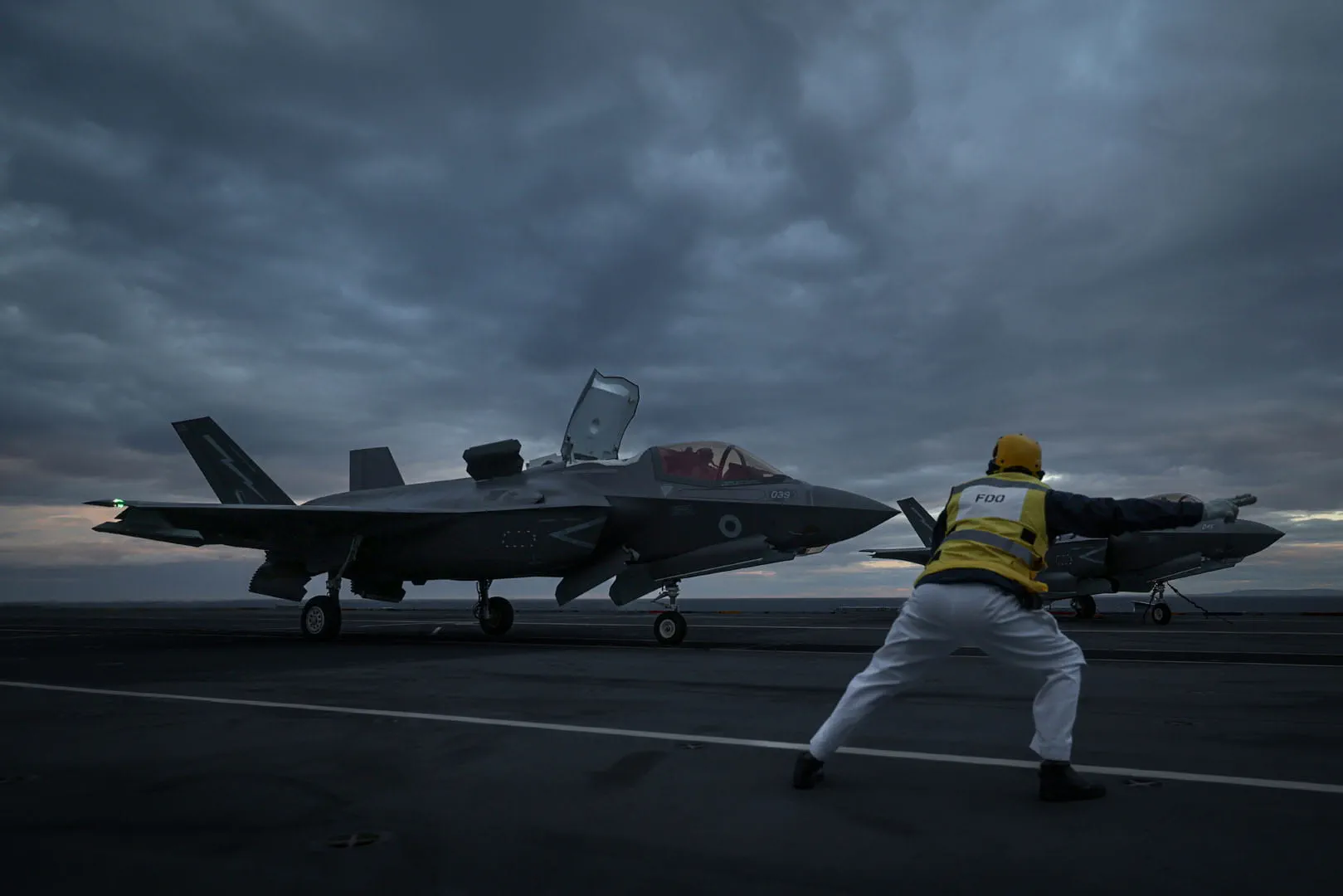
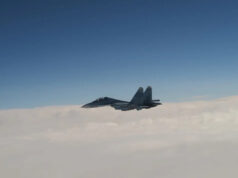
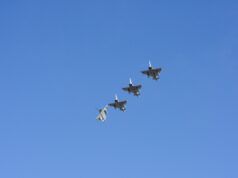
British F-35B Lightning jets have flown sorties over Finland for the first time, launched from HMS Prince of Wales as part of NATO’s premier air warfare exercise, according to the Royal Navy.
The fifth-generation jets of 809 Naval Air Squadron, alongside Merlin and Wildcat helicopters, all operating from the flight deck of the Portsmouth-based carrier, provided the United Kingdom’s principal aerial contribution to Ramstein Flag 26.
The 11-day exercise drew together up to 150 NATO aircraft from 18 nations across 20 locations stretching from Norway to Spain, with the UK Carrier Strike Group, comprising HMS Prince of Wales, destroyer HMS Duncan and tanker RFA Tidespring, operating in the North Sea throughout. Around 150 sorties were flown daily.
The scenario tested the alliance’s ability to respond rapidly and cohesively to an attack on a member state, triggering Article 5 and demanding a response from all member nations. With Finland having joined NATO in April 2023, the country’s airspace and infrastructure are now firmly part of the alliance’s defence planning, and the exercise gave allied air forces an opportunity to integrate operations across the Nordic region at scale. The choice of Finland as a primary operating area carries weight given the country’s long border with Russia, which more than doubled the length of NATO’s direct frontier with Moscow when Helsinki acceded to the alliance.
Tankers providing air-to-air refuelling extended the range of the Lightning jets for sustained, long-range missions deep into Europe, with sorties operating 700 miles or more from the carrier, according to the Royal Navy. The 809 Naval Air Squadron jets made use of the facilities at Pirkkala air base near Tampere, about 100 miles north of Helsinki, while United States Marine Corps F-35Bs participating in the same exercise demonstrated the more unusual capability of landing on, refuelling at and taking off from Finnish highways, a dispersed operations technique designed to complicate targeting by an adversary.
Commodore Richard Hewitt, Commander UK Carrier Strike Group, said the deployment carried a deliberate signal. “The seamless coordination of our Carrier Strike Group with 18 Allied partners during Exercise Ramstein Flag is a powerful testament to the skill of our sailors and aviators,” he said, as quoted by the Royal Navy. He continued: “The UK Carrier Strike Group is fully integrated into NATO’s frontline defence. Operating under NATO command, the fifth-generation capability we are generating from HMS Prince of Wales delivers a deliberate message to any potential adversary: together, the Royal Navy and our allies provide the precise, synchronised combat power required to secure the Northern Flank.”






For an apparently small fleet of aircraft with apparent availability issues the F35B sure seem to be generating a lot of aircraft deployments and sorties.
When it’s supported with the right number of technicians and logistics its availability is impressive.
Hi folks hope all is well.
Hi Jim, yeah funny not much attention from main stream media. Of course the UK is completely useless at any military deployment, no Navy, hardly any fast jets, and only troops to carry out ceremonial tasks. Well we do seem to be very busy.
Cheers
George
Do they have any weapons?
Lying spammer
Good to hear the F35 B aircraft and the RN are showing potential adversaries what they are capable of if required.
That’s one of the things people forget about.. if the carriers are operating within 2500km-3000km of a UK sovereign airbase they have access to strategic tankers, EAW and ISTAR.
And the UK has a lot of sovereign air bases within 3000km of anywhere it’s probably fighting.
Yes, US carrier aircraft and air wings have always been designed around fighting in the pacific thousands of miles from bases but ours have always been more on fighting in the Atlantic and Mediterranean near friendly bases. No carrier air wing could ever come close to producing enablers as capable as E7 or Voyager and outside a war in the Falklands it’s hard to see how we could ever fight a naval battle outside their range.
That being said a probe refuelling installation on some of the voyagers should be a priority. Even though our E7’s have extended range fuel tanks you can never have enough range.
Whilst it is good to see the capability of our F35Bs to carry out operations up to 700 miles from the carrier, it also showed the weakness of the carrier in that they needed a land based air-air tanker for in flight refuelling. These assets will not always be available and it is a weak link as it needs to be co-ordinated. Targets of opportunity could not be hit.
If I could have two things now for our carriers they would be MQ-25s, 4-6 per carrier and MQ-9B STOL in both Sky Guardian with SAAB AEW pods (I think based on SAAB GlobalEye) and Sea Guardian about 10-12 combined per carrier. With a normal load of 24 F35Bs or war load of 36 F35Bs this would give the carrier a good all round air group.
The F35 is very nice and in theory the RN should be able to use them to penetrate even sophisticated air defence systems.
The only issue is that we lack the support assets that allowed Israel to penetrate and destroy Iranian air defences using the F35.
We have no air launched decoy, no SEAD missile and a very limited weapon set on the F35. We also don’t have a cloud of low cost long range drones to fire or a bunch of ballistic missiles.
Unfortunately, our options for increasing our weapon set are:
1. wait for LM to integrate our weapons onto F35 at a glacial pace.
2. spend horrible amounts on American weapons, stunting our own industry in doing so.
Neither are great options.