

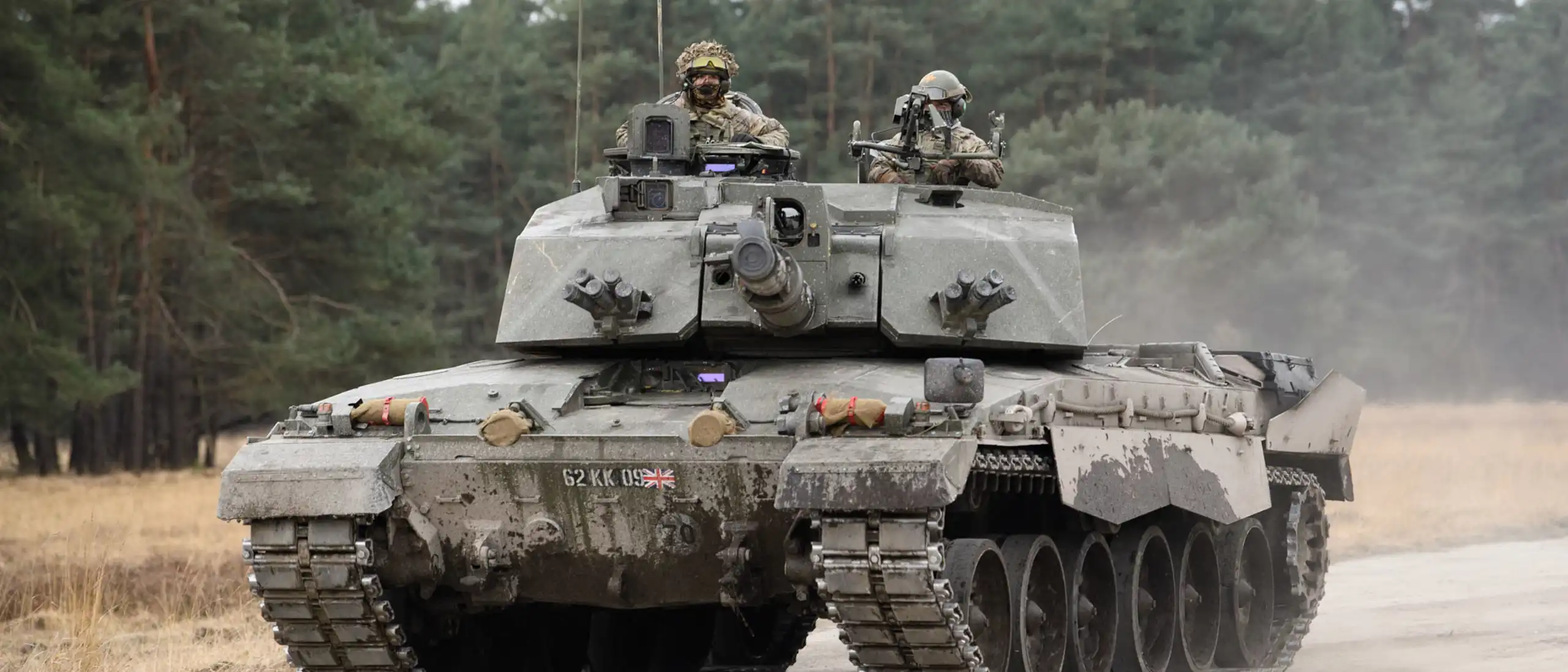
Over 350 troops from the Queen’s Royal Hussars have tested new ways of integrating drones into armoured warfare during an exercise in Sennelager, Germany, according to the British Army.
Exercise Senne Hussar saw soldiers trial the launch of surveillance and strike drones from moving armoured vehicles, with live feeds shared across all troops in real time without crews needing to dismount. The exercise also marked the first field deployment of the Army’s new Find and Strike Squadron, described as the first of its kind in the Field Army.
The squadron combines reconnaissance, drone, and strike troops with the aim of locating and engaging targets faster and at greater distance, according to the British Army.
B Squadron Leader Major Douglas Graham said: “I am converting my Challenger 2 Squadron into the first Find and Strike Squadron in the British Army. Here on exercise, we are developing tactics and procedures and trialling how we integrate ground reconnaissance and the use of drones with precision strike troops to shape the battlefield ahead of us at a greater range than ever before.”
He added: “We are also flying drones under-armour and on the move to integrate the system’s capability into an armoured battle group so we can operate at a tempo unmatched by our enemies.”
Soldiers also trialled sharing live drone data across the battlefield, giving every participant from tank crews to dismounted infantry a common operating picture in real time. The Army said this supports faster decision-making and reduces reliance on voice communications from headquarters.
A new high-cut helmet design was tested for the first time with a field unit, allowing tank crews to clip communications headsets in and out when transitioning between vehicles and on foot without changing helmets.
The exercise used the Combined Arms Tactical Trainer simulator facility at Sennelager before moving to live training, allowing troops to rehearse new tactics in a simulated environment and then immediately apply them in the field.
Commanding Officer Lieutenant Colonel Gerald Kearse said: “We are turning up the dial on Army modernisation. For me it is really simple: It’s about becoming more ruthlessly lethal. But it is not just about capability replacement. We need to think about how we want to fight conceptually, followed by what we want to fight with.”
He added: “Here in Sennelager we are proving some of the no-regret actions that need to be taken in terms of tactics and form and show the benefits of armoured forces being able to integrate into a digital network.”










All well and good but that reads as yet another SQN of tanks out of the Orbat!
A very topical comment.
Great stuff by QRH, a key indicator of the way forward for armoured formations on today’s battlefield in Central and Eastern Europe.
But armoured formations, combined arms operations (and conventional deterrence) also require mass.
We will not achieve the mass required to live up to the commitments that we have made to our allies (and signed up to) without a major reordering of our financial priorities by this government.
‘In the period 2002 to the present, the total cost to the electricity consumer of those renewable electricity subsidy schemes that we can quantify has amounted to approximately £220 billion (in 2024 prices), equivalent to nearly £8,000 per household.
The annual subsidy cost is currently £25.8 billion a year, a sum equivalent to nearly fifty per cent of UK annual spending on defence.
Subsidy to renewable electricity generators now comprises about 40% of the total cost of electricity supply in the United Kingdom. The total subsidy cost per unit of renewable electricity generated has risen by nearly 50% in real terms since 2005 and now stands at approximately £200/MWh. This contradicts government and industry claims that renewables are becoming cheaper.’
Systemic reform is required.