

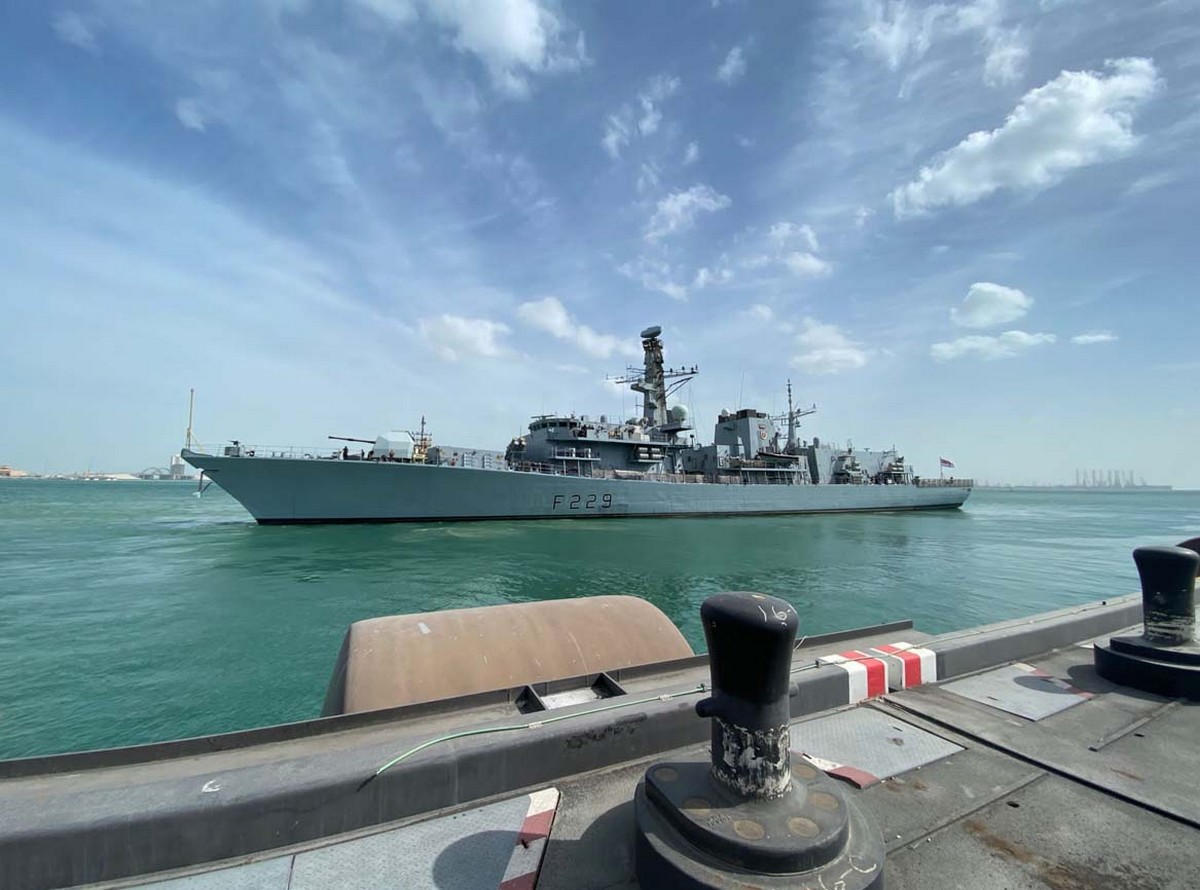
The Royal Navy has formally retired HMS Lancaster, its longest serving Type 23 frigate, following more than three decades of global operations.
The ship will not return to the UK for decommissioning and will instead be prepared for disposal in Bahrain.
The Royal Navy noted the milestone publicly, stating on X that its longest serving frigate has been retired after decades of operational service.
Fleet Commander Vice Admiral Steve Moorhouse told personnel that Lancaster’s service record far exceeded her intended lifespan. He noted that the frigate, originally built for 18 years of service, delivered almost 35 years of operational output across multiple theatres. In remarks to the fleet, Moorhouse said that “HMS Lancaster is approaching the end of her long and distinguished service with the Royal Navy” and urged sailors to recognise her contribution. He highlighted her three year deployment in the Middle East as a defining period of recent activity, stating that her performance had been “simply exceptional”.
During that deployment, Lancaster was the first Royal Navy vessel on task in the Red Sea during the height of regional threat activity in December 2023, and she conducted a series of narcotics seizures valued at more than £150 million. “An immensely successful 35 years”, Moorhouse said, reflecting on his own tenure as a former commanding officer. The decision not to extend Lancaster’s certification or sail her home marks a pragmatic shift as the fleet transitions toward newer platforms. Moorhouse acknowledged that some would be disappointed not to see the ship return to the UK but said the choice reflects a desire to honour a vessel that has already delivered “every ounce of operational capability”.
He paid tribute to Lancaster’s crew for their professionalism, and to their families for sustained support. The intention is to return as many personnel as possible to the UK for Christmas while disposal preparations begin in Bahrain.
The Royal Navy say it maintains a continuous presence in the Gulf, and Lancaster’s retirement will not alter the role of the UK Maritime Component Command in Bahrain, which remains central to regional operations alongside allies and partners.
HMS Lancaster
HMS Lancaster is a Type 23 Duke class frigate launched in 1990 by Queen Elizabeth II and often referred to as The Queen’s Frigate because the Duke of Lancaster is one of the Sovereign’s subsidiary titles. It was initially assigned the pennant number F232 until the Royal Navy realised that 232 corresponded to the report code for collisions and groundings, which they considered inauspicious. As one of the early ships of its class, Lancaster never received the Sonar 2087 upgrade and is therefore treated as a general-purpose frigate rather than a specialist anti-submarine platform.
Built by Yarrow Shipbuilders, the ship was laid down in 1987, launched in 1990 and commissioned in 1992. It has undergone major refits, including one between 2010 and 2012 and another LIFEX overhaul from 2017 to 2019. Lancaster remains in active service and is projected to remain so until 2025 while being forward deployed to Operation Kipion from its homeport at Portsmouth. Its complement is about 185, with capacity for 205.
Lancaster displaces roughly 4,900 tons and uses a CODLAG propulsion system capable of speeds over 28 knots with a range of 7,500 nautical miles at cruising speed. Its armament includes a 32-cell Sea Ceptor vertical launching system, Harpoon anti-ship missiles retained on this vessel through 2024, Sting Ray torpedoes, a 4.5-inch naval gun and various small-calibre weapons. The frigate carries either a Wildcat HMA2 or a Merlin HM2 helicopter along with Peregrine ISR UAVs from 2024, operating from a flight deck and enclosed hangar.






Yet another sad day for the Royal Navy in particular and the U.K.’s dwindling capability in general. There seems to be no end to the destruction of our armed forces.
Bit dramatic Geoff but take your point. There are several replacements in build but it would seem this would introduce a bit of a gap. That said the T45s are potentially coming to a better place or indeed one of our allies might fancy filling the gap.
Why would our allies fill in for our incompetence.
T45 cannot be spared for this position, and it certainly can’t cover the ASW gap
The tragedy Mark is that the rundown is dramatic too. We are now down to seven frigates, all old, and with no likely replacement “fleet” for years. The Royal Navy is a shadow of it’s former self. We will only be able to deploy one or two at a time and they are not really ASW capable if, God forbid, we should need that ability.
Mark B, have we time for gaps? Anything that floats should be the order of the day, knacked or otherwise.
I’ll have you know that FIFTY percent of the fleet is at high readiness!!!
😉
I know…. The government said so it must be true…..!!
As they scrap the fleet, they should reach 100%
I suppose somebody must be high. 😉
Why couldn’t they wait a tad longer for the T31 to come into service? Aren’t the T31 being ordered for “East of the Suez” ops or has that changed? Is this retreating in influence and presence being replaced by anything?
These ships are essentially beyond knackered, the fact it was no longer practical to sail her home says a lot as she has a lot of gear onboard that will need stripping and returning to the UK.
It’s hardly a tad longer, will be another 2-3 years before Venturer deploys
Can’t believe the lack of urgency with the T31s if that’s the case. If they get and exports god help them fitting anymore into their schedules or, maybe that’s what they do need, some gap fillers!
Maybe they should lease back ex HMS Clyde for 2-3 years? I think it went to Bahrain? Or, upgun/upgrade 1-2 of the B2 Rivers for there?
Any other near knackered T23s that can be sent as a replacement?
The RAN here has just retired a few Armidale patrol boats…might be good for a few years…
How long is a tad?
Twice as long as half it’s length. An MOD answer perhaps?
As Jonathan says, they have had it. The problem is that as always the politicians have been and still are sticking their head in the sand, Or in this case the seabed!
That’s a great question Mate. Chile seems to manage with their 3 Type 23s!
Thank you to the crew of HMS Lancaster. For those who have served on it over the last few years, it must be sad to see it go. No celebration. No final farewell in Blighty. No money for sentiment. Just work it up to the last minute and dispose of it cheaply and locally.
What next? Is the end of the UK presence in the Gulf? There was speculation of sending two of the B2 Rivers to the Gulf as a placeholder presence. Has anyone heard if that’s still a thing?
No I haven’t heard anything more recently but I think it was said that it was one B2 river OPV?
Later rumours were for two Rivers.
I’d not heard of that.
Check out the article on Navy lookout on the 26th of September
Thank you. With 2 in the Far East assume one moves there so 1 Falklands, 1 Indies, 1 Gib, Med and N Africa, 1 Gulf, 1 Far East.
Do we really want a rivers 2 OPV with essentially zero protection from air attack anywhere near the gulf region.. I think not we have enemies there that will attack a British ship.
Yes good point.
But do you think HMG care? I don’t. The optics and the being there is what matters to them, or did.
Apparently, the Army can “fight tonight” someone has said, without Ajax, as if that won’t make their job infinitely harder and risk even more lives not having an Armoured Recc Vehicle.
Nauseating.
Sadly you are correct I would not put it past them to be honest.. it’s one of the reasons I don’t like the rivers east of suez. They are patrol boats for our EEzs and low risk areas like the Caribbean.
I was thinking actually if you forward based a rivers 2 in the gulf you would not really care about keeping its 7000 Km range and endurance so you could actually go to town on it.. after all the rivers 2s are 2000 ton ships with warship level survivability and shock resistance.. so if you stuck a 57mm gun on it, a couple of 30 mms either side and 16 CAMMs you would essentially have a patrol frigate that would be suitable for gulf operations.
The RN spent a lot of money on building the rivers 2 to warship standard construction.. maybe it’s time to lever that and give the RN 5 patrol frigates.
The RAN here are looking at upgunning the Arafura’s with 57mm, 4x NSM and two containerised SAM/loitering/drone boxes and are only 80m so River’s at 90m should be doable with something similar. Good excuse for a sensible and affordable upgrade…so probably won’t happen…until it has too.
A 40mm or 57mm and a few Martlets would probably be enough.
Yep but a 30mm is not.
Well the Americans and Israelis pretty much destroyed everything that Iran could do as well as most of the houthis so it’s pretty safe there now
To be honest it makes it worse.. Iran will always rebuild its ability to hurt others in some way and they will be looking for a weak target that is not directly the US or Israel, to show they can still attack the west… a UK patrol boat with a 30mm popgun would be ideal.. and it’s unlikely to stir the US into action, the perfect target.
Hardly, won’t stop a missile
No room left in Portsmouth !!!
Interesting that “decommissioning” is scheduled to take place in Bahrain. Is this due to lack of space in a UK Naval dockyards, or because they are intending to sell on to a country in the region/ south Asia ?
It’s definitely not because of a lack of space in Portsmouth or Devonport!!!
Officially it meant she could stay on operations in The Gulf for longer.
Can’t be a lack of space. We haven’t got any ships!
Certainly feels strange.
Hopefully it’s not because it’d be too great a risk to attempt to sail her back…
Apparently her full 6 year certification from Lloyds was used up on patrol. She’s need recertification just to return home, not worth it for a single sailing.
I imagine they have essentially run her till the point they could no longer keep her at sea.
To be replaced by a two-man dinghy (without an out-board motor to save cost)
Sailor 1 will man the oars.
Sailor 2 will stand at the front and shout “Oi, Behave” to any belligerents encountered.
Plus need a Sailor 3..for holding the flag!
Official out of service dates seem rather optimistic:
Iron Duke 2028
Richmond 2030
Somerset 2031
Sutherland 2032
Kent 2033
Portland 2033
St Albans 2034
What are the chances of them lasting this long? Richmond has been around the world twice since her LIFEX.
Given what happened with Westminster and Northumberland in particular I’d be amazed if the remaining 7 last as planned.
Iron Duke is now very old and has recently been worked really hard, Somerset and Portland have had numerous post LIFEX defects and Richmond must be in need of some serious TLC after 8 months on Op Highmast.
Speeding up T26 & T31 (along with additional orders) should be the absolute top priority alongside sorting out the appalling SSN availability.
If they can’t speed up the T31 production line the UK is it time to increase co-prouduction with joint AH140 partners like Poland and Denmark if the latter go for it?
Are 8 ASW T26s truly enough for the RN? Might be an opportune time while costs are in the bag and with the Norwegian to order another 1-2 prior to T83? Monies and personnel pending.
Extremely optimistic.
For ASW I suspect we’re going to end up relying on relying on just the Astutes and P-8s until the T26s arrive.
Problem is, the area the Russian navy has focussed its spending is on submarine numbers….
As no T23 has survived its 5-6 year post lifex major maintenance period so far.. there is a more than likely chance they will all be gone by 2030.
If that happens we will be lucky to have 4 T31s and 2 T26s in service at 2030, the former still being quite lightly armed. This “frigate gap” could well extend into the mid-2030s, by which point the T45s will be getting old.
Not a chance in hell. All the 23’s are shot. The RN is so run down there is nothing left to cover the basics. All the 45’s are flawed and not reliable enough. The RFA is beyond repair and will run out of People soon. The Submarine service is broken and running out of repair options and people. Both F35 Sqns will be out of the game until recovery from CSG25 which will take a year and there are is no creditable recovery plan. It doesn’t make any odds what the 1st Sea Lord wishes or demands the truth is unless there is some creditable plan to get new ship’s at sea by 2027 the RN will be land based!
HMS Lancaster’s OSD was 2024, so she did well to have lasted an extra year!
She’s so knackered she cant make it home ?
Its not like another ship is ready to transfer her crew to…
That was my thought. But it turns out that her 6 year certification from Lloyds was used up on patrol. She would need recertification for the return journey, which would be a waste of money.
Shows how short the navy is, when they used every last bit of time on her certification for patrol purposes.
So Lancs withdrawal will not alter the role of the UKMCC. Wonderful stuff.
What are they commanding from the RN then?
MCMVs gone or going.
The sole Escort gone.
The Bay shouldn’t even have been there all these years, as there was no other vessel for a mother for the 4 MCMVs, stopping it doing its core role.
LRG (S) vessel Argus probably won’t sail again.
Yet the RN say they will keep a constant presence ( in people maybe ) Ministers will Grandstand, and the forces continue to shrink.
Scoreboard posted on UKAFC by Gabs since the pre SDR 24 Cuts.
2 Tankers gone.
2 LPD gone.
2 Frigates gone.
Argus uncertain, unlikely.
1 MCMV cannibalised.
Meanwhile, the strong words from HMG continue, and we have grand power point plans for MRSS decades away, if ever.
👏 👏 👏 👏 👏 👏 👏 👏 👏 👏
I try to be positive with posts….but…..???? 😬
Oh, forgot to add to the scorecard.
New Orders. 0
New commissions. 0
Facts, regardless of the Spin Mr Healey and Mr Starmer will be coming out with this week.
The fact that much of this is not their fault is irrelevant, they’re in a position to do something about it now. Where? What is new beyond what was already in the pipeline pre 2024?
Hi M8, The problem is there is no action HMG can take now that will have any effect now ! The only actions they can take now may just hasten the time this deplorable state lasts.
There is zero spare ship build capacity, what we have is maxed out so zero point ordering anything extra until the pipeline clears a bit ! I have no idea if BAe and Babcock can speed up delivery by working extra shifts or overtime but that doesn’t mitigate the shortage of skilled workers. We do know that BAe have been planned to speed up T26 delivery’s after the first 2/3 so that should help.
And it’s fine to blame the present set of Brainless Politicians for everything, but fact is all the previous incumbents since the 90’s have been as bad or even worse. This lot have at least committed to increase Defence spending and a Timescale to do so, which is more than Major, Blair, Brown, Cameron, May, Johnson, Truss or Sunak did.
The simple fact is that we as a society elected every single one of these Muppets and did very little to object to what they were doing. The U.K and Europe has been like a great big bus full of sleeping passengers, who have suddenly woken up to find the Drivers have been snoring for decades !
I’m not saying there isn’t anything that couldn’t be done to alleviate the situation reasonably quickly but nothing within our usual procurement processes.
The only thing I could think up is to speak to a very good friend of the U.K and ask them nicely if they would lease us some Mogami Class Frigates for 5/6 years ! That’s out of the box thinking but Political suicide 🤷🏼♂️
It’s got to the stage that we need an embarrassment to actually shame the politicians when they offer a ship, or army unit for one of their ego trips , they need to be told , sorry no can do.
How much did the recent CSG cost to effectively show off without an SSN escort. Did it earn exports? Did it put China in its place? Did the Americans really care? What was the point when the role should be dealing with the RU navy in the Atlantic.
Blair, Brown and Cameron should be shamed for not ordering, between T23 and T26 Industry and the navy needed another class , basically T22 replacement.
That could have been a cut down T45 GP or even a Fremm design built on licence.
Too late to change but two parties to blame.
The cost of the carriers have really sunk the escort fleet for a decade.
A refreshing post, David.
I’ve been saying for years here that both parties are equally to blame, as during the Tory government I’d point to all the cuts under Labour from 97 to 2010 which were just as bad equipment wise and ignored in the storm of “damn Tories and their cuts” cries.
Thank you!
All are to blame since John Major onwards. All.
Not one party.
All.
“…Blair, Brown and Cameron should be shamed for not ordering, between T23 and T26…”
Not True, there was orders between T23 and T26, the T45s were built in the 2000’s, and the OPV’s in 2010’s and T26’s started at that time.
Last T23 built, in 2002.
David clearly meant Frigates, Merion.
Drumbeats went out the window with SSN as well, and Armoured vehicles.
Once upon a time, when the last shipyard in the UK capable of producing frigates and destroyers was running out of orders and was about to go close, the UK goverment decided it should help with building blocks for the carriers, and gave it a financial guarantee that it would have enough work to continue paying its workeforce until the next orders for escorts came along. This was known as the terms of business agreement (TOBA).
The only reason for the OPV orders between the carriers and the T26 frigates was the TOBA guarantee from the previous government, which meant HMG would have to pay more to get nothing than they would to get ships. Even so, I almost have to applaud them for the common sense response to build the ships. Several subsequent governments would rather have drunk bleach than order new ships any price.
The current Government is no better than their predecessors. There is no stated increase in personnel numbers of force structures except the one that is the furthest into the future i.e SSN numbers.
That the DIP has been delayed is telling because the arguments between MOD and the Treasury are obviously pretty fierce and the recent budget made no mention of defence.
Meanwhile the MOD face an in year £2.6Bn budget problem so business as usual despite our big mouthed leaders spouting about being part of the ‘coalition of the willing’ and a ‘leader’ in NATO.
The recent good news about the deal with Norway is ultimately them ordering the 5 ‘missing’ RN Type 26’s and they also make up the P8 numbers we don’t have.
A Government serious about defence would add a couple more Type 26s, 3-5 more Type 31s, 24 Typhoons, 6-9 P8s and 100 more CR3’s as a short to medium term force level increase.
What is largely being kept from the public eye is the expenditure required to renew accommodation and training facilities which is huge. This combined with the eye watering sums being spent on upgrading the maintenance infrastructure particularly for the deterrent and replenishing munition stocks, which because of MOD procurement failings is taking too long and is wasteful.
To address the infrastructure issues and rebuilding the industrial base so we don’t have £1Bn+ warships and SSNs tied up for years because they have been cannibalised for spares will take another decade at least to remedy. I currently read a lot of BS announcements but I have witnessed very little action that shows we are getting serious.
I would just add that your statement about the carriers is simply wrong because if you want to blame anything then I would suggest you start by realising the desert wars cost the U.K. upwards of £35Bn and that is a conservative estimate.
This is why it’s so very frustrating that they disposed of Bulwark… they don’t have that many warships left to crew.. if as I often say is likely all the T23s are gone by 2030 they will have maybe 10 escorts, 5 rivers2 and the two carriers.. so crew wise they could have managed Bulwark and I would have been a potential resource, the same with the 2 wave class tankers.. useful resources.
Couldn’t they reactivate/upgrade/modify the Albion if cheaper than fixing Argus? Have they even looked at doing this? Reduce the MRSS by one if you have too.
No, it was only designed for another 5-6 years of service, besides the massive crew requirements and that Argus crew has gone to a tide class, it would be a waste of money to try and upgrade an Albion
The new frigate crews are being trained right now, there is no crew for an LPD
Ho Hugo the rate we are lossing t23s there will be spare crews.. because if it keeps going as is there will be no type 23s left by 2030..so we will have a lot of crews waiting for ships to be built.
By 2030 Bulwark would be good for scrap sitting around in port, it was already in a bad state
1980/90s planning for the UK’s military was to make it a component part of the eu’s defence force… We left (in name only) that shambles, and now see the result – a depleted UK military.
Still, it will add weight to Starmergeddon pushing us ever closer to the eu, and defeating the dangerous Ruskies
Struck me earlier that selling Argyll or Lancaster to Chile way back in the mid 00’s instead of Grafton that’s 5-6 years younger may have been a better choice.
I know, hindsight and all that!
The reason is simple. Grafton was due a refit.
Hard to imagine after 35 years of service, that she won’t have an official decommissioning ceremony. Such a sad state of affairs.
My thoughts exactly!
Prior to me retiring back to the UK this year the Bahrain Defence Force had been asking about T23 and Sandowns. Their oldest OHP and it’s newer(relatively!!) sister have obsolete radars, command system and other sensors and the SM2 launcher is no longer supported. The newer OHP doesn’t even have a launcher fitted. They want to upgrade sensors and fit VLS and scrap the eldest vessel.
A T23 would be a step up if they wanted it. Fitting Sea Ceptor to the newer OHP would be sensible.
If Lanc is to be scrapped out there they will need a drydock to remove sonar, shafts, props etc.
I would imagine there is a lot of kit from Lancaster that needs to come back to the UK. She will have a ton of ordnance and sensors that will need to return to the UK..
Unless she is sold on as is…😉
Ammo can be offloaded to a Point Class at the end of the pier. That’s how Montrose and Lancaster did ammo ship
Crypto back to UK for sure.
Down scaling the rest of it would take a few months. I paid off Marlborough back in the day in the UK before selling it via BAe to Chile. The unload and de classification is a well trodden path for T23.
Have Bahrain been pleased with ex HMS Clyde? Scope for selling on the B1 Rivers?
Yes but not happy with BAe who screwed them over on the support package so they aren’t talking to them.
Its been re gunned with a remote Aeslan Smash mount. They where also looking at a telescope hangar, CAPTAS Lightweight towed sonar, Exocet MM40, new radar, EO systems and a command system, from Leonardo but last I heard it was waiting on budget approval.
That’s some package! And the UK can’t/won’t even upgrade the B2s with something similar? Even a newer 30mm RWS for the B1s?
Joking before that with all the spare bits and pieces off the T23s they could arm a new build BAE Leander class minus the Phalanx’s. Build a few again in Portsmouth?
No. Half the T23 components are going to T26
That would make sense but what a long wait for all that to happen.
GB,
Hmmm…inference drawn from your post: upgrading a B2 River class to pocket corvettes technically feasible/possible? Any UK yard have the available capacity to accomplish in a timely manner? Any allied yard? Certainly no pretense of this being an elegant plan, simply feasible and expeditious. 🤔
Selling it on would be a nice bonus… but is she likely to be to knackered for that ? But I suppose doddering around the Saudi Persian gulf coast is hardly hard sailing by a stretch of the imagination.
The Peregrine drones are only integrated into HMS Lancaster. Even if we get the drones back, they can’t be used properly elsewhere without the comms and control equipment that’s also installed on Lancaster.
Have they tried the Peregrine’s on the Rivers both B1 and B2s?
How out pious Prime Minister can strut like a peacock on the world stage when all that know he has zero interest in this country’s military.
Starmer must be the dullest peacock ever 😂
Just Cock, no Pea.
Yep. Yet people still can’t see that this rabble are no better thsn the last lot.
There are signs though, judging by the fact that I’m having far less rows/debates with Labour voters who cannot see the wood for the trees.
They’re all in hiding.
The problem with this lot are the lies, talk tough on defence and? This so called defence equipment plan as I understand has been changed so much it does not resemble the last defence review.
Over ambitious, unrealistic costings, terrible decisions by a series of useless senior officers who have left the RN f****d.
Carriers we can’t afford to fully equip or escort
SSNs we can’t keep at sea
Mine hunting mostly gone before replacement in place.
Amphibious capability almost non existent
No sense of urgency from the government to speed up replacements.
For the money spent, our armed forces are a joke.
It takes breathtaking incompetence to be unable to ensure we build a single surface escort a year.
Yeah but, think about all the good things, like err, erm, nah, you’re right !
BZ Lancaster. Like most of the T23’s she had been a true workhouse and credit to the RN and the UK. She was expected to leave Bahrain in October for a leisurely return to the UK and a decommissioning ceremony in November. Instead she was retained in service in the Gulf to the last possible moment, presumably she is no longer classified by the MOD as structurally sound and seaworthy, and as such the Fleet Commander (Vice-Adm Moorhouse) had no choice but reluctantly order that she was taken out of service.
With just one MCMV now left at the UKMCC and money so tight, it’s really hard to see why it’s being kept open unless speculation that a River Class Batch 2 will be moved there is correct. However one possible reason is that the French are building up their military presence in the region and are looking for an upgrade on their current naval base facilities in Abu Dhabi. If HMS Juffair was handed back to Bahrain, there is a high probability that it would then be offered to France instead – an embarrassing loss of face and prestige for the UK in a region where that matters a lot! Of course Bahrain may insist on the base being returned anyway, it was built and leased for free to the UK on the condition that at least one RN frigate or destroyer is always based there. We now have none in the region, whilst France has two plus a replenishment ship operating out of Abu Dhabi.
I think France understands geopolitics better than us.
Not difficult when all our politicians seem to do is hand wring or apologise, for fear of offending.
On this, Trump is right. We need to be more assertive.
It starts at school. In the USA they learn assertiveness at school. In my UK Middle school where it really counts it was untaught by the sadist in charge!
Just for clarity, the last MCMV, HMS Middleton, is expected to return to UK in 2026 and 9MCM Squadron will then cease to exist. It’s being claimed that the RN (or its proxy, the Bombay Marine) will then have no warships in the Arabian Gulf for the first time since the late eighteen century – can anyone give a definitive answer to that question?
Based on my experience in Bahrain before the UK NSF was opened, I expected that the role of SNO Gulf will soon be downgraded from a Commodore back to a Commander, with just a handful of POs and ratings in support.
If the RN are going to be ordering new minewarfare and patrol ships build to commercial standards from Norway I do wonder if it’s time to lever the fact the RN spent over the odds building the rivers 2 to a warship standard of construction.. 20000 tons and 90meters long these could be turned into patrol frigates because the have warship level magazine protection, fire and shock protection, turning them into a patrol frigate would not create a deathtrap.. give them a 57mm cannon on the front, a 30mm either side and 16 CAMM and it’s as well protected as many a patrol frigate and better than some.. yes it would hit range but they have a lot of reserve range and crew space.. and patrol frigates for the gulf area, med and Africa don’t need much range…having five 2000 ton warship standard build ships with only a 30mm cannon on the front is beginning to seem a bit bonkers when your frigate and destroyer fleet is heading close to 10.. and you are deploying those 30mm armed ships all over the world anyway.
5 free Frigates! Yay!
Easy way to upgrade numbers, amazed it’s not been seized on by HMG.
Well founded arguments against this before have included the costs involved in doing so being effectively taken from your real escort fleet when money is short.
Yep in 2014 when ordered there was a very valid argument for not arming them well as the RN did not want to impact on the order for 13 new frigates.. and make it very clear they were patrol boats only for EEZ constabulary work as Politicians may well have seen warships and gone.. well you have 5 warships already, cut the frigate order to 8 and sent the rivers 2s out to the wider world and east of suez..but we are living in a world where the wolves are not just at the door they are in the hallway and our frigate fleet has collapsed to 7 and may go as low as 4-5.. and the government and navy are so desperate they have been using rivers 2s as Patrol frigates across the globe with their pathetic 30mm cannon ( even supporting the North Korean sea policing.. a nation know to shot random torpedoes at ships)..so although I’m a firm believer the best role for the rivers 2 was as and is as cost effective patrol vessels that can host our autonomous systems and do constabulary work in our wide ranging EEZ I think we are beyond that and a 2000 ton ocean going naval grade hull needs to be armed as a patrol frigate.. because it should be possible to fit a 57mm and CAMM to these hulls at a low cost and still give them 4000nm of range and endurance.. we could even slap NSM on them and make them a proper North Sea and Baltic combatant.. are partner navies in northern Europe all have small frigates and corvettes armed to the teeth.. the German K130 is the best example it’s a bit smaller than a Rivers by a 1meter and a few hundred tons.. but it had a 76mm super rapid, 2 23mm cannons, 4 heavyweight anti ship missiles. 2 RAM block 2 AAW missile launchers with 42 missiles, mine racks for 12 mines and a hanger and pad for 2 drones…a nasty combatant.. so no reason the RN could not do the same with NSM, CAMM and a 57mm
I do wonder if it’s still a bit of burying our heads in the sand.. because you build a 2000 ton armed to the teeth combatants when you know your going to fight a bloodbath war and a peer war is a bloodbath there is no way around it.. that’s why China had hundreds of corvettes and heavily armed small surface combatants as well as its blue water navy.. its expecting to loss a huge amount of vessels..
Its funny the RN took one very important lessen from the Falklands.. ( essentially in this case the tyrant of distance created a quasi peer conflict) all warships must be able to defend themselves well.. but it missed another even more vital point.. warships die in droves and you need a lot of them.
I think you would need a better radar for CAMM or maybe a separate director radar. The R2s have the BAE CMS – don’t we have some spare Artisans?
UK navy is really good for an island nation of 70 million. UK is the 6th highest GDP and a military in the top 10. What is everyone whining about? With a tiny land mass and population under 100 million, UK can not match the giant US, China, India, unless they fracture into smaller countries.
The British Armed Forces have been reduced by 300% in 35 years. If you think that’s nothing, then you work at Whitehall. No other country has reduced its forces so drastically, and the worst part is that the dismantling seems endless. If you’re satisfied with this, you’re clearly a Labour bureaucrat in the Ministry of cuts (Defence).
Chinese Bot.
1990. 2025
Combat aircraft 390. 140
Escorts 38. 14
Tanks 450 120
RFA 21 9
MCMV 16. 5
Armed forces
260.000. 150.000
Chinese or Kremlin bot of course.
Not you, you muppet! The petson you replied to!
There’s no need to offend
Micki. None intended, but if you think getting called a muppet is offensive, which is little different to you plonker, I cannot help.
I’d laugh if I was called a muppet, as I’d probably have earned it.
Ok. Have a good week.
UK navy? lol any on who is not in fact an Iranian/Chinese troll/bot calls it the Royal Navy! You muppet. Troll off son.
Careful mate….”muppet” is offensive now.
It seems Lancaster could no longer be certified seaworthy. Not surprising given its age. It’s overseas decommissioning is a surprise and suggests perhaps her physical condition was so poor that she could not safely return home, after all she will have to be stripped of a lot of equipment that will now need to be shipped home by other means.
This is the continued fall out of the deliberate conservative governments policy of significantly underfunding the armed forces over a long period of time and delaying the orders for replacement ships well past what would be deemed prudent, which has caused very significant declines in hull numbers.
It remains likely that additional Type 23’s may give up the ghost before their replacements are available. This might be an acceptable price to pay by the Chancellor of the Exchequer, but militarily the loss of 6 Type 23’s out of a total of 13 is militarily a disaster.
The RN leadership are partly responsible – all t23s should be carefully preserved and minimally used until replacements are built and ready! Why frag t23s so that in the event of conflict they’re decommissioned and unable to be used – it’s an own goal! The brains in main building and RN HQ are in short supply.
HMG require the UK to be a major power and granstand, due to our P5 status and G7 status. That means they rush to any conflict as they have to be seen to be there, regardless of what they do to their own military.
Also, in the grey zone warfare we are seeing, the west, including us, must be seen on stage before the curtain falls.
Failing to do so gives an even greater open door invite to our enemies.
I agree but without seeing the survey or pre survey one cant be sure. Chile and others spin these boats lives beyond ours with apparent ease.
That depends on how Chile operates their Type 23’s,its a given the environment is harsh,but the operating Tempo not so much.Plus Chile has other Hand Me Downs available to use too which lightens the load on any given Ship.
1980/90s planning for the UK’s military was to make it a component part of the eu’s defence force… We left (in name only) that shambles, and now see the result – a depleted UK military.
Still, it will add weight to Starmergeddon pushing us ever closer to the eu, and defeating the dangerous Ruskies
I read in today’s press that Trump wants to pull 4 countries out of the EU and put them under US influence. No doubt Putin has given him a wish list. Hungary and Slovakia are still buying Russian gas.
If he succeeds I suspect that the UK would see an opportunity to rejoin a reformed EU.
The eu can never be reformed…
It can be literally re-formed. But you can’t make an omelette without breaking eggs. At the end of the day its only a bunch of treaties which can be ended by mutual agreement and replaced by new treaties
Direct from Kremlin of course.