

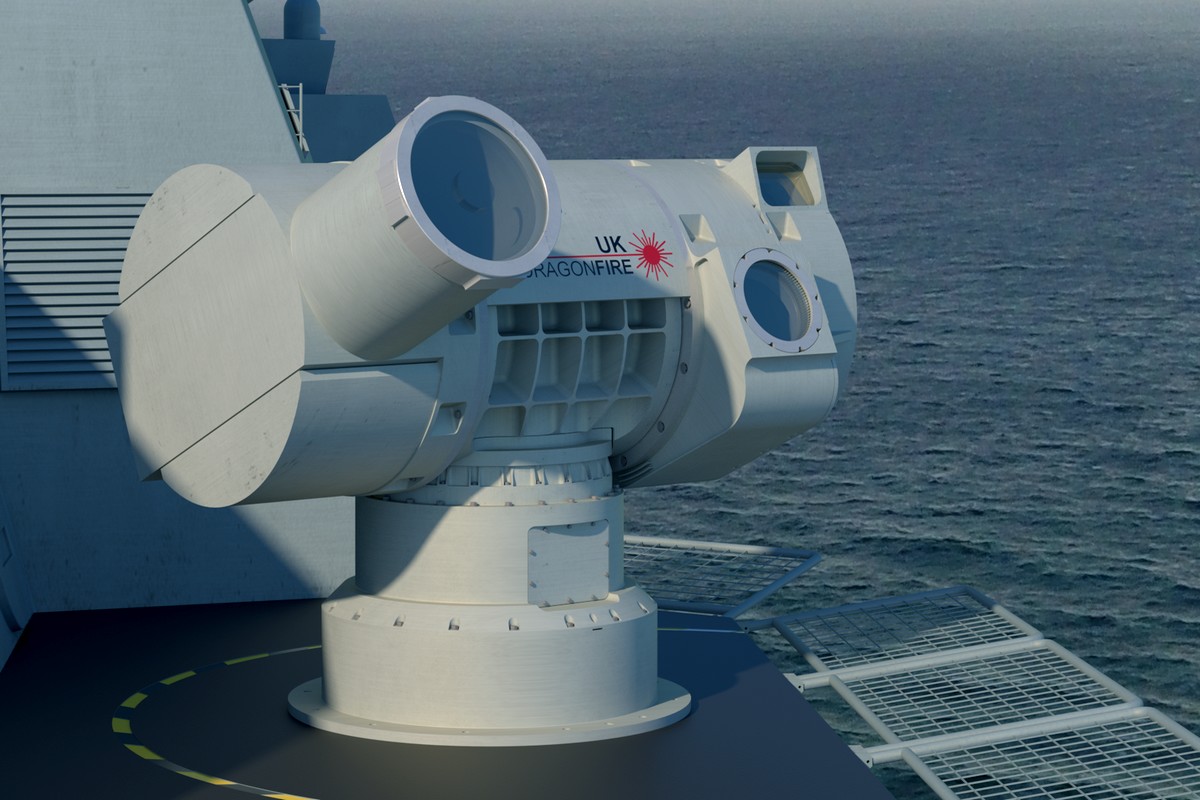
DragonFire is the UK’s new high-power laser weapon system, intended for Royal Navy ships from 2027.
It is being developed by a British consortium that includes MBDA UK, Leonardo UK, QinetiQ and the Defence Science and Technology Laboratory.
DragonFire is designed to track and destroy fast threats such as drones and mortar rounds. Recent trials at the MOD’s Hebrides range showed it detecting, following and shooting down drones travelling at about 650 kilometres per hour. These tests were the first in the UK to demonstrate that level of accuracy and speed.
The system uses a British beam-combining method that merges the output of many glass-fibre lasers into a single, concentrated beam. The full technical approach is classified, but DragonFire sits in the 50-kilowatt class and is accurate enough to hit a one-pound coin from a kilometre away. A turret holds the laser, an electro-optical camera and a second low-power laser for tracking.
One of the main attractions is cost. Each shot is around ten pounds, compared with the very high cost of missile interceptors such as Sea Viper. Because it uses electrical power rather than ammunition, it avoids problems with stockpiles during prolonged engagements and limits the risk of collateral damage.
The government has brought the programme forward by five years after the successful tests and plans to install it on a Type 45 destroyer in 2027. It is also being explored for Army vehicles and future RAF combat aircraft.
The development contract is worth 316 million pounds and will support nearly six hundred jobs across sites in Bolton, Bedford, Farnborough and Edinburgh. MBDA’s UK Managing Director Chris Allam described DragonFire as a “truly game changing weapon system”. Defence Minister Luke Pollard said it will place the Royal Navy “at the leading edge of innovation in NATO” and strengthen the UK’s ability to counter modern aerial threats.
Leonardo, which builds the beam director, has highlighted the potential for laser weapons to reshape close-in defence. The technology can be used to dazzle sensors, disable equipment or destroy incoming threats, depending on what is required.










So i know very little of this type of weapon system so hopefully someone can answer this so how long does the laser beam have to be on the target to destroy it or is it instant ? Or does the laser hit it and then have to heat up the projectile to destroy it ?
I can imagine the strength of the beam, the weather, and the material of the target.
You can see it in videos of the system. But yes it takes a while to burn through the wing of a drone. It’s all about how much energy you can put in one spot. As it gets closer the beam gets stronger and the targeting more precise, so it’s hard to say exactly, but most drones seem to take 10-20 seconds.
It’s certainly still vulnerable to saturation attacks. Cruise missiles at 650kph can close distance quickly, so 2 or more can probably overwhelm it.
Thanks for the reply 10/20 seconds sounds a very long time to have to be on target I’m guessing these things currently are more proof of concept currently rather than replacements for guns and missiles
Depends on the drone type many types would be susceptible within 5 seconds if you can penetrate, it’s a matter of taking out something vital, more complex drones might be more resistant due to their construction but generally trying to cut off wings isn’t really the prime function of this weapon at this stage, its more stiletto not broadsword which is why the tracking and beam focus are so crucial.
It can seem like that, but if you think of the flight time of a close in missile system like SeaRAM, or what has been discussed with Martlet, the total engagement time between firing and destruction is probably the same or less.
Even with Phalanx, which normally seems to track onto its target with the rounds, this could be the case, although I’m less sure on that one.
For now they will complement rather than replace.
At this stage of development/deployment they would be better used against slower moving drones.
Ok so I’m going to assume next evolution will be creating missiles that lasers won’t be able to penetrate as easy or that can reflect the incoming laser this is all very interesting
Hypersonic missile nose sections are made of heat-resistant composite as they have to withstand air friction plasma.
I would think Air defence missiles would be the best kinetic solution to those.
As with anything, it depends on how resilient the target is to the attack. If the target is highly reflective then that will reduce the rate that it absorbs heat. If it spins, then it will be impossible to concentrate heat onto a single point. But if something has an optical seeker on it then the laser will likely cook it rather quickly.
would you care to comment on which wavelengths of the electromagnetic spectrum that you would like to reflect? not to mention the efficiency of your reflective techniques? Would you apply a layer of reflective aluminium over your whole drone? if so would you protect it against oxidation with glass or transparent paint? do you have any figures for just how “reflective” a surface would need to be to work effectively?
spinning? what class of drone could effectively spin? what propulsion system do you envisage you drone having whilst it continually spins? and which axis would you spin it in to be most effective whilst maintaining forward and guided motion?
this seems to have been decades of waiting. I hope it will fulfill the expectations and hopes that we need. especially with the price of a missile
PEW PEW PEW!!!!!
Are they able to scale the power up more or is it stuck at 50 kilowatts.
Going to say the same, aren’t there countries working or have 100-150kw+. There’s toasters and then there’s toasters so hopefully more power to come.
The Israeli’s seem to be “light” years ahead of everyone and Germany, China, US have shipboard systems and even here in Aus there’s EOS.
Yeah think we’re falling behind with a few things, you would hope they can scale it up as it mature’s but you never know.
As the saying goes it’s not just about the size it’s how you use it, so a lot depends on how much regard we pay to their technical claims for the system. Adding power without maintaining precision and tracking accuracy becomes self defeating. Looking forward to hearing objective evaluations of its true capabilities as compared to other systems in the coming years, but no matter how good the underlying enabling technology 50Kw is going to have its limitations so now that they seem to have got the basics right increasing the power will become the priority I’m sure.
Thanks for that I get a bit lost with lasers 👍
this seems to have been decades of waiting. I hope it will fulfill the expectations and hopes that we need. especially with the price of a missile increasing the power and the efficiency of the system will forever be a work in progress.
Beam size is going to critical as that effect the power density
Like any tech, wait a few years and there’ll be an incremental capability.
It’s always been said it’s scalable, you get the complex basics right, create reliability and scale the power while making sure you don’t compromise that precision. Double or perhaps even treble the power could be achieved theoretically with appropriate development and upgrades, when you get beyond that the fundamentals start to change substantially I believe, much of it in the systems that support and power it mind.
300 kilowatt seems to be the supposed goldilocks zone according to some US sources where they start to compete with ballistic weapons in terms of destructive effects but that’s a tough nut to crack in a usable weapon.
In principle the power will scale depending on how many fibre lasers you combine. Efficiency for those is about 30%, so for every watt of laser power you have to dissipate a couple of watts of waste heat from the system. At larger scales that starts to be challenging.
Thanks for the info lan 👍
A lot of these comments don’t really seem to reflect an understanding of this weapon. It isn’t a gun replacement – not yet, anyway. It can shoot things down but it also dazzles and disrupts sensors. It seems to need about 10second on target. If the ship has enough power it reloads in 10 seconds… so it could fire 3 bursts a minute. It hits the target instantly.. at the speed of light, which is a bit faster than several times the speed of sound! So several of these on a ship could give continuous cover, I suppose. And it’s not the only weapon being deployed, so it’s not shooting down drones on it own.
Bu the way, am I right in thinking a 12 bore shotgun would take out a drone at close range? It would shred plastic props?
I think our minds are so historically focused on ballistic weapons that it’s often difficult to think laterally about other ways to disable military technology that have both limitations and advantages ut which can expand the envelope of capabilities.
“A lot of these comments don’t really seem to reflect an understanding”.
Ha, there have been over a million comments on here so far, I think you are right ! 🤔😁
Most of the comments don’t understand what a LASER actually is in the first place.
Just for clarity, under the contract, two DragonFire fits (i.e. required ship infrastructure, the containerised laser fire unit, one operator console, combat management system integration, training and support) are planned for two Type 45 Daring-class destroyers, with the first ship fit scheduled for completion in 2027 – apparently five years ahead of the previous schedule. There is an option for two further T45 fits – so effectively enough for all operational destroyers as the most costly element is the fire unit container and this can probably be transferred to another suitably fitted ship within a few days. Hopefully the cost and complexity of the second generation DragonFire will be much reduced, and there will eventually be a substantial pool of systems available for fitting to any major warship or RFA that needs an anti-drone system.
Do we know where they’re going to be positioned on the T45s as it’ll be a bit crowded with current Phalanx’s and decoys and 30mm? Maybe front somewhere and back on the hangar roof? Isn’t Ancilia also getting installed?
Just forward of the bridge, based on a few graphics.
Put a mirror-finish on drones/missiles etc & won’t lasers become far less effective? Or just some tech to produce a smokescreen ahead of the targets flight?
A continuously moving smokescreen which isn’t blown away by the speed of movement? And just how many times have you suggested the “mirror” finish, dozens? hundreds? I’m surprised that you didn’t mention rain that’s par for the course.
Stop being so “Grouchy” 😁😁😁
indeed, why let facts interfere! More spoilers here …..
Heat Management: Highly reflective coatings could deflect most of the laser’s energy initially. However, these coatings are not 100% reflective and would heat up rapidly.
Burn-Through: If the DragonFire laser is held steadily on the same spot for a few seconds (typically around 10 seconds are mentioned in trials), the coating’s effectiveness would fail, and it would burn through the target structure.
Practicality: Applying durable, effective reflective coatings to an entire aircraft or missile is difficult and would add significant weight and engineering complexity, making the target slower and more detectable by radar.
Adaptive Optics: DragonFire uses adaptive optics to counter atmospheric interference, which also helps maintain a focused beam on the target despite minor movements or attempts at deflection.
And once again It doesn’t say how many systems the £316 million development cost will provide !
20 seconds to melt a drone 1000 metres away might only cost £10 but how many systems will It take to deal with a Swarm (more than 3 drones !) ?
New contract is apparently for 4 ships each with 2 systems, so 8 overall. Still a ridiculous unit cost for what it does.
Oh thanks, Is that definately 8 systems confirmed and is that £316 million definately the cost of all 8 ? I have only read some vague articles and a mention of 3 ships (T45’s). Probably all changed now though as It was a while back.
@ £40 million each does seem a bit steep especially when two are being added to each T45.
Oh well, back to painting the ceiling I guess.
Paint it silver, it keeps lasers away don’t you know!
The return of anti-flash white camo?
You can pop a black balloon with a laser pointer but not a white one.
I have never tried, but the analogy does not stand up, lasers are not heat flashes. A laser pointer does not produce enough heat to burn the white surface colour of your balloon it is however unlikely that the paint on a solid surface would reflect enough of the laser and thus would discolour and thus absorb more energy.
Also I have a tiny tiny tiny feeling that at some point the developers may just have already thought of this a tad before now ……
If you have a magnifying glass see if (in the summer) you can set light to a white piece of paper.
For the cost of what this Buck Roger’s boondoggle won’t provide, the RN could fit every vessel in the RN with 40mm radar directed AA guns with a proven ability to defeat swarm attacks.
Christ, I would love to take one next time I visit Scotland.
Bloody Midges, Swarms of them want to attack me every time.
Daga daga daga, 😁
Effectiveness is going to be dependent on atmospherics and enviromentals along with range to target and target speed. Atmospherics and enviromental are a massive issue. Dust, water vapour all found at sea level will absorb and disapate a beam. Engagement range is likely to be 3-5km in reality
As I have said previously it’s a very close range system. The star wars Giga watt laser able to take out HYpersonics and ballistic targets at 10’s of KM range are a long way off. Engaging a 600km/h target at 1km with a dwell time of a few seconds means engagements against multiple approaching targets are going to be problamatic.
There are a couple of ways of hitting a target. A continuous beam dumping beam power into the target is one. The other, rapidly pulses the beam heating then allowing the area hit to cool before heating it again. The heating and cooling causes rapid expansion and contraction of the area weakening it. It is akin to hitting something with a hammer many times a second. Target speed becomes a disadvantage when damage happens. Friction and forward air speed will cause areas to fail and rip apart.
Upscaling the beam power can be done with Fibre optic lasers… You add more fibre optics. However combining system cooling becomes more of an issue the more power you use.
Using it as a dazzler against IR homing or camera homing targets is more useful. Burning out optics can be done at a far greater range than say physically burning off a wing etc. If a missile / drone cannot see you it cannot hit you.
It’s all physics and the laws are immutable
It would be good to see battle proven in Ukraine – I am sure any help offered at defeating drones will not be turned down.