

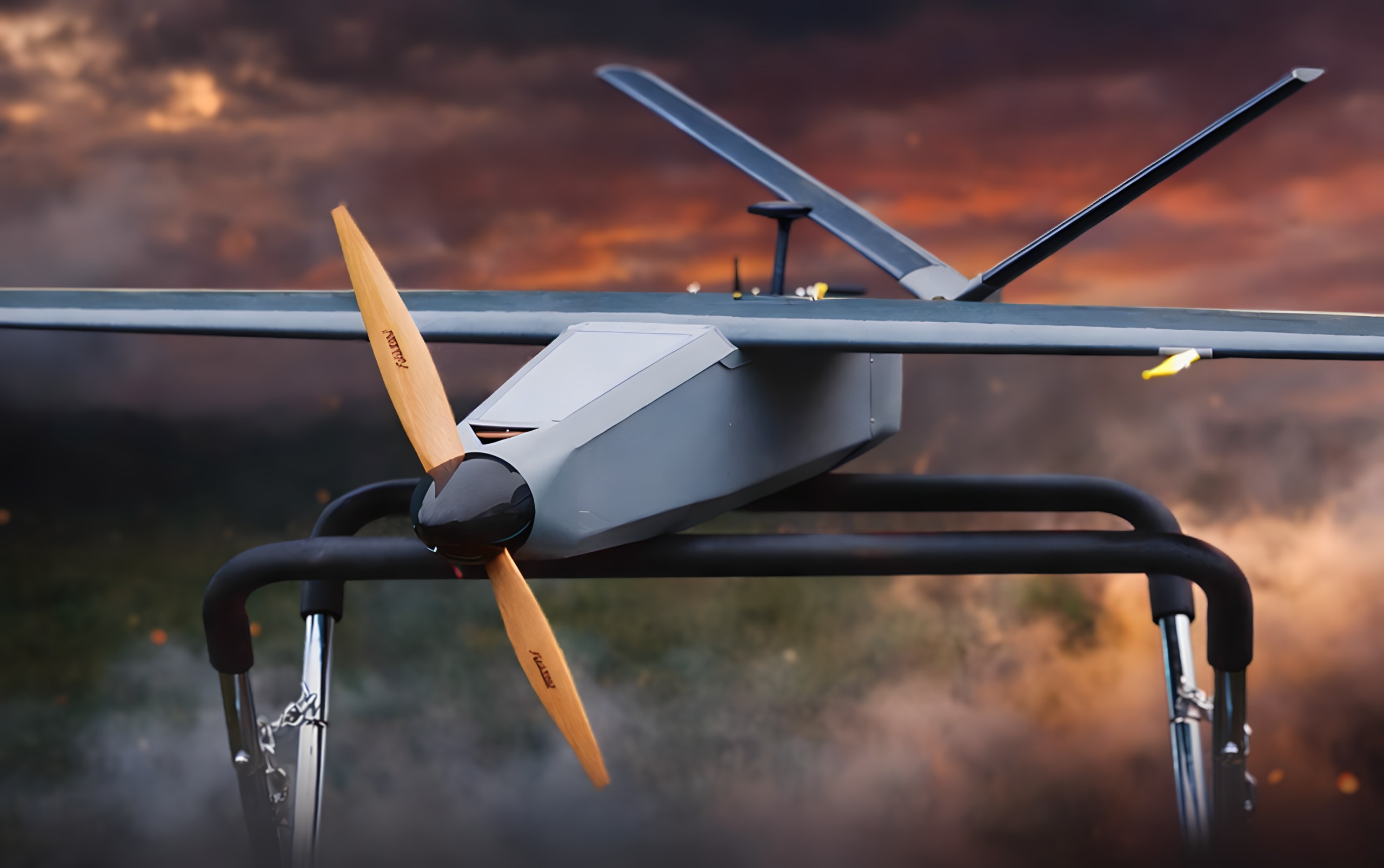
An Edinburgh-based defence firm has launched a new UK-built one-way attack drone, unveiling the HAMMER unmanned aircraft system at a press and stakeholder event in East Lothian.
Edinburgh Drone Company (EDC) confirmed the fixed-wing platform has now been formally introduced following flight trials and munitions testing, with the system intended to support UK and allied operational requirements while reinforcing domestic defence manufacturing capacity.
HAMMER has been developed through a partnership between EDC and Aero Solutions Ltd, forming a UK manufacturing hub drawing on small and medium-sized engineering firms. The aircraft’s primary structures, including the fuselage, along with final assembly, are manufactured in the UK using European-sourced components.
The company said the design emphasis was placed on simplicity, affordability and scalability, allowing the system to be produced rapidly without unnecessary complexity. According to EDC, the aircraft was developed at a cost significantly lower than comparable European systems, while retaining the range and payload required for stand-off employment.
The platform was originally designed to carry a 2.5 kilogram munition, though testing has since indicated a payload capacity of at least 3.5 kilograms. During live munitions trials, EDC said its 2.5 kilogram munition successfully penetrated 600 millimetres of armoured steel.
Munition configurations supported include EDC’s 2.5 kilogram warhead, a user-fillable cassette system, and RPG-7 or similar payloads. A dedicated safe arming mechanism has also been integrated to improve handling safety during preparation and arming.
HAMMER is catapult-launched using a launcher designed and fabricated in-house at EDC’s East Lothian facility. The aircraft can be flown manually in two configurations, offering a standard range of 22 kilometres, or up to 50 kilometres with an extended-range upgrade. The system also allows for an endurance enhancement through the addition of extra batteries.
Speaking at the launch, EDC director Ross Laing said the programme reflected the company’s focus on sovereign capability and manufacturability at scale.
“HAMMER represents the next step in EDC’s mission to deliver a genuinely UK-built capability that is designed for one purpose — operational relevance,” he said. “This platform has been engineered from the ground up as a one-way effector aircraft, with a clear focus on range, payload, and manufacturability at scale.
“We’ve deliberately built HAMMER to be simple and cost-effective — up to £100,000 lower than comparable European start-up offerings — while remaining mission-ready. With over eight years of UAS development and production experience, we believe this is a landmark moment for Scotland’s defence manufacturing base and for the UK’s ability to generate sovereign capability at pace.”
Stewart Clifford of Aero Solutions Ltd said the project demonstrated what could be achieved through UK-based industrial collaboration.
“This programme is about building a practical UK manufacturing pathway for a capability that modern defence forces increasingly require — fast, scalable and mission-ready,” he said. “Our joint manufacturing hub with EDC is structured to enable repeatable production, continuous improvement and rapid integration of additional UK SME capacity.
“With partners like Blast Designs Solutions supporting effects integration and safety systems, we are demonstrating a complete UK-led capability pathway. HAMMER shows what is possible when UK industry collaborates to deliver capability with speed and purpose.”
The launch event was held at EDC’s manufacturing and test facility in Haddington, where industry partners and stakeholders were invited to view the system and discuss its future development and production pathway.









The UK’s true super power is the garden shed and the ability of so many crazy ba***rds that inhabit these isles to Wallace and Gromit up new and lethal s**t.
I hope laser pig does a video on this as he is a great supporter of Ukraine and Edinburgh man himself.
Who could have thought five years ago we would be launching sattelites built in Glasgow on rockets built in fife from a space port in Shetland and building cruise missiles in east Lothian.
Vladimir you don’t stand a chance.
🫡🏴🇬🇧🇺🇦
Slava ukraini
Is that a wooden propeller? I wonder why that would be better than a moulded plastic or composite one?
Wooden props are still a thing in light aircraft use. They also have the advantage of being able to be manufactured in garden sheds, and there is nothing preventing to use of both plastic or wooden props being fitted to the same type of platform so in the event of a huge need to scale up production there are multiple sources of props at least…
Also if you look at the air intake and the nose structure you can see what looks like a wooden cross member suggesting that the airframe is made of wood. I used to fly a microlight that had fabric covered wings and that fuselage looks like it is fabric covered. Also of which suggests that they have gone down the low tech route to achieve the low cost point. A modern day Mosquito – in miniature.
So garden sheds it is…
Cheers CR
Roring you on there until you suggested that the Mosquito was low tech, it was anything but (just ask the Germans who tried to copy it and failed through lack of expertise) the glues and gluing techniques and indeed the use of complex lamination was state of the art, incredibly light and influenced much of the post war use of glues and light weight laminate structures that the Hornet was already taking to a whole new level. Even Britain tried and failed to match it in an all metal structure. It used alternative materials to specifically avoid using in short supply regular war materials and exploit human skills that were not already tied up in the direct war effort. How it used all that was anything but ‘low tech’. That said this new effort is a very valid alternative method to exploit some of the same ideas and thinking back then in avoiding crucial and expensive materials but in this case with a very different mindset and for different reasons because it is a one way effector and disposable. One thing it isn’t, unlike the Mossie, is state of the art. Wood is however a very valid alternative material as it can offer superior damage resistance to mass produced plastics in some circumstances and can be far more stealthy too than alloys. The Australians for latter reasons supply cardboard drones to Ukraine, very cheap, don’t have to be excessively strong or long lasting, easy to transport and assemble and incredibly light and stealthy. This may also be looking to export markets where wood skills may be rather more available than a factory mass producing moulded plastics or metal structures.
Ah, I see what you mean. It was not my intention to suggest that the Mosquito is low tech, nor indeed the modern day microlights! I am well aware of the ‘wooden wonder’s’ brilliance. My point of the ‘Modern day Mosquito – in miniature’ was to reference the use of out sourcing production to skilled people working in their garden sheds which according to one history at least that I read (years ago now!) is precisely what De Havilland did. Obviously, they also supplied materials and detail specs… the point being that there are still many many very skilled people out there producing all sorts of high quality products which we lump into the ‘crafts’ movement. They could easily contribute to production. Near me there is a miniature railway with steam locos and workshop suggesting a very capable group of practical engineering workers..! Plenty of talent in this country to tap into…
Sorry to undermine your roaring support 🙂 Much appreciated all the same.
Cheers CR
Wood Is more Environmentally friendly. The UK is hell bent on saving the planet single handedly.
To be fair, it’s easy to source too.
It literally grows on trees!
Well we do have to suffer the likes of the Daily Mail blathering this myth but in reality we are really only middling in that regard. Germany is far ahead in reality and just look at California the 4th biggest economy in the World where most US growth is predominantly taking place and yet despite what Trump would like us to believe, on some days generates up to 100% green electricity for all those server farms and does so cheap enough for its hi tech companies to thrive. Meanwhile our expensive electricity is to a great degree because we rely far too much on expensive gas that we committed to over a decade ago when it was cheaper as we started to lose our nuclear power stations. This despite only being able to supply around 40% of that gas from our own resources.
It’s not a production drone. It’s a prototype
If they get orderes lots of pieces will be swapped out for others
Looks good but a range of 22 km and a catapult launcher still means the operating soldiers are in range of enemy drone optics, heavy mortar , artillery fire and loitering drone that the enemy is using. Even closer if the aim is to attack deeper into enemy held territory
Are these solution for Ukraine and the efforts will fold as soon as a “peace deal” is forced or long term options for the British army?
Extendable to 50km, so hopefully that will be the standard deployed version.
Cheers CR
Assuming we buy any..?
Both
Cheaper and lower tech the better probably just requires decent software.
Sovereign capabillity at pace,this really is the way to go.The less reliant we are on others the better
Better watch out as China/Russia/North Korea/Iran will/could copy or make this sort of thing themselves in the millions….
They will do anyway, they don’t need to copy or be inspired by us.
They will already be ahead of this. The design turn around in Ukraine is two weeks
Is this a Hammer 4 ?
What’s a….
manufactured in the UK using European-sourced components, so put to geather here a bit like Rolls Royce cars, good they we are starting to at least us this type of weapon more and they some skills etc are home grown. Any orders yet been placed by any nation? or likely to be?
Spend more on the drone. Stick a laser designator on it. Use 120mm laser guided mortars. Time of flight is 10s of seconds not minutes.
You want loitering? Laser guided bombs like Fury.
Long range? 155mm laser guided rounds exist.
This is totally doable. Faster reaction times, excellent accuracy and resistance to EW.
“Crash a drone in to it.” Is not the answer to every question.
That’s a completely different drone
Yes, I know. Perhaps my meaning was not clear.
I am critical of the concept.
If the desired outcome is a warhead placed in a precise location then there are other methods than RC aircraft.
Mike, I agree to an extent. Tat’s 100% where we (The British Mil) started. However, one way attack drones have become prevalent for two reasons.
First, survivability of the gun line. If you have mortar / artillery locating radar and or UAV observation, the Mor line / gun line is easily targeted by counter-battery fire.
Second, the Ukrainians realised that if they were looking at the target with the drone, why couldn’t the drone just hit it? Do away with the middle man. Indeed, if it takes 20 mins for the drone to get overhead, it’s even less time for the drone to destroy the target that for it to call in a fire mission. I think it’s the same evolution as the use of spotter planes in WW1.
I actually think you need both. Always have different ways to strike.
Hi, BobA.
There is no perfect option but as you said, both have value. Coordination is the key as always.
But I would counter your points just to explain my point of view further.
Your first point on the gun line is perfectly valid. But it also applies to drone launch and control sites. They are already being targeted and we are already seeing massive growth in EW solutions. A drone operating possibly at a greater standoff distance designating targets is perhaps more survivable. General survivability of low performance drones is only going to decrease.
For the second point I completely agree. But I believe a more cost effective method would be to equip the drone with light guided munitions like LMM based Fury.
Cost effectiveness is one of my main concerns. Western drones are not actually that cheap. As greater and greater performance is required the costs will also rise. Also many of the prices of UKR drones are propaganda levels of fake. Not including battery, munition or labour costs for example. Plus success rates of the very cheap drones are very poor. I honestly believe a more expensive drone, with laser designator and even it’s own Fury type bombs would be more cost effective. For me it is about the “resource to kill ratio”. Take the above drone. One bang per drone. Take a drone 4 times the cost (or less) carrying 4 Fury and operating in a more survivable manner.
Fully autonomous AI drones are perhaps a different scenario.
I’m having trouble understanding the cost comment. Up to £100,000 cheaper! Than what? They cost around £25,000 per system without the munition, according to EDC ads over the last month or two (eg instagram.com/p/DSMxQZNjL35).
The cost of a basic single-engine equivalent Ukraine DARTS drone from Steel Hornets is only $1,000. It is capable of flying at a distance of up to 50 km, carrying a 3.6 kg warhead and flying at a speed of 160 km per hour.
Even cheaper (around $810) is the Ukrainian-made Blyskavka: range of up to 40–70 km, speed around 110 km/h, and can stay in the air for up to 60 minutes. Payload 8–9 kg. This was reverse engineered from the also cheap Russian “Molniya” drone.
So do you get extra from the Hammer that I’m missing, perhaps some autonomy, unjammable comms or higher level of precision? Or would economies of scale bring down the price by a full order of magnitude if we built them in the tens of thousands like Ukrainian drones? I can see how it would gall a respectable drone manufacturer like EDC to build a OWE to shitty standards, because it only needs to fly once. Is the Hammer at £25,000 still too Gucci for a modern war?
Presumably the cost is being compared to high end ATGMs like Javelin, some of the short range systems like NLAW and the Carl Gustaf are as cheap or cheaper. The only real justification I can think of for the cost is that the components are all sourced from europe unlike Ukraine whose drone companies will buy from basically anywhere (usually China) to get the parts that they need. Maybe the tractor propellor means it can be wire guided?
Sounds good.
The sensible thing to do would be to order a handful of them, send to Ukraine to use, see how they perform and if they do well, order in bulk.
What we’ll probably do is spend a decade in trials and meetings about meetings, spend millions on coffee and biscuits for said meetings, gold-plate them to the point that they’re so expensive we end up buying only 8 of them.