

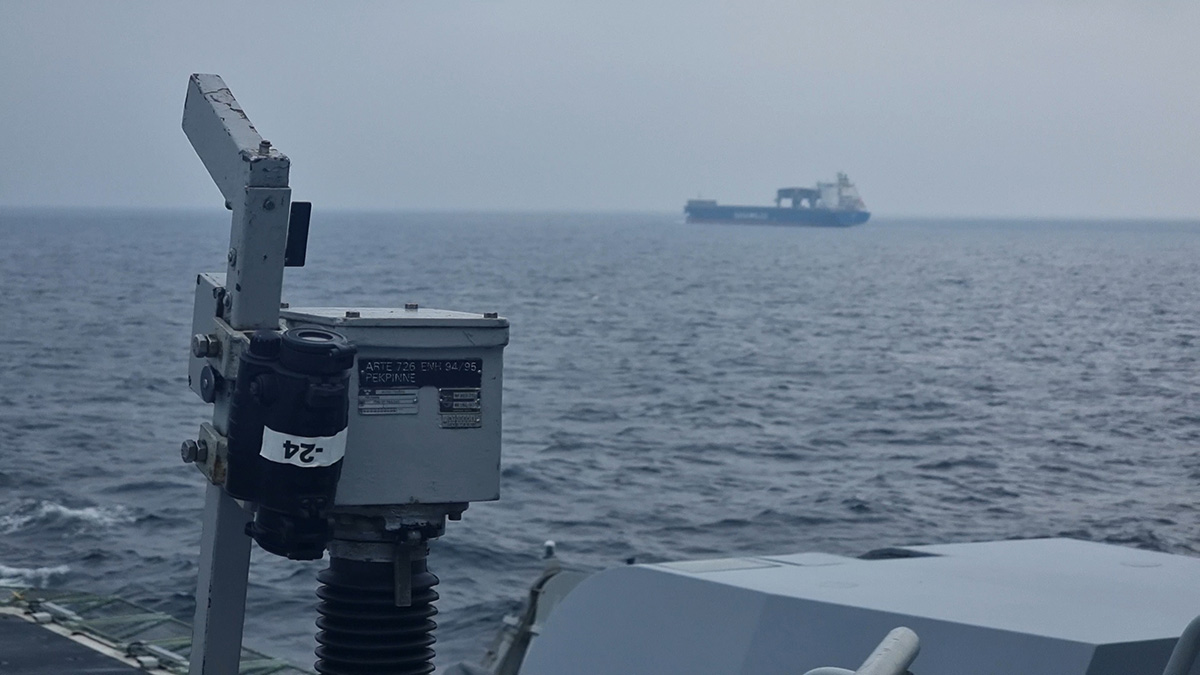
A senior European Union official has warned that Russia’s “shadow fleet” poses a growing threat to maritime security and undersea infrastructure, as concerns mount over the vulnerability of key shipping routes and subsea cables.
Speaking during a maritime security panel at the Munich Security Conference on Friday, Belén Martinez Carbonell, Secretary-General of the European External Action Service, said the shadow fleet represents a direct threat to Europe, both through its role in sustaining Russia’s war economy and through the risks it creates at sea.
“For us, there’s a very direct threat very close to home,” she said. “I call it as the result of a huge violation of the UN Charter, and that’s the amplification of the Russian aggression through the shadow fleet.”
She added: “For us, the Russian shadow fleet is the most direct threat to European security.”
Carbonell argued that the issue extended beyond sanctions evasion, warning that poorly regulated vessels posed environmental dangers and could present threats to critical maritime infrastructure. “We know that those shadow fleets pose risks besides feeding the coffers of war,” she said. “They also are at risk environmental risk… They also pose a risk, because of the risks to cables, maritime cables.”
The panel, moderated by Mina Al-Oraibi, Editor-in-Chief of The National, focused on the growing global importance of maritime security amid geopolitical tension and attacks on shipping lanes. Al-Oraibi told the audience that maritime security now affects everyday life worldwide. “More than 80% of world trade relies on the waterways of the world,” she said, adding that “95 to 99% of our connectivity relies on underwater cables that have become the lifeline for international trade.”
Carbonell said the EU was pursuing a range of non-military and regulatory measures to counter threats posed by the shadow fleet, including sanctions, outreach to flag states, and legal tools under the UN Convention on the Law of the Sea. “We have sanctions already, like 600 shadow fleet vessels and 40 enablers,” she said.
She added that the EU was also engaging directly with countries whose flags were being used by vessels linked to sanctions evasion. “We’re doing outreach to flag states that might not know what’s behind their flags,” Carbonell said. The official also pointed to legal provisions within UNCLOS, arguing they could be used to address unflagged vessels. “We’re also trying to use all possibilities offered precisely by UNCLOS,” she said, citing “article 110… [which] allows, under certain conditions, the boarding of flagless vessels.”
Carbonell also said work was ongoing through the International Maritime Organization, particularly on environmental and safety standards.
Alongside regulatory efforts, she highlighted the EU’s naval operations as part of a broader approach to protecting freedom of navigation. “We have a number of maritime missions and naval operations,” she said, naming Irini, Atalanta and Aspides as key examples. Referring to the Red Sea mission Aspides, she said it had already supported a large number of commercial transits. “It’s there to ensure the safe transit, and has already done it for more than 600 merchant vessels in the Red Sea,” Carbonell said.
She added: “We have saved to this mission, more than 100 sailors and seafarers.”
The panel also included Rashad Mohamed Ali Al-Alimi, Chairman of Yemen’s Presidential Leadership Council, who warned that regional instability in the Red Sea was being driven by Iranian-backed militant groups. “The most urgent threat derives from that corner,” he said, accusing Iran of investing heavily in militias in order to gain leverage over maritime security.
Singapore’s Defence Minister Chan Chun Sing also warned that rising strategic mistrust between major powers was increasingly shaping maritime risk globally. “The main threat… would be the increasing strategic mistrust between and among the major powers,” he said.




Where’s Francis Drake when you need him? 😉
Slung atween the roundshots’ in ………. ?
and yet the only country that has deliberately attacked european undersea infrastructure is ukraine, when they blew up nord stream2 !
our politicians and military live in a topsy turvy world they don’t understand !