

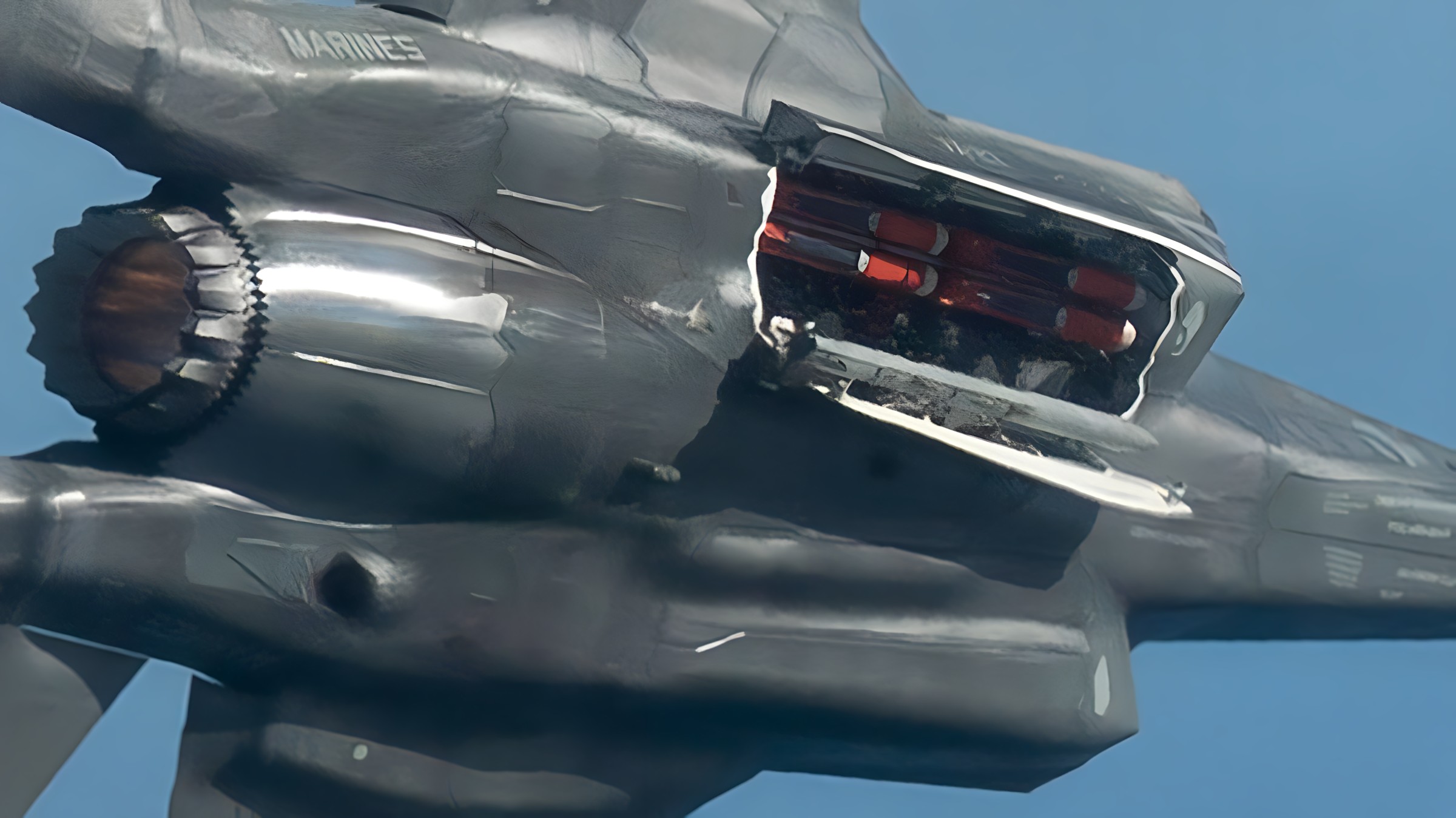
An F-35B test aircraft has completed its first flight carrying four SPEAR 3 missiles, as part of ongoing trials to integrate the UK’s next-generation precision strike weapon onto the fifth-generation fighter, according to the F-35 Joint Program Office.
The flight was conducted at Naval Air Station Patuxent River in Maryland by the F-35 Integrated Test Force, with Royal Navy Lieutenant Commander Nick Baker of the Air and Space Warfare Centre at the controls. The inert missiles were carried as environmental data recording assets, with the team now preparing for the next critical milestones of mission systems integration and jettison trials.
RAF Corporal Daniel Housden, who has been closely involved in the test programme, said the milestone had been a team effort. “As a team, we have been working hard toward this key milestone, and I’m proud to say SPEAR 3 has now flown on F-35B. I look forward to continuing with testing at the F-35 ITF and starting preparations for the first ejections.”

Dan Shelton, F-35 JPO UK and Italy weapons integration programme manager, said the result reflected exceptional collaboration across the team. “Much of this effort is owed to the outstanding work of the combined UK government and industry weapons team, US government and industry partners. The team’s exceptional collaboration was essential in navigating the complexities of this programme, allowing us to work through every challenge and deliver results.”
SPEAR 3 is a miniature turbojet-powered cruise missile developed by MBDA, designed to be carried internally within the F-35B’s weapons bays to preserve its stealth characteristics. With a range of over 100 kilometres, it uses inertial navigation, GPS, and a datalink to engage targets in all weather conditions, including moving and manoeuvring targets. Once fully integrated, the F-35B will be able to carry up to eight missiles internally.
The first flight milestone comes against a backdrop of programme delays. SPEAR 3 was originally planned to enter service in 2025, but the timeline has slipped repeatedly. The programme is currently undergoing re-baselining, and the MoD has confirmed that the estimated in-service date has moved to the early 2030s. A long-delayed review note setting out the formal new timeline has been reported as close to submission for ministerial approval, with Aviation Week reporting in early May 2026 that the MoD now expects to field the weapon from financial year 2028-29.






Interesting article out today on just how bad the TR3 program has been. Apparently all TR3 delivered jets world wide can only be used for training. This includes 12 for the UK.
This appears to be why SPEAR 3 and meteor integration are so badly late. Apparently the entire data fusion system in the aircraft is limited and the electronic warfare suite is limited to threat detection only.
Damn.
And there was you extolling the virtues of this wunderweapon and It’s vast superiority over legacy aircraft such as F18, Typhoon and F15 adding that one F35 was more deadly than a squadron of either.
It’s amazing what you learn reading “Articles out today”.
🤣🤣🤣🤣🤣.
Morning Jim, time to put them Budgie smugglers on and get out In the Sun mate.
The TR2 version is performing very well. It’s TR3 having the issues.
Lockheed is just full of s**t, overly ambitious in what it can do. It’s the software that’s the constant problem, aerospace companies are just not cut out to code.
Oh….
I remember that the TR6 was way better than the TR7.
Must be an evolution thing I guess.
Sadly I am old enough to know what you are talking about. Although if you stick a TR7 on a Range Rover chassis you get a pretty amazing trials car.
I’ve gained $17,240 only within four weeks by comfortably working part-time from home. Immediately when I had lost my last business, I was very troubled and thankfully I’ve located this project now in this way I’m in a position to receive thousand USD directly from home. Each individual certainly can do this easy work & make more greenbacks online by visiting
following website—.,.,.,.,.—>>> JobatHome1.Com
I’ve gained $17,240 only within four weeks by comfortably working part-time from home. Immediately when I had lost my last business, I was very troubled and thankfully I’ve located this project now in this way I’m in a position to receive thousand USD directly from home. Each individual certainly can do this easy work & make more greenbacks online by visiting
following website—.,.,.,.,.,.,.,—>>> PayAtHome1.Com
Remind me which aircraft got shot down by 30 year old Iranian sam systems?
It wasn’t shot down 🙂
Dunno, 757 maybe ?
It’s worth noting that F35 first flew in 2006, Twenty years ago now.
AA gunfire wasn’t it? Visually.
Until the US widely deploy their rumoured “chameleon” skin, clocking devices to obscure aircraft, if it can be seen, it can be shot at.
That surely applies from the best stealth type to a Lancaster bomber.
Yup.
You can see It.
You can Hear It.
You can Feel It (think Chinook pulses)
And any visual spotting can be phoned ahead too.
We are In danger of Ignoring the basics.
Ahhh, the Chinook, my fav helicopter. That throbbing sound you detect long before you see it.
Exactly.
Bring back the ROC!
Exactly again.
I do alot of Sky Gazing most days. It’s staggering how many never look up though.
Well I’m one of those “weird” ufologists on the side, so I do. I observe everything.
Quite so. There is a limit to what you can do about the F35 IR signature.
An F-35 was hit by flak but made it back to base, an F15-E and an A-10 was shot down over Iran. 24 MQ-9’s have been shot down. The rest of the aircraft losses were accidents or destroyed on the ground in Iranian airstrikes.
This is encouraging news. F-35B with Spear 3 and escorts with Stratus-lo will combine to make a much more credible UK carrier strike group.
Did anyone understand why Aviation Weekly is talking about 28/29 if the MOD are talking about the early 2030s?
Could just be different milestones. Obviously the important one being fully operational in front line squadrons.
Is there a peace time and a war time integration accelerator pedal on these system. 5 years seems to be snail pace norm, but as with Hydra rockers on Typhoon it can be done quickly. Storm shadow, PW4, Hammer, Alarm etc have all been fused with old Russian aircraft .
Once they know it fits and can talk to the aircraft could they get them into service in an emergency? say a Russian strike on British forces Or is the F35 such a complex flying computer with sewn up Coding it’s Lockheed speed or nothing?
Hi David,
You ask a very interesting and telling question. Certainly Lochheed have not covered themselves in glory with the software even the ALIS support software is running late and that software does more than order spares. It gathers operational data and feeds back operational effectiveness information to the operational planning of future missions, particularly around how to get the best out of the aircraft stealth characteristics, which evolve with time and maintenance cycles.
So I suspect that getting new capabilities onboard isn’t just about the TR3 tech and Block 4 software but possibly also about data sharing with the ALIS system as well, none of which work properly yet.
As for integrating stuff onto the aircraft in a hurry, I am sure things could be done quicker. Firstly, by switching more effort into the process but that would imply something else getting delayed or chopped.
However, I think the biggest driver for speeding up the process would be down to operational pressures focusing minds on what is needed rather than what would impress your allies in the mess. As you point out some very sophisticated western weapons systems have been integrated into old Soviet era aircraft in Ukrainian service in remarkably short timeframes. Watson-Watt (team leader of the Chain Home Radars) put it something like this, ‘give them third best as second best is always late and best never arrives’. F35 is trying to be the best, war will see folk with nothing willing to take something that works well enough and have it arrive in time and they will put it to very good use, as shown by Ukraine. And boy will we need stuff to arrive quickly given the long list of capability gaps we have.
So yeh, I think things will speed up if the poop hits the fan and we should remember that we have visibility of the source code, at least I think we still do?
Cheers CR
Yes without doubt.
Yes via the UOR route.
What do the Israelis field on their F35s?
Have they been hampered by Industry?
No, because they were given the API keys so that they could do their own integration
Which we both know…!
We should have negotiated harder for ‘the keys to the car’ and just perhaps, we wouldn’t be in this mess.
They still pay Lockheed to write the software for them, they just opted out of the international logistics and maintenance computer system because other countries would be able to see what they were doing through maintenance history and parts ordering.
I remember reading that we were offered a buy in but the government at the time turned it down on cost grounds. I probably read that in UKDJ comments but I can’t find it now so not sure if I imagined it.
We were supposed to have it as the only tier 1 partner but for reasons I can’t work out, some point around 2010 the US states they were retaining API control. Whether we didn’t pay what we promised, or the US altered the deal and we didn’t protest enough I don’t know.
O/T RIAT is cancelled!! 😭😭😭😭😭
This happened in January so already six months more work done. But this project was ordered 7 years ago…JSM was integrated on F35 in just 5 years 2020 -2025 …in this time frame space X has designed built and prototyped from the first hopper to full lunar flight vehicle….and still no mention of meteor…either UK gov not paying the bills or Lockheed Martin absolutely taking UK for a ride. 11+ years to integrate a missile is as bad as Ajax scandle especially when the missile was reported to be ready for use and successfully fired from typhoon.
Given the capability of Spear it could well be a great thing to have provided we have enough missiles.
How many are we purchasing? How many will be ready to fire at the end of 2028, end 2029, end 2030.
For it to be an impressive figure which will stop people ignoring the capability I would think figures of 1,000. 3,000 and 5,000 would be appropriate. 200. 400. and 600 will make it just another expense which Putin or his successors will ignore and will fail to deter their expansionist policies.
Does the picture also show a meteor fitted on the inner door or a AMRAAM?
Pretty sure an AMRAAM. If you look closely you can see the midbody fins which the Meteor doesn’t have.
But once Meteor is integrated it will be able to carry an internal load of 8 SPEAR 3 and 2 Meteor instead of the AMRAAM.
Meteor integration is easy, just tell the computer you have AMRAAM loaded.. 😁
That is indeed a Meteor.