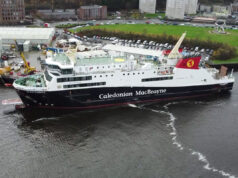
Ferguson Marine has been identified as a significant contributor to Scotland’s civil shipbuilding sector in a new report by the House of Commons Scottish Affairs Committee, which calls for stronger strategic support for Scottish industry and improved representation at the heart of UK industrial policy.
The Port Glasgow yard featured in the committee’s examination of shipbuilding in Scotland, which assessed both defence and civil maritime construction as part of a wider inquiry into the country’s industrial future. The report follows five evidence sessions held between April and October 2025, including dedicated hearings on the state of shipbuilding where the committee took evidence from BAE Systems, Babcock, Ferguson Marine and the Society of Maritime Industries.
Ferguson Marine’s chief executive, Graeme Thomson, gave evidence to the committee in July 2025, highlighting the yard’s role within the civil shipbuilding market and its contribution to balancing Scotland’s defence-heavy industrial base. The committee recognised Ferguson Marine as an important element of the Central Belt’s economic recovery and as a representative voice for non-defence shipbuilding in Scotland.
In a statement following publication of the report, the company said the findings “acknowledge the need for a strategic and supported future for our sector”, adding that Ferguson Marine provides “a critical balance to Scotland’s defence heavy industrial base”.
A central recommendation of the Scottish Affairs Committee report is the formal inclusion of Scottish representation within UK industrial governance. The committee concluded that while the Government’s emerging Industrial Strategy broadly reflects Scotland’s strengths, it does not fully capture the breadth of the country’s economic contribution.
The report states that the absence of a dedicated Scottish representative on the Industrial Strategy Council risks limiting its understanding of Scotland’s “distinct economic and constitutional landscape”. The committee therefore recommends that when legislation is brought forward to establish the council on a statutory footing, a requirement for a permanent Scotland representative should be written directly into law. The committee also warned that gaps in sectoral coverage risk undervaluing key Scottish industries. While the Industrial Strategy’s IS-8 framework aligns with some areas of Scottish strength, MPs noted that the omission of high-value sectors such as whisky demonstrates how Scotland’s economic profile can be underrepresented in UK-wide planning.
The report concludes that Scotland’s diverse industrial base, spanning defence, civil shipbuilding, steel, advanced manufacturing and globally competitive exports, requires a more structured and visible role in shaping national industrial policy. Ferguson Marine said it welcomed being positioned as part of that national conversation, reaffirming its commitment to “protecting our Clydebuilt legacy” and ensuring that its workforce and engineering capability continue to play a role in Scotland’s industrial transition.